
Breaking Airline News: Severe Travel Chaos Paralyzes American Aviation Grid as Flight Cancellations Surge Past 300
Breaking airline news: Amidst catastrophic FAA capacity reductions and severe air traffic control shortages, the United States suffers 341 cancellations and 2,509 massive delays, devastating passengers flying major carriers across the national grid.

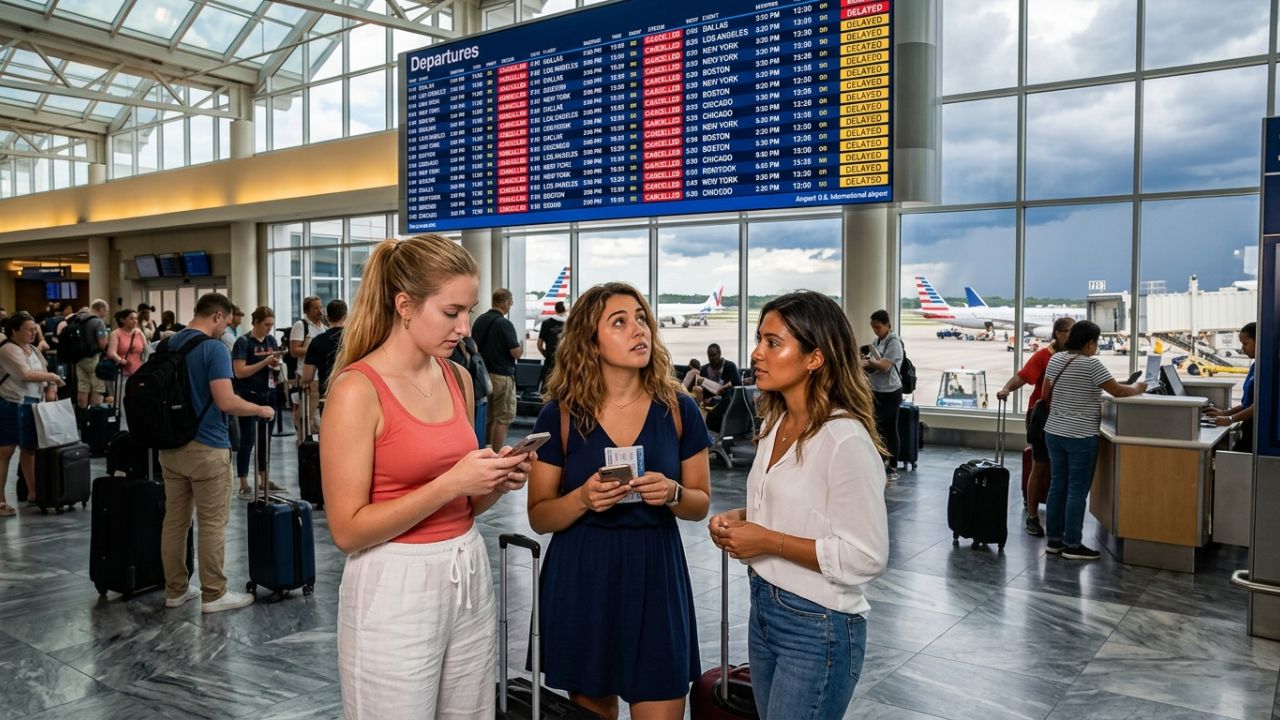
Image representing the intense operational meltdown crippling the United States National Airspace System. With 341 total flight cancellations and 2,509 massive delays, passengers flying American Airlines, PSA Airlines, United, and Delta face catastrophic disruptions and severed domestic connections across major fortress hubs.
Breaking Airline News: Severe Travel Chaos Paralyzes American Aviation Grid as Flight Cancellations Surge Past 300
As catastrophic air traffic controller staffing shortages and highly restrictive Federal Aviation Administration (FAA) capacity limits violently transform the National Airspace System into a massive endurance test, the United States is currently suffering a critical infrastructure failure. In a brutal demonstration of how quickly nationwide terminal bottlenecks can destroy domestic mobility, travel chaos has paralyzed the American aviation grid. The latest operational telemetry confirms a devastating surge in airport disruptions across California, Florida, Texas, Virginia, Pennsylvania, North Carolina, Massachusetts, New York, Michigan, and Ohio. This sudden collapse in schedule integrity has triggered 341 total flight cancellations and 2,509 massive delays. The meltdown has aggressively severed vital domestic corridors and devastated thousands of passengers flying with major carriers including American Airlines, PSA Airlines, Republic Airways, JetBlue, Endeavor Air, United Airlines, Delta Air Lines, Southwest Airlines, and Envoy Air.
In a brutal demonstration of how highly vulnerable independent bookings remain to sudden operational shocks, passengers attempting to navigate through the country's most heavily congested airspace have been met with massive logistical ruin. For travelers banking on seamless cross-country connections or critical regional flights, an airport delay is no longer just a minor inconvenience; it is a terrifying precursor to a completely collapsed itinerary. The massive disruption spreading across the United States proves that even the most robust fortress hubs are highly susceptible to sudden, systemic gridlock. As the FAA enforces mandatory capacity reductions to maintain basic safety levels, airlines are forced into extreme defensive postures, actively axing flights and leaving passengers thrown into intense survival mode, battling long customer service queues and the terrifying prospect of sleeping on terminal floors.
Expanded Overview: The Anatomy of a Nationwide Transit Meltdown
The terrifying reality of overwhelming passenger stress currently testing the entire U.S. network brutally exposes the extreme consequences of relying on highly constrained, understaffed infrastructure. Because the national aviation network is highly dependent on a synchronized flow of aircraft through mega-hubs, the sudden loss of ATC capacity forces the broader system to instantly collapse. To combat this, massive multi-airline coordination is failing, and for the passengers currently trapped in major transit points, the travel chaos represents a devastating financial and mental toll that cannot be instantly repaired.
Section-Wise Breakdown: Decoding the Hub-by-Hub Infrastructure Failure
To fully comprehend the massive logistical failures currently paralyzing the American travel grid, corporate planners and domestic travelers must rigorously review exactly how this explosive disruption is destroying mobility across specific airports.
The Epicenter of the Collapse: Dallas and Washington D.C. To understand the absolute severity of this localized crisis, one must look at the exact operational telemetry at the nation's primary crossroads. Dallas-Fort Worth International Airport has emerged as the most disrupted facility in the nation, buckling under the weight of 307 delayed flights and 64 total cancellations. Simultaneously, the situation in the nation's capital is catastrophic; Reagan National Airport reported the highest cancellation total in the country with 87 flights axed, alongside 124 massive delays, heavily severely mobility out of Washington, D.C.
The East Coast Meltdown: Philadelphia to Charlotte The eastern seaboard is experiencing massive, cascading failures. Philadelphia International Airport has been violently hit, recording 112 delays and 38 cancellations. Further south, Charlotte Douglas International Airport—a vital southeastern artery—saw an explosive 189 delays and 20 cancellations. In New York, the airspace is highly volatile, with John F. Kennedy International Airport recording 98 delays and 32 cancellations, while LaGuardia Airport suffered 83 delays and 29 cancellations. Boston Logan International Airport is also paralyzed, experiencing 102 delays and 19 axed departures.
The Nationwide Ripple Effect The travel chaos is aggressively spreading outward. On the west coast, Los Angeles International Airport reported 137 delays and seven cancellations. In the Midwest, Detroit Metropolitan Airport suffered 53 delays and 12 cancellations, while Cincinnati/Northern Kentucky International Airport recorded 34 delays and eight cancellations. Regional operations are also failing, with Pittsburgh International Airport (32 delays, five cancellations), Jacksonville International Airport (20 delays, six cancellations), and Westchester County Airport (13 delays, 13 cancellations) all reporting severe schedule friction.
Strategic National Disruption Matrices
To guarantee that travelers can aggressively track the specific intelligence regarding this massive operational meltdown, the following matrices detail the exact, verified data confirming the travel chaos across American airports and carriers.
Matrix 1: Heavily Compromised Fortress Hubs
| Major Fortress Hub | Confirmed Delays | Confirmed Cancellations |
|---|---|---|
| Dallas-Fort Worth (DFW) | 307 | 64 |
| Reagan National (DCA) | 124 | 87 |
| Charlotte Douglas (CLT) | 189 | 20 |
| Philadelphia (PHL) | 112 | 38 |
| Los Angeles (LAX) | 137 | 7 |
| Boston Logan (BOS) | 102 | 19 |
| John F. Kennedy (JFK) | 98 | 32 |
| LaGuardia (LGA) | 83 | 29 |
| Detroit Metropolitan (DTW) | 53 | 12 |
| Cincinnati/Northern Kentucky (CVG) | 34 | 8 |
| Pittsburgh (PIT) | 32 | 5 |
| Jacksonville (JAX) | 20 | 6 |
| Westchester County (HPN) | 13 | 13 |
Matrix 2: Severely Impacted Airlines
| Operating Carrier | Confirmed Delays | Confirmed Cancellations |
|---|---|---|
| American Airlines | 574 | 66 |
| Southwest Airlines | 432 | 5 |
| United Airlines | 221 | 17 |
| PSA Airlines | 169 | 138 |
| Delta Air Lines | 163 | 12 |
| Republic Airways | 98 | 29 |
| JetBlue | 75 | 21 |
| Endeavor Air | 57 | 19 |
| Envoy Air | 56 | 5 |
Data reflects the massive operational failure and passenger disruption currently paralyzing the United States aviation grid, with PSA Airlines experiencing nearly a 19% cancellation rate, and American Airlines suffering a 16% delay rate.
Passenger Impact: The Brutal Cost of Travel Chaos
For the thousands of passengers trapped within these failing terminals, the effect of this massive disruption is overwhelmingly negative. A canceled flight aggressively eliminates any certainty in a travel itinerary. Families attempting to traverse the country are facing the terrifying prospect of forced hotel rebookings, exorbitant last-minute rental car fees, and the exhaustion of managing stranded children in highly congested hubs like DFW and Charlotte. For corporate travelers, missed connections translate to lost revenue and destroyed schedules. The financial bleeding associated with this nationwide travel chaos is staggering, forcing passengers to absorb the costs of an aviation network operating on the brink of failure.
Industry Analysis: What is Triggering the National Meltdown?
The global aviation industry is currently witnessing a brutal reality: the American airspace is highly volatile. Aviation industry analysts confirm that these massive flight cancellations and severe delays stem directly from severe air traffic controller staffing shortages. To prevent dangerous mid-air scenarios, the FAA has executed mandatory capacity reductions across dozens of major airports. These restrictions artificially limit the number of flights airports can handle, violently forcing airlines to adjust schedules, rotate aircraft inefficiently, and cancel services. When combined with rolling crew timeout issues, the system collapses.
Conclusion: Surviving the Chaos
As the extremely critical U.S. transit network braces for further instability driven by systemic infrastructure deficits, this massive disruption represents a highly dangerous warning for travelers. Passengers desperate to avoid missed connections and the severe logistical nightmare of being stranded mid-journey must immediately execute aggressive defense strategies. Travelers must fiercely prioritize early check-ins, actively monitor airline apps, and maintain constant digital contact with their carriers regarding rebooking options. This intelligence proves that surviving the modern era of commercial aviation relies entirely on anticipating massive operational failures, expecting severe travel chaos, and always maintaining a heavily fortified backup plan when navigating the highly vulnerable American aviation grid.
Key Takeaways
- Massive Infrastructure Failure: The United States aviation grid has been paralyzed by severe travel chaos, driven by FAA capacity reductions and ATC staffing shortages.
- Verified Disruptions: Operational telemetry confirms 2,509 massive flight delays and 341 total flight cancellations across the country.
- Airlines Compromised: American Airlines led with 574 delays, while PSA Airlines suffered the highest cancellation count with 138 flights axed. Southwest recorded 432 delays.
- Epicenters of Collapse: Dallas-Fort Worth recorded the most delays (307), while Reagan National suffered the highest number of cancellations (87).
- Passenger Survival: Stranded travelers must utilize heavily fortified backup itineraries, keep essential medications in carry-on luggage, and constantly monitor airline alerts to survive the massive financial and logistical toll of national disruptions.
Related Travel Guides
Disclaimer
This article is for informational and educational purposes only. It does not constitute legal, financial, or professional advice. While we strive to provide accurate and up-to-date information, travel policies, regulations, and conditions change rapidly. Always verify information with official sources before making travel decisions. Nomad Lawyer makes no representations about the accuracy, reliability, completeness, or suitability of the information provided. Readers should consult qualified professionals for advice specific to their circumstances. The views expressed in this article are those of the author and do not necessarily reflect the views of Nomad Lawyer.
Kunal K Choudhary
Co-Founder & Contributor
A passionate traveller and tech enthusiast. Kunal contributes to the vision and growth of Nomad Lawyer, bringing fresh perspectives and driving the community forward.
Learn more about our team →