
Seattle Airport Link Light Rail Guide 2026: Sea-Tac to Downtown in 35-40 Minutes for a Few Dollars
Seattle airport Link light rail connects Sea-Tac directly to downtown in 35 to 40 minutes for a few dollars per adult. This guide covers the Skybridge 6 walking route, ORCA tickets, station choices, and luggage strategy.

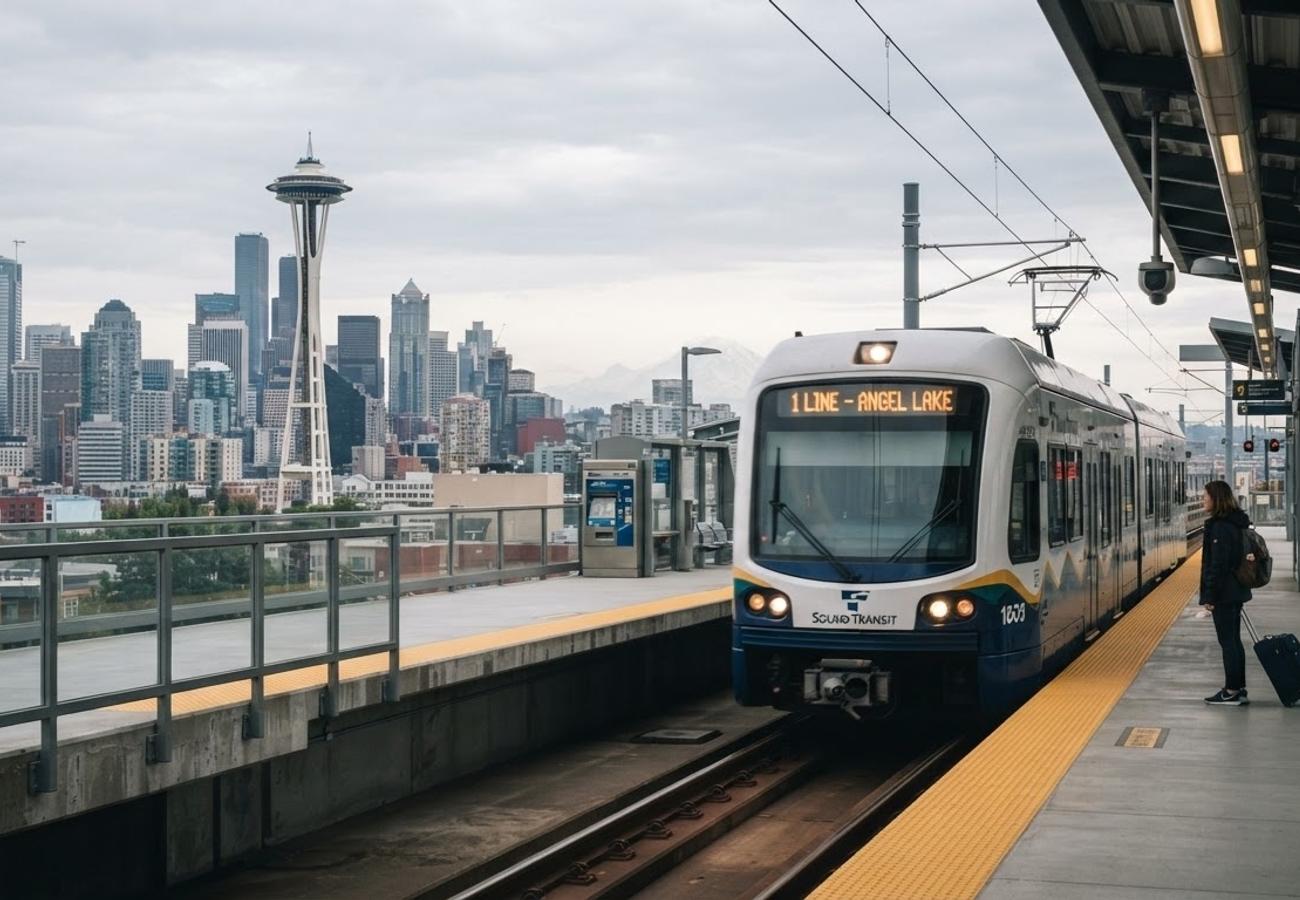
Image generated by AI
The first real decision of a Seattle trip happens at baggage claim. Taxi, rideshare, or train. For a growing share of arrivals at Seattle-Tacoma International Airport, the answer is the Link light rail 1 Line. It runs directly from SeaTac/Airport Station to downtown Seattle, then continues north to Capitol Hill, the University District, and Lynnwood.
The value case is hard to beat. The ride from Sea-Tac Airport to central downtown stations such as Westlake or University Street typically takes 35 to 40 minutes. That usually beats sitting on Interstate 5 in rush hour while a rideshare fare climbs. As of mid-2026, adult fares for the airport-to-downtown segment run a few dollars per person. For a couple or small family, that can mean saving 30 to 60 dollars compared with a taxi or rideshare, especially on busy evenings, game days, or cruise weekends.
Sea-Tac to Downtown: Key Facts at a Glance
- Ride time: 35 to 40 minutes to central downtown; roughly 37 to 40 minutes to Westlake, the northernmost downtown stop.
- Cost: A few dollars per adult as of mid-2026. Savings of 30 to 60 dollars per group versus taxi or rideshare are realistic.
- Terminal access: Skybridge 6 at the north end of the main terminal, near Alaska Airlines check-in and the N and C concourses.
- The walk: 5 to 10 minutes through Level 4 of the parking garage. Fully covered. No moving walkways.
- Payment: Blue ticket machines at the station entrance, or the regional ORCA card.
- Enforcement: Proof of payment system. No turnstiles. Fare inspectors conduct spot checks on board.
- Downtown stops: Stadium, International District/Chinatown, Pioneer Square, and Westlake.
Finding the SeaTac/Airport Station
The station is not inside the terminal. It connects via the airport parking garage and a pedestrian bridge. After collecting bags, follow overhead signs for "Public Transit" or "Link Light Rail." These guide you past the baggage carousels toward the central hallway where skybridges cross into the garage.
For Link, you want Skybridge 6. Walk toward the end of baggage claim closer to Alaska Airlines' check-in area. Take the escalator or elevator up to skybridge level, then cross into the garage. The walkway is fully enclosed and well signed. Even late at night, you stay under cover and away from road traffic.
Once inside the garage on Level 4, follow the painted floor markings and overhead Link signs along a long, straight indoor corridor. This is where many first-timers misjudge the journey. It is a real walk. Budget 5 to 10 minutes at an unhurried pace with luggage. Moving walkways are not provided, so expect to roll your suitcase the entire way. The corridor ends at the open but covered SeaTac/Airport Station entrance, with ticket machines and elevators down to the platform.
Travelers with mobility issues should ask airport staff near baggage claim for assistance. The Port of Seattle and Sound Transit periodically provide electric carts to shuttle passengers between the terminal and the Link station area. Staff can also point you to elevators instead of escalators at every step.
Tickets, ORCA Cards, and Proof of Payment
Blue ticket vending machines sit at the SeaTac/Airport Station entrance, before the platform area. No advance purchase is needed. Machines accept debit and credit cards and usually cash.
Two payment options cover most visitors:
- Single ride ticket: The simplest choice for a one-way airport-to-downtown trip.
- ORCA card: A reusable regional card worth considering for multi-day stays. It also works on King County Metro buses, the Seattle Streetcar, and some regional buses and ferries. Tap the reader before boarding, and again if you transfer within the allowed window.
A Capitol Hill visitor, for example, might ride from the airport to Capitol Hill Station on day one, then use the same ORCA card on the streetcar to South Lake Union the next morning.
Children, seniors, and riders with disabilities typically qualify for reduced fares. However, the reduced-fare ORCA version often requires local registration and paperwork. Short-term visitors traveling with kids may find it simpler to buy a mix of adult and youth single ride tickets at the machines. Information screens explain fare categories, and Sound Transit staff or security officers are often nearby.
One detail catches newcomers off guard. Link operates on proof of payment. There are no turnstiles at SeaTac/Airport Station. Fare inspectors make spot checks on board. Keep your printed ticket or ORCA card accessible for the full ride. Riding without valid fare can bring a citation, which is a rough start to any Seattle trip.
Choosing Your Downtown Station
Most airport riders head to one of four downtown stops. Stations are announced on board and shown on digital screens. Audio announcements distinguish northbound trains toward Lynnwood from southbound service back toward the airport and Federal Way.
| Station | Best For | Key Connections |
|---|---|---|
| Stadium | Hotels near Lumen Field, T-Mobile Park, 1st Avenue South, SODO | Event venues |
| International District/Chinatown | Amtrak and Sounder connections; Chinatown-International District stays | King Street Station, about a block away |
| Pioneer Square | Historic district hotels; Seattle waterfront | Colman Dock ferry terminal, short walk to the piers |
| Westlake | Central downtown hotels, Pike Place Market, shopping | Seattle Center Monorail to the Space Needle and Seattle Center |
Westlake sits under Pine Street, steps from large hotels and the city's main shopping area. Heading farther north? Stay on the same train. The 1 Line is a single continuous service to Capitol Hill, the University of Washington, the U District, Roosevelt, Northgate, and Lynnwood. No downtown transfer is required.
Riding With Luggage
Link light rail trains are designed with luggage in mind. The full route from terminal to platform is step-free when you use elevators, and the covered walkway means weather never enters the equation. With wheeled luggage and a bit of patience, most travelers handle the journey comfortably, even after a long flight.
Three habits make the ride smoother. Board promptly and keep your suitcase close rather than in the aisle. Travel outside peak commute windows when possible, since trains fill with downtown workers. And build the 5 to 10 minute station walk into your schedule, especially when catching a flight home.
Why This Matters
For travelers on this route, the real impact is cost certainty paired with time certainty. A taxi fare fluctuates with traffic and surge pricing. The train does neither. Once on board, travel time stays fixed regardless of jams, accidents, or heavy rain on Interstate 5.
From a logistical perspective, this changes how arrivals plan tight schedules. A midday cruise check-in at Pier 66 becomes a predictable equation: a roughly 40 minute ride to Westlake almost any day of the week, then a short walk, monorail hop, or rideshare for the last mile. That predictability is worth more than the fare savings for anyone working against a boarding deadline.
Our analysis of the route map suggests the 1 Line also quietly reshapes hotel strategy. Because the airport train runs straight through downtown to Roosevelt, Northgate, and Lynnwood, cheaper neighborhoods with direct rail access become practical bases. Visitors no longer pay a downtown premium just to keep the airport transfer simple. Market trends suggest this pattern favors budget-conscious leisure travelers and university visitors most.
Industry Outlook
Expect the airport rail corridor to stay central to Seattle's ground transport mix through the rest of 2026. The 1 Line's continuous service between Federal Way, Sea-Tac, downtown, and Lynnwood anchors the region's transit spine, and demand typically spikes around cruise weekends and stadium event days.
Travelers should watch two variables. First, fares are quoted here as of mid-2026; any adjustments will post at station machines and through Sound Transit channels. Second, proof-of-payment enforcement shows no signs of loosening. Fare inspectors will keep checking, so the cheapest ticket mistake remains the most expensive one.
Skip the surge pricing, ride the 1 Line, and arrive downtown with 30 to 60 dollars still in your pocket.
Related Travel Guides
Disclaimer
This article is for informational and educational purposes only. It does not constitute legal, financial, or professional advice. While we strive to provide accurate and up-to-date information, travel policies, regulations, and conditions change rapidly. Always verify information with official sources before making travel decisions. Nomad Lawyer makes no representations about the accuracy, reliability, completeness, or suitability of the information provided. Readers should consult qualified professionals for advice specific to their circumstances. The views expressed in this article are those of the author and do not necessarily reflect the views of Nomad Lawyer.
Kunal K Choudhary
Co-Founder & Contributor
A passionate traveller and tech enthusiast. Kunal contributes to the vision and growth of Nomad Lawyer, bringing fresh perspectives and driving the community forward.
Learn more about our team →