
Seven Global Scenic Rail and Road Routes Redefining Slow Overland Travel

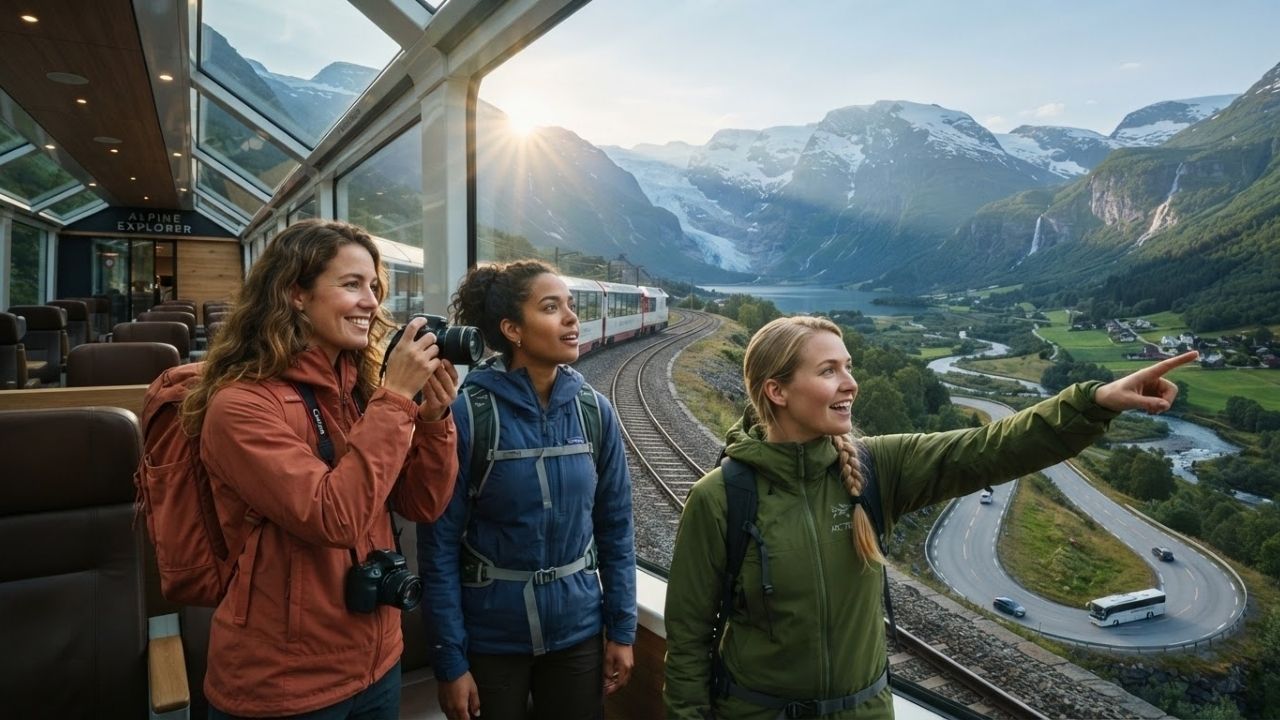
Image generated by AI
Global travel demand is shifting toward slow overland transit, as iconic rail lines and highway corridors in seven key nations transform long-distance travel into primary tourism destinations.
[OSLO, Norway, Sept. 1, 2026] — A growing international preference for experiential, low-emission travel is elevating scenic rail lines and mountain road networks into major global tourist attractions. Anchored by world-renowned routes in Norway, Switzerland, Scotland, New Zealand, Canada, Japan, and Peru, these transit corridors allow travelers to experience alpine passes, fjord coastlines, ancient glaciers, and high-altitude Andean plateaus directly from panoramic train cars and scenic highways.
Rather than treating transit as lost time between hotel check-ins, international visitors are prioritizing multi-hour overland journeys. Technical achievements—such as Norway’s 866-meter rail descent into Sognefjord or Switzerland’s 291-kilometer Glacier Express route—demonstrate how engineered transportation networks create sustainable, highly profitable tourism economies across fragile natural environments.
Flåm Railway Descends 866 Meters to Sognefjord in Norway
Norway’s Flåm Railway (Flåmsbana) operates as one of Europe’s most dramatic standard-gauge adhesion railways. Connecting the high-altitude mountain junction of Myrdal with the fjord-side village of Flåm along Sognefjord, the train covers approximately 20 kilometers while executing a steep vertical descent of nearly 866 meters.
Engineering highlights of the Norwegian route include:
- Steep Gradient Mechanics: Operates on a 5.5% gradient, making it one of the world's steepest adhesion railways without a cog-wheel rack system.
- Mountain Tunnel Network: Navigates 20 engineered tunnels carved directly through sheer granite cliff faces.
- Fjord and Waterfall Panoramas: Provides uninterrupted views of Kjosfossen waterfall, deep ravines, and traditional Scandinavian mountain farms.
The railway acts as a vital eco-tourism conduit, carrying international cruise passengers and independent hikers into the heart of Norway’s UNESCO-listed fjord country without increasing highway traffic.
Glacier Express Crosses 291 Kilometers of Swiss Alpine Passes
In Central Europe, Switzerland’s Glacier Express connects the mountain resort hubs of Zermatt and St. Moritz, establishing a benchmark for luxury scenic rail travel. The eight-hour journey spans 291 kilometers across the Swiss Alps, crossing hundreds of bridges and negotiating dozens of mountain tunnels.
Key route highlights include:
- Oberalp Pass Elevation: Climbs to its highest point at Oberalp Pass, reaching 2,033 meters (6,670 feet) above sea level.
- Panoramic Observatory Design: Specially constructed glass-domed carriages offer unhindered vertical views of the Matterhorn, Rhine Gorge, and alpine glaciers.
- Slow Travel Positioning: Known as the "world's slowest express train," the service averages 36 km/h, encouraging relaxed sightseeing and regional dining.
The service provides a model for integrating high-altitude mountain transit with premium hospitality, attracting high-spending international tourists year-round.
Glenfinnan Viaduct Anchors Scotland’s West Highland Line
Scotland’s West Highland Line connects Glasgow with the Atlantic coastal terminal of Mallaig, cutting through remote Highland wilderness, lochs, and heather-covered mountains.
The 21-arch Glenfinnan Viaduct, spanning the River Finnan, serves as the route's primary heritage architecture milestone. Rising 30 meters above the valley floor, the curved concrete viaduct draws thousands of railway enthusiasts and international visitors annually. Beyond Glenfinnan, the train passes Loch Shiel and Rannoch Moor, providing access to remote Scottish landscapes inaccessible by standard motorways.
New Zealand State Highway 6 and Canada’s Icefields Parkway
In the Southern Hemisphere, New Zealand’s State Highway 6 stretches along the South Island’s rugged West Coast, positioned between the Tasman Sea and the towering peaks of the Southern Alps. The road connects temperate coastal rainforests, Franz Josef and Fox Glaciers, and mountain passes within a single driving itinerary.
In North America, Canada’s Icefields Parkway (Alberta Highway 93) runs 232 kilometers between Lake Louise and Jasper through the Canadian Rockies. Flanked by ancient glaciers of the Columbia Icefield, the highway features glacier-fed turquoise waters at Bow Lake and Peyto Lake, offering road-trippers safe wildlife viewing pull-offs for grizzly bears, elk, and bighorn sheep.
Japan’s Hida Limited Express and Peru’s High-Altitude Andes Train
In Asia, Japan’s Hida Limited Express connects the modern transit hub of Nagoya with the historic mountain town of Takayama. Following the winding Hida River valley through the Japanese Alps, the train pairs modern rolling stock with views of traditional timber villages, cedar forests, and seasonal autumn foliage.
In South America, Peru’s high-altitude railway between Cusco and Puno crosses the Andean altiplano, ascending past 4,300 meters (14,100 feet) above sea level at the La Raya mountain pass. Passengers travel through vast mountain plains, observing vicuña herds and traditional Quechua farming communities framed by snow-capped Andean peaks.
Comprehensive Data Breakdown: World-Famous Scenic Rail and Road Routes
The table below outlines technical metrics, route lengths, and geographic features for the seven world-leading scenic transport corridors:
| Country & Route Name | Route Type & Termini | Distance / Duration | Key Elevation / Feature Metric | Signature Natural Landmark |
|---|---|---|---|---|
| Norway: Flåm Railway | Standard-Gauge Rail (Myrdal to Flåm) | ~20 km (~1 Hour) | 866-Meter Vertical Descent | Sognefjord & Kjosfossen Waterfall |
| Switzerland: Glacier Express | Meter-Gauge Rail (Zermatt to St. Moritz) | 291 km (~8 Hours) | 2,033m Oberalp Pass Peak | Matterhorn & Rhine Gorge |
| Scotland: West Highland Line | Heritage Rail (Glasgow to Mallaig) | ~264 km (~5.5 Hours) | 21-Arch Curved Viaduct | Glenfinnan Viaduct & Loch Shiel |
| Canada: Icefields Parkway | Mountain Highway (Lake Louise to Jasper) | 232 km (Driving Route) | Canadian Rockies Parkway | Bow Lake, Peyto Lake & Columbia Icefield |
| New Zealand: State Highway 6 | Coastal Highway (West Coast Route) | Multi-Day Road Trip | Tasman Sea / Southern Alps Boundary | Franz Josef Glacier & Rainforests |
| Japan: Hida Limited Express | Express Rail (Nagoya to Takayama) | ~165 km (~2.5 Hours) | Hida River Valley Alignment | Japanese Alps & Takayama Old Town |
| Peru: Cusco–Puno Railway | High-Altitude Rail (Cusco to Puno) | ~388 km (~10 Hours) | 4,300m La Raya Pass Peak | Andean Altiplano & Lake Titicaca |
Why This Matters: Essential Takeaways for Overland Travelers
For international tourists planning travel centered on scenic rail and road routes, these technical features offer practical guidance:
- Advance Ticket and Pass Reservations: High-demand services like Switzerland's Glacier Express and Norway's Flåm Railway require seat reservations months in advance during peak summer and autumn seasons.
- Altitude Acclimatization: High-altitude rail routes such as Peru's Cusco–Puno line (exceeding 4,300 meters) require travelers to spend 24 to 48 hours acclimatizing in Cusco before departure to prevent altitude sickness.
- Seasonal Daylight Optimization: Driving routes like Canada's Icefields Parkway or New Zealand's State Highway 6 should be scheduled during seasons with extended daylight hours to maximize lake viewing and mountain trail access.
- Multi-Modal Pass Value: Utilizing national travel passes (such as the Swiss Travel Pass or BritRail Pass) provides cost savings and flexible stopovers along scenic rail corridors.
Frequently Asked Questions
What makes Norway's Flåm Railway engineering unique?
The Flåm Railway is one of the steepest standard-gauge adhesion railways in the world, descending 866 meters over 20 kilometers on a 5.5% gradient through 20 mountain tunnels.
How long does the Swiss Glacier Express take to complete its journey?
The Glacier Express takes approximately eight hours to travel 291 kilometers between Zermatt and St. Moritz, reaching its highest elevation at the 2,033-meter Oberalp Pass.
What is the primary architectural feature of Scotland's West Highland Line?
The route's primary architectural feature is the 21-arch Glenfinnan Viaduct, which spans the River Finnan near Loch Shiel.
What elevation does the Peru Cusco-to-Puno railway reach?
The high-altitude Andean train reaches an elevation exceeding 4,300 meters (14,100 feet) above sea level at the La Raya mountain pass.
Related Travel Guides
Disclaimer
This article is for informational and educational purposes only. It does not constitute legal, financial, or professional advice. While we strive to provide accurate and up-to-date information, travel policies, regulations, and conditions change rapidly. Always verify information with official sources before making travel decisions. Nomad Lawyer makes no representations about the accuracy, reliability, completeness, or suitability of the information provided. Readers should consult qualified professionals for advice specific to their circumstances. The views expressed in this article are those of the author and do not necessarily reflect the views of Nomad Lawyer.
Raushan Kumar
Founder & Lead Developer
Full-stack developer with 11+ years of experience and a passionate traveller. Raushan built Nomad Lawyer from the ground up with a vision to create the best travel and law experience on the web.
Learn more about our team →