
Saudi Arabia Aviation Crisis 2026: 248 Flight Cancellations and 575 Delays Hit Major Hubs
Massive disruptions sweep across Saudi Arabia's aviation network with 248 cancellations and 575 delays, primarily impacting Saudia and major hubs in Jeddah and Riyadh amid regional security tensions.

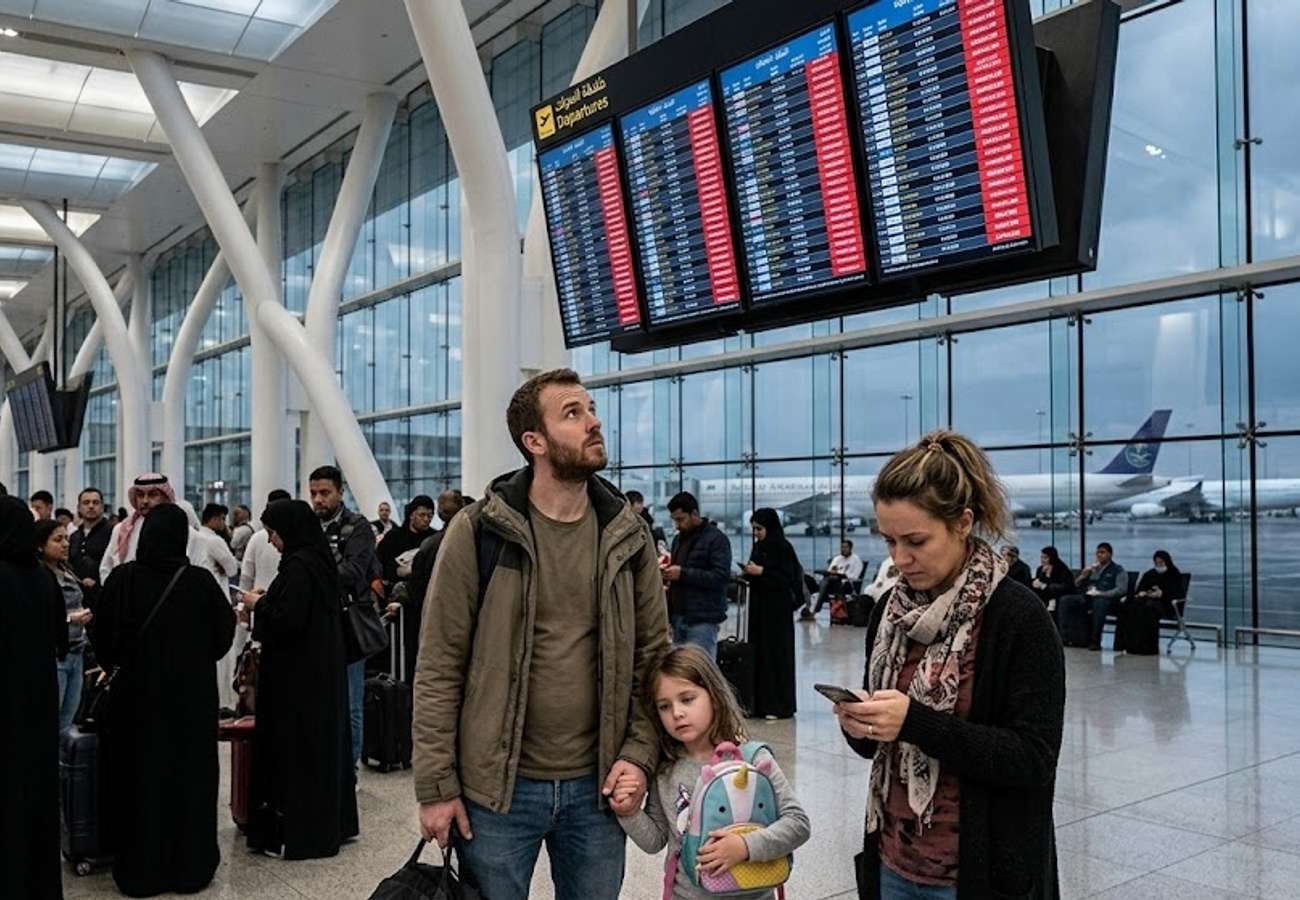
Image generated by AI
Thousands of passengers are currently stranded across the Kingdom as a massive wave of 575 delays and 248 cancellations paralyzes Saudi Arabia's primary aviation gateways. The disruption is centered heavily on the nation's two largest hubs, with the national carrier, Saudia, bearing the brunt of the operational collapse.
Strategic Hub Congestion vs. Regional Cuts
The current disruption pattern reveals a calculated operational strategy by airlines. While major hubs like Jeddah and Riyadh are experiencing extreme congestion and sliding schedules, regional airports are seeing a different trend: outright cancellations with almost no delays.
This suggests that carriers are prioritizing "operational certainty" over schedule recovery. In Jeddah and Riyadh, the extensive infrastructure allows airlines to keep aircraft moving, even if they are hours behind schedule. Conversely, at smaller regional strips, there is no capacity to absorb delays, leading airlines to scrub flights entirely to stabilize the broader network.
The ripple effect is most evident in the domestic connectivity between the hubs and regional cities. When a flight is delayed in Riyadh, it creates a vacuum in the schedule for airports like Abha or Gizan, forcing a total cancellation of the return leg.
Security Factors and Geopolitical Volatility
While aviation authorities rarely link individual flight delays to specific security events without official mandates, the timing coincides with heightened regional instability. The Saudi-Houthi conflict continues to cast a shadow over the airspace, with recent missile and drone threats targeting Saudi facilities following airstrikes on Hodeida.
The Iran-backed Houthi movement has further compounded these risks with renewed threats regarding shipping through the Bab el-Mandeb Strait and tensions surrounding Sanaa International Airport. These geopolitical frictions, coupled with broader tensions involving the United States and Iran, force airlines to adopt a posture of "operational caution."
This caution manifests as adjusted crew planning, repositioning of aircraft, and a willingness to cancel flights proactively to avoid putting assets or passengers in high-risk scenarios.
Impact Analysis by Airport and Carrier
Major Hub Disruptions
King Abdulaziz International Airport (Jeddah) is currently the epicenter of the crisis. As the primary gateway for the Kingdom, it recorded the highest volume of both delays (359) and cancellations (68). Because of its central role in the network, any bottleneck in Jeddah creates a cascading failure across the rest of the country.
King Khalid International Airport (Riyadh) follows closely as the second-largest disruption center, recording 211 delays and 58 cancellations. Unlike regional airports, Riyadh has maintained a flow of traffic, though passengers are facing significant wait times.
Regional Airport Breakdown
The data from regional airports shows a stark preference for cancellations over delays:
- Abha Regional: 51 cancellations vs. only 2 delays.
- Gizan Regional: 37 cancellations and 0 reported delays.
- Ta’if Regional: 17 cancellations and 3 delays.
- Najran Domestic: 17 cancellations and 0 reported delays.
Airline Exposure
The national carrier, Saudia, has been the most severely impacted due to its dominant market share and extensive domestic network. Saudia alone accounted for 74.2% of all cancellations.
| Airline | Delays | Cancellations | Primary Impact Areas |
|---|---|---|---|
| Saudia | 207 | 184 | Jeddah, Riyadh, Abha, Gizan, Ta'if, Najran |
| Flynas | 122 | 16 | Jeddah, Riyadh |
| flyadeal | 96 | 28 | Jeddah, Riyadh, Abha, Gizan |
Passenger Outlook and Recovery
Travelers utilizing the affected airports should expect continued volatility. In Jeddah and Riyadh, the focus will remain on recovering aircraft rotations and repositioning crews, meaning departure delays are likely to persist.
At regional airports, the trend of "targeted cancellations" will likely continue. Airlines are favoring this approach to preserve the reliability of their core hub operations. Passengers are urged to monitor airline notifications in real-time, as schedules remain fluid based on evolving security conditions and operational requirements.
The Saudi aviation network is currently operating as two separate environments: a congested hub system and a trimmed regional network.
Key Takeaways
- Total Impact: 575 delays and 248 cancellations across six major Saudi airports.
- The "Hub" Effect: Jeddah and Riyadh absorbed most delays, while regional airports (Abha, Gizan, Ta'if, Najran) faced mostly cancellations.
- Carrier Strain: Saudia is the most affected airline, representing nearly 75% of all cancelled flights.
- Root Causes: Operational instability exacerbated by regional security threats and Houthi-related tensions.
FAQ
Which airport is most affected? King Abdulaziz International Airport in Jeddah is the most impacted, with 359 delays and 68 cancellations.
Why are regional flights being cancelled instead of delayed? Regional airports have less infrastructure to manage delays. Airlines cancel these flights to prevent a total network collapse and to protect the stability of the main hubs in Riyadh and Jeddah.
Is the disruption related to security? While not officially attributed to a single event, the disruptions occur against a backdrop of missile/drone threats and geopolitical tensions involving the Houthi movement and Iran.
Related Travel Guides
Disclaimer
This article is for informational and educational purposes only. It does not constitute legal, financial, or professional advice. While we strive to provide accurate and up-to-date information, travel policies, regulations, and conditions change rapidly. Always verify information with official sources before making travel decisions. Nomad Lawyer makes no representations about the accuracy, reliability, completeness, or suitability of the information provided. Readers should consult qualified professionals for advice specific to their circumstances. The views expressed in this article are those of the author and do not necessarily reflect the views of Nomad Lawyer.
Kunal K Choudhary
Co-Founder & Contributor
A passionate traveller and tech enthusiast. Kunal contributes to the vision and growth of Nomad Lawyer, bringing fresh perspectives and driving the community forward.
Learn more about our team →