
Salamanca Showcases Spain’s Golden Heritage: Complete Cultural Tourism and Historic Travel Guide
Explore Salamanca, Spain's Golden City: UNESCO-listed heritage, the historic 1218 university, twin cathedrals, Plaza Mayor, world-famous Guijuelo Iberian ham, and cross-border Iberian routes.

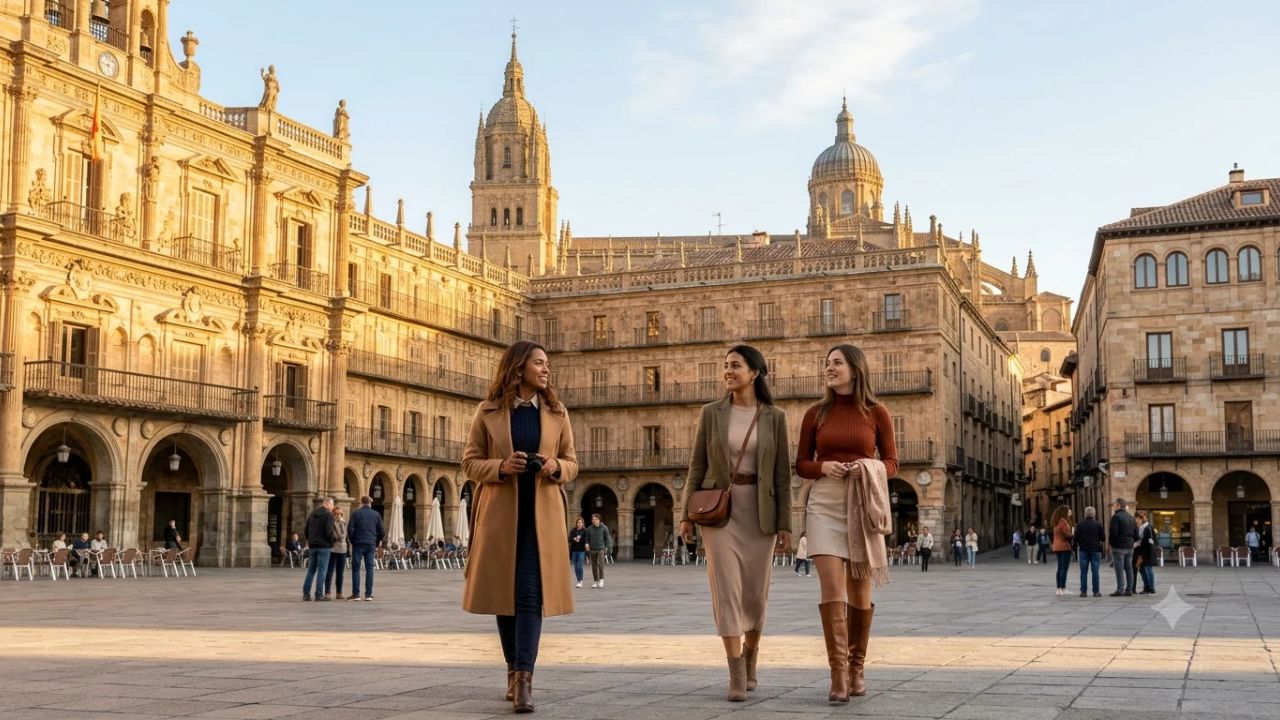
Salamanca has emerged as a premier cultural sanctuary for international travellers seeking architectural grandeur, deep academic tradition, and authentic Castilian gastronomy beyond Spain's crowded coastal corridors and primary metropolitan centres.
Situated along the River Tormes in western Castile and León (Castilla y León), the provincial capital of 145,000 residents is widely celebrated as La Ciudad Dorada (The Golden City). Constructed from local Villamayor sandstone (piedra franca de Villamayor) that absorbs iron oxide to radiate warm ochre and golden hues under changing sunlight, Salamanca's historic centre was inscribed as a UNESCO World Heritage site in 1988.
From the Renaissance Plateresque façades of the University of Salamanca—founded in 1218 as Spain's oldest seat of higher learning—to the monumentality of its adjoining Romanesque and Late Gothic cathedrals, Salamanca provides an interconnected, pedestrian-friendly masterclass in European architectural evolution. Its strategic western location also anchors essential cross-border itineraries connecting central Spain with northern Portugal.
          SALAMANCA CULTURAL AND IBERIAN TRANSIT CORRIDOR (2026)
          =======================================================

             [ MADRID INTERNATIONAL AIRPORT (MAD) ]
                               │
            Renfe Alvia / Media Distancia (1h 36m – 2h 15m)
            Autovía A-50 Expressway (2h 30m by road)
                               │
                               ▼
        ┌────────────────────────────────────────────────────────┐
        │       SALAMANCA: UNESCO WORLD HERITAGE ENSEMBLE        │
        ├──────────────────────────┬─────────────────────────────┤
        │  HISTORIC & ACADEMIC     │  MONUMENTAL LANDMARKS       │
        │  • University of 1218    │  • Plaza Mayor (Baroque)    │
        │  • Plateresque Frog      │  • Old & New Cathedrals     │
        │  • Casa de las Conchas   │  • Casa Lis (Art Nouveau)   │
        └────────────┬─────────────┴──────────────┬──────────────┘
                     │                            │
                     ▼                            ▼
        ┌─────────────────────────┐  ┌─────────────────────────┐
        │   REGIONAL GASTRONOMY   │  │   CROSS-BORDER IBERIAN  │
        │ • Hornazo Pastry        │  │   PORTUGAL EXTENSION    │
        │ • Guijuelo Ibérico Ham  │  │ • Vilar Formoso Border  │
        │ • Castilian Roast Lamb  │  │ • Coimbra & Porto Links │
        └─────────────────────────┘  └─────────────────────────┘
Architectural Alchemy: The Villamayor Sandstone and the Golden City Phenomenon
The singular visual identity of Salamanca stems directly from its geology. For centuries, master stonemasons sourced their raw building blocks from the quarries of nearby Villamayor. This porous feldspathic sandstone is soft when freshly excavated, allowing sculptors to chisel intricate relief ornamentation with surgical precision.
As the stone cures and interacts with the atmosphere, iron minerals oxidize, hardening the exterior surface and casting a rich amber-gold patina across every facade. The visual impact is most pronounced during late afternoon and sunset, when low-angled light illuminates the city's spires, domes, and arcades against the Castilian sky.
The UNESCO designation recognizes this urban coherence:
- Plateresque Mastery: The seamless blending of Gothic structural forms with Italian Renaissance decorative motifs, characterized by scrollwork, heraldic crests, and floral garlands carved to resemble silversmith work (platería).
- Pedestrian Integration: The compact historic core restricts vehicular traffic, enabling visitors to walk between major Romanesque, Gothic, Renaissance, and Baroque monuments within a 15-minute radius.
- Living Heritage: Unlike open-air museum towns, Salamanca functions as an active civic community where roughly 30,000 university students animate ancient cobblestone streets, plazas, and public libraries.
University of Salamanca: Eight Centuries of Global Intellectual Heritage
Founded in 1218 by King Alfonso IX of León, the University of Salamanca (Universidad de Salamanca) holds the distinction of being the oldest active university in the Hispanic world and one of the four foundational universities of medieval Europe alongside Bologna, Oxford, and Paris.
During the 15th and 16th centuries, Salamanca was the intellectual engine of the Spanish Golden Age:
- Foundations of International Law: The School of Salamanca, led by jurist and theologian Francisco de Vitoria, formulated revolutionary doctrines regarding human rights, sovereignty, and the law of nations (ius gentium) during the exploration of the Americas.
- Grammar of the Castilian Language: In 1492, scholar Antonio de Nebrija published his Gramática de la lengua castellana at Salamanca, establishing the first standardized grammatical rules for a modern European vernacular language.
- Scientific Inquiries: Astronomers at Salamanca examined and supported Nicolaus Copernicus's heliocentric planetary models while Christopher Columbus defended his Atlantic navigation proposals before royal scholars in the university's council chambers.
The university's crowning architectural masterpiece is its Plateresque entrance facade on the Patio de Escuelas, completed in 1529 under the Catholic Monarchs. Travellers and scholars gather in the courtyard to locate the legendary carved frog perched atop a skull (la rana de Salamanca). According to centuries-old student lore, finding the frog without assistance ensures good fortune in upcoming academic examinations, while art historians interpret the skull and amphibian as a Renaissance moral warning against lust and mortal decay.
Beyond the main building, the university complex includes the Colegio Mayor de Anaya, the Escuelas Menores with its celestial ceiling mural known as The Sky of Salamanca (El Cielo de Salamanca), and historic lecture halls preserved with rough-hewn wooden student benches from the 16th century.
Monumental Contrast: The Old and New Cathedrals Side by Side
Salamanca is one of the few European cities where two distinct cathedrals adjoin one another seamlessly, preserving a physical transition from Romanesque solemnity to Late Gothic and Baroque splendor.
| Feature | The Old Cathedral (Catedral Vieja) | The New Cathedral (Catedral Nueva) |
|---|---|---|
| Dedication | Santa María de la Sede | Asunción de la Virgen |
| Construction Period | 12th to 13th Century (Romanesque/Transitional) | 16th to 18th Century (Gothic/Renaissance/Baroque) |
| Architectural Style | Heavy Romanesque masonry, barrel vaults | Soaring Late Gothic vaults, intricate ribbing |
| Signature Exterior Landmark | Torre del Gallo (Byzantine-influenced Cock Tower) | Tower of the Cathedrals (110-metre bell tower) |
| Interior Highlights | 53-panel altarpiece painted by Nicolás Florentino | Ornate Baroque choir stalls designed by Churriguera |
| Atmospheric Ambience | Intimate, contemplative, cloistered courtyards | Expansive, luminous, monumental nave heights |
| Visitor Perspective | Ground-floor museum & historic chapels | Ieronimus Tour accessing medieval open-air battlements |
The Old Cathedral was initiated around 1102 during the repopulation of Salamanca. Its fortified exterior and thick stone walls reflect the defensive requirements of medieval Castile. Its ribbed dome (cimborrio), topped by the weathercock of the Torre del Gallo, reveals Romanesque architectural influences imported from Aquitaine and the Byzantine sphere.
By the early 1500s, Salamanca's academic prestige demanded a grander ceremonial structure. Rather than tearing down the Old Cathedral, builders constructed the New Cathedral directly against its northern wall between 1513 and 1733. Builders preserved Late Gothic aesthetics to harmonize with the older structure, later incorporating Plateresque portals and Baroque domes.
Through the Ieronimus Exhibition, travellers can climb interior stone spiral stairs to access elevated triforium walkways inside the naves, step onto external crenellated battlements, and view sweeping 360-degree panoramas of the River Tormes and the city rooftops.
Plaza Mayor: The Living Baroque Heart of Western Spain
Designed by architects Alberto and Nicolás Churriguera and completed in 1755 under Andrés García de Quiñones, the Plaza Mayor of Salamanca is universally regarded as one of the finest Baroque public squares in Europe.
Constructed as a vast, slightly irregular quadrilateral, the plaza is framed by three-story sandstone buildings supported by 88 rounded semicircular arches. Intricate stone medallions depicting Spanish kings, explorers, and literary figures—including Miguel de Cervantes—adorn the spandrels above the arcades.
Unlike ceremonial plazas in major capitals that empty after business hours, Salamanca’s Plaza Mayor serves as the community's living room:
- Daytime Rhythm: Students gather on shaded benches, professors meet under the colonnades, and visitors sit at historic outdoor cafés like Café Novelty (founded in 1905), which historically hosted intellectual salons for writers like Miguel de Unamuno.
- Nocturnal Illumination: At dusk, hundreds of perimeter lights illuminate the stone arches in a brilliant golden canopy. Crowds assemble for the traditional evening stroll (el paseo), spilling into adjacent tapas quarters.
Artistic Counterpoints: Casa Lis, Casa de las Conchas, and Secret Literary Havens
Salamanca's architectural inventory extends well beyond ecclesiastical structures:
1. Casa Lis: Art Nouveau and Art Deco Museum
Perched directly atop the southern Roman ramparts overlooking the River Tormes, Casa Lis is an eye-catching modernist palace completed in 1905 for industrialist Miguel de Lis. Designed by architect Joaquín de Vargas y Aguirre, the building features an extraordinary southern facade made of iron and vibrant stained glass.
Inside, the Museo de Art Nouveau y Art Deco showcases more than 2,500 decorative pieces, including chryselephantine bronze-and-ivory figurines, Emile Gallé art glass, Lalique crystal jewellery, antique porcelain dolls, and Fabergé enamels.
2. Casa de las Conchas (The House of Shells)
Constructed in the late 15th century by Rodrigo Arias de Maldonado, a knight of the Order of Santiago, this Gothic-Plateresque palace is famous for its exterior facade decorated with more than 300 hand-carved stone scallop shells.
The scallop shell is the enduring symbol of the Camino de Santiago pilgrimage route and the heraldic insignia of the Maldonado family. Today, the building serves as a public library and cultural center, featuring an interior patio with mixed Gothic and Mudejar wooden ceilings.
3. Huerto de Calixto y Melibea
Tucked behind the cathedral ramparts lies the Huerto de Calixto y Melibea, a tranquil walled garden filled with climbing vines, fruit trees, and stone fountains. This secluded enclave is celebrated as the setting for Fernando de Rojas's seminal 1499 Spanish literary classic, La Celestina (The Tragicomedy of Calisto and Melibea). The terrace garden offers shaded benches and framed views over the Roman bridge (Puente Romano) spanning the River Tormes.
Regional Gastronomy: The Flavours of Castile and León
Salamanca's culinary traditions are shaped by the open oak woodlands (dehesas) of western Spain and a rich heritage of livestock farming:
- Hornazo de Salamanca: The city's signature culinary creation. This rich, golden-crusted savoury yeast pastry is packed with slices of marinated pork loin (lomo adobado), spicy chorizo sausage, cured ham, and hard-boiled eggs. Traditionally eaten on Lunes de Aguas (the Monday following Easter), hornazo is available year-round across local bakeries and tapas bars.
- Jamón Ibérico de Bellota (DOP Guijuelo): The town of Guijuelo, located 45 kilometres south of Salamanca at an altitude of over 1,000 metres, produces Spain's most celebrated acorn-fed Iberian cured ham. The high-altitude winds and dry mountain winters allow for slow, natural curing spanning 36 to 48 months, yielding a sweet, nutty, and marbled cured meat.
- Chanfaina: A traditional rice dish made with lamb offal, chorizo, hard-boiled egg, and aromatic spices, reflecting medieval shepherd heritage.
- Farinate: A distinct local sausage made from breadcrumbs, pork lard, onion, paprika, and aniseed, traditionally fried and served beneath fried farm eggs.
- Wines of Sierra de Salamanca (DOP): High-altitude terraced vineyards along the southern mountains produce delicate, mineral-rich red wines crafted from the native Rufete grape variety, offering fresh acidity and wild red-berry notes.
Cross-Border Travel Corridors: Connecting Spain and Portugal
Salamanca’s geographic position makes it a natural hub for travellers exploring the broader Iberian Peninsula. Located just 115 kilometres east of the Portuguese border, the city anchors an emerging cross-border heritage circuit:
            CROSS-BORDER IBERIAN HERITAGE CORRIDOR
            ======================================

     [ MADRID ] ──(Renfe Alvia 1h 36m)──▶ [ SALAMANCA ]
                                                │
                                       (Autovía A-62 / E-80)
                                                │
                                                ▼
                                    [ Vilar Formoso Border ]
                                                │
                     ┌──────────────────────────┴──────────────────────────┐
                     ▼                                                     ▼
           [ COIMBRA (PORTUGAL) ]                               [ PORTO (PORTUGAL) ]
           • UNESCO 1290 University                             • Douro Valley Gateway
           • Biblioteca Joanina Baroque                         • Historic Ribeira Waterfront
Combining Salamanca with Portugal allows cultural travellers to trace shared historical, architectural, and educational threads. For example, pairing the University of Salamanca (1218) with the University of Coimbra (1290) creates an exceptional comparative study of medieval Iberian university traditions and baroque academic libraries.
Practical Logistics: Transportation, Seasons, and Touring Advice
| Consideration | Practical Guidance | Key Details & Recommendations |
|---|---|---|
| Primary International Gateway | Madrid-Barajas Airport (MAD) | Most practical air gateway with global long-haul connections |
| Rail Connections from Madrid | Renfe Alvia / Media Distancia | Fastest trains depart Madrid Chamartín; 1h 36m to 2h 15m transit |
| Road Travel & Car Rental | Autovía A-50 Expressway | Approximately 2 hours 15 minutes driving time from central Madrid |
| Optimal Travel Seasons | Spring (April–June) & Autumn (Sept–Nov) | Pleasant daytime temperatures (18°C–24°C) ideal for walking |
| Summer Considerations | July and August heat | Temperatures often surpass 32°C; explore monuments in mornings |
| Winter Considerations | December to February chill | Crisp, cold mornings (0°C–8°C); pack warm coats for evening strolls |
| Local Sightseeing Approach | 100% Pedestrian | The historic core is compact; private vehicles are restricted |
| Recommended Stay Duration | 2 to 3 nights | 1 day covers major monuments; 2–3 days allow museums, dining & gardens |
Frequently Asked Questions
Why is Salamanca called the Golden City?
Salamanca is known as the Golden City because its monuments are constructed from Villamayor sandstone, which oxidizes over time to create a glowing amber-gold tone in daylight.
When was the University of Salamanca founded?
The University of Salamanca was founded in 1218 by King Alfonso IX of León, making it the oldest university in Spain and one of the oldest in Europe.
What is the legend of the frog at the University of Salamanca?
According to local tradition, finding the small carved stone frog atop a skull on the university’s Plateresque facade without assistance brings good luck and success in academic exams.
What regional foods should travellers try in Salamanca?
Visitors should sample hornazo (a savory pork, chorizo, and egg pastry), protected Jamón Ibérico de Bellota from Guijuelo, and local Castilian roast lamb paired with Rufete wines.
Related Travel Guides
- UK Airports Accelerate Border Processing as Contactless Facial Recognition E-Gates Expand to 13 Major Gateways
- Port of Santos Schedules 164 Cruise Calls and 785,000 Travellers Across 10 Ships for Brazil’s 2026–2027 Summer Sailing Season
- Europe’s Underrated Autumn Foliage Destinations: Ambroz Valley, Gauja National Park, and Hidden Fall Escapes
Disclaimer
This article is for informational and educational purposes only. It does not constitute legal, financial, or professional advice. While we strive to provide accurate and up-to-date information, travel policies, regulations, and conditions change rapidly. Always verify information with official sources before making travel decisions. Nomad Lawyer makes no representations about the accuracy, reliability, completeness, or suitability of the information provided. Readers should consult qualified professionals for advice specific to their circumstances. The views expressed in this article are those of the author and do not necessarily reflect the views of Nomad Lawyer.
Preeti Gunjan
Contributor & Community Manager
A passionate traveller and community builder. Preeti helps grow the Nomad Lawyer community, fostering engagement and bringing the reader experience to life.
Learn more about our team →