
Ronald Reagan Washington National Airport Triggers Massive Travel Chaos as US Capital Enforces July 4 Airspace Shutdown, Forcing Rolling Flight Cancellations and Severe Airport Disruptions: Latest Airline News
A highly restrictive airspace shutdown over Washington D.C. for the July 4 holiday guarantees severe travel chaos and rolling flight cancellations at Ronald Reagan National Airport.

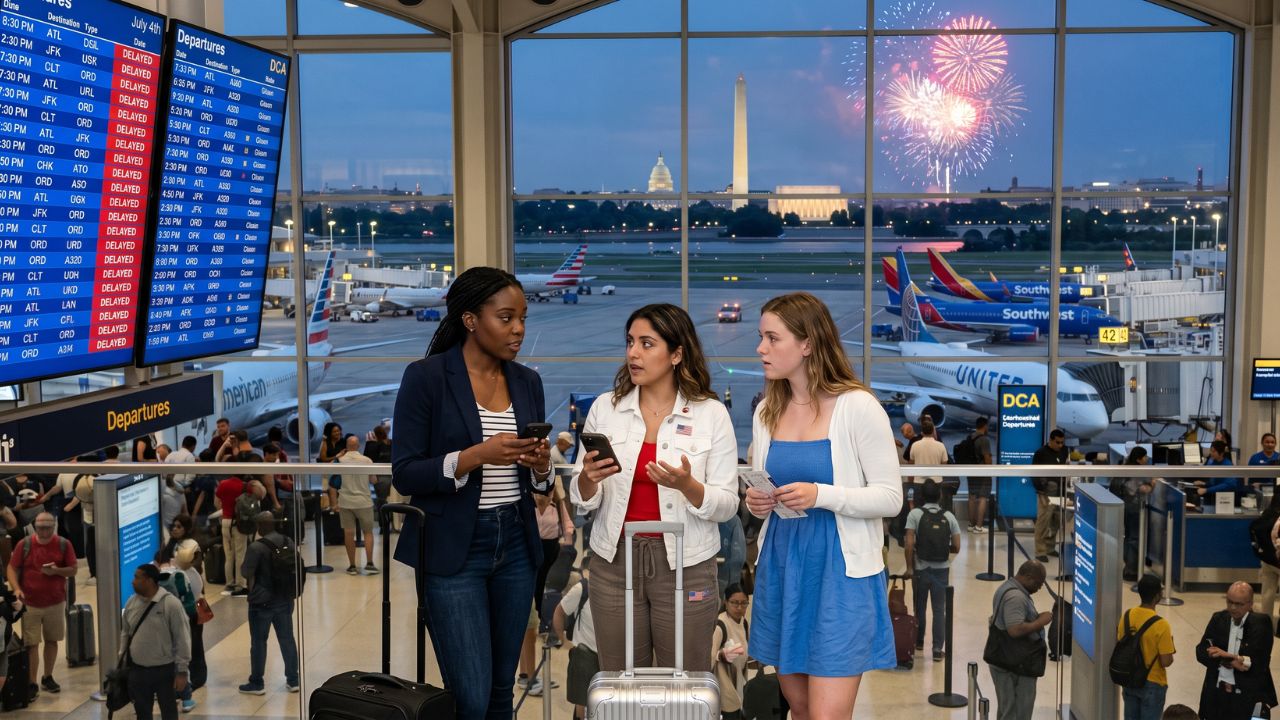
Image generated by AI
In a massive, government-mandated operational shutdown guaranteed to trigger unprecedented travel chaos and rolling flight cancellations across the United States domestic network, aviation authorities have announced severe airspace restrictions over Washington, D.C. Released on June 18, 2026, the directive confirms that Ronald Reagan Washington National Airport will face highly restrictive airspace closures during the peak of the July 4 holiday and the historic America 250 commemorations. With strict no-fly zones enforced to accommodate high-risk aerial flyovers, massive fireworks displays, and security over the National Mall, airlines are being forced into a brutal scheduling corner. As operations are systematically suspended starting July 3, millions of summer holidaymakers and connecting passengers are bracing for catastrophic airport disruptions. For tourists and corporate commuters trapped in the crossfire of national security and holiday celebrations, this impending airspace lockdown stands as the premier headline in today's breaking airline news and absolutely vital global aviation updates.
By introducing direct passenger coordination and dynamic scheduling backups, the regional aviation hubs target growing passenger demand across vital commerce sectors. The choice to coordinate flight departures in phases helps to manage gate capacity, supporting the country's broader regional transportation network.
Context: The Collapse of Capital Connectivity
For the millions of domestic passengers navigating the highly concentrated US East Coast aviation corridor, the sheer scale of the looming operational bottlenecks at Ronald Reagan National Airport threatens to transform the July 4 weekend into an absolute nightmare.
Historically, when peak seasonal holiday demand collides with strict, government-mandated airspace closures, the result is instantaneous travel chaos. The airspace surrounding Washington, D.C., is already one of the most sensitive and tightly controlled zones on the planet. When aviation authorities introduce temporary, rolling closures to permit military flyovers and massive Independence Day fireworks, the airport effectively ceases to function. Airlines simply cannot operate their normal schedules. Because the restrictions begin on July 3 and severely escalate on July 4, carriers are being forced to execute proactive flight cancellations. Even a brief 30-minute closure of Reagan National's runway triggers a cascading effect, forcing inbound flights into extensive holding patterns and causing severe airport disruptions across connecting hubs nationwide. Passengers booked on flights into or out of the capital during this window must immediately prepare for destroyed itineraries and brutal terminal gridlock.
To view live flight schedules, verify the active delay status of your specific itinerary, or to track active regional airspace restrictions, travelers must consult official aviation directories. For direct booking access on carriers actively rerouting flights to bypass this massive terminal gridlock, travelers should actively monitor the official portals for major US domestic airlines. To explore live flight tracking and monitor the exact severity of the cascading holding patterns causing the flight cancellations you are actively surviving, passengers can consult the official FlightAware tracking service.
Section-Wise Breakdown of the DC Airspace Shutdown
The Escalating July Closure Window
The airspace shutdown is not a single event; it is a layered, multi-day restriction protocol. Disruptions officially commence on July 3, where select early afternoon flight movements will be heavily restricted to accommodate ceremonial preparations. The travel chaos reaches its absolute peak on July 4, where flight operations will be entirely suspended after midday. This hard closure forces airlines to cram a full day's worth of departures into the morning, virtually guaranteeing severe congestion and rolling delays at the gate.
America 250 and National Mall Security
The severity of this year's closure is directly linked to the America 250 celebrations. Because Washington, D.C. will host massive public gatherings on the National Mall, the Department of Homeland Security and the FAA are enforcing an impenetrable security bubble. The convergence of these public celebrations, aerial demonstrations, and high-profile government gatherings has created one of the most complex airspace management scenarios in modern US aviation history. Safety is the exclusive priority, meaning commercial aviation takes a definitive back seat.
The Domestic Ripple Effect
The impact of shutting down Reagan National—even temporarily—cannot be isolated. As a primary hub for domestic connectivity, flight cancellations here instantly trigger travel chaos in Boston, Atlanta, Chicago, and Dallas. Airlines are desperately attempting to consolidate flights, reassign aircraft, and adjust crew schedules to keep their national networks moving while a massive hole is punched in their East Coast scheduling.
Technical Roster: Reagan National Airspace Restrictions Data
To ensure absolute factual accuracy regarding the exact scale of this operational shutdown and the extreme security measures driving the disruption, the following matrix details the verified restriction data for the July 4 window:
Washington D.C. Airspace Disruption Matrix
| Strategic Metric | Operational Verification |
|---|---|
| Affected Mega-Hub | Ronald Reagan Washington National Airport |
| Primary Disruption Window | July 3 – July 5, 2026 |
| Triggering Events | America 250 Celebrations, July 4 Fireworks, Flyovers |
| July 3 Operations | Select early afternoon movements restricted |
| July 4 Operations | Full flight operations suspended after midday |
| Systemic Impact | Proactive flight cancellations, extended ground holds, cascading delays |
Passenger Impact: Trapped in the Capital
For the tens of thousands of leisure travelers and political commuters forced to navigate Washington, D.C. this holiday weekend, the psychological toll of a government-mandated airspace closure is severe.
The immediate passenger impact is the absolute destruction of schedule reliability. A passenger attempting to fly out of Reagan National on the afternoon of July 4 will find their flight cancelled. Because the airspace is physically closed, airlines cannot offer a "later flight"; they must rebook the passenger for July 5 or later. This creates immediate, localized airport disruptions as passengers flood the terminal demanding rebooking during a period of peak holiday demand. Furthermore, the rolling pauses in flight movements mean that passengers arriving on July 3 will likely be trapped on the tarmac in extended holding patterns, forced to wait out security windows before their aircraft is legally permitted to taxi to the gate.
Industry Analysis: The Fragility of Controlled Airspace
Aviation industry analysts view the impending shutdown at Reagan National as definitive proof that highly controlled urban airports are exceptionally vulnerable to systemic travel chaos during national events.
Analysts note that airlines operating out of Reagan National are already highly restricted by strict perimeter rules and slot controls. When the FAA overlays a rolling holiday shutdown on top of these existing restrictions, the schedule shatters. Industry experts warn that airlines who fail to proactively execute strategic flight cancellations will suffer massive financial losses. Attempting to "wait out" the fireworks displays will simply result in aircraft burning fuel in holding patterns while flight crews time out. The only mathematical way to survive this airspace closure is to aggressively thin the schedule, meaning passengers must bear the brunt of the travel chaos as seat availability completely evaporates.
Actionable Advice for Surviving the July 4 Airspace Shutdown
If you are navigating the highly volatile US domestic network during the July 4 holiday, execute this strategic planning checklist to fully bypass regional travel chaos:
- Avoid Afternoon Flights: If you must fly out of Reagan National on July 3 or July 4, book the earliest morning flight available. As the day progresses and the aerial displays begin, the airspace closures will trigger rolling flight cancellations that exclusively target afternoon and evening itineraries.
- Reroute to Dulles or BWI: Do not attempt to fly into Reagan National if you can avoid it. Aggressively rebook your arrival into Washington Dulles International Airport (IAD) or Baltimore/Washington International (BWI). While these airports will still be busy, their airspace is significantly less restricted by the National Mall events.
- Monitor Last-Minute Slot Changes: Because this is a dynamic security environment, the FAA may suddenly activate no-fly windows. Do not assume your flight is safe until the aircraft is airborne. Frequently monitor the airline app while sitting at the gate.
- Anticipate Severe Tarmac Delays: If you are arriving during a rolling pause, expect to sit on the tarmac for over an hour. Use the restroom before the aircraft descends, and ensure you have water and snacks in your carry-on to survive the localized airport disruptions.
FAQ: Reagan National Airport Operations & Travel Chaos
Why is Reagan National Airport shutting down operations?
The airport is enforcing temporary, strict airspace closures to ensure safety during massive America 250 commemorations and July 4 celebrations, including fireworks and military flyovers over the National Mall.
When will the flight cancellations and closures peak?
Disruptions begin on July 3 with afternoon restrictions, but the travel chaos will peak on July 4 when all flight operations are strictly suspended after midday.
Will connecting flights outside of Washington be affected?
Yes. Reagan National is a major hub; closing its airspace creates a cascading ripple effect, causing severe airport disruptions, ground holds, and rolling flight cancellations across the entire US domestic network.
The Reality of Government Airspace Restrictions
The historic holiday shutdown executed over Washington, D.C. proves definitively that government-mandated security perimeters are the ultimate catalyst for systemic physical travel chaos. By forcing airlines to suspend operations at Ronald Reagan National Airport during the peak of the summer travel season, authorities have guaranteed that millions of passengers will suffer severe airport disruptions. As legacy carriers desperately struggle to manually process surging holiday demand through a heavily fractured schedule—triggering massive terminal queues and proactive flight cancellations—travelers must accept a critical new reality: avoiding brutal travel anxiety during national holidays requires aggressively bypassing highly restricted capital airports and rerouting through less sensitive regional gateways.
Key Takeaways
- Midday July 4 Shutdown: Flight operations at Reagan National will be entirely suspended after midday on July 4, 2026, to accommodate America 250 celebrations.
- Multi-Day Disruption: Travel chaos will begin on July 3 with early afternoon restrictions and continue through July 5 as airlines struggle to recover.
- Security-Driven Chaos: The closures are mandated by safety requirements for flyovers, fireworks, and massive public gatherings on the National Mall.
- National Ripple Effect: The localized shutdown will trigger rolling flight cancellations and severe airport disruptions across connecting hubs nationwide.
- Passenger Survival: Travelers must aggressively reroute to Dulles or BWI, or exclusively book early morning flights to bypass the extreme afternoon airspace closures.
Related Travel Guides
Massive Travel Chaos Paralyzes Chicago O'Hare with 1,425 Disruptions
Disclaimer
This article is for informational and educational purposes only. It does not constitute legal, financial, or professional advice. While we strive to provide accurate and up-to-date information, travel policies, regulations, and conditions change rapidly. Always verify information with official sources before making travel decisions. Nomad Lawyer makes no representations about the accuracy, reliability, completeness, or suitability of the information provided. Readers should consult qualified professionals for advice specific to their circumstances. The views expressed in this article are those of the author and do not necessarily reflect the views of Nomad Lawyer.
Kunal K Choudhary
Co-Founder & Contributor
A passionate traveller and tech enthusiast. Kunal contributes to the vision and growth of Nomad Lawyer, bringing fresh perspectives and driving the community forward.
Learn more about our team →