
Reagan National Airport Enforces Massive July 4 Airspace Shutdown, Triggering Devastating Travel Chaos and Domestic Flight Cancellations Across the US Network: Latest Airline News
As Washington D.C. prepares for America 250, a mandated July 4 airspace shutdown at Reagan National Airport is set to unleash severe travel chaos and rolling flight cancellations.

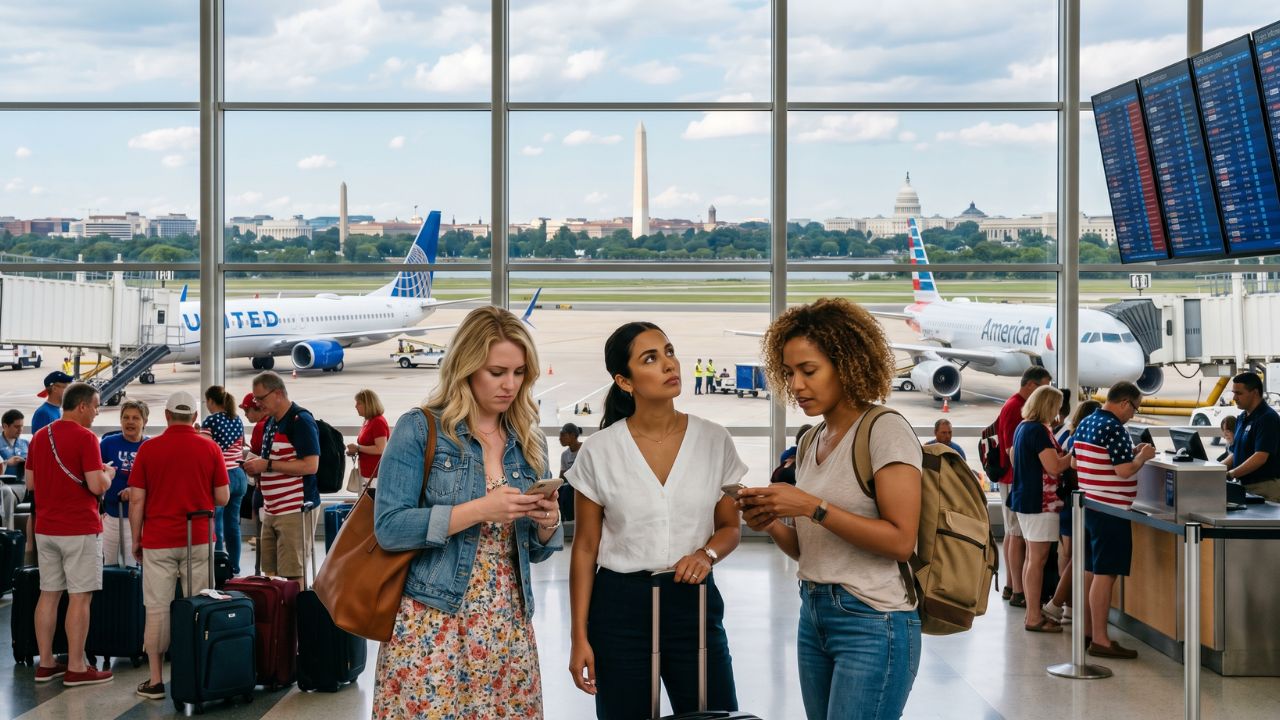
Image generated by AI
In a massive, highly restrictive operational lockdown explicitly guaranteed to trigger unprecedented travel chaos and cascading flight cancellations across the entire United States domestic network, aviation authorities have announced a severe airspace shutdown at Ronald Reagan Washington National Airport. Confirmed on June 18, 2026, the strict operational controls are being enforced to secure the highly sensitive airspace above Washington, D.C., during the historic America 250 commemorations over the July 4 holiday window. Because the US capital is deploying large-scale national celebrations—including complex aerial flyovers and massive fireworks displays—commercial aviation has been ordered to hold. With flight operations facing total suspension after midday on July 4, this forced bottleneck will immediately paralyze one of the most critical transit corridors in the country, trapping thousands of holidaymakers in rolling airport disruptions and driving today's most urgent headline in breaking airline news and absolutely vital global aviation updates.
By introducing direct passenger coordination and dynamic scheduling backups, the regional aviation hubs target growing passenger demand across vital commerce sectors. The choice to coordinate flight departures in phases helps to manage gate capacity, supporting the country's broader regional transportation network.
Context: The Domino Effect of Capitol Airspace Control
For the thousands of domestic tourists and corporate commuters attempting to navigate the peak summer holiday window, the sudden closure of Reagan National Airport represents the absolute worst-case scenario for localized travel chaos.
Historically, Ronald Reagan Washington National Airport operates as a vital pressure valve for the East Coast aviation network. Because it handles dense, high-frequency domestic traffic, any disruption at Reagan instantly bleeds into connecting hubs like Atlanta, Chicago, and Dallas. Aviation authorities have declared that the America 250 celebrations require absolute airspace segmentation. This is not a minor delay; this is a highly structured, mandated operational pause. Beginning on July 3, select early afternoon flights will be barred from operating, leading up to the catastrophic total suspension of flight movements after midday on July 4. When an airport of this magnitude stops launching aircraft, the airlines are forced to execute preemptive flight cancellations at origin cities across the country to prevent planes from circling endlessly in holding patterns. Passengers holding tickets for the holiday weekend must accept that the airspace restrictions protecting the national celebrations will fundamentally destabilize the commercial schedule, trapping them in a brutal wave of rolling delays and terminal gridlock that will last well into July 5.
To view live flight schedules, verify the active delay status of your specific itinerary, or to track active regional airspace restrictions, travelers must consult official aviation directories. For direct updates regarding how this massive airspace shutdown guarantees sudden route abandonments affecting your specific Washington D.C. connections, travelers should aggressively utilize the official portals of their operating carriers. To explore live flight tracking and monitor the exact severity of the cascading bottlenecks causing the flight cancellations across the US domestic network, passengers can consult the official FlightAware tracking service.
Section-Wise Breakdown of the Holiday Disruption
The July 3 Early Afternoon Squeeze
The travel chaos begins before the actual holiday. On July 3, aviation authorities will implement controlled no-fly windows to accommodate rehearsal flights and early ceremonial displays. Select early afternoon flight movements will be completely restricted. This localized disruption will force airlines to aggressively condense their remaining flights into narrower departure windows, immediately triggering severe terminal congestion and long delays for passengers attempting to beat the holiday rush.
The July 4 Midday Total Suspension
The absolute epicenter of the airport disruptions occurs on Independence Day. Operations at Reagan National Airport will be fully suspended after midday. Because no aircraft will be allowed to take off or land during this period, airlines will be forced to park their fleets or divert incoming traffic to other regional airports (like Dulles or BWI), instantly destroying the itineraries of thousands of inbound passengers and triggering massive, unavoidable flight cancellations nationwide.
The July 5 Residual Gridlock
While terminal activity (baggage handling, security processing) will continue in a limited capacity during the shutdown, full flight operations are not expected to normalize until July 5. However, because aircraft and flight crews will be massively out of position following the July 4 ground stop, the recovery phase will be excruciatingly slow. Passengers attempting to fly out of Washington on July 5 will face severe residual delays as airlines desperately attempt to reboot their fractured networks.
Technical Roster: Reagan National Airspace Shutdown Data
To ensure absolute factual accuracy regarding the exact parameters of this massive operational lockdown and the specific airspace closures driving the threat of nationwide flight cancellations, the following matrix details the verified regulatory data:
Reagan National Airport July 4 Disruption Matrix
| Strategic Operational Metric | Verification Data |
|---|---|
| Affected Aviation Hub | Ronald Reagan Washington National Airport |
| Geographic Location | Washington, D.C., United States |
| Primary Disruption Catalyst | America 250 national celebrations and high-risk aerial flyovers |
| July 3 Operational Impact | Controlled restrictions barring select early afternoon flight movements |
| July 4 Operational Impact | Full mandated suspension of all flight operations after midday |
| July 5 Operational Impact | Phased network recovery battling massive residual schedule delays |
| Secondary Network Impact | Cascading travel chaos across connecting domestic US flight networks |
| Terminal Status Overview | Terminal facilities remain physically open with highly limited passenger services |
Passenger Impact: Grounded in the Capital
For the tens of thousands of holidaymakers attempting to transit through Washington D.C., this massive airspace shutdown fundamentally guarantees extreme schedule anxiety and total itinerary failure.
The immediate passenger impact of this mandated closure is the absolute eradication of flight reliability. When the airspace shuts down after midday on July 4, any passenger holding a ticket for an afternoon departure is mathematically guaranteed to face a flight cancellation. Airlines cannot simply delay a flight for six hours while fireworks explode over the National Mall; they will cancel the flight, stranding the passenger. Furthermore, because load factors during the July 4 weekend are already at 100 percent, rebooking a canceled flight will be nearly impossible. Passengers caught in this travel chaos will find themselves trapped inside the Reagan terminal, forced to compete with thousands of other stranded travelers for non-existent hotel rooms and scarce rental cars, as the massive public celebrations choke the surrounding city infrastructure.
Industry Analysis: The Cost of Airspace Segmentation
Aviation industry analysts view the July 4 shutdown at Reagan National Airport as a stark demonstration of how highly concentrated, sensitive airspace acts as the ultimate vulnerability in the US domestic aviation network.
Analysts note that airlines operating out of Reagan (particularly American Airlines, which utilizes DCA as a massive hub) are being forced to absorb catastrophic financial hits. By mandating rolling operational pauses and total suspensions, the government is forcing airlines to ground highly profitable aircraft during the most lucrative travel window of the summer. Industry experts warn that the cascading effect will be brutal: a plane that cannot leave Washington on July 4 means a canceled flight from Chicago to Dallas later that evening. The decision to prioritize large-scale national events over civil aviation mobility guarantees that the travel chaos will spread far beyond the capital, infecting the entire national flight schedule and destroying the punctuality metrics of every major US carrier for the entire week.
Actionable Advice for Surviving the July 4 Gridlock
While passengers cannot override federal airspace closures, you can execute this strategic planning checklist to fully protect your holiday itineraries from sudden airline collapse:
- Flee Before July 3: If your itinerary involves Reagan National Airport, you must absolutely execute your departure before the rolling restrictions begin on the afternoon of July 3. Booking a flight on July 4 is a mathematical guarantee of a flight cancellation and extreme travel chaos.
- Aggressively Reroute to Dulles (IAD) or BWI: While Reagan is facing total midday shutdowns, Washington Dulles International Airport and Baltimore/Washington International Airport operate outside the most sensitive no-fly zones. Immediately contact your airline and demand to be rerouted through IAD or BWI to bypass the DCA gridlock.
- Monitor the July 5 Recovery Wave: Do not assume your morning flight on July 5 is safe. Because aircraft will be stranded out of position from the July 4 shutdown, early morning flights the following day are highly vulnerable to rolling delays. Monitor your airline's app constantly before leaving for the airport.
- Abandon Connecting Flights Through DCA: If you are flying from Boston to Miami and your itinerary includes a layover at Reagan National Airport between July 3 and July 5, cancel the ticket immediately. Transiting through the epicenter of this massive airspace shutdown is financial suicide.
FAQ: Reagan National Airport July 4 Shutdown
Why is Reagan National Airport shutting down on July 4?
Aviation authorities are enforcing strict, temporary airspace restrictions, suspending operations after midday on July 4 to accommodate high-risk aerial flyovers and massive public celebrations tied to the America 250 holiday events in Washington D.C.
Will flights be delayed or canceled on July 3?
Yes. The travel chaos begins on July 3, with controlled restrictions barring select early afternoon flight movements, causing severe terminal congestion and rolling delays as airlines compress their schedules.
How will this affect connecting domestic flights?
Because Reagan is a massive East Coast hub, the midday shutdown on July 4 will trap aircraft on the ground, preventing them from flying their subsequent routes and triggering cascading flight cancellations across the entire US domestic network.
The Reality of Airspace Lockdown
The federally mandated airspace shutdown at Ronald Reagan Washington National Airport proves definitively that civil aviation remains entirely subservient to national security and large-scale public events. By enforcing rolling operational pauses on July 3 and executing a total flight suspension after midday on July 4, aviation authorities have mathematically guaranteed a devastating wave of physical travel chaos. As domestic airlines desperately struggle to reposition their fleets and manage surging holiday passenger volumes—frequently triggering massive connecting queues, rolling flight cancellations, and excruciating airport disruptions nationwide—travelers must accept a critical new reality: avoiding brutal travel anxiety during major national holidays requires actively abandoning highly sensitive capital airspace and aggressively rerouting through heavily insulated secondary airports.
Key Takeaways
- Massive Airspace Lockdown: Ronald Reagan Washington National Airport will face severe operational shutdowns due to America 250 July 4 celebrations in Washington D.C.
- July 3 Disruption Begins: Select early afternoon flights on July 3 will be restricted, triggering the initial wave of travel chaos.
- July 4 Total Midday Suspension: All flight operations will be fully suspended after midday on July 4 to allow for aerial flyovers and fireworks, causing massive flight cancellations.
- Nationwide Ripple Effect: The grounding of aircraft at Reagan will trigger cascading delays and flight cancellations across the entire connecting US domestic network.
- Passenger Survival: Travelers must aggressively reroute their itineraries through Dulles (IAD) or BWI to physically bypass the catastrophic airport disruptions guaranteed at DCA.
Related Travel Guides
Massive Travel Chaos Paralyzes Chicago O'Hare with 1,425 Disruptions
Disclaimer
This article is for informational and educational purposes only. It does not constitute legal, financial, or professional advice. While we strive to provide accurate and up-to-date information, travel policies, regulations, and conditions change rapidly. Always verify information with official sources before making travel decisions. Nomad Lawyer makes no representations about the accuracy, reliability, completeness, or suitability of the information provided. Readers should consult qualified professionals for advice specific to their circumstances. The views expressed in this article are those of the author and do not necessarily reflect the views of Nomad Lawyer.
Kunal K Choudhary
Co-Founder & Contributor
A passionate traveller and tech enthusiast. Kunal contributes to the vision and growth of Nomad Lawyer, bringing fresh perspectives and driving the community forward.
Learn more about our team →