United Airlines Launches Nonstop Newark–St. Croix Flights to Expand Caribbean Tourism and Diaspora Travel

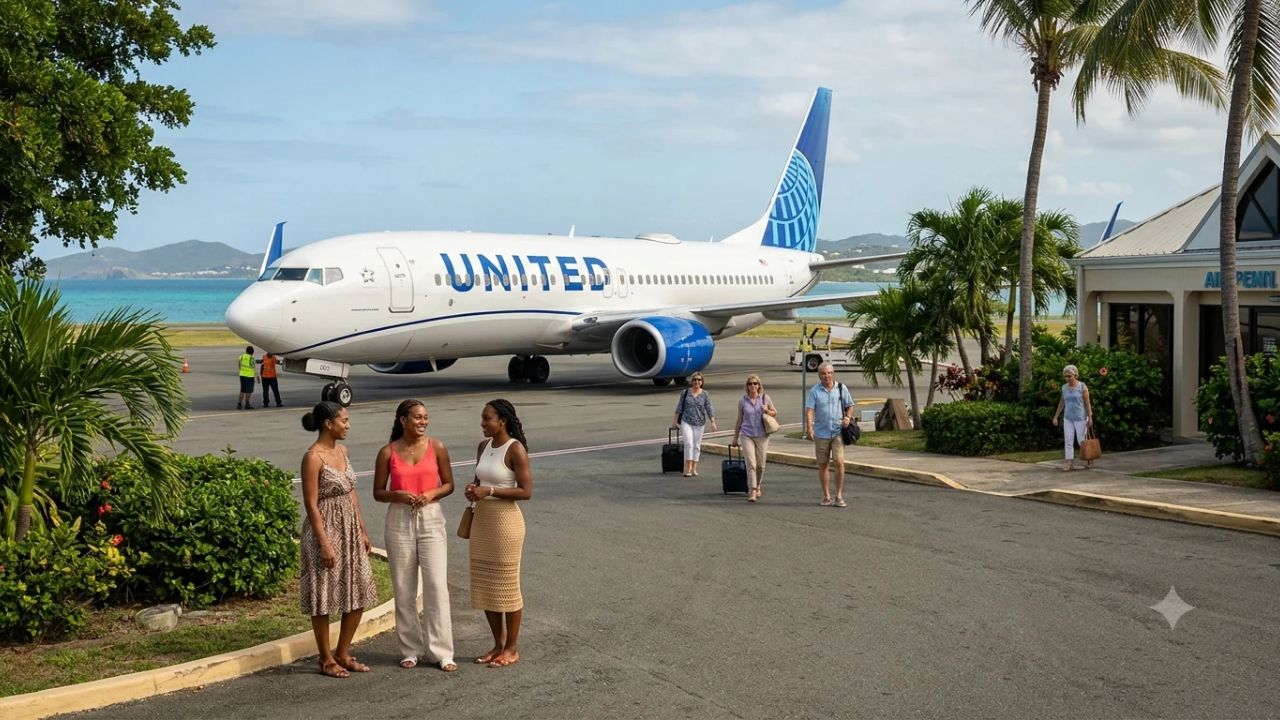
United Airlines connects Newark Liberty International Airport directly with St. Croix's Henry E. Rohlsen Airport, expanding nonstop travel to the US Virgin Islands.
CHRISTIANSTED, Nov 1 (Nomad Lawyer) — United Airlines has officially inaugurated nonstop commercial service between Newark Liberty International Airport (EWR) in New Jersey and Henry E. Rohlsen Airport (STX) on the island of St. Croix, delivering an essential nonstop aviation conduit linking the New York metropolitan area with the largest of the United States Virgin Islands (USVI). Commencing operations with the touchdown of its inaugural flight on October 31, 2026, the new scheduled route eliminates the necessity of regional aircraft transfers, unlocking expanded economic potential for Caribbean leisure tourism, business investment, and the vibrant Virgin Islands diaspora residing across the northeastern United States.
[!NOTE] Inaugural Flight Details: Operating under flight numbers UA1409 (southbound from Newark) and UA1410 (northbound return to Newark), the new service connects the New York Tri-State region directly to St. Croix. The milestone flight on October 31, 2026, carried historical significance as four commercial pilots with deep personal and family roots in St. Croix commanded the inaugural round-trip rotations.
UNITED AIRLINES NEWARK-ST. CROIX NONSTOP AIR CORRIDOR & TOURISM IMPACT
| [Origin Gateway] -----------------> Newark Liberty International Airport (EWR) |
|---|
| New York Tri-State Metropolitan Hub |
| [Flight Pair & Distance] ---------> Flight 1409 (EWR-STX) / Flight 1410 (STX-EWR) |
| [Destination Gateway] ------------> Henry E. Rohlsen Airport (STX), St. Croix, USVI |
| 10,004-ft runway; deep-water Caribbean portal |
| [Inaugural Crew Tribute] ---------> 4 Native Crucian Aviators Command Flight Rotations |
| Military, regional, and commercial pedigrees |
| +------------------------------------------------+------------------------+ |
| v v |
| [Leisure Tourism Diversification] [Diaspora & Community Mobility] |
| - Christiansted Danish colonial architecture - Direct link for Virgin Islanders |
| - Frederiksted waterfront & pier - Seamless VFR travel across NY/NJ |
| - Buck Island Reef National Monument - Bypasses San Juan/Miami layovers |
| - Salt River Bay ecological reserves - Fosters trade and social ties |
| v |
| [Domestic Regulatory Advantage] |
| US Citizens Travel Passport-Free (Government Photo ID / REAL ID) |
| Pre-Clearance via US Customs & Border Protection (CBP) at STX |
Strategic Route Inception: Connecting the New York Tri-State Hub with St. Croix
The introduction of direct scheduled flights between Newark Liberty International Airport and Henry E. Rohlsen Airport represents a transformative expansion in air connectivity for the United States Virgin Islands. Historically, travelers departing the New York metropolitan region bound for St. Croix faced fragmented travel schedules, frequently requiring intermediate aircraft connections through regional hubs such as San Juan's Luis Muñoz Marín International Airport (SJU) in Puerto Rico, Miami International Airport (MIA), or Charlotte Douglas International Airport (CLT).
By inaugurating nonstop service, United Airlines establishes a four-hour direct air bridge that connects the dense population centers of New Jersey, New York City, Connecticut, and eastern Pennsylvania directly to St. Croix. The outbound service, operating as United Airlines Flight 1409, provides travelers with an early-morning or midday departure from Newark, arriving on the sunny shores of St. Croix in time for afternoon hotel check-ins. The return leg, operating as Flight 1410, offers a seamless northbound transit back into the Tri-State area, connecting smoothly to United's domestic and international route banks.
From a network planning perspective, Newark Liberty serves as United Airlines' primary East Coast transatlantic and domestic megahub. Housing extensive terminal infrastructure across Terminal A and Terminal C, Newark enables travelers from across the American Midwest, New England, and international originating points in Canada and Europe to book single-ticket connections to St. Croix with a single transfer at Newark.
| Flight Metric & Indicator | Outbound Sector (UA1409) | Northbound Return Sector (UA1410) |
|---|---|---|
| Origin Airport | Newark Liberty International (EWR), New Jersey | Henry E. Rohlsen Airport (STX), St. Croix |
| Destination Airport | Henry E. Rohlsen Airport (STX), St. Croix | Newark Liberty International (EWR), New Jersey |
| Inaugural Flight Date | October 31, 2026 | October 31, 2026 |
| Flight Distance | Approximately 1,670 nautical miles (3,090 km) | Approximately 1,670 nautical miles (3,090 km) |
| Approximate Block Time | 4 hours 05 minutes | 4 hours 15 minutes |
| Cabin Classes Offered | United First, Economy Plus, Standard Economy | United First, Economy Plus, Standard Economy |
| Border Processing Status | Domestic Departure (Terminal A/C) | CBP Pre-Clearance Departure at STX Terminal |
This nonstop connection provides the US Virgin Islands Department of Tourism with a powerful competitive asset. In the highly contested Caribbean leisure travel sector, destination accessibility is one of the most influential variables determining consumer vacation selection. By eliminating the friction, baggage loss risks, and fatigue associated with connecting flights, St. Croix instantly becomes a highly attractive option for weekend leisure breaks, corporate incentive trips, and multi-week family holidays.
Aviation Heritage in the Cockpit: The Historic All-Crucian Inaugural Flight Crew
While the commercial implications of the new route are substantial, the inaugural operation on October 31, 2026, carried profound cultural and community significance through the unique composition of its flight crews. In an extraordinary tribute to St. Croix's rich aviation heritage, United Airlines assigned four commercial pilots of Crucian descent to pilot the inaugural services.
Two pilots with deep personal and family roots on the island operated United Airlines Flight 1409 on its southbound journey from Newark to Henry E. Rohlsen Airport, while two fellow Crucian aviators were assigned to operate the return rotation on Flight 1410 back to New Jersey. The assembly of an all-Crucian cockpit crew for both legs of the maiden journey honored the significant contributions that Virgin Islanders have made to the global aviation and aerospace industries over several decades.
The professional backgrounds of these four aviators represent a broad spectrum of aviation disciplines:
Their careers encompass military flight operations within the United States Armed Forces, extensive experience across Caribbean regional commercial aviation, service within specialized corporate transport divisions, and leadership roles in aerospace training and flight academy instruction. Several of the aviators began their basic flight training on the very runways of Henry E. Rohlsen Airport before advancing through regional carriers and major commercial airlines.
When Flight 1409 touched down on Runway 10 at Henry E. Rohlsen Airport on October 31, it was greeted by traditional water cannon salutes delivered by the Virgin Islands Port Authority Fire and Rescue teams, accompanied by local government dignitaries, cultural performers, and cheering family members gathered at the terminal. The moment captured an authentic intersection of infrastructure modernization and civic pride, demonstrating how commercial aviation can celebrate the talent of island communities while expanding their economic horizons.
Island Tourism Acceleration: Broadening St. Croix's Cultural and Eco-Adventure Appeal
For the island of St. Croix, the arrival of United Airlines' nonstop service from Newark marks a pivotal moment in its strategy to diversify and expand its tourism economy. While its sister island of St. Thomas is celebrated for high-density mega-cruise ship calls and duty-free shopping districts, and nearby St. John is revered for the pristine wilderness of the Virgin Islands National Park, St. Croix offers a distinctive, multi-layered Caribbean experience that blends rich historical heritage with pristine marine ecosystems.
St. Croix is the largest of the US Virgin Islands, spanning eighty-four square miles of rolling green hills, arid cactus-studded eastern shores, lush subtropical western rainforests, and historic coastal settlements. The island's architectural and cultural identity is profoundly shaped by its complex colonial history. Having existed under seven different sovereign flags—including Spain, Great Britain, the Knights of Malta, France, Denmark, and the United States—St. Croix preserves some of the most authentic Danish-Caribbean colonial architecture in the Western Hemisphere.
ST. CROIX GEOGRAPHIC AND CULTURAL TOURISM ECOSYSTEM
| Column 1 |
|---|
| [Christiansted Historic Harbor] --> Danish colonial yellow brick architecture, |
| Fort Christiansvaern, Steeple Building, scalehouse |
| [Frederiksted Waterfront Pier] ---> Deep-water cruise terminal, Victorian gingerbread |
| architecture, Fort Frederik, Freedom City heritage |
| [Buck Island Reef Monument] ------> 176-acre barrier island; protected marine park; |
| underwater marked snorkeling trail & Elkhorn coral |
| [Salt River Bay Ecological Park] -> Christopher Columbus 1493 landing site; mangrove |
| estuary; bioluminescent night kayak expeditions |
| [Crucian Culinary Heritage] ------> Traditional fungi, pot fish, callaloo, Cruzan Rum |
| distillery, and farm-to-table culinary festivals |
In the historic northern harbor town of Christiansted, visitors encounter townscapes defined by eighteenth-century pastel-painted buildings, covered masonry sidewalks (arcades), and heavy mahogany doors designed to withstand tropical hurricanes. The town is anchored by the Christiansted National Historic Site, a preserved park administered by the National Park Service featuring Fort Christiansvaern, a striking yellow-brick fortress built by Danish authorities in 1749 to defend the harbor from pirate raids and rival European fleets.
On the island's western coastline, the deep-water harbor town of Frederiksted—affectionately known by locals as "Freedom City"—commemorates the historic emancipation of enslaved Africans in the Danish West Indies on July 3, 1848, led by General Buddhoe at Fort Frederik. The town features distinctive Victorian gingerbread fretwork, seaside promenades, and calm turquoise waters ideal for paddleboarding and coastal swimming.
Beyond its historical architecture, St. Croix is an elite destination for marine recreation and eco-tourism. Located just two miles north of the island, Buck Island Reef National Monument encompasses one of the finest marine sanctuaries in the Caribbean. Managed by the National Park Service, the 176-acre uninhabited barrier island is surrounded by a magnificent elkhorn coral barrier reef that features an internationally celebrated underwater snorkeling trail marked with educational plaques set into the ocean floor.
On the central northern coast, the Salt River Bay National Historical Park and Ecological Preserve protects the only known landing site of Christopher Columbus's fleet on what is now United States territory (November 14, 1493). The bay encompasses fragile mangrove estuaries, prehistoric indigenous Taino archaeological sites, and one of the rare marine lagoons in the world that exhibits glowing bioluminescence, where night kayakers paddle through water illuminated by microscopic dinoflagellates.
Diaspora Bridges and Community Mobility: Supporting Virgin Islanders in the Northeast
While leisure holidaymakers represent a major target demographic for United Airlines, the introduction of the Newark–St. Croix route fulfills an equally vital social mission: providing direct, reliable transportation for the large Virgin Islands diaspora community established across the northeastern United States.
For more than a century, economic, educational, and cultural migration has connected the US Virgin Islands with the New York metropolitan area. Sizable populations of Virgin Islanders have established permanent communities across New York City—particularly in Brooklyn, Queens, and the Bronx—as well as throughout northern New Jersey, Long Island, and Connecticut. For these families, maintaining active contact with relatives on St. Croix is a central part of cultural life.
| Demographic Traveler Segment | Travel Motivations & Frequency | Direct Route Practical Benefits |
|---|---|---|
| Visiting Friends & Relatives (VFR) | Annual family reunions, holiday gatherings, funerals, weddings, cultural festivals | Eliminates layovers, reduces baggage loss risk, and shortens total travel time by 3+ hours |
| Mainland Students & Academics | Semester breaks, university holidays, educational research at regional institutes | Accessible, affordable transit connecting East Coast universities with home islands |
| Healthcare & Specialist Travel | Accessing specialized medical facilities and hospital networks in New York/New Jersey | Direct air return minimizing physical stress and complex transit for recovering patients |
| Commercial Entrepreneurs | Sourcing regional products, coordinating island logistics, managing dual-market firms | Facilitates same-day commercial travel and efficient cargo transport across air corridors |
Historically, traveling home to St. Croix during peak festive seasons—such as the celebrated Crucian Christmas Festival that enlivens the island with parades, calypso competitions, and food fairs from December through early January—was an arduous undertaking. Travelers faced expensive, multi-leg flights with unpredictable connections in Florida or Puerto Rico. During weather disruptions in the Northeast, missed connections often stranded families midway through their journeys.
The direct flight from Newark Liberty International Airport eliminates these friction points. Diaspora residents can now board a flight in New Jersey in the morning and embrace their families in St. Croix by mid-afternoon. Additionally, the route fosters reciprocal commercial relationships, enabling island entrepreneurs, agricultural producers, and artisans to transport goods and establish business partnerships across the New York Tri-State economic market.
Regulatory and Border Facilitation: Domestic Travel Privileges for American Visitors
A critical structural advantage that positions St. Croix ahead of competing Caribbean destinations is the regulatory convenience of its territorial status. As an unincorporated territory of the United States, the US Virgin Islands operates under American domestic jurisdiction, providing unique border-crossing privileges for American citizens.
For United States citizens and permanent residents, traveling to St. Croix does not require a passport. Travelers can board flights at Newark Liberty International Airport utilizing standard domestic identification documents, such as a state-issued REAL ID driver's license or official government photo identification card. This domestic status removes a major administrative barrier for families, last-minute travelers, and individuals who do not possess a valid passport, making St. Croix as legally accessible as traveling to Florida, Hawaii, or Puerto Rico.
BORDER CONTROL AND CUSTOMS REGULATORY FRAMEWORK
| Column 1 |
|---|
| [Outbound Departure from EWR] ----> Standard domestic security screening (TSA) |
| No passport required for US citizens / REAL ID |
| [Arrival at St. Croix (STX)] -----> Direct disembarkation onto island tarmac |
| No international immigration or passport control |
| [Return Departure from STX] ------> US Customs and Border Protection (CBP) Inspection |
| - Physical pre-clearance conducted at STX terminal |
| - Proof of US citizenship / legal status verified |
| - Generous $1,600 duty-free customs allowance |
| [Arrival back at Newark (EWR)] ---> Lands as a fully cleared domestic flight |
| Baggage collected at standard domestic carousels |
| Zero secondary customs or immigration lines |
However, because the US Virgin Islands maintains a distinct customs territory established under federal trade statutes, the return journey to the mainland United States incorporates an efficient pre-clearance protocol. Before boarding their return flight on United Airlines Flight 1410 at Henry E. Rohlsen Airport, all passengers undergo inspection by officers of U.S. Customs and Border Protection (CBP) stationed permanently within the terminal.
During this pre-clearance process, travelers present their identification and declare any agricultural goods or retail purchases. Travelers benefit from an exceptionally generous federal duty-free exemption: United States residents returning from the US Virgin Islands are permitted to bring back up to $1,600 worth of merchandise duty-free—double the standard $800 allowance applied to international Caribbean nations. This allowance includes up to five liters of alcohol, provided at least one liter is a product manufactured in the US Virgin Islands, such as world-renowned Cruzan Rum.
Once passengers clear CBP inspection and TSA screening at St. Croix, Flight 1410 is treated as a domestic flight upon touchdown at Newark Liberty International Airport. Travelers disembark directly into the domestic terminal concourse, claim their luggage at standard domestic baggage carousels, and exit the airport without standing in international customs or immigration queues.
Regional Caribbean Aviation Dynamics: United's Competitive Stand against American and Delta
The inauguration of the Newark–St. Croix route marks an aggressive competitive expansion by United Airlines into a Caribbean territory long dominated by its legacy rivals. For decades, American Airlines held an effective commercial stronghold over the US Virgin Islands, channeling the overwhelming majority of mainland passengers through its massive fortress hub at Miami International Airport (MIA) and secondary operations at Charlotte Douglas (CLT).
Delta Air Lines similarly captures a share of the territory's traffic through its primary hub at Hartsfield-Jackson Atlanta International Airport (ATL). However, both competing carriers require travelers based in the densely populated New York, New Jersey, and New England corridors to make intermediate connections in the southern United States.
| Airline Operator | Mainland Aviation Hubs Serving St. Croix | Operating Model & Routing | Regional Strategic Advantage |
|---|---|---|---|
| United Airlines (Star Alliance) | Newark Liberty International (EWR) | Nonstop direct service (UA1409 / UA1410) | Direct capture of the New York Tri-State diaspora and high-yield luxury market |
| American Airlines (oneworld) | Miami (MIA), Charlotte Douglas (CLT) | High-frequency connecting hubs in southern US | Extensive Latin American and Caribbean route network; frequent flight choices |
| Delta Air Lines (SkyTeam) | Hartsfield-Jackson Atlanta (ATL) | Connecting hub operations from Georgia | Strong connectivity for travelers originating across the American Southeast |
| Silver Airways / Cape Air (Regional) | San Juan (SJU), St. Thomas (STT) | Inter-island twin-engine turboprop shuttles | Essential inter-island air bridge connecting St. Croix with neighboring islands |
By establishing a direct, nonstop link out of Newark, United Airlines bypasses southern connecting hubs entirely, offering the fastest and most convenient flight schedule for millions of prospective travelers residing across the northeastern seaboard. The route strengthens United's overall Caribbean portfolio, complementing existing nonstop services from Newark to regional destinations such as St. Thomas (STT), San Juan (SJU), Aruba (AUA), and St. Maarten (SXM).
The physical infrastructure of Henry E. Rohlsen Airport is uniquely suited to handle this expanded widebody and narrowbody commercial traffic. Named in honor of Crucian aviator Henry E. Rohlsen—a decorated member of the historic Tuskegee Airmen who served valiantly during World War II—the airport features an exceptional 10,004-foot (3,049-meter) asphalt runway. This runway is one of the longest in the Eastern Caribbean, capable of accommodating large commercial airliners up to the Boeing 747 and 777 without payload restrictions.
Supported by multi-million-dollar modernizations funded by the Virgin Islands Port Authority (VIPA)—including expanded departure lounges, upgraded air conditioning systems, modernized jetbridges, and enhanced concession spaces—Henry E. Rohlsen Airport provides United Airlines with a modern operational gateway capable of supporting sustained long-term passenger growth.
Economic Multipliers across Local Hospitality: Hotels, Restaurants, and Tour Operators
The macroeconomic impact of introducing a nonstop flight from the nation's wealthiest metropolitan area reverberates across St. Croix's small-business economy. Tourism is an essential employer on the island, supporting hundreds of independent enterprises that depend on reliable visitor arrivals.
The hospitality sector stands as the primary beneficiary. St. Croix features an eclectic assortment of lodging options that contrast sharply with the cookie-cutter mega-resorts found elsewhere in the Caribbean. Historic luxury properties, such as The Buccaneer Beach & Golf Resort—founded in the seventeenth century and operating continuously as a family-owned resort for generations—offer championship golf, tennis facilities, and secluded private beaches. In downtown Christiansted, boutique historic hotels like the King Christian Hotel and the Company House Hotel have undergone extensive restorations, blending historic Danish architecture with chic contemporary design.
REGIONAL ECONOMIC MULTIPLIER & COMMERCIAL FLOW
| [United Airlines Nonstop Ingress] -> 150+ to 180+ weekly passengers per frequency |
|---|
| v |
| [Accommodation Sector] -----------> Increased occupancy across luxury resorts, |
| historic boutique inns, and beachside villas |
| v |
| [Epicurean Economy] ---------------> Direct visitor spend in Crucian-fusion dining, |
| waterfront seafood shacks, and distillery tours |
| v |
| [Experiential Tour Operators] -----> Expanded bookings for Buck Island catamaran |
| charters, scuba diving schools, and kayak tours |
| v |
| [Municipal Tax Base Enrichment] ---> Growth in Hotel Room Occupancy Tax (12.5%), |
| commercial vendor licenses, and airport port fees |
The culinary landscape of St. Croix, widely regarded by food critics as one of the most exciting in the Caribbean, experiences an immediate boost from incoming New York travelers. The island's gastronomic culture reflects a rich fusion of African, Danish, French, and Puerto Rican culinary traditions. Visitors frequent waterfront seafood tavernas serving fresh grilled wahoo, mahimahi, and whole red snapper, accompanied by traditional Crucian side dishes such as fungi (a savory cornmeal and okra polenta) and callaloo (a fragrant stew of leafy greens and local seasonings).
Local excursion operators also experience heightened demand. Catamaran day-sail operators departing from the Christiansted boardwalk carry visitors to Buck Island Reef for guided snorkeling adventures, while certified scuba diving centers in Frederiksted lead divers to explore dramatic undersea drop-offs along the St. Croix Wall, where vertical coral cliffs plunge thousands of feet into the Caribbean trench.
For island retail merchants, taxi associations, independent car rental agencies, and craft artisans, the influx of nonstop passengers translates into sustained daily commerce, creating new jobs and providing economic stability for Crucian families.
Essential Traveler Blueprint: Navigating St. Croix Itineraries via the Newark Gateway
For travelers and travel planners preparing to utilize United Airlines' new nonstop service from Newark to St. Croix, executing a well-structured itinerary ensures a smooth and memorable Caribbean holiday.
Flight Logistics and Booking Recommendations
When planning a journey aboard Flight 1409 from Newark, travelers should arrive at Newark Liberty International Airport at least two hours prior to departure to clear TSA security screening comfortably. Because the flight operates as a domestic departure, check-in procedures are identical to flying to any mainland United States destination. For the return flight, UA1410 from St. Croix, passengers should arrive at Henry E. Rohlsen Airport at least two and a half to three hours prior to departure. This additional time ensures ample window to complete agricultural inspections, check luggage, and clear US Customs and Border Protection pre-clearance without rushing.
Island Mobility: Navigating St. Croix by Rental Car
While organized taxi vans operate from Henry E. Rohlsen Airport to major hotels, renting a car is strongly recommended for travelers seeking to explore St. Croix independently. Because the island spans eighty-four square miles with distinct regional attractions separated by scenic mountain ranges, having a personal vehicle provides unmatched flexibility.
Importantly, travelers must remember that vehicles in the US Virgin Islands drive on the left side of the road—a lasting legacy of early Danish road regulations—despite the vast majority of rental vehicles possessing standard American left-hand drive steering wheels. Navigating left-hand traffic requires initial concentration, particularly when executing right-hand turns across oncoming traffic lanes.
Seasonal Planning and Cultural Festivals
St. Croix is an exceptional year-round destination, with daytime temperatures averaging between 80°F and 88°F (27°C to 31°C) accompanied by steady easterly trade winds. The peak winter travel season extends from mid-December through April, marked by dry, sunny weather and vibrant cultural festivals. Travelers visiting between late December and early January can experience the Crucian Christmas Festival, enjoying costumed parades, live soca and calypso performances, and traditional food fairs in Frederiksted. Late spring and summer offer tranquil beach conditions, lower hotel rates, and world-class scuba diving with underwater visibility exceeding one hundred feet.
Eco-Conscious Travel and Coral Reef Preservation
The US Virgin Islands enforces strict environmental legislation designed to protect its fragile marine ecosystems. Under territorial law, the importation, distribution, and use of sunscreens containing toxic chemical compounds—specifically oxybenzone, octinoxate, and octocrylene—is completely banned. Travelers visiting St. Croix must pack and use exclusively mineral-based, reef-safe sunscreens formulated with non-nano zinc oxide or titanium dioxide to safeguard the living corals of Buck Island and surrounding reefs.
By combining direct aviation convenience, rich historic architecture, authentic culinary traditions, and warm island hospitality, United Airlines' new nonstop link between Newark and St. Croix invites travelers to discover an unforgettable Caribbean destination where history and natural beauty live in total harmony.
Related Travel Guides
- Singapore Airlines Prepares Airbus A380 Return on Hong Kong Route
- Europe Overhauls Corporate Travel Rules with Biometric Borders and Rail Mandates
- Nepal and Indonesia Forge Landmark Mountaineering Partnership
- Barcelona Leads European Clampdown with Heavy Tourist Tax Hikes
- Alaska Airlines Expands Anchorage Nonstop Routes to Dallas, Austin, and Nashville
This article is for informational purposes. Flight routes, passenger regulations, visa rules, and transit advisories are subject to change by airlines and aviation authorities. Readers are advised to verify schedules and travel documentation with relevant carriers and border agencies before departure.
Related Stories

United Airlines Expands Economy Meal Preorders to 900-Mile Flights: Route Additions, Menus, and In-Flight Tech
Singapore Airlines Prepares Airbus A380 Return on Hong Kong Route for Winter 2027 Schedule