
Italian Villages Guard World's Rarest Handmade Pastas: Sardinia and Tuscany's Disappearing Culinary Traditions
From su filindeu's 256 threads to hand-braided lorighittas, remote Italian villages preserve UNESCO-recognized pasta traditions few travelers ever witness.

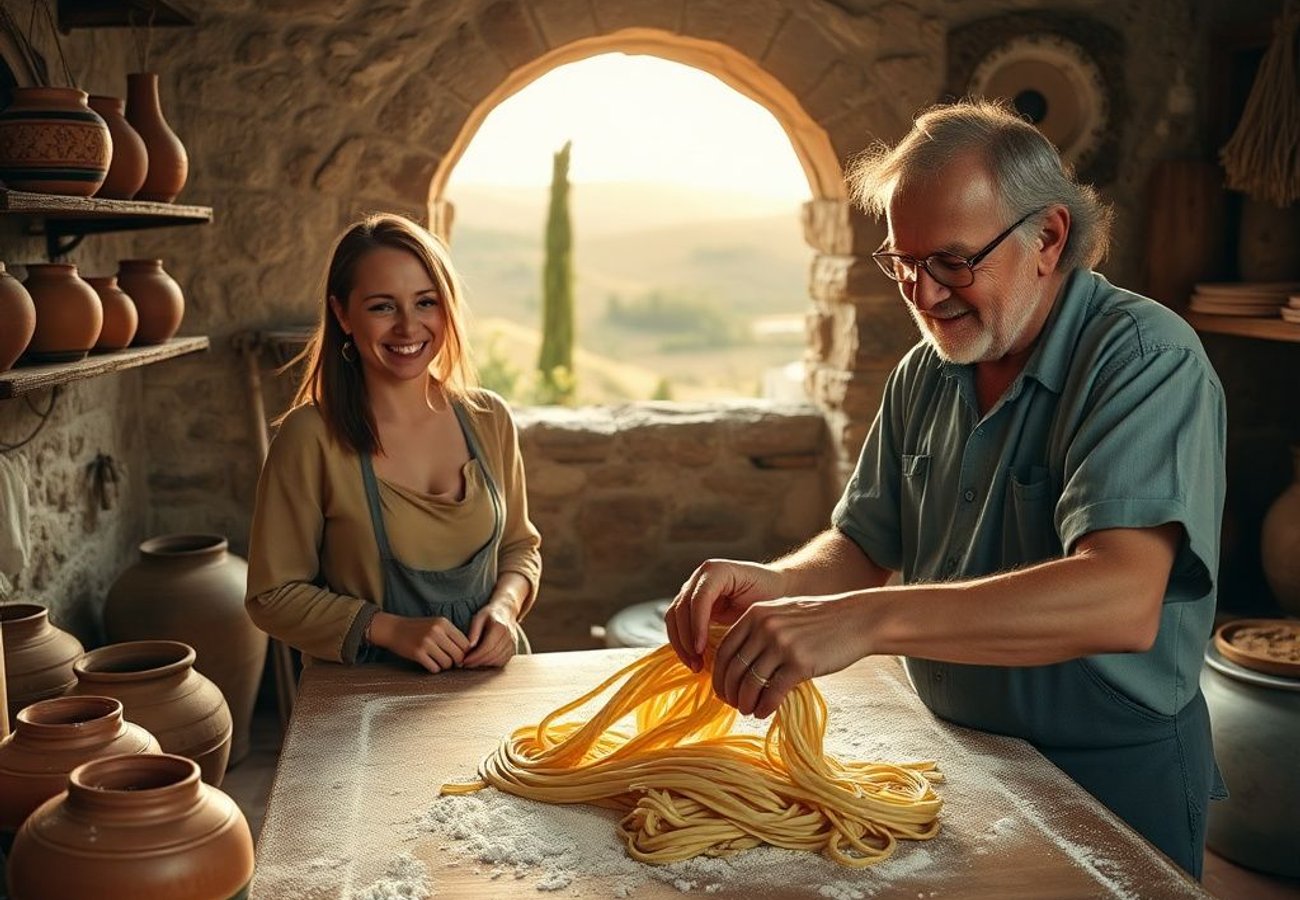
Image generated by AI
In the shadow of Sardinia's volcanic peaks and Tuscany's walled medieval towns, a culinary crisis unfolds in silence. Italian grandmothers—the keepers of centuries-old pasta traditions—are aging without successors. Young people flee villages for cities. Ancient recipes face extinction.
Yet in kitchens across rural Sardinia and Tuscany, a handful of artisans fight to preserve the world's rarest handmade pastas. These aren't Instagram-friendly carbs. These are living documents of Italian heritage, each strand and twist encoded with family history, spiritual devotion, and near-vanishing folk traditions.
This is where real culinary pilgrimage happens.
The 256-Thread Miracle: Su Filindeu of Nuoro
The morning light cuts through Raffaella Marongiu's kitchen in Nuoro—the "Athens of Sardinia"—and lands on a ball of dough destined for the impossible.
Su filindeu. "Threads of God."
This isn't pasta. It's an act of defiance against time itself.
Marongiu and her aunt begin the ritual that takes months each year. Two hands. One motion. Repeated eight times without breaking the dough. Then comes the architecture: 256 ultra-thin strands—arranged in three perfect layers—laid across a basket woven from asphodel plant fiber that covers the Supramonte Mountains. Hours pass. The dough dries into an intricate lattice so delicate it looks like sacred lace.
Only then does it get blessed.
Reddit: "I spent three hours watching a Sardinian nonna make su filindeu. My brain couldn't process how those hands moved. It felt like watching magic." — r/travel
The tradition traces to 17th-century bandit Francesco Tolu. Wrongly accused of murder, Tolu prayed to St. Francis for salvation. When his innocence emerged, he built a church—and kept his vow to guard it forever. Today, su filindeu is served exactly twice yearly: May 1 and October 4, only to pilgrims who trek 20 miles on foot (some barefoot as spiritual practice) or horseback in an overnight journey from Nuoro to the Sanctuary of St. Francesco in nearby Lula.
Eight hours of devotion. For a bowl of pasta in mutton broth.
"Everyone in the village used to help make su filindeu, but only a handful of women still know how," Marongiu tells visitors, showing a black-and-white photograph of herself as a girl beside her father—chosen 60 years ago as the honorary prior, the designated keeper of the tradition.
The connection runs deeper. At the Church of the Madonna della Solitudine in Nuoro, next to the tomb of Grazia Deledda—the 1926 Nobel Laureate whose novel Elias Portolu celebrates this very pilgrimage—villagers leave asphodel tubers. Food for the dead. Continuity across centuries.
Deledda wrote: "As a custodian of this tradition that has been passed down from mother to daughter ... I remain hopeful that one of them will one day take it on. But if they can't, then I will be sad."
Where to stay: Exoria Luxury Rooms & Spa sits steps from Deledda's childhood home, now a museum.
The Wedding Ring Pasta: Lorighittas of Morgongiori
On the slopes of the dormant Mount Arci volcano, 800 residents of Morgongiori hold another vanishing secret: lorighittas—hand-braided, ring-shaped pasta born from a king's horsewear.
In the 1500s, when King Ferdinand II of Aragon ruled Sardinia, iron rings ("lorigas") held his horses steady. Village pasta makers reimagined those rings in dough—a symbol that twisted loop-work into edible legend.
Chiara Massa, now 28, learned the technique as a child. Local folklore warned girls that the witch "Maria Pungi Pungi" would stab the bellies of children who ate too much lorighittas. But Massa wasn't deterred. Unlike peers who hoped the pasta would magically summon marriage proposals, she embraced her family's craft.
Today she runs Il Grano D'oro ("Golden Grain"), the only company still producing authentic lorighittas. Her parents launched it in 2000. Now, with two aunts, Massa oversees women who loop and twist dough—semolina, warm water, salt—around three fingers into thousands of lasso-shaped rings, lined up to slow-dry.
The Slow Food Foundation lists lorighittas in its Ark of Taste—a catalog of near-extinct endangered foods.
"Thanks to the company, now more people know that lorighittas exist," Massa says. "I want to keep the tradition of Morgongiori alive."
Lorighittas surface twice yearly: the Festival of Lorighittas (first Sunday of August) and All Saints' Day (November 1), served traditionally in chicken broth.
Where to stay: Sardegna Termale Hotel & Spa offers geothermal hot spring pools after hiking Monte Arci Regional Natural Park and touring the Living Museum of Textile Art, showcasing 18th-century hand-woven tapestries from Morgongiori itself.
The Dove and Rooster: Crogoristas and Caombus of Masullas
In Masullas, a village where ancient recipes nearly died, Giorgio Grussu—now 86—became an unlikely guardian.
He's the only man among Sardinian women preserving vanishing pasta traditions. For years, he refused to share his secrets. When his restaurant closed, he initially resisted teaching even a neighbor. But the weight of cultural extinction changed him.
Grussu now teaches crogoristas—rooster-shaped pasta infused with saffron—and caombus—dove-shaped pasta symbolizing peace and divine intervention, served around a nesting egg yolk in dill.
The symbolism matters. Doves released by medieval bishops now honor spiritual lineage through broth. Roosters crow through dimensioned dough. Food becomes theology.
"This pasta almost disappeared," explains Simonetta Bazzu, a cultural preservationist who teaches traditional methods at her school, Vittoria Arimani. "He is the only one who has kept its memory alive."
Grussu's decision to share—at 86, tears streaming down his face—represents a turning point. Not victory. A reprieve.
The UNESCO Seal and the Crisis
Italy's cuisine was recently recognized as the first UNESCO-designated national cuisine, elevating food traditions to global cultural significance. Yet recognition without active transmission means nothing. These pastas require hands. Living hands. Hands willing to spend months crafting what tourists consume in minutes.
Across both regions, the pattern repeats: aging artisans, absent youth, recipe extinction. Simonetta Bazzu and others work tirelessly—offering culinary classes, documenting techniques, inviting travelers into kitchens—but time compresses.
This is travel with stakes.
When you visit Sardinia or Tuscany, seek out regional food experiences that support living artisans. Eat su filindeu on pilgrimage days. Attend the lorighittas festival. Sit in Grussu's kitchen. These aren't tourist performances; they're acts of cultural resuscitation.
The nonnas won't be here forever. Neither will these pastas—unless you help keep them alive by bearing witness.
Where flour, salt, and water become immortality.
Related Travel Guides
Disclaimer
This article is for informational and educational purposes only. It does not constitute legal, financial, or professional advice. While we strive to provide accurate and up-to-date information, travel policies, regulations, and conditions change rapidly. Always verify information with official sources before making travel decisions. Nomad Lawyer makes no representations about the accuracy, reliability, completeness, or suitability of the information provided. Readers should consult qualified professionals for advice specific to their circumstances. The views expressed in this article are those of the author and do not necessarily reflect the views of Nomad Lawyer.
Raushan Kumar
Founder & Lead Developer
Full-stack developer with 11+ years of experience and a passionate traveller. Raushan built Nomad Lawyer from the ground up with a vision to create the best travel and law experience on the web.
Learn more about our team →