
From Italian Alcatraz to Mediterranean Paradise: How Asinara Island Became Europe's Most Haunting National Park in 2026
Once a brutal prison island housing mafia bosses and war prisoners, Asinara has transformed into a pristine Mediterranean sanctuary where nature reclaims its borders and rare albino donkeys roam free.

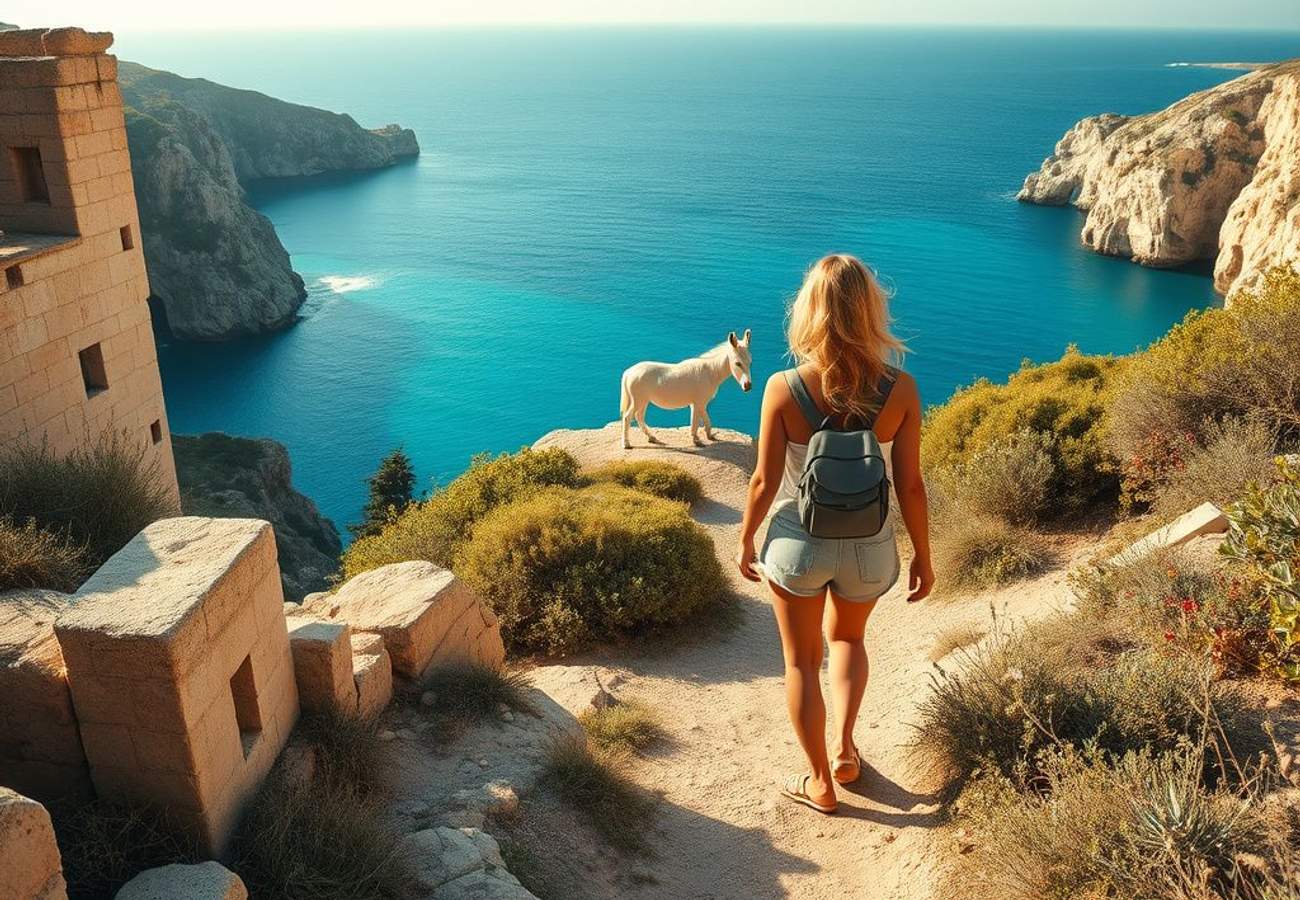
Image generated by AI
The Island That Held Italy's Darkest Secrets
When freediver Alessandro Masala first submerged himself in the waters surrounding Asinara Island in the early 2000s, he immediately sensed something extraordinary. "It was clear to me that there's no place in Sardinia like it—in fact, only a few spots in the whole Mediterranean can claim such a level of environmental integrity," he recalls.
But what makes Asinara truly unique isn't just its pristine marine ecosystem. It's what the island had to endure—and survive—to become the nature sanctuary it is today.
For over 100 years, this remote slice of the western Mediterranean off Sardinia's coast functioned as Europe's most infamous prison compound. Concentration camps. War internment camps. Maximum-security cells holding mafia bosses and Italian far-left militants. An "Italian Alcatraz" where thousands died and political prisoners vanished from public memory.
Then, in 1997, the gates closed forever. And something remarkable happened: nature came roaring back.
When 500 People Were Forcibly Erased
The transformation of Asinara began not with violence, but with bureaucracy.
In 1885, as Mediterranean maritime trade intensified, the Italian government needed an isolated quarantine station. A place where ships arriving from distant continents could be inspected for infectious diseases before docking at Italian ports. They chose Asinara.
What they didn't choose—the people there had no say—was exile.
Authorities evicted approximately 500 residents of Sardinian and Ligurian origin. An entire population was removed from their ancestral home. In their place, a brand-new village called Stintino was hastily constructed on the Sardinian mainland to house the displaced families.
Masala knows this history intimately. "My grandparents were among the families kicked out of their homes to set up the first quarantine station in the Kingdom of Italy," he explains. "It was an exodus in the true sense of the word. By the time the national park was established, the asinaresi (Asinara people) no longer existed."
The quarantine station building, Stazione Sanitaria Marittima, still stands today alongside Palazzo Cala Reale, the former summer residence of Italy's royals, now the park headquarters.
War, Plague, and Mass Death
By 1915, Asinara's transformation from quarantine post to nightmare was complete.
The island received 24,000 Austro-Hungarian war prisoners, transported from the Balkans during World War I. The infrastructure was woefully inadequate. Within months, a catastrophic cholera outbreak swept through the camps.
Roughly 7,000 prisoners—nearly a third of the arrivals—died within months. Their bodies lay unburied for weeks due to a lack of digging tools.
Reddit: "That's genuinely one of the most heartbreaking facts I've read about WWI. 7,000 people essentially forgotten on an island." — r/history
The Austro-Hungarian Ossuary, a monumental cross-shaped structure built in 1936, now collects the remains extracted from those mass graves. A chapel built by the surviving prisoners still stands, its stained glass windows painted by artist István Szász, a haunting testament to human resilience amid unimaginable suffering.
Fascism, Colonial Crimes, and a Princess's Tragedy
The violence didn't end with World War I. It evolved.
In 1937, following an assassination attempt on Italy's Viceroy of Ethiopia Rodolfo Graziani, Mussolini ordered a purge that would become the infamous Addis Ababa massacre. Thousands died, including innocent monks and pilgrims.
But some prisoners were spared death—only to be deported to Asinara.
Among 300 members of the Ethiopian elite sent to the island for "sanitary observation and disinfection" was Princess Romanework, eldest daughter of Ethiopian Emperor Haile Selassie. In 1937, her two-year-old son, Gideon, died in Cala Reale.
One child's death among thousands. One story among countless silenced voices.
The Maximum-Security Years: Where Mafia Bosses Disappeared
Post-war discussions about converting Asinara into a national park began circulating. Then came another national emergency.
Starting in 1971, Italy revived Asinara's isolation tactics—this time targeting the growing influence of mafia organizations and, later, leaders of the Red Brigades, the far-left militant organization active from 1970 to 1988.
The extreme conditions were designed to cut all external communication, yet criminal networks somehow maintained contact with the outside world. The island's final chapter as a maximum-security prison began in 1985, when judges Giovanni Falcone and Paolo Borsellino drafted the Maxiprocesso indictment—the largest and most significant trial against organized crime in Italian history.
Both judges would be assassinated in 1992 by the very criminals they prosecuted. Asinara became the epicenter of the new Article 41-bis "hard prison" system, a regime of complete isolation designed specifically for mafia bosses, including Salvatore Riina, the architect of Sicily's bloodiest decades.
Only one prisoner ever escaped. Matteo Boe, a Sardinian inmate, jumped onto a speedboat driven by accomplices in 1986. One man. Out of thousands.
The Accidental Eden
When the prison finally closed in 1997, Asinara was immediately designated a national park. But its real transformation had been happening quietly for decades.
The prison's restricted access inadvertently created one of the most biodiverse marine areas in the Mediterranean. No mass tourism. No industrial fishing. Just nature, reclaiming what had been stolen from it.
Today, the Asinara donkey—a rare breed of albino donkey indigenous to the island and now at risk of extinction—roams freely among the ruins of former prison buildings and juniper bushes. Wild horses graze where guards once patrolled.
Masala, who now runs the Cala d'Oliva Diving Center, describes the underwater world in terms of wonder: "At a depth of just 10 meters, you can find an incredible number of fish. When we go snorkeling, we can see barracudas, sea breams, groupers—the richness of the seabed, the flora is absolutely stunning."
In 2023, during one dive, Masala rediscovered a shipwreck lost for 80 years: the Sogliola, an Italian Royal Navy vessel sunk by a British submarine in 1943 during World War II.
"The shipwreck shows exactly how nature has reclaimed its space," Masala reflects. "There is this beautiful duality—untouched by humans, the shipwreck has acted as a magnet, evolving until it has become something entirely alive."
How to Visit the Haunting Sanctuary
Asinara remains accessible, yet still remote. Delcomar ferries depart daily from Porto Torres during high season (May to September) and three times weekly (Tuesday, Friday, Sunday) during low season, allowing a full day of exploration.
There's also a 20-minute ferry from Stintino to Fornelli at the island's southern tip. Most visitors spend a day hiking the rugged terrain, visiting the abandoned prison structures, snorkeling in pristine waters, and encountering the island's famous albino donkeys.
Bring sturdy walking shoes. Bring water. And bring an appreciation for places where history and redemption collide.
From chambers of isolation to chambers of wonder—Asinara reminds us that even the darkest corners of human history can transform into sanctuaries of natural grace.
Related Travel Guides
Disclaimer
This article is for informational and educational purposes only. It does not constitute legal, financial, or professional advice. While we strive to provide accurate and up-to-date information, travel policies, regulations, and conditions change rapidly. Always verify information with official sources before making travel decisions. Nomad Lawyer makes no representations about the accuracy, reliability, completeness, or suitability of the information provided. Readers should consult qualified professionals for advice specific to their circumstances. The views expressed in this article are those of the author and do not necessarily reflect the views of Nomad Lawyer.
Preeti Gunjan
Contributor & Community Manager
A passionate traveller and community builder. Preeti helps grow the Nomad Lawyer community, fostering engagement and bringing the reader experience to life.
Learn more about our team →