
Queensland Rail ETCS Level 2 Launch Marks New Digital Era For Brisbane Trains Ahead Of 2032 Games
Queensland Rail ETCS Level 2 Launch Marks New Digital Era For Brisbane Trains Ahead Of 2032 Games

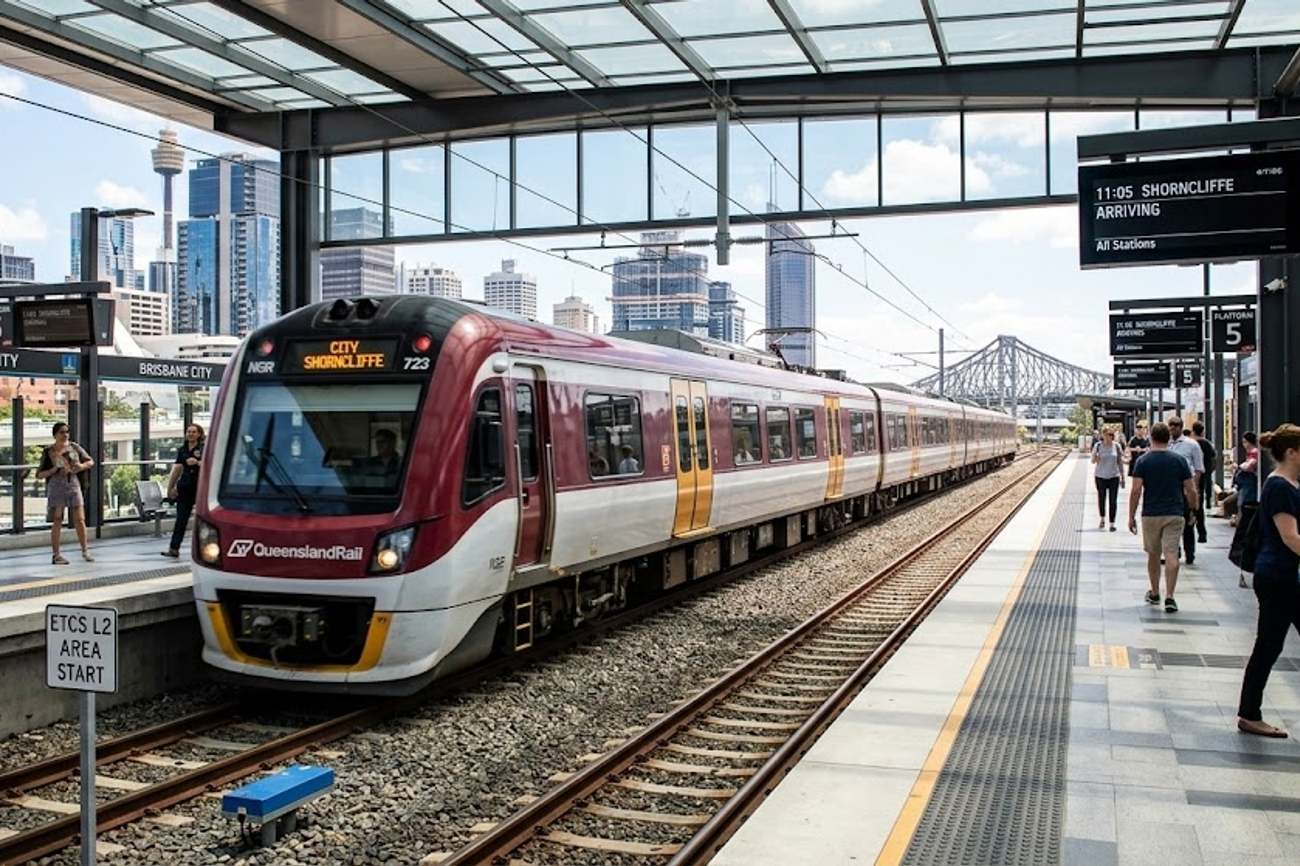
Image generated by AI
The transition from traditional fixed-block signaling to digital ETCS Level 2 in South East Queensland marks a pivot from manual safety margins to real-time data optimization, a shift that historically increases line capacity by up to 20-30% in similar European deployments. While the immediate passenger experience on the Shorncliffe line remains unchanged, the backend shift from trackside signals to continuous digital communication represents the first structural step in preparing Brisbane's transit architecture for the massive surge in demand expected for the 2032 Olympic and Paralympic Games.
The Digital Shift in Numbers: ETCS Level 2 Implementation
In September 2026, Queensland Rail transitioned the European Train Control System (ETCS) Level 2 from a testing phase into active revenue passenger service. The initial deployment is concentrated on the Northgate–Shorncliffe corridor, where trains now operate as shuttle services. This specific pilot was selected to provide a controlled environment for validating the system's ability to exchange real-time data—including precise train location, speed, and direction—directly with the Rail Management Centre.
The technical objective is a complete replacement of conventional signaling. Traditional systems rely on fixed trackside signals that dictate movement based on static blocks of track. In contrast, ETCS Level 2 utilizes a digital dialogue between the train and the control center, allowing for dynamic safety separation. This allows trains to run closer together without compromising safety, effectively increasing the number of slots available per hour on a single line. According to data from the International Union of Railways (UIC), such digital migrations are essential for cities facing population growth and high-density event requirements.
Comparative Context: Legacy Signaling vs. Digital Integration
The deployment in Queensland mirrors a global trend where legacy rail networks are abandoning "fixed-block" logic for "moving-block" or digitally managed capabilities. When comparing the Shorncliffe pilot to traditional rail operations, the primary difference is the removal of reliance on physical signals.
The following table illustrates the operational shift occurring within the South East Queensland (SEQ) network:
| Feature | Legacy Signaling (Pre-2026) | ETCS Level 2 (Current/Future) | Impact on Network |
|---|---|---|---|
| Communication | Fixed trackside signals | Continuous digital data exchange | Reduced human error/signal failure |
| Train Spacing | Static block distances | Dynamic, real-time safety margins | Increased train frequency |
| Data Flow | Driver-observed signals | Direct link to Rail Management Centre | Precise real-time fleet tracking |
| Control Method | Manual/Semi-automated | Digital system-led monitoring | Higher reliability and consistency |
| Capacity | Limited by physical signal placement | Scalable via software and digital blocks | Support for 2032 Games surges |
This regional upgrade is not an isolated event but part of a broader infrastructure synergy involving the Cross River Rail Delivery Authority. By integrating ETCS Level 2 into the Cross River Rail tunnels and extending it to the Gold Coast and Sunshine Coast corridors, Queensland is aligning its rail standards with those found in high-capacity hubs like London or Paris. Data from the International Association of Public Transport (UITP) indicates that cities implementing these standards see a marked improvement in "on-time performance" (OTP) due to the reduction of signal-related bottlenecks.
What This Means for Travelers
For the individual traveler, the ETCS Level 2 rollout is an "invisible" upgrade. You will not see new seats or faster top speeds; instead, the value is realized through systemic reliability.
If you are commuting within South East Queensland or planning a visit during the lead-up to 2032, here is how this data translates into your travel experience:
- Increased Frequency: As the rollout expands from the Shorncliffe line to the Gold Coast and Sunshine Coast corridors, expect shorter wait times between trains. The ability to run more services on the same tracks means the "peak hour crush" should theoretically diminish.
- Reduced Cascading Delays: In traditional systems, one signal failure can freeze an entire line. Digital signaling allows for more flexible rerouting and faster recovery from incidents, meaning a delay at one station is less likely to paralyze the entire network.
- Booking and Planning: For those visiting Brisbane in the late 2020s, the integration of ETCS with Cross River Rail will make rail the primary viable option for cross-city transit. Travelers should prioritize rail over ride-sharing during major events, as the digital capacity will far exceed road throughput.
Forward Projection: The Road to Brisbane 2032
The current trajectory suggests that the Shorncliffe pilot is the "proof of concept" for a network-wide digital overhaul. The Sequence Alliance—comprising the Queensland Department of Transport and Main Roads, Queensland Rail, Hitachi Rail, and the Cross River Rail Delivery Authority—is building a foundation that can scale.
The next 6 years will likely see a phased expansion. We can project that the Gold Coast and Sunshine Coast lines will be the next priority zones, as these are the primary arteries for international visitors. By 2030, the goal will be a fully integrated digital corridor from the coastlines through the Cross River Rail tunnels. This ensures that when the 2032 Games arrive, the city can handle the "spike demand"—the sudden influx of millions of passengers—without the systemic collapse often seen in cities relying on 20th-century signaling.
The long-term data trend indicates that Queensland is moving toward a "Smart City" transit model. This digital signaling is the prerequisite for future automation; once a network is fully ETCS Level 2 compliant, the transition to higher levels of automation (GoA) becomes a software update rather than a multi-billion dollar hardware rebuild. For the nomad lawyer or the frequent business traveler, this means Brisbane is positioning itself as a top-tier global hub with transit reliability that matches Singapore or Tokyo.
FAQ: Queensland Rail Digital Signaling 2026
Will train ticket prices increase because of the ETCS Level 2 upgrade? There is no data suggesting a direct fare increase linked to signaling. These upgrades are typically funded as capital infrastructure projects to improve efficiency and safety, rather than as service add-ons that would be passed to the consumer via ticket pricing.
Is the Shorncliffe line the only place where this is happening? No. While the Northgate–Shorncliffe corridor is the first to enter revenue service in September 2026, contracts are already in place to expand the technology to the Gold Coast and Sunshine Coast lines and the Cross River Rail tunnels.
Will I notice a difference in the train's speed? Not directly. ETCS Level 2 focuses on the frequency and safety of trains rather than increasing the maximum speed of the rolling stock. The "speed" improvement is felt in the reduction of waiting times and more consistent scheduling.
Which companies are responsible for the technology? The rollout is managed by the Sequence Alliance, with Hitachi Rail specifically providing the signaling technology delivery, supported by Queensland Rail and the Department of Transport and Main Roads.
Digital rails are the silent engine of urban scalability, turning a city's transit from a bottleneck into a competitive advantage.
Tags: Queensland Rail ETCS Level 2, Brisbane 2032 Transport, SEQ Rail Capacity 2026, Hitachi Rail Australia, Digital Signaling Migration
Related Travel Guides
- Assam Gohpur Numaligarh Underwater Tunnel Set To Rewrite Northeast India Travel With A New Brahmaputra Gateway
- JR East GREEN×EXPO 2027 Shinkansen Launch Creates A New Japan Rail Travel Experience Across Major Cities
- Uzbekistan Travel Revolution Begins As First China To Iran Block Train Opens Historic Eurasian Rail Gateway
Disclaimer
This article is for informational and educational purposes only. It does not constitute legal, financial, or professional advice. While we strive to provide accurate and up-to-date information, travel policies, regulations, and conditions change rapidly. Always verify information with official sources before making travel decisions. Nomad Lawyer makes no representations about the accuracy, reliability, completeness, or suitability of the information provided. Readers should consult qualified professionals for advice specific to their circumstances. The views expressed in this article are those of the author and do not necessarily reflect the views of Nomad Lawyer.
Kunal K Choudhary
Co-Founder & Contributor
A passionate traveller and tech enthusiast. Kunal contributes to the vision and growth of Nomad Lawyer, bringing fresh perspectives and driving the community forward.
Learn more about our team →