
Uzbekistan Travel Revolution Begins As First China To Iran Block Train Opens Historic Eurasian Rail Gateway

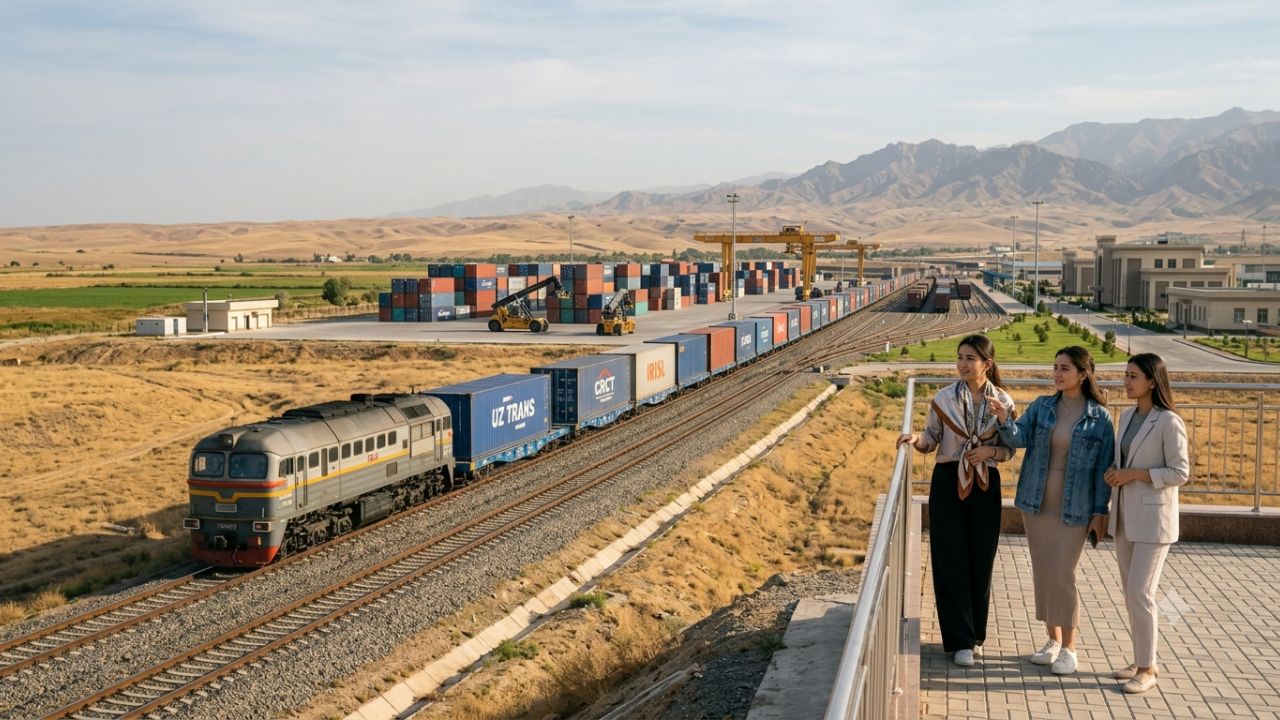
Uzbekistan is entering a transformative era of Eurasian travel and trade connectivity as the first China-to-Iran block train traverses its national rail network, establishing a landmark 6,000-kilometre overland freight gateway that seamlessly connects major commercial hubs across East Asia, Central Asia, and the Middle East in just 14 to 16 days.
The maiden departure marks a critical milestone in establishing dependable, high-speed overland alternatives to traditional maritime shipping channels. By bypassing congested sea routes and mitigating geopolitical vulnerabilities associated with maritime bottlenecks such as the Strait of Hormuz, this new railway freight corridor accelerates door-to-door transit schedules while cementing Uzbekistan’s strategic position as the primary logistics bridge of Central Asia.
Operational Milestone: Launch of the 6,000 km China-Central Asia-Iran Freight Corridor
The inaugural container service initiated its cross-continental journey from Chengxiang Station in China, proceeding directly toward the western border. Upon reaching the pivotal Khorgos-Altynkol border crossing, cargo was efficiently transferred onto Kazakhstan's national railway system. The train officially departed Altynkol Station on September 7, 2026, commencing its high-speed transit through Central Asia.
Traversing Kazakhstan, Uzbekistan, and Turkmenistan, the block train terminates at the Sarakhs border crossing with Iran. This direct rail link bridges distinct economic zones, demonstrating how coordinated rail operations across four sovereign nations can streamline cross-border logistics and provide stable supply chain continuity for industrial manufacturing and regional commerce.
For more information on regional connectivity and trade standards, visit the Organization for Economic Co-operation and Development (OECD) to explore Central Asian economic development.
| Corridor Parameter | Operational Metric & Specification |
|---|---|
| Total Route Length | Exceeds 6,000 kilometres |
| Door-to-Door Transit Time | 14 to 16 days |
| Origin Terminal | Chengxiang Station, China |
| Primary Transshipment Hub | Khorgos-Altynkol Border Crossing |
| Kazakhstan Transit Departure | Altynkol Station (September 7, 2026) |
| Intermediate Transit Nations | Kazakhstan, Uzbekistan, Turkmenistan |
| Destination Gateway | Sarakhs Border Crossing, Iran |
| Primary Route Advantage | Bypasses maritime transit via the Strait of Hormuz |
Strategic Positioning: Uzbekistan as the Central Logistics Hub of Eurasia
Situated at the geographic heart of Central Asia, Uzbekistan has systematically scaled its national transport infrastructure to transform landlocked geography into a competitive trade advantage. Modern railway corridors radiating from Tashkent connect China, Central Asia, Afghanistan, Iran, and broader European markets.
The introduction of scheduled block train services along the China-Central Asia-Iran corridor expands containerized freight capacity while providing international shippers with reliable schedules. As global supply chains prioritize flexibility and localized resilience, Uzbekistan’s expanding rail network offers an efficient alternative to traditional maritime shipping lines.
Global Multimodal Freight Trials & Expanding Intermodal Connections
Uzbekistan’s national logistics authorities have successfully completed several high-profile intermodal freight trials, proving the operational feasibility of complex multi-country corridors:
Travelers planning to visit the region can find official visa requirements and tourism guides via the Uzbekistan Tourism Committee.
- Malaysia-to-Tajikistan Palm Oil Transit: A 32-day multimodal shipping initiative combined maritime transport from Southeast Asia with rail delivery through Uzbekistan into landlocked Tajikistan.
- United States-to-Kazakhstan Trans-Pacific Rail Link: Cargo dispatched from the U.S. entered Asia via the Port of Qingdao in eastern China before transferring onto transcontinental rail lines heading to Almaty, Kazakhstan.
These intermodal benchmarks demonstrate how integrated logistics networks can connect disjointed trade corridors across North America, Southeast Asia, and Central Asia through Uzbekistan’s railway system.
Infrastructure Investment: Uztemiryulkonteyner’s Fleet Expansion Plan
To accommodate accelerating freight volumes generated by new Eurasian rail connections, Uzbekistan's primary container operator, Uztemiryulkonteyner (operating since 2002), is aggressively expanding its rolling stock and intermodal equipment fleet.
To understand the broader framework of Eurasian transport corridors, refer to the United Nations Economic Commission for Europe (UNECE) regarding international transport agreements.
Uztemiryulkonteyner has integrated 250 newly manufactured 40-foot high-cube containers into active service, primarily serving heavy-traffic routes linked with Chinese industrial centers. Designed for high-volume cargo loads, high-cube containers significantly boost transport efficiency per train departure.
This equipment acquisition forms part of Uztemiryulkonteyner’s comprehensive 2025–2030 corporate development strategy. Under this blueprint, the company will acquire over 1,000 modern, large-capacity containers over the next five years. Supported by a nationwide network of more than 20 specialized logistics centers, Uzbekistan is building the technical capacity required to sustain its growing role as Eurasia’s premier rail transit hub.
FAQ: Uzbekistan Travel Revolution Begins As 2026
How long does the new China-to-Iran rail route take? The new 6,000-kilometre overland freight gateway significantly reduces transit times, with door-to-door delivery now taking between 14 to 16 days.
Which countries does the China-Central Asia-Iran block train pass through? The rail corridor traverses four sovereign nations: China, Kazakhstan, Uzbekistan, and Turkmenistan, before terminating at the Sarakhs border crossing in Iran.
Why is this rail corridor better than maritime shipping? This route provides a high-speed alternative to sea freight, bypassing congested maritime bottlenecks and geopolitical vulnerabilities associated with the Strait of Hormuz.
Does this new rail link affect passenger travel in Uzbekistan? While this specific milestone focuses on block train freight, the expansion of rail infrastructure generally enhances Uzbekistan's connectivity and logistics capacity for all Eurasian travel.
Related Travel Guides
Disclaimer
This article is for informational and educational purposes only. It does not constitute legal, financial, or professional advice. While we strive to provide accurate and up-to-date information, travel policies, regulations, and conditions change rapidly. Always verify information with official sources before making travel decisions. Nomad Lawyer makes no representations about the accuracy, reliability, completeness, or suitability of the information provided. Readers should consult qualified professionals for advice specific to their circumstances. The views expressed in this article are those of the author and do not necessarily reflect the views of Nomad Lawyer.
Raushan Kumar
Founder & Lead Developer
Full-stack developer with 11+ years of experience and a passionate traveller. Raushan built Nomad Lawyer from the ground up with a vision to create the best travel and law experience on the web.
Learn more about our team →