Southern Hemisphere Ultra-Long-Haul Flights: Qantas, Air NZ, and LATAM Guide 2027


For nearly a century, traveling between Australia, Southern Africa, and South America required an exhausting 25-to-30-hour detour through equatorial hubs in Singapore or Dubai—yet advanced twin-engine widebodies and polar navigation are now establishing direct southern corridors that shave up to eight hours off round-trip journeys. By leveraging composite airframes, extended twin-engine operational standards (ETOPS), and fuel-efficient turbofans, carriers like Qantas, Air New Zealand, Fiji Airways, and LATAM Airlines are connecting southern continents across the Southern Ocean and South Pacific.
These corridors bypass congested transfer hubs in the Middle East and Southeast Asia, inaugurating an era of point-to-point southern transoceanic mobility.
The Southern Transoceanic Revolution: Bypassing Northern Megahubs
Passenger transport across the southern hemisphere was long constrained by aircraft range and safety rules over freezing, remote waters. Crossing from Sydney to Santiago or Johannesburg required multi-stage itineraries with lengthy stopovers in northern hubs.
Modern widebodies like the Boeing 787-9 and Airbus A350 have rewritten these operational rules. Powered by Rolls-Royce Trent XWB-97 turbofans, twin-engine jets achieve extended stage lengths while consuming far less fuel per seat than four-engine Boeing 747s.
Qantas will launch the first nonstop passenger link between Australia and South Africa’s Western Cape Province in October 2027. Operating three times weekly on Boeing 787-9 Dreamliners, the Sydney (SYD) to Cape Town (CPT) route bypasses domestic transfers in Johannesburg. Negotiated between Australia's DITRDCA and South Africa's Department of Transport, the route supports South Africa’s goal of 15 million annual international visitors by 2030, coordinated through Cape Town Air Access and Wesgro. Official travel planning is available through Tourism Australia.
Project Sunrise and Deep Southern Polar Navigation
Qantas is advancing non-stop connectivity through its Project Sunrise initiative. Between late 2027 and mid-2028, Qantas will launch non-stop flights linking Sydney and Melbourne with London and New York, operating continuous sectors of 18 to 20 hours.
Qantas selected a custom Airbus A350-1000ULR fitted with an additional rear center fuel tank and a low-density 238-seat configuration, dedicating over 40 percent of cabin space to premium suites. An open-access Wellbeing Zone provides hydration stations, stretching facilities, and circadian lighting.
Operating flights exceeding 18 continuous hours required regulatory overhaul. Australia’s Civil Aviation Safety Authority (CASA) regulates these operations under the Civil Aviation Act 1988. CASA mandated a Fatigue Risk Management System (FRMS) using biomathematical modeling, EEG brainwave monitoring, and circadian hormone tracking, scheduling four pilots across alternating rest shifts. Safety rules are detailed via the Civil Aviation Safety Authority of Australia.
Across the South Pacific, LATAM Airlines flies Boeing 787-9s between Santiago (SCL), Sydney (SYD), and Auckland (AKL) near the Antarctic Circle under ETOPS 330, managing sub-zero fuel temperatures and cosmic radiation, backed by Chilean JAC and Australian BITRE traffic data.
Leading Southern Hemisphere Corridors: Route, Fleet, and Traveler Experience
The table below details five pioneering Southern Hemisphere air corridors, outlining operating carriers, aircraft types, projected launch windows, and primary traveler advantages.
| Operational Corridor | Operating Carrier | Aircraft Type | Projected Service Window | Strategic Passenger Benefit |
|---|---|---|---|---|
| Sydney (SYD) ⇄ Cape Town (CPT) | Qantas | Boeing 787-9 Dreamliner | October 2027 | First direct link to Western Cape (3x weekly seasonal); skips Johannesburg transfer |
| Sydney / Melbourne ⇄ London / NY | Qantas | Airbus A350-1000ULR | Late 2027 – Mid-2028 | Project Sunrise 18–20 hour nonstop flights with dedicated Wellbeing Zone |
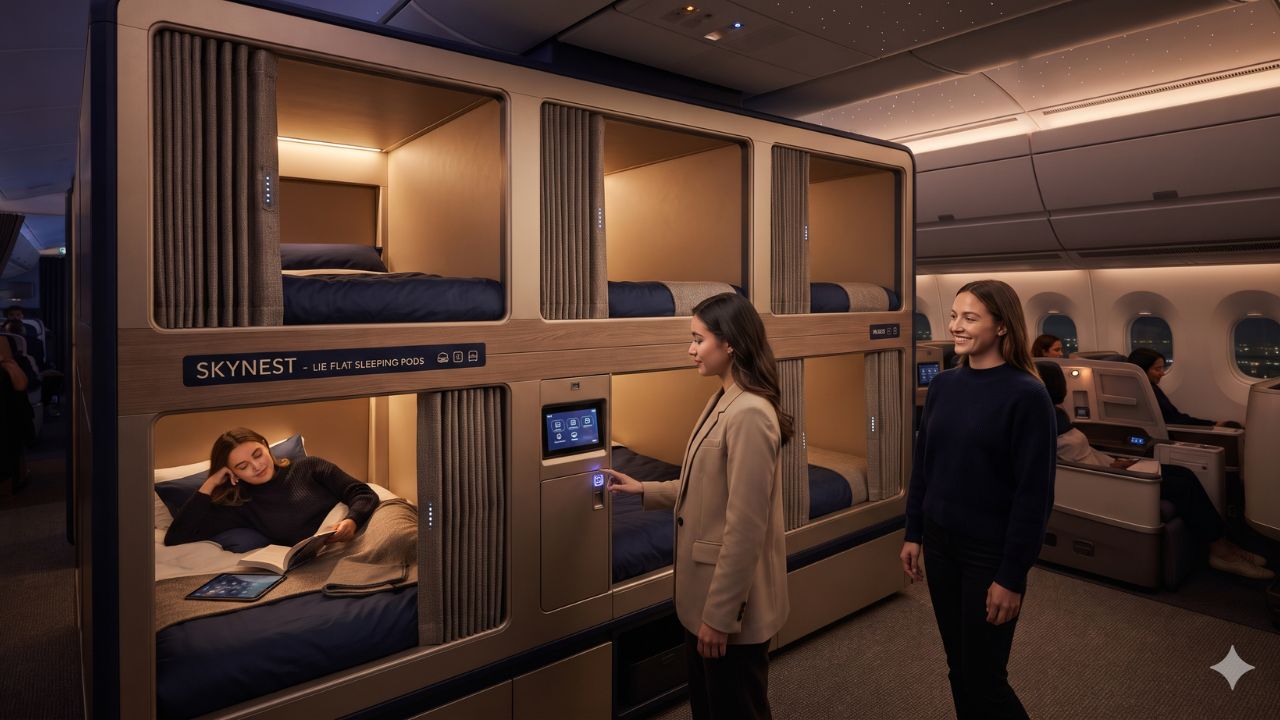
| Auckland (AKL) ⇄ Americas / Asia | Air New Zealand | Boeing 787-9 (Custom) | 2027–2028 | Deployment of Skynest modular six-berth lie-flat sleeping pods in economy |
| Nadi (NAN) ⇄ North America / Pacific | Fiji Airways | Airbus A350-900 | 2027–2028 | Strategic mid-Pacific hub linking Australasia to Dallas Fort Worth (DFW) |
| Santiago (SCL) ⇄ Sydney / Auckland | LATAM Airlines | Boeing 787-9 | 2026–2028 | Southern Ocean transpolar routing under ETOPS 330, bypassing North America |
Visitor Insider Tips: Mastering Southern Hemisphere Marathon Flights
Travelers preparing for ultra-long southern transoceanic crossings should utilize these practical flight strategies:
- Reserve Timed Sleeping Sessions on Air New Zealand: If booking transpacific flights on Air New Zealand’s retrofitted Boeing 787-9 fleet from Auckland to New York (JFK), Chicago (ORD), or Houston (IAH), reserve four-hour horizontal sleep blocks in the Skynest economy sleeping pod. Certified by the Civil Aviation Authority of New Zealand (CAA NZ) and the US FAA, these berths feature automatic oxygen delivery and private curtains, providing genuine lie-flat rest. Detailed destination guidance is available via Tourism New Zealand.
- Maximize Fiji Airways Mid-Pacific Stopovers: Rather than enduring 15 continuous hours over ocean waters, take advantage of Fiji Airways’ strategic mid-Pacific hub at Nadi International Airport (NAN). Utilizing Airbus A350-900 aircraft connecting Sydney and Auckland with Dallas Fort Worth (DFW), travelers can incorporate a 48-hour tropical stopover in Fiji on oneworld alliance bookings before continuing to North America.
- Pre-Plan Movement in the Qantas Wellbeing Zone: When booking Project Sunrise flights on the Airbus A350-1000ULR, schedule regular visits to the dedicated Wellbeing Zone between cabin meals to complete guided physical stretches and stay properly hydrated at dedicated water stations.
- Prepare for Antarctic Jetstream Turbulence: On LATAM transpolar flights between Santiago and Sydney, expect active high-latitude turbulence over the Southern Ocean. Keep seatbelts fastened throughout the flight and carry warm layers, as polar atmospheric conditions can cool cabin floors.
Cultural and Environmental Context: Indigenous Geographies and Sustainable Aviation Fuel
Southern hemisphere air routes retrace ancient transoceanic navigation corridors, reconnecting indigenous cultures across the Pacific and Indian Oceans. Direct links foster cultural exchange between Maori in Aotearoa New Zealand, Aboriginal and Torres Strait Islander peoples in Australia, indigenous Fijian communities, and southern African populations without mediation by northern hemisphere transit hubs.
From an ecological perspective, ultra-long-haul aviation must align with the International Civil Aviation Organization’s (ICAO) target of net-zero carbon emissions by 2050. Bypassing northern transit hubs saves several flight hours, eliminating the substantial carbon footprint associated with secondary takeoffs and climbs. Concurrently, initiatives like the Australian Jet Zero Council are accelerating domestic production of Sustainable Aviation Fuel (SAF). Airlines including Qantas and Fiji Airways are conducting commercial SAF trials, reducing lifecycle greenhouse emissions while maintaining range capabilities across remote southern waters.
FAQ: Booking Southern Hemisphere Ultra-Long-Haul Routes 2026–2028
When will Qantas begin nonstop flights between Sydney and Cape Town?
Qantas plans to launch seasonal nonstop flights between Sydney Airport (SYD) and Cape Town International Airport (CPT) in October 2027, operating three times weekly on Boeing 787-9 Dreamliners.
What is the flight time for Qantas Project Sunrise flights?
Project Sunrise flights linking Sydney and Melbourne with London and New York will operate continuously for 18 to 20 hours aboard custom Airbus A350-1000ULR aircraft.
How does Air New Zealand Skynest work in economy class?
Skynest is a modular six-berth pod located in the economy cabin of retrofitted Boeing 787-9 aircraft, allowing passengers to book timed horizontal sleeping sessions in lie-flat bunks during transpacific flights.
Which airline provides a mid-Pacific transfer hub to the United States?
Fiji Airways operates an Airbus A350-900 network linking Australian and New Zealand cities through Nadi International Airport directly to Dallas Fort Worth and other North American gateways.
By charting new southern paths across polar skies and vast oceans, modern aviation proves that the quickest path between two distant worlds is a direct line across the bottom of the globe.
Related Travel Guides
This article is for informational purposes. Flight routes, passenger regulations, visa rules, and transit advisories are subject to change by airlines and aviation authorities. Readers are advised to verify schedules and travel documentation with relevant carriers and border agencies before departure.
Related Stories
Air New Zealand and Global Airlines Redesign Mid-Cabin Spaces: Skynest and Premium Economy Guide 2026

Mount Fuji First Sunrise Flights 2027: Japan Airlines New Year Aerial Guide