Air New Zealand and Global Airlines Redesign Mid-Cabin Spaces: Skynest and Premium Economy Guide 2026

While a single intercontinental Business Class suite commands up to eight times the fare of Economy, it is the mid-cabin—where a 9-square-foot Premium Economy seat produces a revenue density ratio of up to 2.2—that generates aviation's highest profit margins. Global carriers are redesigning the spatial territory between economy and business class. Leading this movement, Air New Zealand has introduced its Skynest lie-flat sleep pods, while peer flag carriers Qantas, Singapore Airlines, and Lufthansa deploy rigid micro-cabins and specialized ergonomic shells to capture high-spending international travelers.
This shift marks a structural rethinking of long-haul passenger comfort. Rather than reserving true horizontal rest exclusively for executive suites, airlines are unbundling luxury. On grueling transoceanic corridors connecting the Americas and Europe with Oceania and Southeast Asia, smart cabin architecture lets passengers sleep flat or relax within self-contained shells without paying five-figure fares.
The Premium Economy 2.0 Frontier: Bunks, Shells, and Mid-Cabin Pods
Long-haul cabins historically followed a rigid three-tier division: tightly packed economy rows, slightly wider recliner chairs in premium economy, and sprawling lie-flat suites upfront. Today, surging demand from affluent leisure flyers alongside strict corporate budgets has triggered a fierce design race.
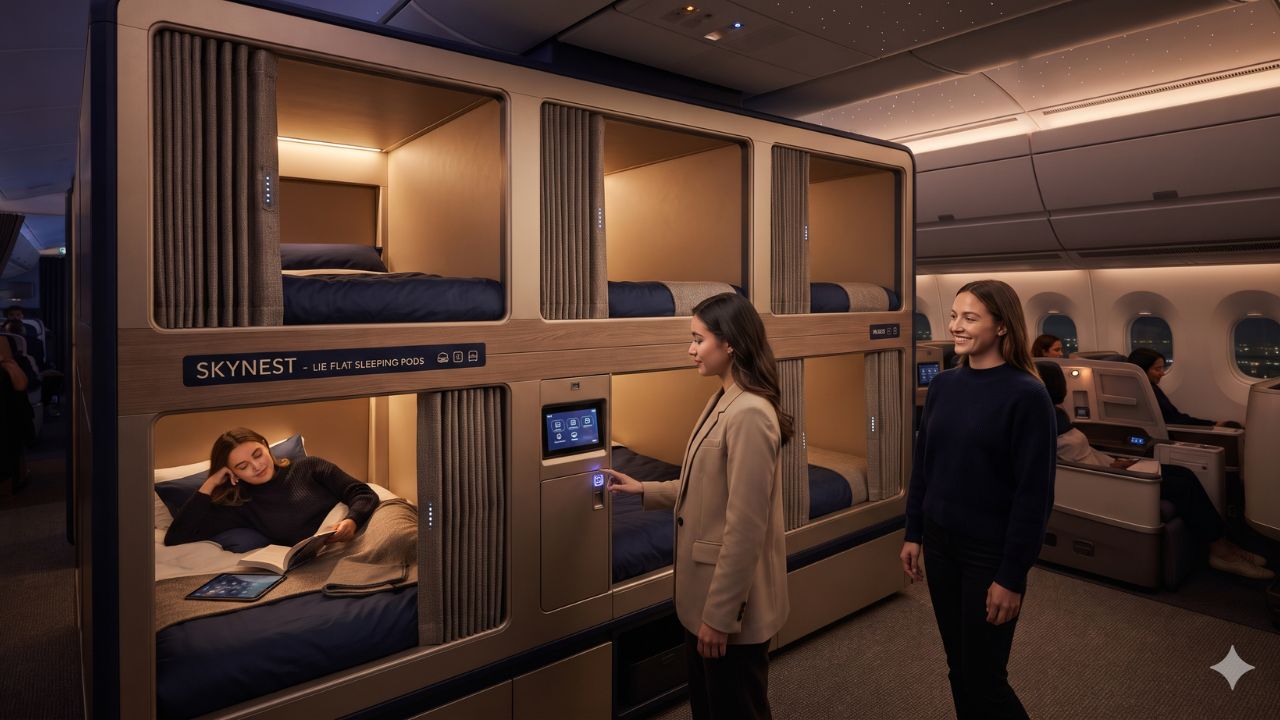
Air New Zealand leads this shift with its modular Skynest installation. Designed for flagship marathon routes like Auckland to New York, the setup places six bunk beds in a stacked two-by-three layout directly within the economy cabin. Instead of purchasing a bunk for an entire flight, passengers book dedicated four-hour sleep sessions during cruising phases. Full booking details and service specifications are accessible via the Air New Zealand Economy Skynest Portal.
Across the Tasman, Qantas is engineering dedicated cabins for its Project Sunrise nonstop routes connecting Sydney and Melbourne with London and New York. On flights exceeding 17 continuous hours, physical fatigue requires technical intervention. Qantas pairs deep-cradle seat ergonomics and articulated leg rests with 4K high-definition seatback monitors and Bluetooth audio pairing, allowing travelers to sync their personal noise-cancelling headphones directly without tangled cables.
In Southeast Asia, Singapore Airlines has reconfigured its ultra-long-haul Airbus A350-900ULR aircraft into premium-heavy configurations. Its mid-cabin seats incorporate hard-shell outer perimeters, ensuring that reclining seats move entirely within an internal frame without encroaching on rear passengers. Meanwhile, Lufthansa Allegris retrofits introduce fixed-back shell seating paired with individual micro-zone temperature controls and wireless device charging pads.
What Makes Ultra-Long-Haul Mid-Cabin Travel Different
Boarding an ultra-long-haul flight to the South Pacific tests physical stamina. Crossing twelve or more time zones between New York or London and Auckland inflicts severe circadian disruption. Traditional economy seating forces travelers upright for 16 to 18 hours, resulting in leg swelling, back stiffness, and persistent jet lag that can drain the opening days of a holiday.
Mid-cabin innovations directly address this physical strain. Reserving a four-hour block in a fully flat Skynest bunk enables restorative sleep cycles at 35,000 feet. Waking rested allows travelers to hit the ground running upon arrival in New Zealand, whether hiking Tongariro National Park or touring Waiheke Island vineyards highlighted by Tourism New Zealand.
Similarly, crossing the Australian continent on 17-hour nonstop services promoted by Tourism Australia feels manageable when ergonomic calf rests and Bluetooth audio remove customary inflight discomfort. Fixed-back shells also eliminate recline friction, letting travelers dine or work uninterrupted.
Airline Cabin Economics: Space, Cost, and Revenue Density Comparison
The aggressive expansion of mid-cabin products is anchored in airline balance sheets. While Business Class generates high headline fares, it occupies massive floor area and requires expensive ground amenities. The table below outlines how Economy, Premium Economy, and Business Class compare across long-haul widebody aircraft.
| Cabin Category | Average Fare Multiplier | Floor Footprint per Seat | Revenue Density Ratio | Soft-Product & Catering Cost | Ground Overhead & Airport Costs |
|---|---|---|---|---|---|
| Standard Economy | 1.0x (Base rate) | ~6 sq ft | 1.0 (Baseline) | Low ($15 to $25 per passenger) | Baseline (Standard terminal check-in) |
| Premium Economy | 2.0x to 3.0x | ~9 sq ft | ~1.6 to 2.2 (Highest overall) | Moderate ($40 to $70 per passenger) | Low (Priority check-in & priority boarding) |
| Business Class Suites | 5.0x to 8.0x | ~27 sq ft | ~1.3 to 1.8 | High ($150 to $300+ per passenger) | High (Lounge access, high baggage allowance) |
Key economic drivers explain why carriers prioritize mid-cabin configurations:
- Floor Space Optimization: A single lie-flat Business Class suite occupies roughly 27 square feet of cabin floor space—equivalent to three Premium Economy seats (~9 sq ft each) or nearly five standard Economy seats (~6 sq ft each).
- Superior Revenue Density: Because three Premium Economy seats occupy the identical footprint of one Business suite, retailing those three seats at a 2.5x fare multiplier yields a revenue density ratio between 1.6 and 2.2, easily outperforming luxury suites.
- Controlled Operating Costs: Business Class demands premium airport lounge contracts, fine dining, and complex motorized seats that add aircraft weight. Premium Economy earns elevated margins with modest catering budgets ($40 to $70) and limited priority ground perks.
- Corporate Policy Alignment: Corporate travel policies frequently forbid Business Class bookings on flights under ten hours. Premium Economy captures this business expenditure while remaining accessible to self-funded leisure travelers.
Visitor Insider Tips: Booking Skynest Bunks, Shell Recline Etiquette, and Headphone Pairing
To extract maximum comfort from next-generation long-haul flights, keep these practical pointers in mind:
- Reserve Mid-Flight Skynest Windows: On Air New Zealand, select the second or third four-hour Skynest block rather than the initial session immediately after departure. Mid-flight timing coincides with your body's circadian rest cycle and begins after main meal services conclude.
- Pair Bluetooth Audio Early: On Qantas Project Sunrise aircraft featuring Bluetooth connectivity, pair your noise-cancelling headphones right after boarding. Keep a backup wired 3.5mm cord and charging case in your carry-on bag to cover battery needs across 17 flight hours.
- Leverage Fixed-Shell Workspace: On Singapore Airlines and Lufthansa Allegris services, the rigid shell design ensures your tray table stays steady throughout flight. You can operate laptops safely without worrying about sudden recline movements ahead.
- Adjust Micro-Zone Climate Controls: On Lufthansa Allegris aircraft, configure personal seat heating or cooling early to avoid the localized cabin chill common on transoceanic flights.
- Use Priority Baggage Privileges: Premium Economy tickets include dedicated check-in lines and expedited luggage handling, allowing you to bypass main terminal queues in Auckland, Sydney, and Singapore Changi.
Environmental Realities and Long-Haul Fleet Efficiency
Reconfiguring mid-cabins aligns with broader fleet sustainability objectives. Ultra-long-haul services consume substantial fuel. Heavy motorized business suites and extensive galley provisions add dead-weight that drives up fuel burn per passenger kilometer.
Conversely, space-efficient Premium Economy seating and modular bunk systems like Skynest maximize interior layout efficiency. By delivering genuine rest within compact floor space, airlines improve load factors and lower emissions per traveler. For remote Pacific destinations dependent on long-haul aviation, maximizing revenue density keeps critical intercontinental links viable without requiring unsustainable flight frequency increases.
FAQ: Booking Premium Economy and Lie-Flat Pods 2026–2027
How do Air New Zealand Skynest sleep pods work?
Skynest contains six full-length bunk beds in a stacked two-by-three layout. Economy flyers reserve four-hour sleep blocks on ultra-long-haul routes like Auckland to New York.
Why is Premium Economy more profitable than Business Class?
Premium Economy occupies only 9 square feet per seat versus 27 square feet for a Business suite, producing a superior revenue density ratio of 1.6 to 2.2 with lower catering overhead.
What cabin features are on Qantas Project Sunrise flights?
Qantas Project Sunrise cabins offer 4K seatback displays, wireless Bluetooth audio pairing for personal headphones, deep-cradle seat ergonomics, and articulated leg rests.
How do fixed-back shell seats protect passenger space?
Fixed-back shell seats recline entirely within a rigid outer perimeter, preventing forward seats from encroaching on your legroom, tray table, or laptop screen.
By redesigning the middle of the aircraft for rest and spatial efficiency, global carriers prove that quality long-haul comfort is no longer confined to the front cabin.
Related Travel Guides
This article is for informational purposes. Flight routes, passenger regulations, visa rules, and transit advisories are subject to change by airlines and aviation authorities. Readers are advised to verify schedules and travel documentation with relevant carriers and border agencies before departure.
Related Stories

King Pine New Hampshire Unveils $4 Ski Lift Tickets: Winter Mountain Guide 2026–2027
Malaysia Airlines Debuts Historic WTM London Showcase: Yonder Rewards, Klarna Plans, and A330neo Cabin Guide 2026