
Prague’s New Eurasian Gateway: Inside STARLUX Airlines’ Direct Taipei Route and Smartwings Alliance

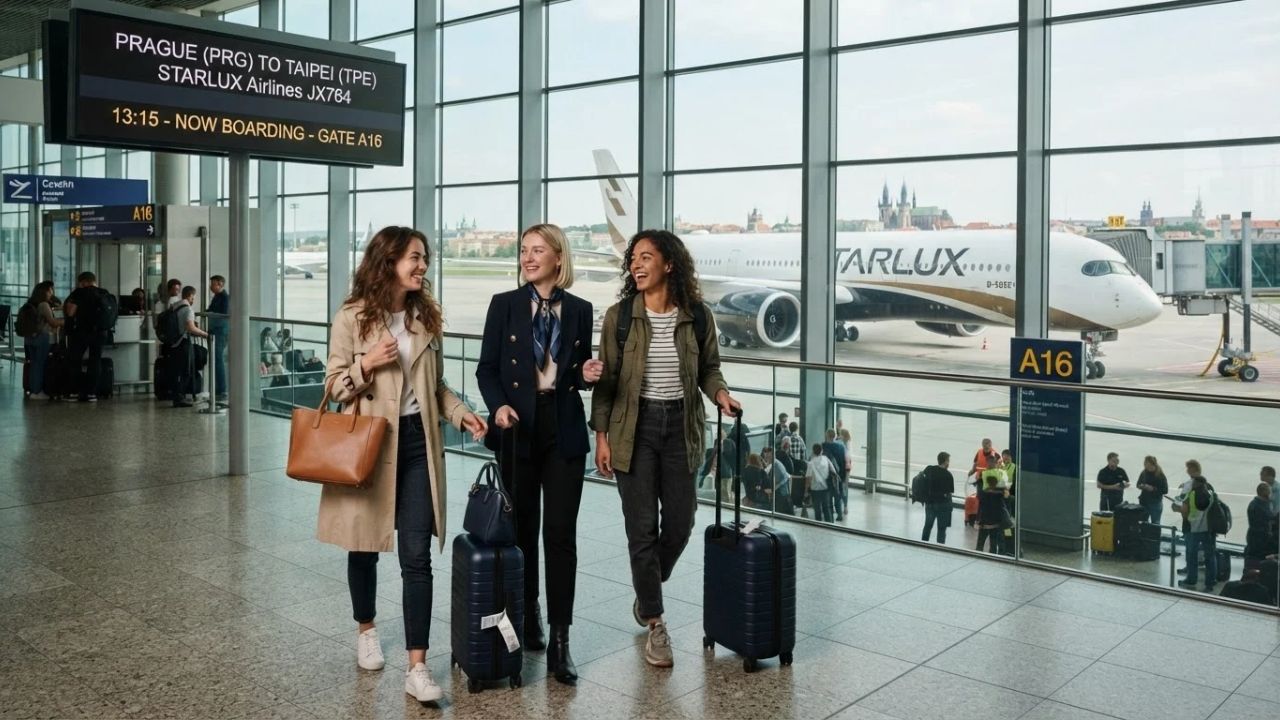
While major East Asian airlines have traditionally concentrated their European flight networks around congested megahubs in Frankfurt, Vienna, or Paris, Taiwan’s boutique luxury carrier STARLUX Airlines made a daring strategic pivot by selecting Prague as its first-ever European destination. Commencing nonstop flights between Taipei Taoyuan International Airport and Prague Václav Havel Airport on August 1, 2026, the carrier paired its transcontinental debut with a coordinated partnership alongside Czech operator Smartwings, establishing the Bohemian capital as Central Europe’s most exciting emerging transit crossroads.
Walking across Charles Bridge in the cool stillness just before sunrise, watching the spires of Malá Strana catch the first amber rays of light, it is easy to see why Prague captivates the global imagination. For decades, travelers moving between East Asia and the Czech Republic faced exhausting multi-stop itineraries through the Middle East or Western Europe. The introduction of direct services by STARLUX Airlines removes these travel barriers entirely, uniting two high-tech, heritage-rich democracies with unprecedented speed and elegance.
The Bohemian Crossroads: STARLUX Airlines and Smartwings Forge a New Eurasian Link
The inauguration of STARLUX Airlines' direct Taipei–Prague service on August 1, 2026, marks a watershed moment in trans-Eurasian aviation. Operating several weekly frequencies from Taipei Taoyuan International Airport to Prague Václav Havel Airport, the route represents the Taiwanese carrier's very first scheduled service into Europe.
Rather than relying purely on point-to-point tourism traffic, the route’s commercial vitality is significantly enhanced by a reported partnership with Smartwings, the Czech Republic’s largest airline. Smartwings maintains a comprehensive regional and charter network connecting Prague with dozens of secondary cities across Central Europe, the Mediterranean basin, and the Middle East.
This alliance creates a seamless regional feeder mechanism. A passenger departing Taipei on STARLUX can touch down at Václav Havel Airport and transfer directly onto Smartwings flights bound for regional hubs across Poland, Slovakia, Hungary, Austria, and eastern Germany. Conversely, European travelers residing in secondary regional cities gain a streamlined pathway to East Asia without enduring congested layovers at London Heathrow or Frankfurt.
The economic timing of the launch aligns with rapidly expanding trade ties between Taiwan and the Czech Republic. While the Czech Republic boasts a century-long manufacturing legacy in automotive engineering, precision machinery, and advanced industrial design, Taiwan serves as the undisputed global leader in semiconductor fabrication and microelectronics. As both nations deepen bilateral technological cooperation and educational exchanges, direct business mobility between Taipei and Prague has transitioned from an occasional corporate luxury into an operational necessity.
What Makes Prague’s New Long-Haul Dynamic Different
Unlike sprawling, impersonal transfer hubs in Western Europe where passengers must navigate cavernous concourses and automated people-movers simply to change terminals, Prague Václav Havel Airport offers a refreshingly compact, human-scale transit experience.
Non-Schengen long-haul flights from Taipei arrive at Terminal 1, while regional European flights operated by Smartwings depart from Terminal 2. The two terminals sit immediately adjacent to each other, connected by a covered walkway that takes less than five minutes to traverse on foot. Minimum connection times in Prague are among the shortest of any European capital airport, sparing passengers the anxiety of missed connections.
Furthermore, Prague's geographic position in the dead center of the European continent makes it an exceptional overland springboard. Travelers disembarking at Václav Havel Airport can easily reach Dresden in two hours by rail, Vienna in four hours, and Krakow in six hours. This Central European proximity allows leisure visitors from Asia to begin an immersive overland journey across Bohemia and Moravia before continuing into neighboring Alpine and Carpathian regions.
The arrival of a self-styled "luxury boutique" airline like STARLUX also reshapes the passenger experience. Known for its curated cabin service, BMW Designworks-styled interiors, Michelin-starred culinary collaborations, and signature aromas, the carrier appeals directly to culturally discerning travelers who prioritize comfort, quiet cabins, and gastronomic sophistication over cut-rate budget fares.
Visitor Insider Tips
Experiencing Prague with the intimacy of a local specialist requires bypassing standard tourist clichés and understanding the city’s authentic neighborhood rhythms.
First, master public transport from Václav Havel Airport to avoid notorious street taxi surcharges. Disregard expensive private shuttles and hop on high-capacity electric Trolleybus Line 59 directly outside Terminal 1. The bus delivers you to Nádraží Veleslavín metro station in roughly 17 minutes, where Metro Line A whisks you into the historic center in another ten minutes. A standard 90-minute transit ticket costs just 42 CZK (less than two euros) and covers all transfers across buses, trams, and subways.
Second, time your visit to iconic historic sites to avoid dense tour groups. Charles Bridge and Old Town Square experience suffocating crowds between 10:00 and 17:00. Set your alarm for 06:15 and experience the medieval cobblestones in absolute tranquility. In the evening, visit Prague Castle after 19:00; while the palace interiors close, the castle courtyards and the enchanting Golden Lane remain open for quiet atmospheric walks beneath gas lamps.
Third, base yourself outside the congested tourist core. Skip the overpriced hotels of Staré Město (Old Town) and establish your base in Vinohrady or Karlín. Vinohrady features leafy boulevards lined with grand Art Nouveau residential blocks, tranquil green spaces like Riegrovy Sady, and independent cafes. Karlín, once an industrial dockside district, has transformed into a culinary haven filled with third-wave coffee roasters, natural wine bars, and artisan bakeries.
Fourth, understand local pub etiquette. When entering a traditional Czech hospoda (pub), wait to be acknowledged or find an open wooden bench. Servers will place a paper coaster in front of you; this serves as an unwritten order for an unpasteurized pilsner poured straight from the copper tank. Order authentic Bohemian comfort food: svíčková na smetaně—tender beef larded with bacon, served in a velvety spiced root-vegetable cream sauce with bread dumplings and a dollop of cranberries.
Cultural and Environmental Context
Prague’s architectural soul represents one of the world's greatest cultural treasures. Miraculously spared the widespread devastation suffered by other Central European cities during the Second World War, the Historic Centre of Prague is inscribed by UNESCO World Heritage, encompassing 866 hectares of Romanesque rotundas, soaring Gothic churches, Renaissance arcades, and Baroque palaces along the winding Vltava River.
However, preserving this delicate medieval stone requires responsible visitor management. The national tourism authority, Visit Czechia, actively promotes sustainable regional dispersion, encouraging international arrivals to explore historic provincial towns such as the Renaissance jewel of Český Krumlov, the Gothic silver-mining center of Kutná Hora, and the spa sanctuaries of Karlovy Vary.
Direct aviation corridors contribute directly to environmental efficiency. By offering a direct route between Taipei and Prague, STARLUX eliminates the excess fuel burn, circuitous routing, and double-descent carbon emissions associated with two-leg flights via Gulf or Western European hubs. When paired with the Czech Republic’s comprehensive electrified rail network, international travelers can transition seamlessly from an energy-efficient long-haul twin-engine aircraft straight onto clean electric passenger trains, safeguarding Bohemia’s natural environments for generations to come.
FAQ: Visiting Prague and Flying STARLUX 2026
When did STARLUX Airlines begin direct flights to Prague? STARLUX Airlines officially commenced nonstop scheduled flights between Taipei Taoyuan International Airport and Prague Václav Havel Airport on August 1, 2026, marking the airline’s European network debut.
How does the Smartwings partnership benefit international travelers? The partnership allows travelers flying STARLUX into Prague to connect seamlessly onto Smartwings flights serving destinations across Poland, Slovakia, Hungary, Germany, and the Mediterranean on coordinated itineraries.
What is the fastest public transit option from Prague Airport to the city center? Take electric Trolleybus 59 from outside the terminals to Nádraží Veleslavín metro station, then transfer to Metro Line A. The journey takes under 30 minutes and costs 42 CZK.
What is the best neighborhood to stay in Prague for an authentic experience? Vinohrady and Karlín offer peaceful residential charm, stunning Art Nouveau architecture, exceptional local bistros, and authentic pubs, all within a ten-minute tram ride of Prague Castle and Old Town.
When ancient stone bridges meet modern flight paths, the world shrinks just enough for two distant cultures to share a table in the heart of Europe.
Related Travel Guides
Disclaimer
This article is for informational and educational purposes only. It does not constitute legal, financial, or professional advice. While we strive to provide accurate and up-to-date information, travel policies, regulations, and conditions change rapidly. Always verify information with official sources before making travel decisions. Nomad Lawyer makes no representations about the accuracy, reliability, completeness, or suitability of the information provided. Readers should consult qualified professionals for advice specific to their circumstances. The views expressed in this article are those of the author and do not necessarily reflect the views of Nomad Lawyer.
Raushan Kumar
Founder & Lead Developer
Full-stack developer with 11+ years of experience and a passionate traveller. Raushan built Nomad Lawyer from the ground up with a vision to create the best travel and law experience on the web.
Learn more about our team →