
PM Modi Opens Alluri Sitarama Raju International Airport to Link Andhra Pradesh with Southeast Asia
The inauguration of Alluri Sitarama Raju International Airport in Bhogapuram marks a strategic shift in India's aviation, positioning Andhra Pradesh as a primary gateway for trade and tourism with ASEAN nations.

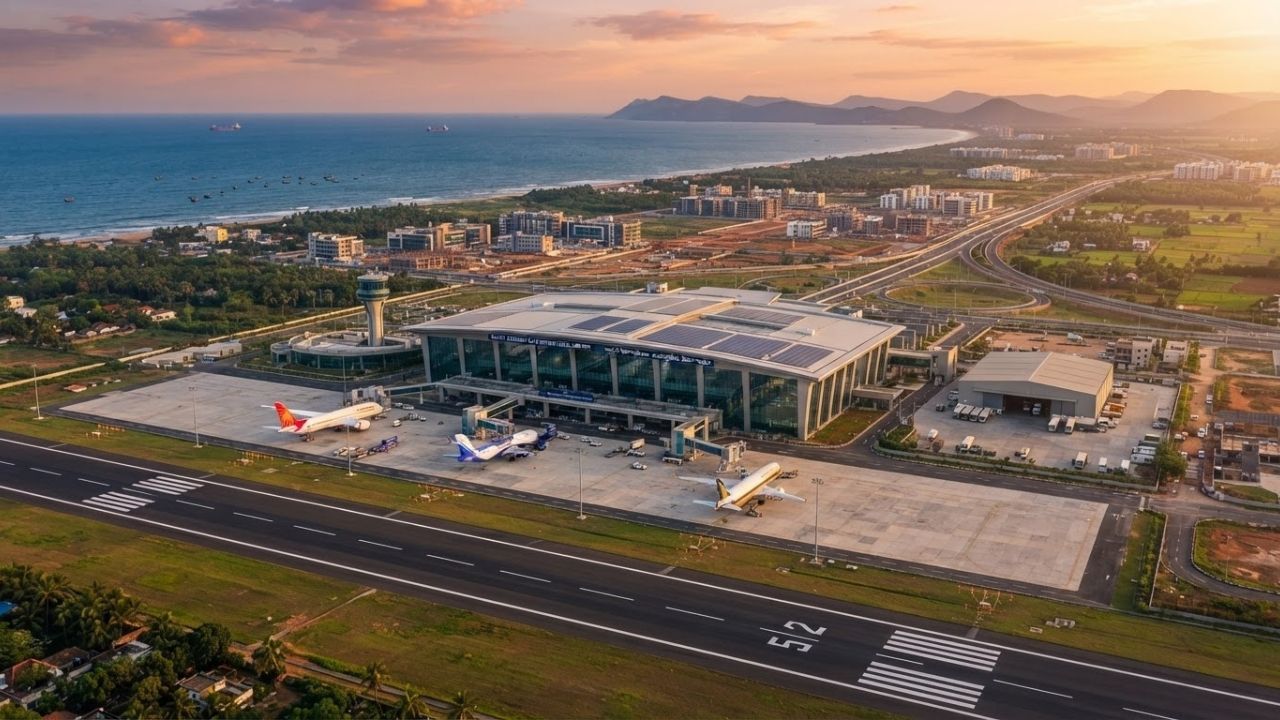
Image generated by AI
The launch of the Alluri Sitarama Raju International Airport transforms the eastern coastline into a strategic hub, slashing flight times to major ASEAN capitals.
Prime Minister Narendra Modi officially inaugurated the Alluri Sitarama Raju International Airport at Bhogapuram, near Visakhapatnam, on Friday. This greenfield project is not merely an upgrade in transit but a calculated move to establish Andhra Pradesh as South India’s primary gateway to Southeast Asia.
With commercial operations set to commence on August 17, the new facility will take over civilian flight duties from the existing Visakhapatnam Airport. This transition allows the current site to return to its primary function as a dedicated naval airbase, removing previous civilian aviation restrictions.
Infrastructure Scale and Investment
Developed via a Public-Private Partnership (PPP) with GMR Visakhapatnam International Airport Ltd., the project represents an investment of nearly ₹5,640 crore. The facility is engineered for massive scalability to meet India's surging aviation demand.
- Initial Capacity: 6 million passengers annually (Phase 1).
- Future Potential: Scalable to over 40 million passengers per year.
- Runway Capabilities: A 3,800-metre runway capable of handling wide-body aircraft, including the Boeing 777, Boeing 787 Dreamliner, Airbus A330, and Airbus A340.
Strategic Pivot Toward the "Act East" Policy
The geographical positioning of Bhogapuram provides a distinct advantage for routes heading east. By reducing flight distances to hubs like Singapore, Bangkok, Kuala Lumpur, Jakarta, Ho Chi Minh City, and Manila, the airport directly supports India’s Act East Policy.
This shift reduces the heavy reliance on traditional southern hubs such as Chennai, Bengaluru, and Hyderabad. International travelers, particularly those visiting Buddhist heritage sites or exploring the eastern coast, now have a more direct point of entry into India.
Catalyzing Tourism and Regional Economy
The airport is expected to unlock previously underutilized tourism assets in Andhra Pradesh. The ease of international access makes the following destinations more competitive for Southeast Asian visitors:
- The beaches of Visakhapatnam and the Eastern Ghats.
- Araku Valley and the Borra Caves.
- Buddhist archaeological sites and tribal tourism circuits.
- Emerging cruise tourism hubs along the Bay of Bengal.
Beyond travel, the airport is the centerpiece of a broader ₹18,000 crore infrastructure push by the government. This includes highways and power projects designed to turn Visakhapatnam into a technology and industrial powerhouse. Key sectors poised for growth include semiconductor manufacturing, pharmaceuticals, green energy, and aerospace.
Logistics and Export Optimization
To bolster trade, the airport features a sophisticated cargo ecosystem designed to improve the competitiveness of local exports.
| Feature | Specification/Capacity | Target Sectors |
|---|---|---|
| Cargo Terminal Size | 5,000 square metres | Seafood, Shrimp, Pharmaceuticals |
| Annual Freight Capacity | 25,000 tonnes | Fresh agricultural produce |
| Key Infrastructure | Cold-chain & Modern Logistics | Perishable goods exports |
The Passenger Experience and Sustainability
The terminal integrates high-tech processing to minimize transit friction. Passengers will have access to DigiYatra, automated baggage handling, self-check-in kiosks, and an AI-supported Airport Predictive Operations Centre (APOC).
Environmental resilience is also a priority. Given the region's susceptibility to cyclones, the terminal is engineered for high climate resilience and incorporates:
- A 5 MW solar power plant.
- Rainwater harvesting and energy-efficient lighting.
- Electric vehicle (EV) charging stations.
- Strict green building and waste management standards.
The Aerocity Vision
The long-term master plan extends beyond the runway to create a comprehensive aviation city. This ecosystem includes:
- Aerocity: 154 acres of mixed-use development.
- Township: 139 acres of residential and commercial space.
- Industrial Zone: 500 acres dedicated to aviation-related industries, including Maintenance, Repair, and Overhaul (MRO) facilities, logistics parks, and aerospace manufacturing.
Visakhapatnam is now positioned not just as a coastal city, but as a pivotal link in the global supply chain connecting India to the Pacific Rim.
Key Takeaways
- Commercial Start Date: Passenger services begin August 17, 2026.
- Strategic Goal: Establish a direct gateway to ASEAN nations, bypassing traditional southern hubs.
- Economic Impact: Part of a wider ₹18,000 crore regional investment in tech and infrastructure.
- Capacity: Starts at 6 million passengers with a roadmap to 40 million.
- Trade Boost: New 5,000-sq-m cargo terminal to accelerate pharmaceutical and seafood exports.
FAQ
When do commercial flights start at the new airport? Commercial operations are scheduled to begin on August 17, 2026.
Which aircraft can land at Alluri Sitarama Raju International Airport? The 3,800-metre runway can accommodate wide-body aircraft, including the Boeing 777, 787 Dreamliner, and Airbus A330 and A340.
What happens to the old Visakhapatnam Airport? The existing airport will transition to serve exclusively as a naval facility.
Related Travel Guides
Disclaimer
This article is for informational and educational purposes only. It does not constitute legal, financial, or professional advice. While we strive to provide accurate and up-to-date information, travel policies, regulations, and conditions change rapidly. Always verify information with official sources before making travel decisions. Nomad Lawyer makes no representations about the accuracy, reliability, completeness, or suitability of the information provided. Readers should consult qualified professionals for advice specific to their circumstances. The views expressed in this article are those of the author and do not necessarily reflect the views of Nomad Lawyer.
Raushan Kumar
Founder & Lead Developer
Full-stack developer with 11+ years of experience and a passionate traveller. Raushan built Nomad Lawyer from the ground up with a vision to create the best travel and law experience on the web.
Learn more about our team →