
Major European Aviation Disruption 2026: 1,245 Delays and 56 Cancellations Hit Hubs
Widespread operational failures across Europe's primary aviation hubs led to over 1,300 flight disruptions on July 8, 2026, severely impacting KLM, British Airways, and Lufthansa operations.

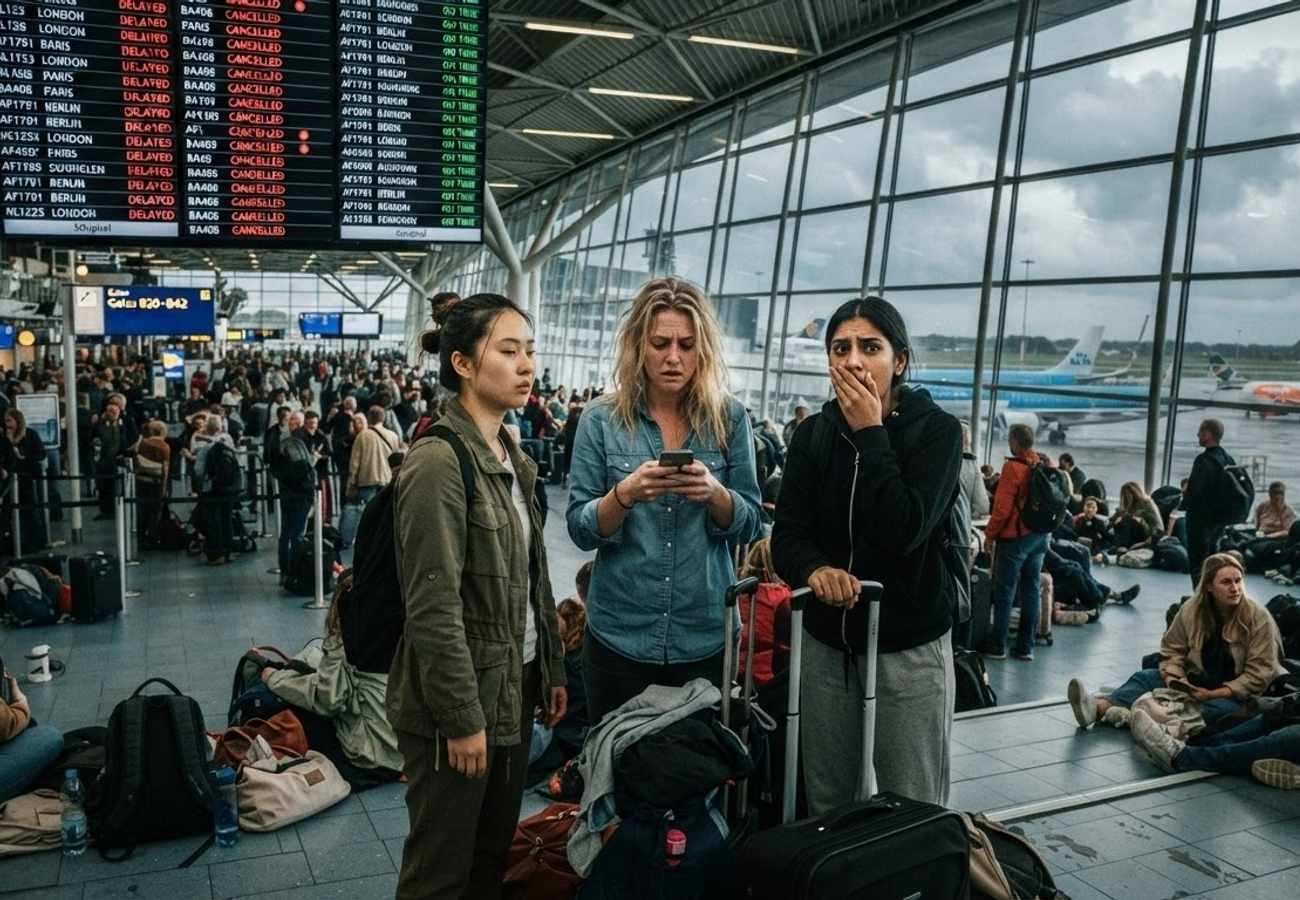
Image generated by AI
A systemic wave of operational failures swept across European airspace on July 8, 2026, resulting in 1,245 flight delays and 56 cancellations. The disruption spanned multiple national borders, impacting critical hubs in the Netherlands, Germany, England, Norway, and beyond.
The instability was most acute at major transit hubs, where a combination of network congestion and aircraft availability created a ripple effect. This level of volatility highlights the fragility of the interconnected European aviation corridor, where a bottleneck in one city frequently triggers delays across the continent.
Hub-Specific Disruption Analysis
The scale of the disruption varied by city, with some airports facing sheer volume of delays while others dealt with higher rates of total flight cancellations.
Amsterdam Schiphol emerged as the primary epicenter of the instability, recording the highest volume of delays at 229. While KLM bore the brunt of these setbacks, Air France and German Airways also reported cancelled services.
London Heathrow recorded the most severe cancellation rate of any single airport, with 9 flights scrapped. British Airways dominated both the delay and cancellation statistics at this hub, though Virgin Atlantic, Delta, and American Airlines were also affected.
Frankfurt and London Gatwick followed closely in terms of volume. Frankfurt saw 135 delays, largely impacting Lufthansa and its subsidiaries, while Gatwick reported 130 delays, with easyJet being the most affected carrier.
Airline Operational Impact
The disruption did not hit all carriers equally. Legacy flag carriers and low-cost giants both experienced significant scheduling failures.
- KLM: The hardest-hit airline by volume, registering 111 delays and 6 cancellations, mostly centered at its Schiphol hub.
- Finnair: Experienced 73 delays and 3 cancellations, with the majority of issues concentrated at Helsinki-Vantaa.
- British Airways: Reported 71 delays and 7 cancellations, primarily affecting London Heathrow and Gatwick.
- SAS: Faced 52 delays and 5 cancellations, reflecting broader operational instability across Scandinavian routes in Copenhagen and Oslo.
- Ryanair: Recorded 37 delays across a fragmented network including Vienna, Palma de Mallorca, and Helsinki.
Comprehensive Disruption Data
The following table details the specific operational failures recorded across the most affected European airports.
| Airport | Delays | Cancellations | Primary Affected Carriers |
|---|---|---|---|
| Amsterdam Schiphol | 229 | 15 | KLM, German Airways, Air France |
| Palma de Mallorca | 142 | - | Ryanair, Various |
| Frankfurt | 135 | 5 | Lufthansa, Condor, Discover, Air Dolomiti |
| London Gatwick | 130 | 6 | easyJet, BA Euroflyer |
| London Heathrow | 123 | 9 | British Airways, Virgin Atlantic, Delta, American |
| Vienna | 110 | 4 | Lauda Europe, Austrian Airlines, Air Baltic |
| Oslo Gardermoen | 96 | 4 | SAS, Norwegian Air Shuttle, Wideroe |
| Sheremetyevo | 95 | 4 | Aeroflot, Rossiya Airlines |
Understanding the Systemic Failure
These disruptions are rarely the result of a single event but rather a convergence of network-related factors. When a major hub like Schiphol or Heathrow experiences a surge in delays, it creates a "domino effect."
Airlines operate on tight rotations; if an aircraft is delayed leaving Frankfurt, it cannot arrive in London on time, which subsequently delays the next leg to New York or Dubai. This is compounded by crew rotation limits, where pilots and cabin crew may exceed their legal flying hours due to delays, forcing airlines to cancel flights entirely.
Additional contributing factors typically include:
- Air Traffic Control (ATC) Constraints: Volume limits on the number of aircraft allowed in a sector.
- Maintenance Requirements: Unexpected technical faults that ground specific airframes.
- Weather Volatility: Localized storms or wind shears affecting takeoff and landing sequences.
Guidance for Affected Passengers
For those navigating these disruptions, the priority should be real-time information and documentation.
Immediate Actions:
- Verify Status: Do not rely on original itineraries; check the airline app or official airport screens before departing for the terminal.
- Communication: Monitor SMS and email alerts for gate changes or rebooking notifications.
- Documentation: Retain all boarding passes and receipts for expenses incurred due to delays, as these are necessary for potential compensation claims.
- Rebooking: If a flight is cancelled, contact the airline immediately via digital channels to secure the next available seat.
Travelers are advised that during large-scale disruptions, airport staffing may be stretched, making digital self-service tools the fastest way to manage itinerary changes.
Key Takeaways
- Scale: Over 1,300 total disruptions (1,245 delays, 56 cancellations) hit Europe on July 8, 2026.
- Hardest Hit Hubs: Amsterdam Schiphol (most delays) and London Heathrow (most cancellations).
- Primary Carriers: KLM and British Airways faced the most significant operational setbacks.
- Root Causes: Network ripple effects, crew rotations, and airport congestion.
FAQ
Which airport had the most cancellations? London Heathrow recorded the highest number of cancellations with 9 flights.
Which airline experienced the most delays? KLM registered the highest number of delays among all carriers, totaling 111.
Why do delays in one city affect flights in another? Because airlines use "interconnected networks," a delay in one hub prevents the aircraft and crew from reaching their next destination on time, triggering a chain reaction of delays across the region.
Related Travel Guides
Disclaimer
This article is for informational and educational purposes only. It does not constitute legal, financial, or professional advice. While we strive to provide accurate and up-to-date information, travel policies, regulations, and conditions change rapidly. Always verify information with official sources before making travel decisions. Nomad Lawyer makes no representations about the accuracy, reliability, completeness, or suitability of the information provided. Readers should consult qualified professionals for advice specific to their circumstances. The views expressed in this article are those of the author and do not necessarily reflect the views of Nomad Lawyer.
Raushan Kumar
Founder & Lead Developer
Full-stack developer with 11+ years of experience and a passionate traveller. Raushan built Nomad Lawyer from the ground up with a vision to create the best travel and law experience on the web.
Learn more about our team →