
Philippines’ Biggest Transport Upgrade Begins as Ninoy Aquino International Airport Terminal 3 Subway Link Targets 40-Minute Journeys
Philippines’ Biggest Transport Upgrade Begins as Ninoy Aquino International Airport Terminal 3 Subway Link Targets 40-Minute Journeys

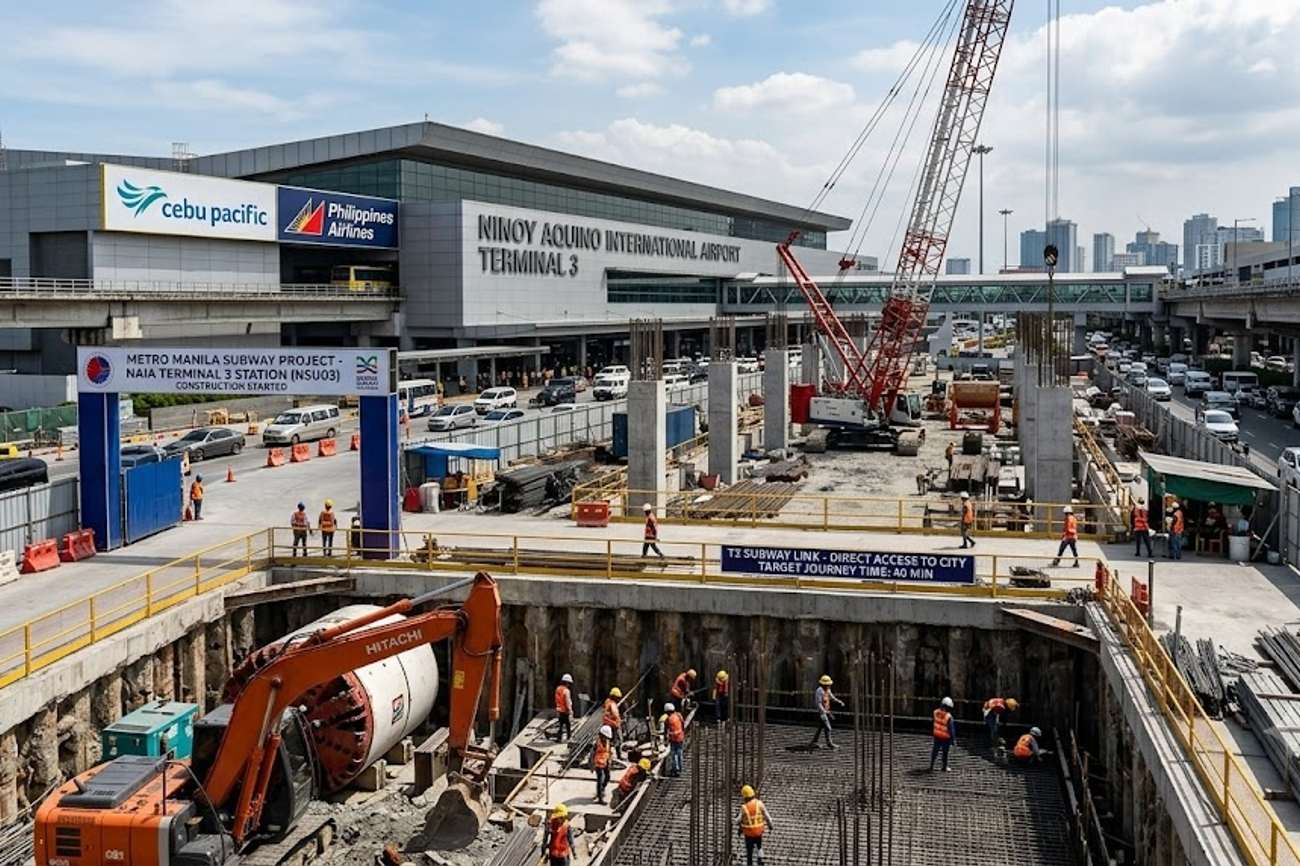
Image generated by AI
40 minutes is the projected transit time from Valenzuela City to Ninoy Aquino International Airport (NAIA) Terminal 3 once the new mass transit link is operational. This represents a drastic reduction from the current average travel time of approximately one hour and 35 minutes, signaling a fundamental shift in how the Philippines manages the logistical bottleneck of its primary international gateway.
The Metro Manila Subway Project Framework
The commencement of construction on the NAIA Terminal 3 station is not an isolated infrastructure project but a strategic component of the broader Metro Manila Subway Project. Specifically categorized under Contract Package 109, this phase focuses on the underground station and its associated tunnel structures. For decades, the capital region has struggled with some of the most severe road congestion globally, creating a volatile environment for travelers where arrival times at the airport are often unpredictable.
The scope of the full subway system is ambitious, spanning a total of 33 kilometers and incorporating 17 distinct stations. The NAIA Terminal 3 segment alone covers approximately 2.413 kilometers of the subway alignment. By moving passenger flow underground, the Philippine government is attempting to decouple airport access from the surface-level gridlock that currently defines the journey to the airport. This shift is part of a wider regional trend across Asia to prioritize high-capacity urban rail to sustain economic competitiveness and manage rapid population growth.
Infrastructure Scale and Passenger Projections
The engineering of the NAIA Terminal 3 station is designed to scale alongside the projected growth of the Philippine aviation and tourism sectors. The facility is not merely intended for current demand but is built to accommodate a steady climb in daily ridership over the next two decades.
The following data outlines the expected passenger volume for the airport link:
| Projection Year | Estimated Daily Passengers |
|---|---|
| 2035 | 70,000 |
| 2045 | 74,000 |
This growth trajectory indicates that the Department of Transportation (DOTr) and its partners are preparing for a significant increase in international arrivals and domestic transfers. By integrating the airport directly into the city's rail backbone, the government aims to reduce the systemic reliance on private vehicles, taxis, and buses, which currently saturate the roads surrounding the airport terminals.
Expert Analysis: The Logistics of Connectivity
For the seasoned traveler or the corporate nomad, the value of this project lies in the elimination of "transit anxiety." In Manila, the gap between a 95-minute journey and a 40-minute journey is not just about time—it is about reliability. When travel times fluctuate by nearly an hour due to road conditions, the "buffer time" required for airport departures becomes a significant logistical burden.
The direct consequence of this project is a shift in the "last-mile" economy of Manila. Currently, the airport transfer is a high-friction experience. By providing a rail link, the Philippines is adopting a model similar to those used by the International Air Transport Association (IATA) recommended standards for seamless passenger processing. When a traveler can predict their arrival time to the minute, the entire airport ecosystem—from check-in counters to lounge utilization—operates more efficiently.
Furthermore, this infrastructure creates a pricing pressure shift. Currently, premium airport transfers and private cars command a premium because they are seen as the only "reliable" way to bypass traffic. Once a high-speed rail alternative exists, the value proposition of road-based transfers will change, potentially lowering the cost of airport access for the average tourist while increasing the volume of visitors who feel comfortable venturing further into the city.
From a geopolitical and economic standpoint, this is a play for investment. International firms are often hesitant to establish hubs in cities where the commute from the airport to the central business district is a gamble. By slashing the transit time from Valenzuela City to NAIA Terminal 3, the Philippines is effectively expanding the "reachable" radius of the airport, making the capital more attractive for foreign direct investment and high-spend business tourism.
The new subway link aims to drastically reduce congestion by connecting Ninoy Aquino International Airport Terminal 3 to the city center, targeting travel times of just 40 minutes. This infrastructure project is a key component of the broader modernization efforts overseen by the Manila International Airport Authority, ensuring more efficient passenger logistics for international arrivals.
Key Takeaways
- Time Efficiency: Transit from Valenzuela City to NAIA Terminal 3 will drop from 1 hour 35 minutes to approximately 40 minutes.
- System Scale: The airport link is part of a 33-kilometer network featuring 17 stations and a 2.413-kilometer alignment specifically for the Terminal 3 station.
- Capacity Growth: The station is engineered to handle 70,000 daily passengers by 2035, increasing to 74,000 by 2045.
- Operational Shift: The project moves airport access from congested road networks to a dedicated underground rail system (Contract Package 109).
- Economic Driver: The link aims to boost tourism and business travel by providing a predictable, high-speed alternative to taxis and private cars.
FAQ: Manila Airport Subway 2024
Which terminal will the new subway serve? The current construction phase specifically focuses on providing a direct rail connection to NAIA Terminal 3, integrating it into the wider Metro Manila Subway Project.
How much faster will the trip be from Valenzuela City? Travelers can expect the journey to be reduced to roughly 40 minutes, compared to the current average of 1 hour and 35 minutes.
When will the station reach its peak capacity? The station is designed for long-term growth, with projections showing a rise to 70,000 daily passengers by 2035 and 74,000 by 2045.
Will this replace the need for taxis at NAIA? While taxis will still exist, the subway provides a predictable, rail-based alternative that avoids road congestion, specifically for those traveling toward the city center and Valenzuela.
The transition from gridlock to glide marks the beginning of a new era for Philippine aviation logistics.
Related Travel Guides
- Montenegro Travel Growth Reaches New Heights as Seventy Seven Thousand Tourists Boost September Visitor Numbers
- South Korea Pair Up With China and More as Tanzania Boosts Luxury Safari Tourism With New Ruaha Family Stay
- Beck Hole Yorkshire Becomes Autumn Travel Gem as Hikers Discover Historic Riverside Pub and Scenic Walks
Disclaimer
This article is for informational and educational purposes only. It does not constitute legal, financial, or professional advice. While we strive to provide accurate and up-to-date information, travel policies, regulations, and conditions change rapidly. Always verify information with official sources before making travel decisions. Nomad Lawyer makes no representations about the accuracy, reliability, completeness, or suitability of the information provided. Readers should consult qualified professionals for advice specific to their circumstances. The views expressed in this article are those of the author and do not necessarily reflect the views of Nomad Lawyer.
Raushan Kumar
Founder & Lead Developer
Full-stack developer with 11+ years of experience and a passionate traveller. Raushan built Nomad Lawyer from the ground up with a vision to create the best travel and law experience on the web.
Learn more about our team →