
Beyond the Inca Trail: How Sacred Valley Community Homestays and Quechua Weaving Reshape Peru Travel in 2026
Cusco-based operator South Andes Travel expands community-led tourism across Peru's Sacred Valley, connecting international travelers with Quechua weavers, traditional potters, and highland farming families.

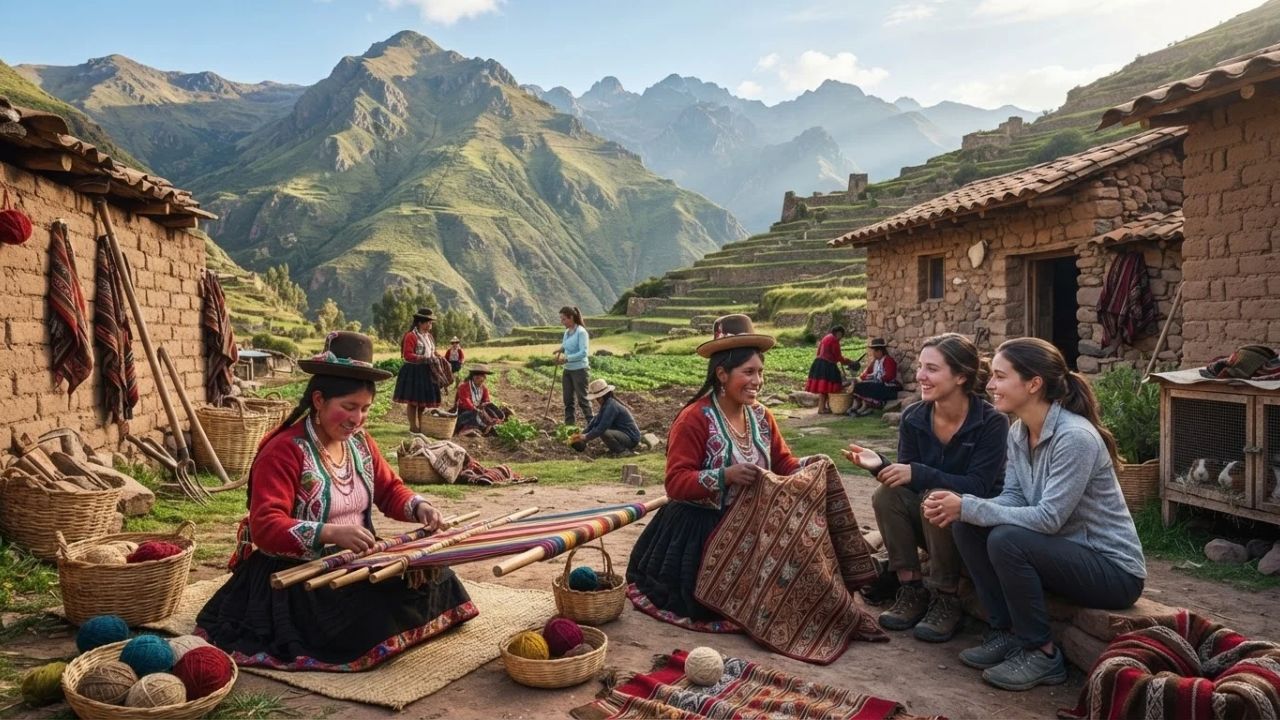
Highland community tourism in Peru connects travelers directly with generational Quechua weavers and agricultural homestays across the Sacred Valley.
While over 1.5 million international travelers make the pilgrimage toward Machu Picchu every year, fewer than five percent step off the tourist train to share a home-cooked meal inside an authentic Quechua highland village. For decades, the global vision of Peru travel revolved around rapid-fire photographic stops: landing in Cusco, boarding an early morning train along the Urubamba River, snapping a postcard view of the 15th-century citadel, and departing before dusk. Today, a profound grassroots movement is dismantling that superficial circuit. Guided by Cusco-based operator South Andes Travel, travelers are redirecting their journeys into the terraced agricultural communities of the Sacred Valley, trading hurried sightseeing for generational textile weaving, ancestral pottery studios, and overnight family homestays.
This evolution from passive spectator to active guest marks a fundamental maturation in South American travel. Rather than treating indigenous highland villages as mere picturesque backdrops, thoughtful voyagers are immersing themselves directly into daily community rhythms. By spending nights in adobe homesteads, peeling native Andean potatoes alongside family elders, and learning the sacred symbolism woven into traditional backstrap textiles, visitors forge genuine cultural connections that sustain indigenous heritage while distributing economic prosperity far beyond corporate concessions.
The Two-Decade Shift: From Guided Buses to Living Community Immersion
The shift toward community-based travel across the Peruvian Andes is the fruit of two decades of deliberate grassroots development. Matthew, co-founder of South Andes Travel, has worked continuously within Peru’s travel industry since 2006. When he first arrived in the southern highlands twenty years ago, community tourism existed only in rudimentary fragments. Over the intervening two decades, indigenous villages have systematically developed the hospitality infrastructure, sanitary facilities, and educational frameworks needed to host international guests comfortably without sacrificing their ancestral lifestyle.
Operating as an independent business for nine years, South Andes Travel has cultivated personal relationships with village elders, farming cooperatives, and artisan families across the Andes. Matthew emphasizes that the company’s model is intentionally small-scale and relational rather than transactional. They do not operate high-capacity tour buses or package standardized excursions. Instead, their client base has expanded organically through word-of-mouth recommendations, drawing conscious travelers from Romania, the United States, Canada, and Britain, alongside broader regions of Europe and North America.
As documented across national cultural travel guidelines presented by PROMPERÚ, this personalized model does not ask travelers to abandon iconic landmarks like the Historic Sanctuary of Machu Picchu. Rather, it incorporates community homestays as an essential cultural prelude or postscript to the archaeological citadel, allowing visitors to comprehend the living descendants of the civilization that constructed the stone temples.
What Makes the Sacred Valley Different: Ancient Agriculture and Living Quechua Artistry
The Sacred Valley of the Incas occupies a unique geographic and cultural position. Situated between the high-altitude colonial capital of Cusco (at 11,150 feet) and the subtropical cloud forests of Machu Picchu (at 7,970 feet), the valley sits at a milder elevation of roughly 9,000 feet. This temperate river basin has served as the agricultural breadbasket of the Andes for millennia, fed by glacial snowmelt and protected by towering granite peaks.
Community-based itineraries in the valley center around hands-on workshops led by master indigenous practitioners:
Ancestral Textile Weaving on Backstrap Looms
In highland communities like Chinchero and Patacancha, Quechua women maintain one of the world's most sophisticated continuous textile traditions. Travelers sit alongside master weavers to clean raw alpaca and sheep fleece using natural saqta root detergent, spin yarn using traditional drop spindles (k'anti), and extract organic dyes from native plants, mosses, and cochineal insects. Visitors discover that the intricate geometric motifs (pallay) woven into traditional mantles are not decorative flourishes, but an ancient visual language recording topographical maps, astrological alignments, and village history.
Traditional Ceramics and Clay Arts
In riverfront settlements such as Urubamba and Maras, local potters instruct travelers in sculpting and firing terracotta vessels using ancestral Andean clay techniques. These functional vessels, decorated with natural mineral slips, continue to be used in daily family cooking and agricultural rituals honoring Pachamama (Mother Earth).
High-Altitude Agriculture and Native Biodiversity
Highland farming workshops invite visitors into the fields to participate in traditional potato and corn harvesting. Peru safeguards more than 4,000 distinct varieties of native potatoes, cultivated on steep terraced slopes using the chaquitaclla—an ancient foot-plow unchanged since Incan antiquity. Guests learn how indigenous farmers utilize microclimates across varying elevations to preserve food security in the face of shifting rainfall patterns.
Educational Homestays for Multi-Generational Families
South Andes Travel specifically designs these programs to accommodate multi-generational families. Children and teenagers engage directly with village youth, feeding alpacas, baking flatbreads in traditional wood-fired clay ovens, and learning basic words in Runasimi (the native Quechua language). These shared moments break through language barriers, providing younger travelers with life-shaping lessons in cultural humility and community cooperation.
Environmental preservation guidelines across these delicate river ecosystems are maintained in collaboration with SERNANP, the national agency overseeing protected natural habitats in Peru.
Visitor Insider Tips: Acclimatization, Quechua Courtesy, and Village Living
Experiencing Andean community tourism with respect and comfort requires thoughtful preparation and local cultural awareness:
- Descend Directly to the Sacred Valley for Altitude Acclimatization: When landing at Alejandro Velasco Astete International Airport in Cusco, resist the temptation to stay in the city immediately. Cusco sits at an oxygen-thin 11,150 feet, making acute mountain sickness common. Instead, arrange direct transport immediately down to the Sacred Valley (9,000 feet). Spending your first three days in the valley allows your body to adjust gently to the altitude while engaging in village homestays.
- Master Basic Quechua Greetings: While most host families speak conversational Spanish, greeting village elders in their native Quechua demonstrates deep cultural respect. Greet locals with "Allillanchu" (pronounced ah-yee-yahn-choo, meaning "Are you well?"), to which the customary reply is "Allillanmi" (ah-yee-yahn-mee, "I am well"). Express your gratitude by saying "Sulpayki" (sool-pie-kee, "Thank you").
- Pack for Radical Mountain Temperature Swings: The Andean sun is intensely bright during the day, with temperatures reaching the low 70s°F, but once the sun dips behind the mountain ridges, temperatures regularly plummet near freezing. Pack high-SPF sunscreen, polarized sunglasses, and a wide-brimmed sun hat for daytime field walks, alongside heavy thermal base layers, a fleece jacket, and warm wool socks for unheated adobe village homes at night.
- Savor Traditional Pachamanca Feasts: If your village visit coincides with a communal celebration, participate in a traditional Pachamanca. This ancient earth-oven feast involves heating volcanic stones over wood fires, burying marinated meats, native tubers, broad beans, and sweet plantains deep in the ground, and covering the pit with wild Andean herbs and damp sacks to slow-cook for hours.
- Responsible Photography Etiquette: Never point cameras directly at indigenous elders, weavers, or children without asking polite verbal permission first. When visiting weaving associations, show appreciation for their time by purchasing authentic handmade alpaca textiles directly from the craftswoman who wove them, rather than treating their working spaces as free photo studios.
Cultural and Environmental Context: Indigenous Autonomy and Agricultural Sovereignty
The rise of community-led tourism represents an essential shield against the negative externalities of mass travel. Unregulated commercial tourism along the classic Inca Trail and Aguas Calientes (Machu Picchu Pueblo) has frequently led to environmental degradation, excessive plastic waste in mountain streams, and the economic exploitation of indigenous porters and artisans by corporate operators.
By contrast, genuine community tourism returns decision-making power to the villages themselves. South Andes Travel works through community assemblies, ensuring that homestay rotations are distributed equitably among families and that tourism fees are deposited directly into collective community funds. These revenues finance clean water filtration systems, school supplies for bilingual Quechua-Spanish classrooms, and elderly medical support.
Decisively, this economic autonomy incentivizes younger generations to remain in their ancestral mountain villages. In many developing regions, economic necessity forces youth to migrate into urban shantytowns, severing the transmission of indigenous agricultural knowledge and textile arts. When international travelers demonstrate genuine respect and financial value for Quechua traditions, young weavers and farmers realize that their cultural heritage is a source of immense pride, dignity, and sustainable livelihood in the modern world.
FAQ: Visiting Peru's Sacred Valley 2026
How does community tourism differ from traditional tours in the Sacred Valley? Community tourism replaces passive bus sightseeing with hands-on workshops, direct family homestays, and agricultural participation alongside indigenous Quechua families.
Where is South Andes Travel based and how long has it operated? South Andes Travel is based in Cusco, Peru, and has operated for nine years, founded by Matthew, who has worked in Peruvian tourism since 2006.
What activities are included in Sacred Valley village homestays? Itineraries feature backstrap textile weaving, ancestral pottery making, native potato harvesting, Quechua language learning, and shared home-cooked meals with host families.
Is the Sacred Valley suitable for travelers acclimatizing to high altitude? Yes, at approximately 9,000 feet, the Sacred Valley is significantly lower than Cusco (11,150 feet), making it an ideal base to acclimatize comfortably while exploring.
In the quiet shadows of the Andes, the true wonder of Peru is not carved in ancient stone, but lived in the warm embrace of a Quechua hearth.
Related Travel Guides
Disclaimer
This article is for informational and educational purposes only. It does not constitute legal, financial, or professional advice. While we strive to provide accurate and up-to-date information, travel policies, regulations, and conditions change rapidly. Always verify information with official sources before making travel decisions. Nomad Lawyer makes no representations about the accuracy, reliability, completeness, or suitability of the information provided. Readers should consult qualified professionals for advice specific to their circumstances. The views expressed in this article are those of the author and do not necessarily reflect the views of Nomad Lawyer.
Raushan Kumar
Founder & Lead Developer
Full-stack developer with 11+ years of experience and a passionate traveller. Raushan built Nomad Lawyer from the ground up with a vision to create the best travel and law experience on the web.
Learn more about our team →