
Oslo Airport ATC Strike Causes 69 Flight Cancellations Across Norway and Europe in 2026
An air traffic controller strike at Oslo Gardermoen has triggered 69 flight cancellations and 18 delays, severely disrupting domestic routes to Bergen and Tromsø and multiple international European connections.

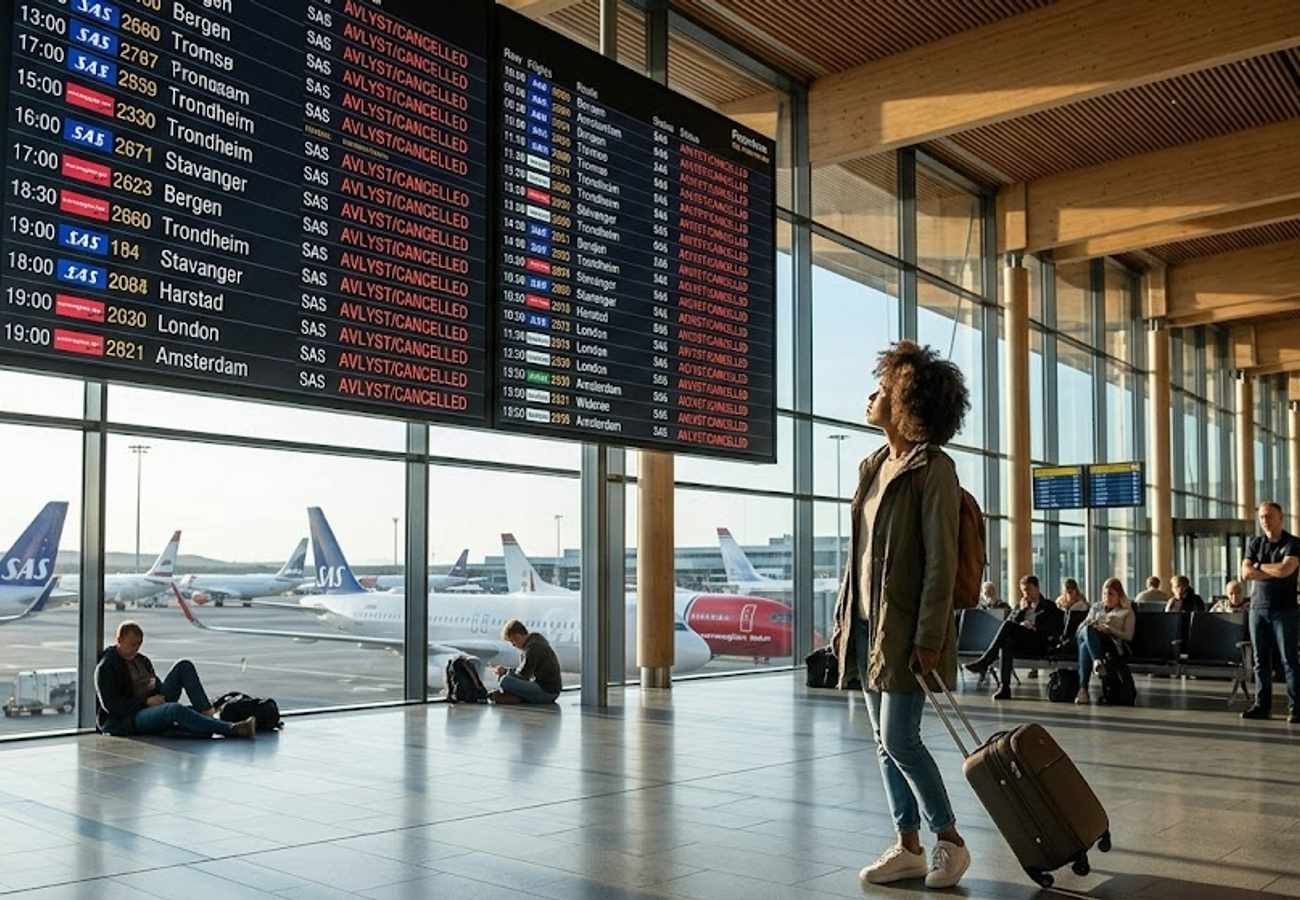
Image generated by AI
An air traffic controller (ATC) strike has paralyzed operations at Oslo Gardermoen, resulting in 69 cancelled flights and 18 delays. The disruption has severed critical domestic links to Norway's regional hubs and suspended multiple international corridors to Europe.
The strike has effectively throttled air traffic capacity at Norway's primary aviation gateway. Because Oslo Gardermoen serves as the central node for both international arrivals and domestic transfers, the operational standstill has created a ripple effect across the entire national travel network.
Thousands of passengers are currently stranded or facing significant itinerary changes. The impact is most acute for those utilizing Oslo as a transit point to reach the Arctic north or the western fjords.
Operational Impact Summary
The scale of the disruption is concentrated at the capital's main hub, though the effects are felt nationwide:
- Oslo Gardermoen: 69 cancellations and 18 delays.
- Domestic Hubs Hit: Bergen, Tromsø, Trondheim, Stavanger, Bodø, and Harstad/Narvik.
- International Reach: Multiple cancellations across key European routes.
Airline Performance and Cancellation Data
Our analysis of the flight data indicates that SAS and the Norwegian group bore the brunt of the operational collapse due to their heavy reliance on the Oslo hub for domestic rotations.
| Airline | Cancelled Flights | Cancellation Rate | Delayed Flights | Delay Rate |
|---|---|---|---|---|
| SAS | 27 | 11% | 0 | 0% |
| Norwegian Air Shuttle | 21 | 9% | 5 | 2% |
| Norwegian Air Sweden | 10 | 8% | 5 | 4% |
| KLM | 7 | 58% | 0 | 0% |
| Widerøe’s Flyveselskap A/S | 3 | 7% | 1 | 2% |
| LOT Polish Airlines | 1 | 12% | 0 | 0% |
| Danish Air Transport | 0 | 0% | 1 | 4% |
| Finnair | 0 | 0% | 1 | 12% |
| Luxair | 0 | 0% | 1 | 100% |
| Qatar Airways | 0 | 0% | 1 | 100% |
| Wizz Air | 0 | 0% | 1 | 16% |
| Air France | 0 | 0% | 2 | 33% |
Critical Route Failures
Domestic connectivity has seen the most severe degradation. The following specific departures from Oslo Gardermoen were confirmed cancelled:
Domestic Departures:
- SAS4086 to Harstad/Narvik Evenes (A20N) - 11:20 CEST
- WIF163 to Ørsta (DH8A) - 10:50 CEST
- NOZ424 to Molde (B738) - 10:50 CEST
- WIF145 to Sandane (DH8A) - 10:50 CEST
- NOZ752 to Trondheim (B738) - 10:40 CEST
- NOZ608 to Bergen (B738) - 10:40 CEST
- NSZ528 to Stavanger (B38M) - 10:40 CEST
- SAS4106 to Bodø (E190) - 10:35 CEST
- SAS4023 to Stavanger (E190) - 10:35 CEST
- NOZ372 to Tromsø (B738) - 10:30 CEST
- SAS257 to Bergen (E190) - 09:35 CEST
- SAS4406 to Tromsø (A20N) - 08:55 CEST
- WIF1403 to Bergen (DH8D) - 08:55 CEST
- SAS251 to Bergen (E190) - 08:30 CEST
International Departures:
- Norwegian (NOZ1354) to Edinburgh (B738) - 08:20 CEST
- KLM: Multiple cancellations to Amsterdam Schiphol
- SAS: Cancellations to Manchester, Zurich, Stockholm Arlanda, Düsseldorf, Amsterdam Schiphol, Rome Fiumicino, Copenhagen, and Keflavik
- LOT Polish Airlines: Cancellation to Warsaw
- Lufthansa: Cancellation to Frankfurt
- Norwegian Air Sweden: Cancellations to Paris Charles de Gaulle and Tallinn
- Norwegian: Cancellations to Copenhagen and Vilnius
- Finnair: Cancellation to Helsinki
Why This Matters: Industry Implication
From a logistical perspective, this strike exposes the fragility of Norway's "hub-and-spoke" aviation model. Because the vast majority of international traffic flows through Oslo before dispersing to regional airports, a single point of failure at Gardermoen effectively isolates the rest of the country.
For travelers, the real impact extends beyond the initial cancellation. In aviation, aircraft and crew rotations are tightly sequenced. When a flight to Tromsø is cancelled in the morning, the aircraft is not in position for its afternoon return or its next leg to Bergen. This creates a "compounding delay" effect that often lasts 48 to 72 hours after the strike officially ends.
Furthermore, the impact on tourism is significant. Travelers booking fixed-date fjord cruises in Bergen or Northern Lights excursions in Tromsø face non-refundable losses when their primary transit link—the Oslo connection—collapses.
Forward Outlook
Market trends suggest that recovery will not be instantaneous. Airlines must now prioritize the repositioning of crews and aircraft to the correct regional outstations. Passengers should expect residual delays and potential "ghost flights" (scheduled flights that are cancelled at the last minute due to crew displacement) for several days.
The stability of the Nordic aviation corridor now depends entirely on the speed of the ATC labor resolution.
Related Travel Guides
Disclaimer
This article is for informational and educational purposes only. It does not constitute legal, financial, or professional advice. While we strive to provide accurate and up-to-date information, travel policies, regulations, and conditions change rapidly. Always verify information with official sources before making travel decisions. Nomad Lawyer makes no representations about the accuracy, reliability, completeness, or suitability of the information provided. Readers should consult qualified professionals for advice specific to their circumstances. The views expressed in this article are those of the author and do not necessarily reflect the views of Nomad Lawyer.
Preeti Gunjan
Contributor & Community Manager
A passionate traveller and community builder. Preeti helps grow the Nomad Lawyer community, fostering engagement and bringing the reader experience to life.
Learn more about our team →