
Turkish Airlines Launches Homegrown Business Class Suite, Signaling Shift in Premium Aircraft Competition
Breaking airline news and aviation industry updates for 2026.

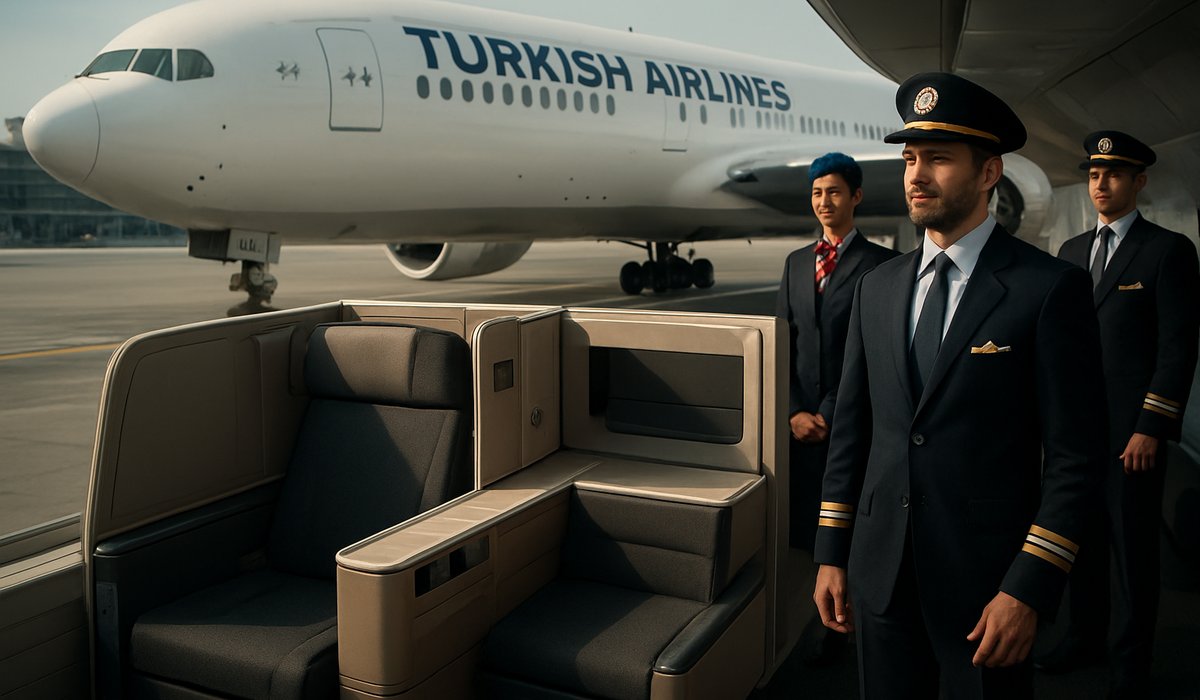
Image generated by AI
Turkish Airlines Launches Homegrown Business Class Suite, Signaling Shift in Premium Aircraft Competition
The carrier bets on in-house cabin innovation to rival Gulf rivals in ultra-competitive long-haul market
Turkish Airlines is preparing to deploy a custom-designed business class suite developed entirely in-house, marking a significant strategic move in the intensifying competition for premium cabin dominance among Middle Eastern and European carriers.
Consolidating Premium Market Position
The Istanbul-based airline, already ranking among the world's largest carriers by passenger volume, is positioning itself as a direct competitor to the "Big Three" Gulf airlines—Emirates, Etihad Airways, and Qatar Airways—by investing heavily in proprietary cabin innovation rather than relying on third-party manufacturers. The move reflects a broader industry trend where major carriers are increasingly taking control of their in-flight product development to differentiate themselves in a crowded premium travel market.
Turkish Airlines' strategic advantages lie in its unique geographic positioning. Unlike Gulf carriers operating from the Arabian Peninsula, Turkish Airlines leverages Istanbul's proximity to Europe, enabling the airline to operate frequent narrowbody services to European destinations while maintaining its role as a critical connectivity hub for long-haul connections across Asia, Africa, and the Americas.
Capitalizing on Hub Advantage
The carrier's superconnector model mirrors the operational strategies of Emirates, Etihad, and Qatar Airways, but with a crucial distinction: Istanbul sits at the crossroads of Europe and Asia, positioning the airline to serve both markets with unmatched frequency and efficiency. This geographic advantage allows Turkish Airlines to capture connecting passengers at competitive fares while developing premium products that rival the industry's most prestigious carriers.
By developing its business class suite in-house, Turkish Airlines aims to reduce dependency on external suppliers and accelerate the timeline for rolling out innovations across its widebody fleet. The strategy aligns with broader aviation industry trends, where carriers like Singapore Airlines, Cathay Pacific, and Japanese carriers have invested substantially in proprietary cabin design and engineering.
Industry Context
The premium cabin segment remains a critical profit driver for international carriers, with business class revenue often exceeding economy yields by 400-600%. As jet fuel prices stabilize and air travel demand rebounds globally, competition for high-value corporate and leisure travelers has intensified, compelling carriers to continuously upgrade product offerings.
Turkish Airlines' investment in proprietary cabin innovation underscores the airline's ambitions to expand its global market share beyond connecting traffic, establishing itself as a standalone competitor for origin-destination business on long-haul routes.
FAQ: Turkish Airlines Business Class and Premium Aviation Innovation
What makes Turkish Airlines' new business class suite different from competitors? Turkish Airlines is developing the suite entirely in-house rather than purchasing from third-party cabin manufacturers, allowing for faster customization and proprietary design advantages similar to offerings from Emirates, Qatar Airways, and Etihad.
How does Istanbul's location benefit Turkish Airlines compared to Middle Eastern carriers? Istanbul sits at the geographic crossroads of Europe and Asia, enabling Turkish Airlines to operate high-frequency narrowbody services to European destinations while maintaining connectivity hub advantages traditionally associated with Gulf carriers.
When will the new business class suite debut on Turkish Airlines aircraft? The airline has not announced a specific deployment date, but the in-house development approach typically accelerates rollout timelines compared to external manufacturer partnerships.
How does premium cabin investment affect airline economics? Business class revenue typically generates 4-6 times the per-seat yield of economy class, making premium product investments critical for international carrier profitability, especially on long-haul routes.
What other carriers have successfully developed proprietary cabin products? Singapore Airlines, Cathay Pacific, and Japanese carriers including ANA and Japan Airlines have invested significantly in in-house cabin design and engineering to maintain competitive differentiation in premium segments.
Related Travel Guides
External Resources
Disclaimer
This article is for informational and educational purposes only. It does not constitute legal, financial, or professional advice. While we strive to provide accurate and up-to-date information, travel policies, regulations, and conditions change rapidly. Always verify information with official sources before making travel decisions. Nomad Lawyer makes no representations about the accuracy, reliability, completeness, or suitability of the information provided. Readers should consult qualified professionals for advice specific to their circumstances. The views expressed in this article are those of the author and do not necessarily reflect the views of Nomad Lawyer.
Raushan Kumar
Founder & Lead Developer
Full-stack developer with 11+ years of experience and a passionate traveller. Raushan built Nomad Lawyer from the ground up with a vision to create the best travel and law experience on the web.
Learn more about our team →