
NYC Cultural Parades Face Security Crisis After Fatal Inwood Violence During Dominican Day Celebrations 2026
New York City officials are overhaulng urban safety plans after a fatal stabbing and property destruction in Inwood marred the National Dominican Day Parade celebrations.

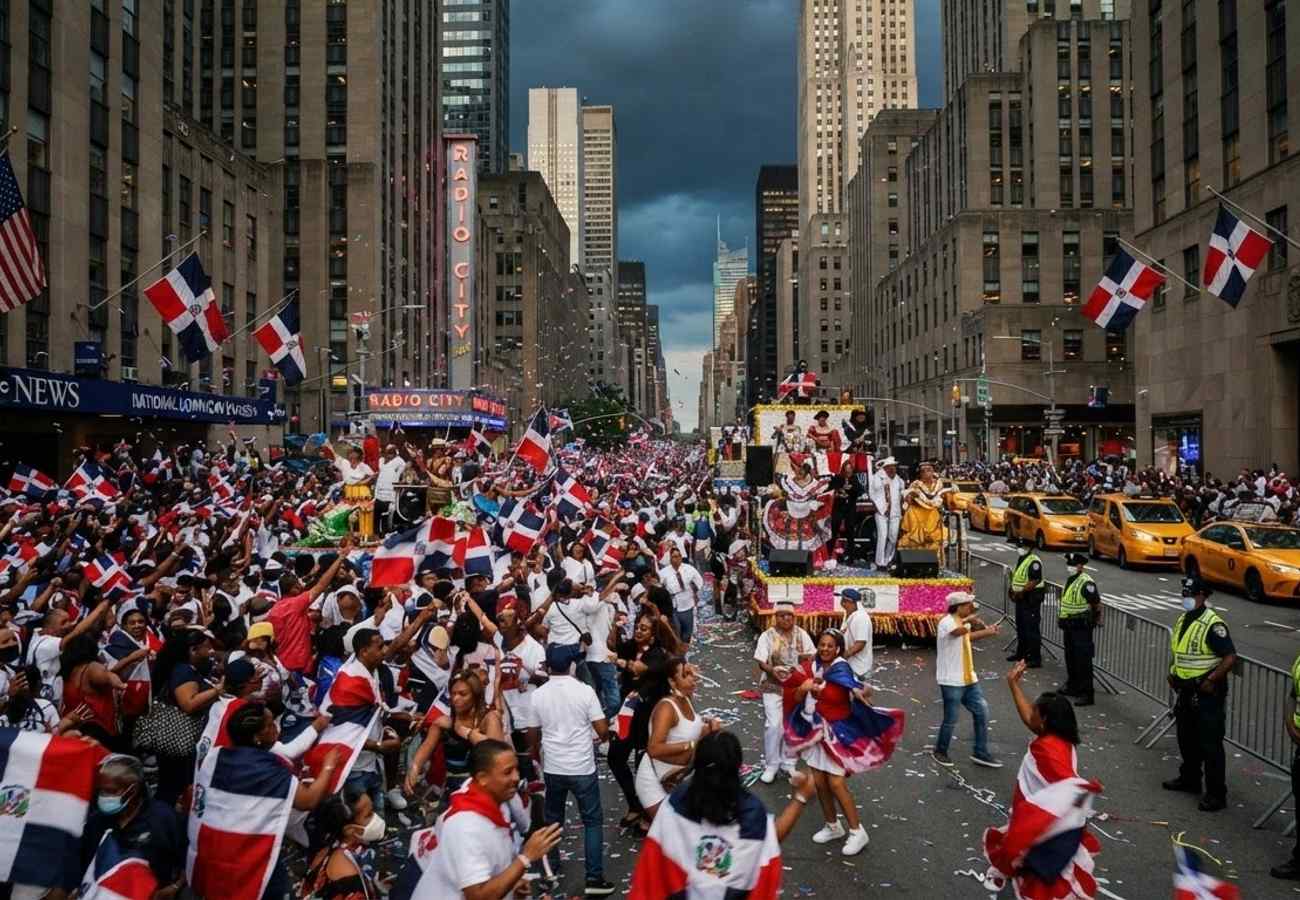
Image generated by AI
A celebratory atmosphere in Manhattan turned deadly as a fatal stabbing and widespread property damage in the Inwood neighborhood followed the conclusion of the National Dominican Day Parade. City officials are now under pressure to tighten security protocols for large-scale diaspora celebrations to prevent "teen takeovers" and violent street altercations from overshadowing cultural heritage.
The duality of the event highlights a growing challenge for municipal planners: while the formal, sanctioned portions of the parades are managed with high-visibility policing, the unstructured "after-parties" that migrate into residential corridors often escape the same level of oversight.
Violence in Inwood Overshadows Midtown Festivities
The day began as a triumphant display of Dominican identity along Sixth Avenue in Midtown Manhattan. Hundreds of thousands of attendees gathered to witness a procession defined by energetic dembow and merengue music, intricate traditional costumes, and elaborate floats. Throughout the afternoon, the event functioned as a successful showcase of community pride and artistic expression, operating under strict police supervision and heavy barricades.
However, the security success of the Midtown corridor did not extend to the late-night hours in Upper Manhattan. As the official event concluded, informal gatherings shifted north toward the Inwood neighborhood. What began as post-parade celebrations quickly devolved into chaos. Reports indicate that street blockades led to violent clashes and a "teen takeover" event, resulting in multiple stabbings and the death of one young man. Local residents reported significant property destruction, turning a day of cultural pride into a night of municipal crisis.
Logistical Hurdles for the National Puerto Rican Day Parade
The security failures in Inwood have cast a spotlight on the National Puerto Rican Day Parade, one of the largest ethnic heritage events in the United States. Held annually in June along Fifth Avenue, this event attracts over one million participants.
Because of its massive scale, the parade requires a complex coordination effort across multiple police precincts. The primary challenge for city planners is not the parade itself—which is heavily regulated—but the dispersal of a million people into the surrounding urban grid. Municipal authorities are currently refining traffic routing and crowd dispersal strategies to ensure that the high-density concentrations in Midtown do not spill over into residential areas, creating the same volatile conditions seen in Inwood.
Global Comparisons in Large-Scale Event Management
New York is not alone in struggling to balance cultural expression with public safety. Several other global hubs manage similar tensions during their largest annual festivals.
London’s Notting Hill Carnival
Every August, the narrow residential streets of West London host the Notting Hill Carnival, Europe's largest street festival. Attracting up to two million visitors, the event is a celebration of Caribbean history and sound system culture.
The Metropolitan Police face extreme logistical hurdles due to the confined urban layout, which complicates emergency vehicle access and crowd surges. While the daytime remains festive, the evening hours frequently see localized brawls. London authorities rely on high-visibility patrolling and advance intelligence monitoring to mitigate these risks.
Rio de Janeiro’s Carnival
In Brazil, the Rio Carnival utilizes a two-tier system to manage safety. The elite samba school competitions are held within the Sambadrome, a purpose-built stadium with rigid ticket controls and timed entry.
Conversely, millions of revelers participate in blocos—unsanctioned street parties spread across the city. To manage these dispersed crowds, Brazilian law enforcement employs real-time surveillance networks and specialized riot control units to prevent petty crime and overcrowding from paralyzing the city's transportation grid.
Toronto’s Caribbean Carnival (Caribana)
North America’s largest Caribbean festival, Caribana, manages hundreds of thousands of masqueraders along Exhibition Place and Lake Shore Boulevard. The primary challenge in Toronto is the proximity of the parade route to major expressways, requiring tight integration between festival organizers and regional transport authorities to prevent gridlock and ensure safe pedestrian corridors.
Comparative Safety Strategies for Global Cultural Events
| City | Event | Estimated Attendance | Primary Safety Challenge | Key Mitigation Tactic |
|---|---|---|---|---|
| New York | Dominican Day Parade | Hundreds of Thousands | Post-event residential migration | Refined crowd dispersal plans |
| New York | Puerto Rican Day Parade | 1 Million+ | High-density Midtown congestion | Multi-precinct coordination |
| London | Notting Hill Carnival | 2 Million | Narrow street accessibility | High-visibility patrolling |
| Rio de Janeiro | Carnival | Millions | Unsanctioned blocos | Real-time surveillance & riot units |
| Toronto | Caribana | Hundreds of Thousands | Expressway proximity | Transport authority integration |
Analysis of Urban Safety and Cultural Expression
The events in Inwood reveal a critical gap in "end-to-end" event planning. Most municipal safety plans focus on the event footprint—the specific streets where the parade occurs. However, the risk profile shifts the moment the official event ends and the crowd disperses.
For the resident of Upper Manhattan or West London, the "celebration" often feels like an invasion when it moves from a sanctioned boulevard to a residential side street. From a logistical standpoint, the transition from a controlled environment (the parade route) to an uncontrolled environment (the neighborhood) is where the highest risk of violence occurs.
For the traveler or attendee, this means that while the primary events are safe, the "after-party" scenes in residential areas can become unpredictable. The shift toward "teen takeovers" suggests a need for targeted youth engagement and a police presence that follows the crowd's migration pattern rather than remaining static at the parade's end point.
The challenge for 2027 will be ensuring that the celebration of diaspora heritage does not come at the cost of neighborhood stability.
Related Travel Guides
Disclaimer
This article is for informational and educational purposes only. It does not constitute legal, financial, or professional advice. While we strive to provide accurate and up-to-date information, travel policies, regulations, and conditions change rapidly. Always verify information with official sources before making travel decisions. Nomad Lawyer makes no representations about the accuracy, reliability, completeness, or suitability of the information provided. Readers should consult qualified professionals for advice specific to their circumstances. The views expressed in this article are those of the author and do not necessarily reflect the views of Nomad Lawyer.
Preeti Gunjan
Contributor & Community Manager
A passionate traveller and community builder. Preeti helps grow the Nomad Lawyer community, fostering engagement and bringing the reader experience to life.
Learn more about our team →