
Northern Railway Strengthens Festival Connectivity With New Special Trains Linking Punjab and Eastern India
Northern Railway Strengthens Festival Connectivity With New Special Trains Linking Punjab and Eastern India

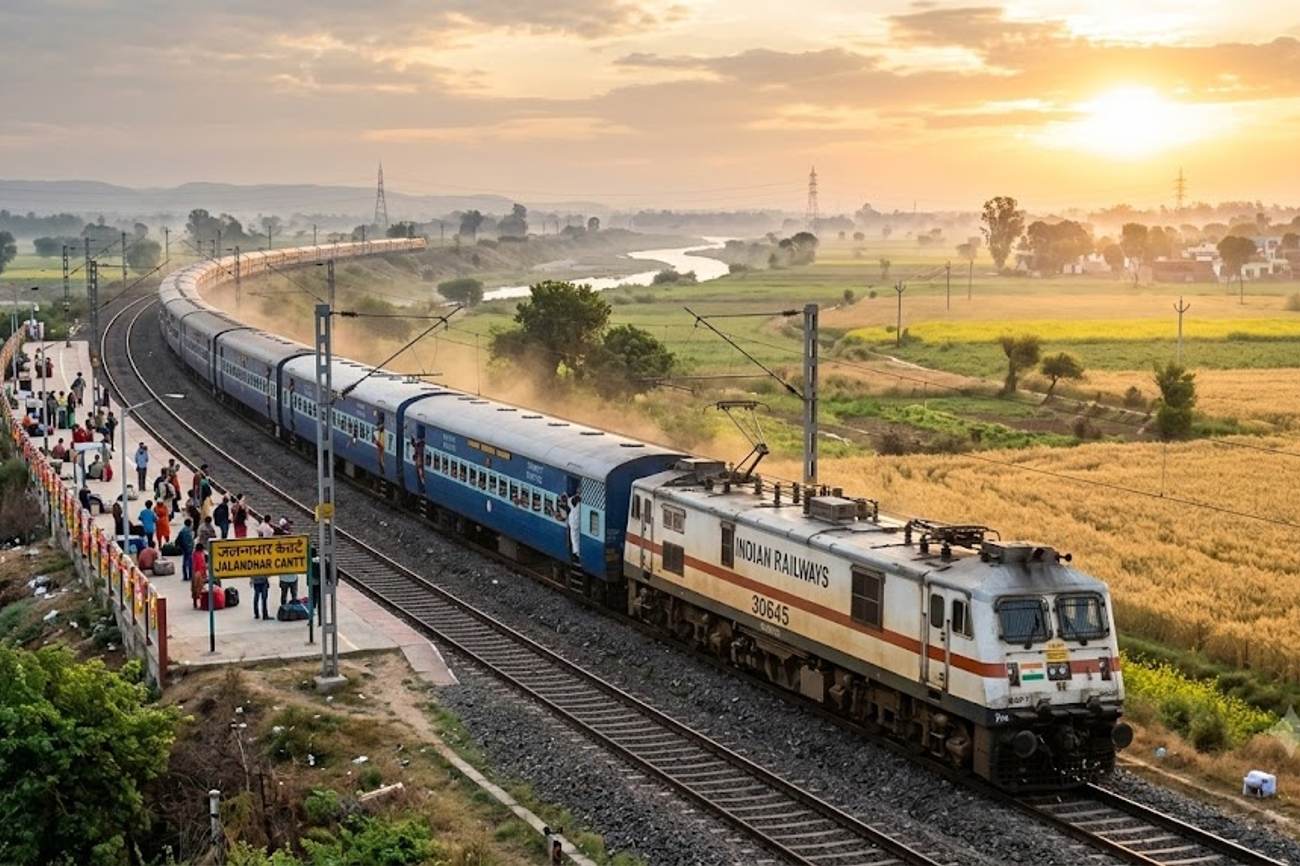
Image generated by AI
Rail capacity on long-haul corridors in India typically spikes by 15-20% during Q4 to accommodate the massive migration of workers and families during the festive season. The introduction of dedicated festival specials by Northern Railway for 2026 is a direct response to this cyclical demand, targeting the high-volume corridor between Punjab and the eastern states of West Bengal and Bihar.
The Punjab-East Corridor in Numbers
The 2026 festive schedule reveals a calculated effort to alleviate congestion on some of the most strained routes in the Indian rail network. Northern Railway has deployed two specific reserved special services to manage the surge between October and December 2026.
For the Amritsar–Kolkata–Amritsar route, the operation is split between Train No. 04624 and Train No. 04623. Train No. 04624 will depart Amritsar every Wednesday from October 7 to November 25, 2026, leaving at 8:10 PM and arriving in Kolkata at 3:00 PM. This journey spans 42 hours and 50 minutes. The return leg, Train No. 04623, operates every Saturday from October 10 to November 28, 2026, departing Kolkata at 4:45 AM and arriving in Amritsar at 9:05 PM, with a total travel time of 40 hours and 20 minutes.
Simultaneously, the Amritsar–Barauni–Amritsar corridor will be bolstered by Train Nos. 04668 and 04667. Train No. 04668 will run every Sunday from October 4 to November 29, 2026, departing Amritsar at 8:10 PM and reaching Barauni at 2:10 AM after 30 hours. The return service, Train No. 04667, departs Barauni every Tuesday from October 6 to December 1, 2026, at 5:05 AM, arriving in Amritsar at 1:50 PM after a journey of 32 hours and 45 minutes.
The fleet composition for both services is identical, reflecting a standardized approach to passenger demographics on these routes. Each train consists of:
- 1 AC 2-Tier coach
- 2 AC 3-Tier coaches
- 9 Sleeper Class coaches
- 6 General Class coaches
This configuration prioritizes high-density, affordable travel (Sleeper and General) while maintaining a small percentage of premium capacity, aligning with the migration patterns seen in IATA and other transport data regarding seasonal labor movements across Asia.
Comparative Regional Logistics
The deployment of these specials highlights a broader trend in Indian rail management: the shift toward "surge-capacity" scheduling rather than permanent route expansion. By limiting these trains to a two-month window, Northern Railway avoids the overhead of permanent staffing while capturing peak revenue.
When comparing the two routes, the Amritsar-Barauni service is significantly more efficient in terms of time, saving passengers approximately 12 hours per leg compared to the Kolkata route. This reflects the geographic proximity of Bihar to Punjab relative to West Bengal. However, the Kolkata route serves as a primary artery for the easternmost reaches of the country, justifying the longer transit time.
The following table breaks down the operational specifics of the 2026 Festival Specials:
| Route Metric | Amritsar $\rightarrow$ Kolkata (04624) | Kolkata $\rightarrow$ Amritsar (04623) | Amritsar $\rightarrow$ Barauni (04668) | Barauni $\rightarrow$ Amritsar (04667) |
|---|---|---|---|---|
| Departure Day | Wednesday | Saturday | Sunday | Tuesday |
| Operating Window | Oct 7 – Nov 25, 2026 | Oct 10 – Nov 28, 2026 | Oct 4 – Nov 29, 2026 | Oct 6 – Dec 1, 2026 |
| Departure Time | 8:10 PM | 4:45 AM | 8:10 PM | 5:05 AM |
| Arrival Time | 3:00 PM | 9:05 PM | 2:10 AM | 1:50 PM |
| Total Duration | 42h 50m | 40h 20m | 30h 00m | 32h 45m |
| Total Trips (04668) | N/A | N/A | 9 Trips | N/A |
This strategic allocation of rolling stock is a common pattern observed in emerging markets where infrastructure cannot keep pace with population growth. According to data patterns from Statista, the demand for rail travel in India remains highly elastic, fluctuating sharply based on the lunar calendar and regional holidays.
What This Means for Travelers
For the individual traveler or the digital nomad navigating India during the 2026 festive window, this data signals a critical need for early intervention in booking.
First, the limited number of AC coaches (only three per train) suggests that premium seating will sell out almost instantly. If you require AC 2-Tier or 3-Tier accommodation, you must book the moment the reservation window opens. The heavy weighting toward Sleeper (9 coaches) and General (6 coaches) indicates that the bulk of the capacity is designed for budget travelers, meaning these carriages will be extremely crowded.
Second, the specific departure days (Wednesdays for Kolkata, Sundays for Barauni) mean that flexibility is low. If your travel dates do not align with these specific days, you will be forced back onto regular services, which are historically overbooked during Q4.
Third, the travel durations—exceeding 40 hours for the Kolkata route—require significant planning for sustenance and hygiene. Travelers should budget for these "marathon" journeys, as special trains often have different catering arrangements than permanent express services.
Projections for Long-Haul Connectivity
The 2026 schedule indicates that Northern Railway is moving toward a more granular, data-driven approach to seasonal demand. We can expect a future shift where "Festival Specials" are not just added to existing routes, but are dynamically routed based on real-time booking heatmaps.
As the Indian government continues to invest in high-speed rail and the modernization of tracks, the 40-hour transit time between Punjab and West Bengal will likely become the benchmark to beat. The current reliance on 18-coach configurations (1+2+9+6) suggests that the demand for "affordable" long-distance travel still far outweighs the demand for luxury travel on these specific corridors.
Furthermore, the extension of the Barauni return service into December 1 suggests a longer "tail" for the festive season in Bihar compared to West Bengal, signaling a regional difference in how holidays are celebrated and how laborers return to their home states. This suggests that for future Q4 planning, Bihar-bound travel requires a longer booking window than West Bengal-bound travel.
FAQ: Northern Railway Festival Specials 2026
Will ticket prices increase for these special trains? Yes. Festival special trains typically carry a "special fare" premium compared to regular express trains. Travelers should expect a slight increase in ticket costs in exchange for the guaranteed availability during the peak season.
Is it better to book these specials or regular trains? If regular trains are already showing "Waitlisted" status, these specials are your best option. However, they operate on a limited schedule (e.g., only Wednesdays or Sundays), so they offer less flexibility than daily services.
Which class of travel is most likely to be available? Sleeper Class and General Class have the highest capacity (15 coaches combined). AC classes are extremely limited (3 coaches total), making them the most difficult to secure.
How do these trains affect travel time? These specials are designed to provide extra capacity, not necessarily faster speeds. With travel times reaching 42 hours and 50 minutes for the Kolkata route, they mirror the duration of standard long-haul services.
The shift toward surge-capacity rail scheduling proves that in the world of mass transit, flexibility is the only way to survive the peak.
#NorthernRailway2026 #AmritsarKolkataRail #BarauniConnectivity #IndiaRailSurgeCapacity #Q4TravelTrendsIndia #RailPassengerVolume2026
Related Travel Guides
- Assam Completes Full Rail Electrification Drive to Deliver Smarter and More Efficient Train Services
- United States Unveils Colorado Mountain Travel Revolution With Proposed High Speed Train Reaching 90 Miles Per Hour
- Spain High-Speed Rail Passenger Numbers Plunge 21% in 2026 Following Major Network Disruptions Across Key Tourism Routes
Disclaimer
This article is for informational and educational purposes only. It does not constitute legal, financial, or professional advice. While we strive to provide accurate and up-to-date information, travel policies, regulations, and conditions change rapidly. Always verify information with official sources before making travel decisions. Nomad Lawyer makes no representations about the accuracy, reliability, completeness, or suitability of the information provided. Readers should consult qualified professionals for advice specific to their circumstances. The views expressed in this article are those of the author and do not necessarily reflect the views of Nomad Lawyer.
Preeti Gunjan
Contributor & Community Manager
A passionate traveller and community builder. Preeti helps grow the Nomad Lawyer community, fostering engagement and bringing the reader experience to life.
Learn more about our team →