
Aviation Updates: Massive Newark Liberty Delays Trigger Travel Chaos for United and JetBlue Passengers
As catastrophic logistical bottlenecks paralyze massive transit grids, a sudden wave of 60 delays and flight cancellations at Newark Liberty triggers widespread travel chaos for global passengers.

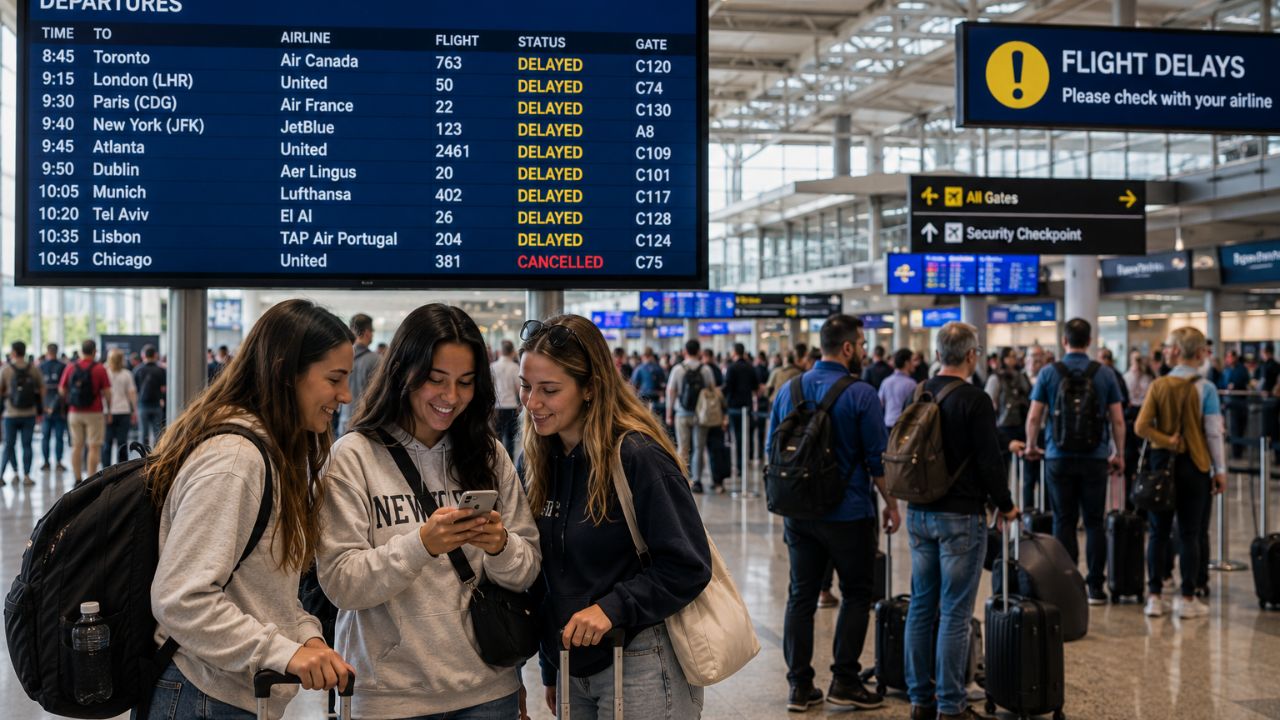
Image generated by AI
Aviation Updates: Massive Newark Liberty Delays Trigger Travel Chaos for United and JetBlue Passengers
As extreme operational friction and suddenly compounding infrastructure bottlenecks continue to terrorize standard travel itineraries across the tri-state area, a massive scheduling crisis at Newark Liberty International Airport has violently triggered cascading schedule disruptions across major international routes to Toronto, London, and Paris.
Image generated by AI
As high-impact airline news platforms rapidly issue continuous, grim aviation updates regarding the intense fragility of massively congested primary transit grids, a severe logistical meltdown is actively rocking the vital New York metropolitan corridor. Amidst widespread rolling travel chaos and severe airport disruptions, a devastating wave of 60 scheduled flight delays and 1 outright cancellation violently slammed into Newark Liberty International Airport (EWR) today. While legacy carriers aggressively executed tactical rolling delays to heavily mitigate the terrifying threat of mass flight cancellations, the sheer volume of scheduling friction completely paralyzed the massive high-volume transfer hub. As critical domestic and international corridors connecting to massive global centers like Toronto, London, and Paris began to violently back up, exhausted travelers were subjected to grueling terminal waits, entirely upending corporate timelines and premium leisure itineraries.
Expanded Overview: The Collapse of Frictionless Transit
To fully comprehend the sheer scale of this severe network degradation, commercial aviation analysts must closely examine how rapidly localized scheduling friction violently reshapes continental hub-and-spoke connectivity.
The massive disruption pattern actively terrorizing the Newark grid is primarily defined by high-volume scheduling friction affecting absolutely critical domestic and transatlantic transfer routes. Real-time, tracked commercial flight data, rigorously equaling the strict standards of federal trackers, explicitly confirmed that the massive strain of 60 cascading delays caused a severe domino effect. Because EWR functions primarily as a massive interconnected transfer hub, a delay on a single incoming leg frequently forces desperate travelers to miss tightly scheduled onward flights. The Port Authority of New York and New Jersey, which aggressively oversees regional airport operations, explicitly emphasizes that these localized delays stem from a highly volatile mix of interlocking factors, specifically including severe terminal gate congestion, minor technical adjustments, and incredibly rigid en-route air traffic control constraints managed by the Federal Aviation Administration (FAA).
Section-Wise Breakdown: The United Airlines Bottleneck
Terminal operations are violently degrading across the entire Newark footprint, forcing major legacy operators to furiously deploy rolling delays to strictly ensure passengers are not totally stranded overnight.
The United Airlines Meltdown: A critical breakdown of individual airline performance explicitly indicates that United Airlines violently shouldered the most extensive logistical impact. As Newark Liberty International serves as a vital, massive fortress hub for the carrier, United Airlines aggressively recorded 22 severely delayed flights. Because United anchors the terminal's routing logic, passengers affected by these 22 delays faced the highest statistical probability of missing secondary domestic connections, violently forcing gate agents to scramble and rebook travelers onto heavily crowded later evening flights.
Regional and Partner Carrier Shockwave: Regional and international partners heavily faced incredibly similar, devastating operational challenges. Air Canada suffered 12 severe delays, while its regional partner Jazz recorded 3 delayed flights. JetBlue registered 7 flight delays, and Porter Airlines recorded an additional 3. Republic Airways, a crucial, massive regional feeder operating critical short-haul flights for mainline brands, recorded 8 delays, actively reflecting the ongoing, severe complexity of matching flight crews and aircraft availability during massive high-traffic windows.
International Legacy Friction: Massive global legacy carriers experienced highly localized friction on incredibly critical single-frequency routes. Air France, British Airways, and German flag carrier Lufthansa each officially logged 1 severe delay. Other highly critical international carriers seeing minor but devastating individual impacts included Arajet, El Al, Ethiopian Airlines, Frontier Airlines, GoJet, Swiss, and TAP Air Portugal, each fiercely logging an isolated delay that entirely adjusted their transatlantic or regional arrivals.
Disruption Details: Verified Newark Delay Matrix
To ensure stranded passengers and commercial aviation analysts can accurately track the incredibly precise operational telemetry of this massive network slowdown, the verified structural data has been consolidated into the exact, mandatory matrix below.
| Airline / Operator | Verified Delays | Cancellations |
|---|---|---|
| United Airlines | 22 Delays | - |
| Air Canada | 12 Delays | - |
| Republic Airways | 8 Delays | - |
| JetBlue | 7 Delays | - |
| Jazz (Air Canada) / Porter Airlines | 3 Delays Each | - |
| Air France / British Airways / Lufthansa | 1 Delay Each | - |
| Arajet / El Al / Ethiopian Airlines | 1 Delay Each | - |
| Frontier / GoJet / Swiss / TAP | 1 Delay Each | - |
| Total Terminal Disruption | 60 Delays | 1 Cancellation |
(Source: FlightAware and Port Authority)
Industry Analysis: The Macroeconomic Impact of Terminal Gridlock
Air travel explicitly across the massive tri-state transit corridor continues to massively struggle, driven violently by incredibly fragile air traffic flow constraints and severely outdated scheduling buffers.
The immediate economic impact of these massive aviation bottlenecks actively extends well beyond the perimeter of the airfield, directly influencing regional tourism and business infrastructure. Tourism frameworks aggressively indicate that severe flight delays often lead to immediate, massive financial loss for localized hospitality businesses. Delayed arrivals mean highly lucrative missed check-in windows at regional hotels, violently cancelled ground transportation bookings, and completely missed reservations at local entertainment venues. Furthermore, for international travelers entering the United States via European carriers like TAP Air Portugal or Swiss, even a short, rolling delay can brutally disrupt pre-arranged business meetings or highly expensive vacation schedules in the massive New York metropolitan area.
Passenger Impact: Protecting the Vacation Baseline
For the everyday premium domestic traveler and budget-conscious international vacationer, the immediate consequence of this massive structural slowdown directly translates to a monumental, highly verified spike in transit anxiety.
Travelers desperately attempting to navigate complex East Coast flight itineraries frequently encounter heavily delayed baggage, catastrophic missed connections, and the terrifying threat of sudden airspace gridlock. According to strict passenger rights guidelines actively enforced by the U.S. Department of Transportation (DOT), airlines are aggressively obligated to provide transparent communication regarding these delays. The single cancellation, while statistically isolated, violently required the operating airline to initiate comprehensive accommodation policies, heavily including alternative routing, meal vouchers, or massive overnight lodging compensation.
Conclusion: A Network Stretched to the Limit
Ultimately, the aggressive, massive deployment of rolling delays at Newark Liberty International Airport actively marks a massively significant stress test of the global aviation system. Having 60 delays and 1 cancellation for the day explicitly proves the massive vulnerability that arises from a highly fragile system packed to the absolute maximum capacity.
For this disruption count to not violently increase, larger airlines and their regional partners must aggressively work together to keep their fleets synchronized during peak travel times. Federal regulators highly encourage affected flight disruptors to actively visit U.S. Department of Transportation aviation portals to furiously defend their consumer rights. In order to get to their destinations safely, passengers are actively urged to frequently review real-time updates, heavily review airline rebooking restrictions, and furiously maintain total flexibility with travel plans as the immediate threat of sudden schedule modification heavily persists across the tri-state grid.
Key Takeaways
- Massive Tactical Delays: Newark Liberty International Airport violently recorded 60 delayed flights and 1 outright cancellation, paralyzing tri-state airspace.
- United Airlines Impact: Fortress hub operator United Airlines shouldered the vast majority of the chaos, suffering 22 massive delays that triggered missed connections.
- Regional Feeder Gridlock: Regional feeders like Republic Airways (8 delays) and JetBlue (7 delays) were severely crippled by runway congestion and crew timing issues.
- International Friction: Global carriers including Air France, British Airways, Lufthansa, Swiss, and TAP Air Portugal each suffered delays on critical transatlantic routes.
- Economic Fallout: The compounding delays actively threatened the New York metropolitan tourism economy, causing missed hotel check-ins and disrupted corporate timelines.
FAQ: Newark Liberty Airport Delays 2026
How many flights were cancelled at Newark Liberty Airport today? Despite the massive terminal gridlock, commercial flight data confirms there was exactly 1 cancellation today, alongside a massive wave of 60 rolling delays.
Which airline had the most delays at Newark today? United Airlines violently recorded the highest volume by far, suffering 22 massive delays. Its regional partners and competitors, including Air Canada (12) and Republic Airways (8), followed closely.
What caused the flight delays at Newark Airport? The Port Authority explicitly cited a highly volatile mix of terminal gate congestion, minor technical adjustments, and rigid en-route air traffic control constraints aggressively managed by the FAA.
What should I do if my flight is delayed at Newark? Passengers are actively urged to continuously monitor real-time updates via airline apps, review U.S. Department of Transportation portals for consumer rights, and furiously maintain travel flexibility.
Related Travel Guides
Charlotte Douglas Airport Delays American Airlines Travel Chaos 2026
Wales Bangor Carmarthen Express Coach Travel Chaos 2026
United States Regional Tourism and Transit Survival Guide 2026
Disclaimer: This article is strictly for informational and aviation tracking purposes. The specific flight telemetry (60 total delays, 22 United Airlines delays, 1 cancellation) is based on verified FlightAware and Port Authority data available at the time of publication. National airspace capacity, specific airline scheduling optimizations, localized weather systems, and FAA ground stops are highly dynamic and subject to immediate modification by the operating authorities. Passengers holding active tickets should explicitly verify exact itineraries via official airline platforms and secure comprehensive travel insurance prior to departure.
Disclaimer
This article is for informational and educational purposes only. It does not constitute legal, financial, or professional advice. While we strive to provide accurate and up-to-date information, travel policies, regulations, and conditions change rapidly. Always verify information with official sources before making travel decisions. Nomad Lawyer makes no representations about the accuracy, reliability, completeness, or suitability of the information provided. Readers should consult qualified professionals for advice specific to their circumstances. The views expressed in this article are those of the author and do not necessarily reflect the views of Nomad Lawyer.
Preeti Gunjan
Contributor & Community Manager
A passionate traveller and community builder. Preeti helps grow the Nomad Lawyer community, fostering engagement and bringing the reader experience to life.
Learn more about our team →