
Nashville and New Orleans are Surging as Premier Weekend Short Getaway Destination Across US for These New Reasons in 2026
Nashville and New Orleans are Surging as Premier Weekend Short Getaway Destination Across US for These New Reasons in 2026

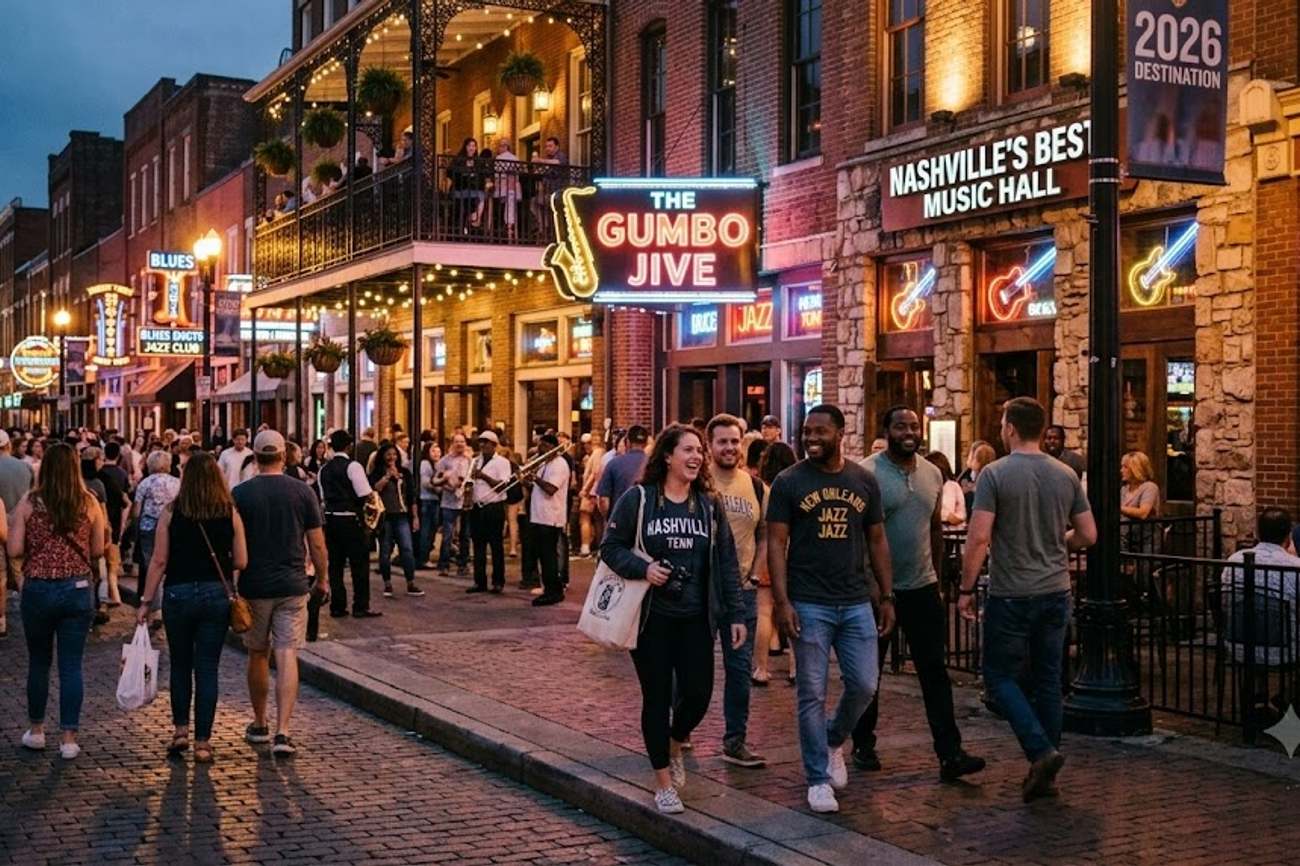
Image generated by AI
$1.19 trillion is the projected domestic travel spending in the United States for 2026, signaling a massive pivot toward high-frequency, culturally dense short-haul trips. This figure represents a sharp escalation from the $895 billion recorded in 2025, confirming that American consumers are prioritizing experiential "pilgrimages" over traditional, long-term resort vacations. The data indicates a fundamental reallocation of the travel budget, where spending has shifted away from retail and toward dining and recreation, fueling the rise of cities that offer authentic, non-replicable regional identities.
The Rise of the Cultural Pilgrimage
The traditional American holiday model—once dominated by formulaic theme parks and generic beach resorts—has been dismantled by a demand for authenticity. Travelers are now engaging in what is termed a "cultural pilgrimage," a highly intentional journey designed to consume specific artistic and gastronomic outputs. This shift is not merely a trend in preference but a structural change in how the hospitality industry operates.
Municipalities are responding by treating local heritage as a primary economic asset. Rather than building new attractions, city planners are investing in the preservation of historic music venues and the promotion of indigenous culinary techniques. This strategy targets a specific demographic: younger, highly educated travelers who are willing to pay a premium for artisanal, locally sourced experiences. This behavioral shift has forced a realignment of airline routing strategies across North America, as carriers prioritize high-frequency weekend corridors to urban centers with strong regional identities.
Economic Dominance of the Southern Hubs
The financial impact of this shift is most evident in the surge of Nashville and New Orleans, where music and food serve as the primary engines of growth. The economic multiplier effect in these cities is significantly higher than in retail-centric destinations because spending is directed toward independent, chef-driven restaurants and family-run music clubs, ensuring that capital circulates more rapidly within the local economy.
Nashville, in particular, has evolved into a dual-threat tourism economy by pairing its country music legacy with a sophisticated culinary renaissance. The scale of this impact is detailed in the following breakdown of Davidson County's performance.
| Metric | 2025 Data Point | Growth/Context |
|---|---|---|
| Direct Visitor Spending | $11.6 Billion | 3.5% Year-over-Year Increase |
| Share of TN State Spending | 35% | Highest of 95 TN Counties |
| Total Annual Visitors | 17.4 Million | Daily & Overnight |
| Average Daily Economic Injection | $31.8 Million | Direct local impact |
The dominance of Nashville is so absolute that the combined visitor spending of the next four highest-performing counties in Tennessee—Shelby, Sevier, Knox, and Hamilton—is required just to match the output of Davidson County alone. This concentration of wealth highlights the power of "destination branding" based on specific cultural niches.
Expert Analysis: The "Micro-Vacation" Economic Engine
For the modern traveler, the direct consequence of this trend is a surge in "micro-vacation" pricing. As demand concentrates on specific weekends in cities like Nashville and New Orleans, we are seeing a volatility in short-term rental and hotel pricing that mirrors the "event-pricing" model typically reserved for the Super Bowl or the Oscars.
The pricing pressure created by this shift means that the "weekend getaway" is no longer a budget-friendly alternative to a long vacation; it is a premium product. Because travelers are now prioritizing "dining and recreation" over retail, the cost of the trip has shifted from the shopping mall to the restaurant table and the concert ticket. This creates a feedback loop: as these cities become more expensive, they attract a higher-spending demographic, which in turn encourages the development of even more high-end, artisanal experiences.
From a logistical perspective, this trend is placing immense pressure on regional aviation hubs. When 17.4 million people descend on a single county, the infrastructure—from the Federal Aviation Administration (FAA) regulated airspace to local ground transport—reaches a breaking point. We are seeing a shift where airlines are optimizing flight schedules not for business commuters, but for "Friday-to-Sunday" cultural tourists. For those booking these routes, the strategy must shift toward extreme early booking to avoid the "cultural premium" added to airfares during peak music and food festival windows.
The reliance on "authentic" experiences also puts these cities at risk of "cultural dilution." As the International Air Transport Association (IATA) tracks the increase in passenger volume to these hubs, the challenge for Nashville and New Orleans will be maintaining the very authenticity that drives the $1.19 trillion domestic spend without turning their historic districts into sanitized tourist zones.
Key Takeaways
- Spending Pivot: Domestic travel spending is forecast to hit $1.19 trillion in 2026, up from $895 billion in 2025.
- Nashville's Dominance: Davidson County generated $11.6 billion in 2025, accounting for 35% of all visitor spending in Tennessee.
- Expenditure Shift: Travelers are abandoning retail shopping in favor of "dining and recreation," increasing the economic multiplier for local, independent businesses.
- Volume Metrics: Nashville welcomed 17.4 million visitors in 2025, injecting an average of $31.8 million into the economy daily.
- Travel Pattern Change: The "cultural pilgrimage" model has replaced long-haul resort stays with high-frequency, short-duration urban trips.
FAQ: US Cultural Getaways 2026
Why are Nashville and New Orleans more popular than beach resorts in 2026? Travelers are prioritizing "experiential travel" and cultural authenticity. The desire to engage with unique regional music (Country and Cajun) and indigenous culinary scenes has made these cities more attractive than generic, formulaic resort experiences.
How has the cost of domestic travel changed for 2026? Spending has increased to a projected $1.19 trillion. While overall budgets are higher, the money is being spent differently—shifting from retail goods to high-end dining, live music, and curated local tours.
What is the "economic multiplier effect" mentioned regarding these cities? It refers to how money spent at independent, locally-owned businesses (like a Cajun kitchen or blues club) stays within the community and circulates more times than money spent at multinational chains, boosting the local economy more effectively.
Is Nashville the most visited place in Tennessee? Yes, in terms of spending. Davidson County is the top performer among Tennessee's 95 counties, with $11.6 billion in spending, outperforming the next four largest counties combined.
The era of the generic vacation is dead; the age of the intentional pilgrimage has arrived.
Tags: Nashville Tourism 2026, New Orleans Cultural Travel, Davidson County Economics, US Domestic Travel Trends 2026, Experiential Tourism Analysis
Related Travel Guides
Disclaimer
This article is for informational and educational purposes only. It does not constitute legal, financial, or professional advice. While we strive to provide accurate and up-to-date information, travel policies, regulations, and conditions change rapidly. Always verify information with official sources before making travel decisions. Nomad Lawyer makes no representations about the accuracy, reliability, completeness, or suitability of the information provided. Readers should consult qualified professionals for advice specific to their circumstances. The views expressed in this article are those of the author and do not necessarily reflect the views of Nomad Lawyer.
Preeti Gunjan
Contributor & Community Manager
A passionate traveller and community builder. Preeti helps grow the Nomad Lawyer community, fostering engagement and bringing the reader experience to life.
Learn more about our team →