
Middle East Flight Disruptions Intensify as Delays Surge at Doha Hamad International Airport 2026
Flight delays are surging across major Gulf hubs, specifically at Doha's Hamad International Airport, as restricted airspace and conflict-related routing constraints create systemic bottlenecks for global travel between Europe and Asia.

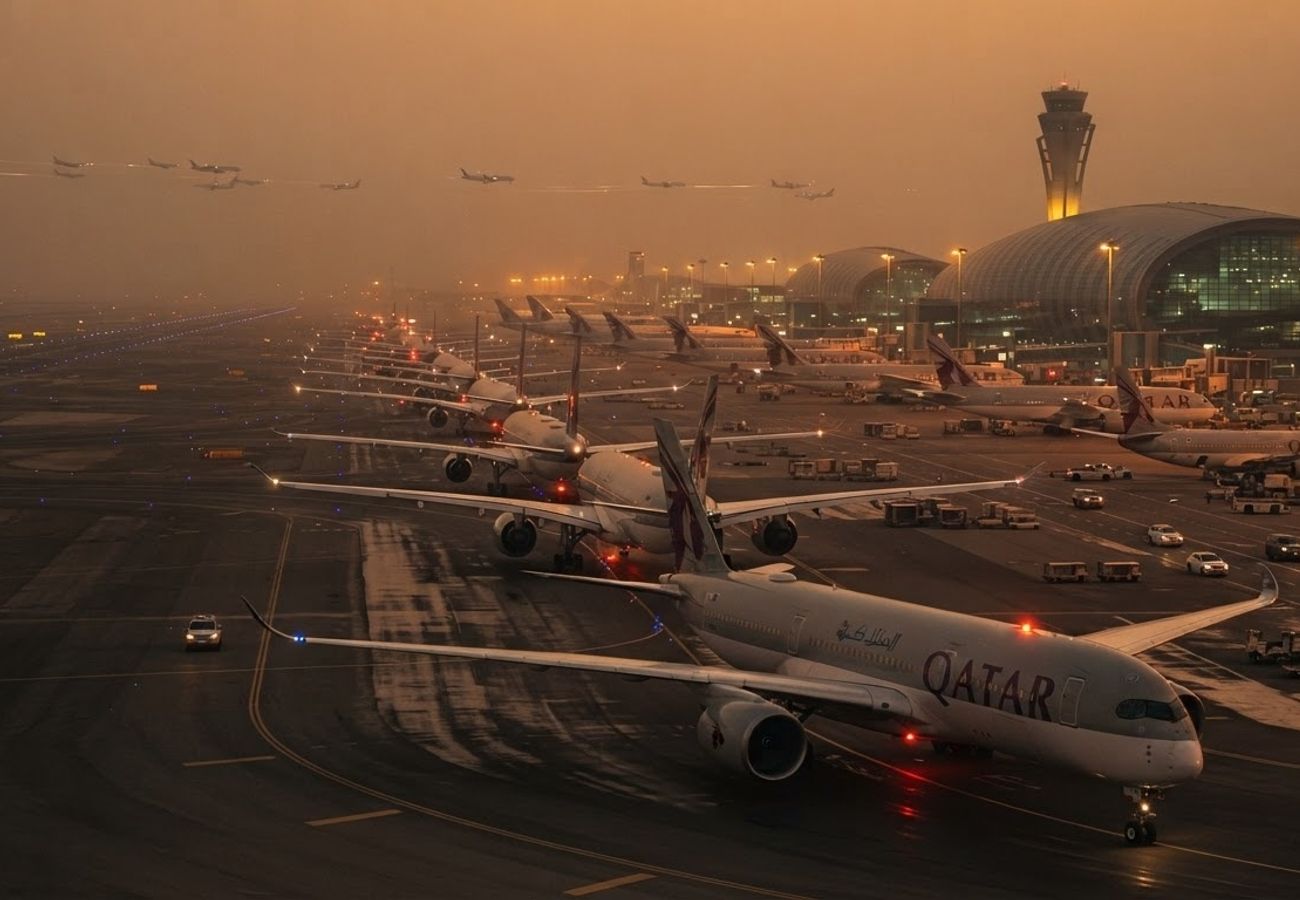
Image generated by AI
Flight delays have spiked across primary Middle East aviation hubs, with Hamad International Airport in Doha reporting widespread schedule disruptions. These delays are creating significant knock-on effects for global routes linking Europe, Asia, and East Africa.
The regional aviation network remains fragile, operating under strict conflict-related airspace restrictions that have limited flight paths to specific corridors and routing points. While Hamad International remains functional as a primary transfer hub, the current operational environment is highly sensitive; minor disruptions are rapidly cascading into systemic delays.
Airspace Constraints at Doha
Operational data indicates that flights to and from Doha are constrained to limited, published routes. Throughout 2026, Qatari airspace has faced partial closures, forcing arriving and departing services into narrow corridors. These restrictions persist even as traffic volumes recover, meaning any spike in demand immediately triggers flow restrictions.
The "banked" structure of Doha’s schedule—characterized by dense evening and overnight waves of departures—amplifies this risk. Upstream congestion, weather-related rerouting, or air traffic flow management in neighboring regions frequently result in clusters of delayed flights during peak connecting windows.
Regional Systemic Vulnerabilities
The 2026 Middle East conflict initially caused a sharp reduction in scheduled capacity across the Gulf. While airports in Qatar, the UAE, and Saudi Arabia have reopened for commercial traffic, they operate with minimal spare runway or airspace capacity during peak hours.
Industry intelligence identifies a state of "stabilized disruption" across the following key hubs:
- Doha (DOH)
- Dubai (DXB)
- Abu Dhabi (AUH)
- Riyadh (RUH)
- Jeddah (JED)
These hubs are currently subject to tactical rerouting, congestion, and occasional GPS interference. Given the high summer demand, a single late inbound aircraft can trigger a chain reaction of missed connections across the region.
Impact on Saudi and Emirati Hubs
Disruptions are not isolated to Qatar. Operational summaries for August 2026 reveal elevated instability at other Gulf gateways:
- King Abdulaziz International Airport (Jeddah): Independent tracking has recorded over 100 cancellations this month alone.
- United Arab Emirates: Carriers serving Dubai continue to adjust schedules based on evolving security assessments and airspace guidance.
Because aircraft and crews rotate through multiple regional hubs in a single duty day, a delay in Jeddah or Dubai frequently manifests as a late arrival in Doha, creating ramp queues and airspace bottlenecks.
Safety Advisories and Routing Bottlenecks
International safety advisories continue to complicate operations in the Persian Gulf and Gulf of Oman. European regulators have urged operators to limit or avoid airspace over:
- Bahrain
- Kuwait
- Qatar
- United Arab Emirates
While these are not full closures, they restrict available flight levels and routes. Some national regulators prohibit specific carriers from entering Qatari airspace entirely, diverting traffic into a small number of neighboring corridors and increasing pressure on those remaining paths.
Operational Impact Summary
| Metric/Factor | Current Status | Impact on Passenger Experience |
|---|---|---|
| Doha Airspace | Restricted to specific corridors | Increased flight times and bottlenecking |
| Jeddah (August) | 100+ Cancellations | High risk of total trip disruption |
| Hub Capacity | Reduced/Stabilized | Tighter turnaround times; higher baseline delays |
| Routing | Diverted via safety advisories | Reduced flexibility to avoid weather systems |
Why This Matters: Industry Analysis
From a logistical perspective, the "stabilization" cited by coordination bodies is deceptive. The aviation industry is currently operating with zero margin for error in the Gulf. For travelers, this means that a "confirmed" connection in Doha or Dubai is significantly higher risk than in previous years.
Our analysis of the route map suggests that the reliance on a few "mega-hubs" to facilitate Europe-Asia transit has created a single point of failure. When Doha slows, it doesn't just affect Qatar Airways; it disrupts the entire global flow because there are simply not enough alternative corridors to absorb the diverted volume. The shift from "full closure" to "restricted corridors" has replaced total cancellations with unpredictable, cascading delays.
Forward Outlook
Expect intermittent but intense disruption days to continue through the remainder of the current scheduling season. Until conflict-related advisories are lifted and airspace is fully reopened, airlines will lack the flexibility to absorb operational shocks. Passengers should anticipate longer flight durations on sectors involving the Persian Gulf and should build significant buffers into connecting itineraries.
The Gulf's aviation recovery remains a fragile equilibrium of restricted corridors and peak demand.
Related Travel Guides
Disclaimer
This article is for informational and educational purposes only. It does not constitute legal, financial, or professional advice. While we strive to provide accurate and up-to-date information, travel policies, regulations, and conditions change rapidly. Always verify information with official sources before making travel decisions. Nomad Lawyer makes no representations about the accuracy, reliability, completeness, or suitability of the information provided. Readers should consult qualified professionals for advice specific to their circumstances. The views expressed in this article are those of the author and do not necessarily reflect the views of Nomad Lawyer.
Preeti Gunjan
Contributor & Community Manager
A passionate traveller and community builder. Preeti helps grow the Nomad Lawyer community, fostering engagement and bringing the reader experience to life.
Learn more about our team →