
Middle East Flight Disruptions: 560 Delays and 95 Cancellations Hit Dubai, Jeddah, Cairo, and Regional Hubs


While Dubai International Airport absorbed the largest share of regional schedule friction with 164 delayed flights, the epicenter of outright flight cancellations struck Saudi Arabia, where 61 commercial departures were abruptly grounded across Jeddah, Riyadh, and Abha as heightened security reviews and airspace restrictions forced carriers to redraw their flight corridors. Real-time aviation tracking records compiled by FlightAware on 1 November 2026 at 2:46 pm US Eastern Time (11:47 pm Gulf Standard Time) confirmed an aggregate of 560 delays and 95 cancellations across ten primary gateways in the Middle East and surrounding connecting regions. As security developments involving Houthi cross-border actions and defensive radar deployments pressure commercial flight corridors, international airlines face complex routing diversions that extend aircraft rotation cycles and disrupt high-volume passenger connections between Europe, Africa, and Asia.
Regional Airspace Pressures and Hub-Level Disruption Trends
The operational fallout across Middle Eastern aviation manifests in two contrasting operational realities: extreme flight delay accumulation at high-capacity megahubs like Dubai and Istanbul, contrasted with concentrated flight cancellations in Saudi Arabia, Bahrain, and Kuwait.
The United Arab Emirates’ primary aviation gateway, Dubai International Airport (DXB), recorded 164 flight delays alongside three cancellations, leading all surveyed airports in delay volume. Neighboring Sharjah International Airport (SHJ), the primary operating base for low-cost carrier Air Arabia, logged 81 delays and five cancellations, demonstrating significant ground holding across the Emirates. Northward in Türkiye, Istanbul Airport (IST)—one of the primary intercontinental bridges between the West and the Orient—registered 91 delays and two cancellations.
In Egypt, Cairo International Airport (CAI) experienced 79 flight delays and two cancellations, showing that schedule bottlenecks have rippled along North African feeder routes that funnel traffic toward the Red Sea and Arabian Gulf. Meanwhile, Kuwait International Airport (KWI) posted 15 delays and six cancellations, and Bahrain International Airport (BAH) reported an even split of 12 delays and 12 cancellations.
| Airport Gateway | City | Country | Recorded Flight Delays | Recorded Flight Cancellations | Primary Operational Dynamic |
|---|---|---|---|---|---|
| Dubai International Airport (DXB) | Dubai | UAE | 164 | 3 | High-volume intercontinental delay absorption |
| Istanbul Airport (IST) | Istanbul | Türkiye | 91 | 2 | Connecting wave holding patterns |
| King Abdulaziz International (JED) | Jeddah | Saudi Arabia | 84 | 31 | Highest cancellation count in Middle East |
| Sharjah International Airport (SHJ) | Sharjah | UAE | 81 | 5 | Regional point-to-point turnaround delays |
| Cairo International Airport (CAI) | Cairo | Egypt | 79 | 2 | North African connecting corridor congestion |
| Kuwait International Airport (KWI) | Kuwait City | Kuwait | 15 | 6 | Upper Gulf airspace flow management |
| King Khalid International (RUH) | Riyadh | Saudi Arabia | 14 | 29 | Capital security buffers and route pruning |
| Bahrain International Airport (BAH) | Manama | Bahrain | 12 | 12 | Concentrated regional transit cancellations |
| Damascus International (DAM) | Damascus | Syria | 11 | 4 | Eastern Mediterranean routing restrictions |
| Abha Regional Airport (AHB) | Abha | Saudi Arabia | 9 | 1 | Southern border security precautions |
| Combined Regional Disruption | 10 Gateways | 7 Nations | 560 | 95 | 655 Disrupted Commercial Flights |
Saudi Arabia’s Cancellation Concentration and Airline Impact
Saudi Arabia represents the heaviest concentration of outright cancellations in the regional dataset, totaling 61 grounded flights across three airports: 31 in Jeddah, 29 in Riyadh, and one in Abha. Regulatory notices from the General Authority of Civil Aviation Saudi Arabia (GACA) require airlines to conduct detailed risk assessments before entering specific flight information regions, particularly along southern and western air routes.
These airspace constraints have hit regional low-cost carriers with intense severity. Budget carrier flyadeal recorded the highest cancellation count and cancellation rate among regional operators, grounding 17 flights (9% of its schedule) while delaying 20 services (10%). Bahrain’s flag carrier, Gulf Air, experienced 12 cancellations (an 8% cancellation rate) alongside five delays (3%).
In the United Arab Emirates, Air Arabia absorbed the highest delay rate across the Middle East, recording 78 delayed flights that represented 35% of its daily operations, alongside five cancellations (2%). Hybrid operator flydubai logged 59 delays (a 21% delay rate) and two cancellations. Saudi Arabia’s national flag carrier, Saudia, reported 57 delays (12% delay rate) and eight cancellations (1%), while budget operator flynas registered two cancellations (1%) and 17 delays (11%).
| Airline Carrier | Home Nation | Cancelled Flights | Cancellation Rate (%) | Delayed Flights | Delay Rate (%) | Operational Impact Analysis |
|---|---|---|---|---|---|---|
| flyadeal | Saudi Arabia | 17 | 9% | 20 | 10% | Highest cancellation count and percentage |
| Gulf Air | Bahrain | 12 | 8% | 5 | 3% | Second-highest cancellation proportion |
| Saudia | Saudi Arabia | 8 | 1% | 57 | 12% | Long-haul diversions and domestic buffers |
| Air Arabia | UAE | 5 | 2% | 78 | 35% | Highest delay volume and delay percentage |
| flydubai | UAE | 2 | 0% | 59 | 21% | Substantial regional turnaround delays |
| flynas | Saudi Arabia | 2 | 1% | 17 | 11% | Disciplined domestic schedule adjustments |
Visitor Insider Tips: Navigating Middle East Air Transit in 2026
For business travelers, pilgrims, and long-haul international passengers connecting through Middle Eastern airports, adapting travel logistics can mitigate missed connections and unexpected overnight stays:
- Expand Dubai International (DXB) Layover Windows to Three Hours: With 164 delayed flights at DXB, minimum 60-minute connection windows on Emirates or flydubai itineraries are extremely risky. If transferring between Terminal 3 and Terminal 2 (which requires an airside shuttle bus traversing active taxiways), book connections with at least three hours of scheduled buffer time.
- Track Inbound Aircraft Tail Registrations: Gate information displays in Cairo, Jeddah, and Sharjah often post optimistic departure estimates. Use real-time flight tracking platforms to monitor the physical position of your assigned aircraft. If the inbound jet is delayed on a preceding leg from Riyadh or Kuwait, prepare for a delayed departure regardless of board announcements.
- Differentiate Between Terminal 1 and North Terminal in Jeddah: King Abdulaziz International Airport operates distinct passenger complexes. International flag carriers and Saudia use modern Terminal 1, while select regional discount airlines continue to operate from the older North Terminal. Ensure your ground transportation drops you at the correct facility, as cross-terminal transfers take up to 30 minutes by highway taxi.
- Carry Essential Medications and Electronics in Hand Luggage: When airlines experience a 35% delay rate like Air Arabia, checked baggage transfer systems become backlogged. Pack essential prescription medications, universal charging adapters, and a change of clothes in your cabin carry-on in case your checked bags miss an airside transfer in Sharjah or Bahrain.
- Obtain Written Cancellation Slips Before Leaving the Airside Zone: If your flight is grounded in Riyadh, Jeddah, or Cairo, request an official written flight interruption manifest or stamp from the airline customer service counter. This document is essential when filing travel insurance reimbursement claims for unrefundable hotel reservations or missed tour packages.
Cultural and Environmental Context: Regional Bridges and Atmospheric Costs
Middle Eastern aviation functions as the central nervous system connecting diverse civilizations, expatriate labor forces, and religious sanctuaries. Jeddah serves as the sacred threshold for millions of Muslims undertaking Umrah and Hajj, while Cairo and Istanbul stand as historical crossroads of commerce and diplomacy. When regional tensions force flight groundings in Saudi Arabia and delays in Dubai, the disruption echoes far beyond tourist itineraries—it separates families, halts medical travel, and freezes commercial negotiations across the Levant and North Africa.
From an environmental standpoint, dynamic airspace restrictions impose a heavy carbon penalty. To steer clear of restricted airspace over Yemen, parts of the Red Sea, and southern Saudi borders, commercial jetliners must fly extended dogleg flight paths over the Arabian Sea, Oman, and central Saudi Arabia. Carrying thousands of kilograms of reserve contingency fuel and flying indirect flight routes increases aircraft gross weight and burns millions of additional liters of jet kerosene, compounding the aviation industry's greenhouse gas emissions during a period of intense ecological focus.
FAQ: Middle East Flight Disruptions November 2026
Which Middle East airport recorded the highest number of flight delays?
Dubai International Airport (DXB) logged the highest delay volume with 164 delayed flights and three cancellations, followed by Istanbul Airport with 91 delays and King Abdulaziz Airport in Jeddah with 84 delays.
Why are so many flights being cancelled in Saudi Arabia?
A total of 61 cancellations were recorded across Jeddah, Riyadh, and Abha due to airspace restrictions and heightened security protocols following regional drone and missile concerns, prompting airlines to temporarily suspend vulnerable flight corridors.
Which airline experienced the highest percentage of flight delays?
UAE-based low-cost carrier Air Arabia recorded the highest delay percentage, with 78 delayed flights representing 35% of its scheduled operations, alongside five cancellations.
What should connecting passengers in Dubai or Istanbul do if their flight is delayed?
Immediately verify the departure gate of your connecting flight on airline mobile apps, notify cabin crew before landing if your layover window has compressed below 45 minutes, and visit the airline’s dedicated transit service desk upon deplaning for automatic rebooking vouchers.
[Amid shifting skies and regional security maneuvers, disciplined flight tracking and generous connection buffers remain the international traveler's ultimate compass across the Middle East.]
Related Travel Guides
This article is for informational purposes. Flight routes, passenger regulations, visa rules, and transit advisories are subject to change by airlines and aviation authorities. Readers are advised to verify schedules and travel documentation with relevant carriers and border agencies before departure.
Related Stories
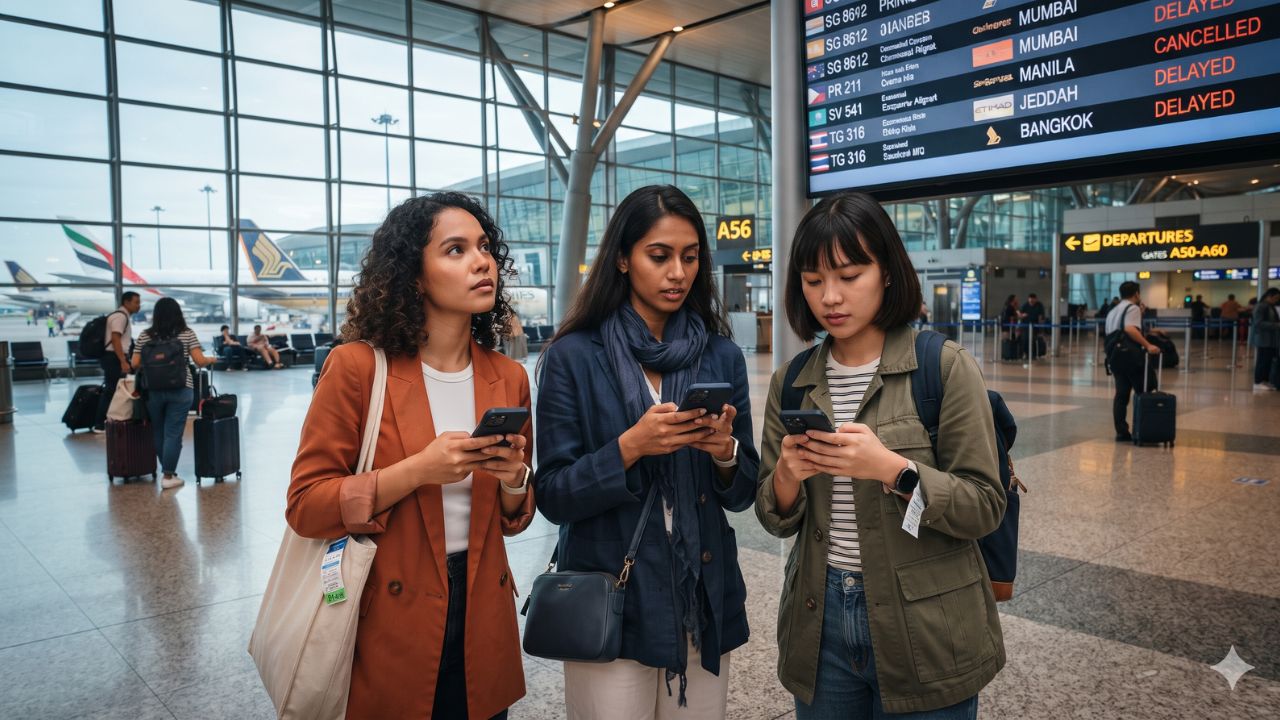
Asia Air Travel Hit by 193 Cancellations and 1,573 Delays: Mumbai, Jeddah, and Manila Lead Flight Gridlock
Air India and Air India Express Suspend All Saudi Arabia Flights Amid Security Threats in 2026
