Miami Tourism Surges as 3.2 Million International Visitors Drive Record Hotel Rates in 2026

While average hotel room rates across Miami climbed by 13% during the first six months of 2026, visitor spending generated an average annual local tax relief of US$2,300 for every resident household. According to official half-year disclosures from the Greater Miami Convention & Visitors Bureau and regional economic reports, Greater Miami and Miami Beach welcomed approximately 3.2 million international travelers between January and June 2026, marking a 3% expansion over the previous year. International visitors poured roughly US$10.5 billion into the regional economy, reasserting South Florida's position as the primary commercial bridge connecting North America, Latin America, and Europe.
Yet for independent travelers booking flights into Miami International Airport, this economic rebound brings immediate friction. With Miami ranking among the top four US cities for average daily room rates and among the top six nationwide for hotel occupancy, discovering the city's authentic neighborhoods requires looking beyond the luxury corridors of South Beach.
The International Resurgence: Latin Roots and European Long-Haul Demand
The post-pandemic recovery across South Florida has settled into a steady, high-spending rhythm. The 3.2 million overseas arrivals recorded in the first half of 2026 reflect sustained loyalty from five primary source markets: Colombia, Canada, Brazil, the United Kingdom, and Mexico. These source nations demonstrate how Miami functions less like a conventional American city and more like an autonomous cultural capital of the Americas.
Data from the South Florida Business Journal shows visitor expenditures hit US$10.5 billion over the six-month span. This builds on the full-year 2025 performance reported by the Greater Miami Convention & Visitors Bureau, which tallied US$23 billion in total annual tourism spend—a 4% rise over 2024. Tourism continues to underpin the regional labor market, supporting approximately 216,000 jobs across Miami-Dade County, or roughly 10% of all county employment, while generating US$5.3 billion in municipal, state, and federal taxes.
The corporate travel sector is mirroring leisure demand. During the 2025–2026 fiscal year, regional venues secured 785 conventions and major corporate meetings, committing approximately 520,000 hotel room nights for an estimated 586,379 delegates. Long-term capacity will expand further when the Grand Hyatt Miami Beach Convention Center Hotel opens in late 2027, adding dedicated meeting lodging directly adjacent to the exhibition halls.
| Metric / Tourism Benchmark | Official Figure (2025–2026) | Travel Sector Context |
|---|---|---|
| H1 2026 International Visitors | 3.2 million | 3% growth year-on-year across Greater Miami |
| H1 2026 Regional Visitor Spending | US$10.5 billion | Reported by the South Florida Business Journal |
| Hotel Average Daily Rate (ADR) Rise | +9% to +13% | Ranked top 4 nationally for daily room rates |
| Top 5 International Source Markets | Colombia, Canada, Brazil, UK, Mexico | Balanced mix of Americas and transatlantic travelers |
| County Employment Supported | 216,000 hospitality jobs | Represents 10% of total Miami-Dade employment |
| Annual Resident Household Tax Relief | US$2,300 per household | US$809 savings calculated per individual resident |
| Convention Bookings (FY 2025–2026) | 785 events (520,000 room nights) | 586,379 expected business conference attendees |
Divergence Across Florida: Urban Magnetism Versus Statewide Moderation
Miami's buoyant figures present a notable contrast to broader state-level trends. Preliminary data issued on 16 November 2026 by VISIT FLORIDA revealed that Florida logged 34.73 million visitors during the third quarter of 2026, an incremental rise of only 0.1% compared to Q3 2025.
Statewide, domestic travelers accounted for 31.86 million visits, while overseas travelers accounted for 2.31 million and Canadian trips totaled 561,000. Significantly, overseas visits across Florida dropped by 1.6% and Canadian trips slipped by 2.8% in Q3. Miami-Dade, however, continues to outpace the rest of the peninsula by capturing high-yielding international travelers who prioritize metropolitan dining, cultural festivals, and major athletic spectacles over suburban theme parks.
The city's calendar revolves around high-impact annual fixtures. The Miami Open tennis championship, the Formula 1 Miami Grand Prix at Hard Rock Stadium, and Art Basel Miami Beach bring concentrated waves of affluent travelers who fill five-star resorts and drive nightly room tariffs to seasonal peaks.
Neighborhood Selection: Where to Base Yourself
Navigating double-digit hotel price increases demands deliberate geographic choices. Each Miami district offers radically different price points, transit connections, and cultural textures:
Brickell and Downtown: The Financial and Cultural Core
Brickell has transformed into a high-density urban district filled with rooftop lounges, financial headquarters, and upscale dining. Staying here gives you direct access to the Metromover—a free automated elevated rail system running through Downtown, the arts district, and Brickell. It allows travelers to dodge expensive ride-hailing fees while remaining within striking distance of the Pérez Art Museum Miami (PAMM).
Coral Gables: Historic Mediterranean Revival
Planned in the 1920s by George Merrick, Coral Gables offers quiet tree-lined avenues, Mediterranean Revival architecture, and historic landmarks like the Venetian Pool and the Biltmore Hotel. It is ideal for families and heritage travelers seeking an authentic community atmosphere away from beachfront noise.
South Beach and Mid-Beach: Oceanfront Energy
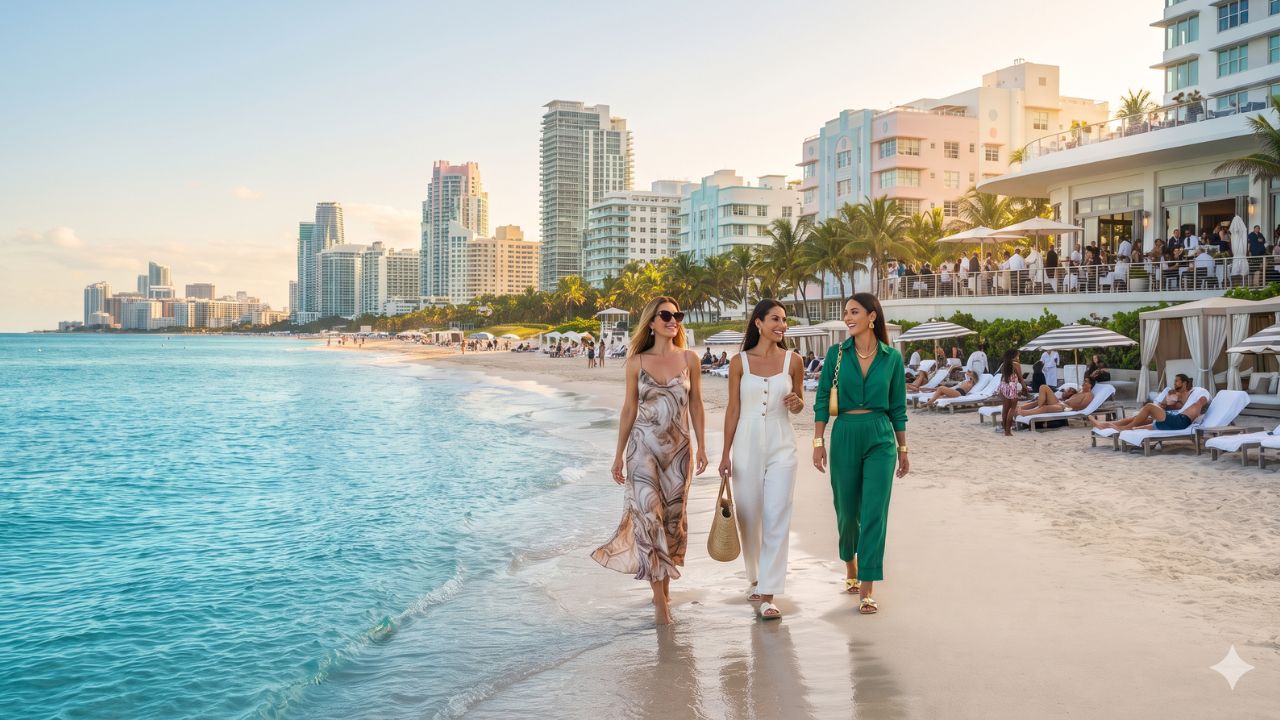
Miami Beach remains the iconic visual signature of South Florida, particularly the Art Deco Historic District along Ocean Drive. Mid-Beach, stretching north from 23rd Street to 44th Street, offers a slightly quieter beachfront strip with restored mid-century MiMo (Miami Modern) properties, though resort fees and valet parking routinely add $70 to $100 per day to base hotel tariffs.
Visitor Insider Tips: Timing, Etiquette, and Transit
- Bypass Ocean Drive for Dinner: While strolling Ocean Drive to admire 1930s neon architecture is essential, avoid dining at the sidewalk cafes facing the street, where inflated menus and mandatory 20% service fees target tourists. Head instead to Washington Avenue or Española Way for authentic Cuban, Colombian, and Peruvian fare.
- Utilize Free Public Transit Loops: Take advantage of the free Miami Beach Trolley network, which operates across South Beach, Middle Beach, and North Beach from morning until midnight. On the mainland, pair the free Metromover with the Metrorail to reach Miami International Airport for just $2.25 each way.
- Dodge Mandatory Hidden Charges: When comparing hotel rooms online, verify the fine print regarding daily resort fees, amenity surcharges, and destination taxes. These fees often add $35 to $60 per night on top of quoted base rates.
- Explore Maritime National Parks: Few travelers realize Miami sits between two distinct federal reserves. Take a morning drive south to Biscayne National Park to snorkel offshore coral reefs, or head west on the Tamiami Trail (US-41) to experience the freshwater sawgrass marshes of the Everglades.
Cultural Preservation Amid Rapid Gentrification
Miami's rapid growth has intensified conversations regarding historic preservation and neighborhood identity. Longstanding Caribbean and Hispanic enclaves—such as Little Havana's Calle Ocho corridor and the historic Bahamian settlement of Coconut Grove—face mounting pressure from commercial real estate developers.
Community organizations and cultural heritage trusts are actively defending historic vernacular architecture, from shotgun cottages to historic jazz venues that once hosted icons like Billie Holiday during the segregation era. Supporting family-run ventanitas (coffee windows) for a morning cafecito, shopping at independent neighborhood bodegas, and engaging certified local heritage walking guides helps ensure that tourism revenues directly sustain the diverse resident populations that built modern Miami.
FAQ: Visiting Greater Miami in 2026
What drove the increase in Miami hotel rates during 2026?
Average room rates climbed 13% due to strong international demand from Latin America and Europe, high convention attendance, and headline international sports and art events.
What are the five largest international visitor markets for Miami?
During the first half of 2026, the five leading international source markets were Colombia, Canada, Brazil, the United Kingdom, and Mexico.
How can visitors avoid paying high parking and transport costs in Miami?
Base yourself near the free Metromover system in Brickell and Downtown, or utilize the free municipal trolleys in Miami Beach and Coral Gables to eliminate rental cars and expensive valet fees.
What is the expected opening date for the Miami Beach Convention Center hotel?
The Grand Hyatt Miami Beach Convention Center Hotel is scheduled to open in late 2027, adding dedicated convention accommodation directly adjacent to the facility.
Related Travel Guides
- FAA Nationwide Ground Stop Grounds Over 12,000 Flights: Cruise and Hotel Travel Disruption Guide
- Hawaii and Alaska Lead 2026 Travvy Awards as Miami and Honolulu Win Top Urban Honors
- Los Ríos Thunderstorm Alert: SENAPRED Weather Advisory and Chile Travel Guide 2026
Look beyond the neon storefronts of South Beach, explore the city's historic cultural districts, and time your reservations wisely to experience the authentic rhythm of South Florida.
This article is for informational purposes. Flight routes, passenger regulations, visa rules, and transit advisories are subject to change by airlines and aviation authorities. Readers are advised to verify schedules and travel documentation with relevant carriers and border agencies before departure.
Related Stories

Jamaica Unveils $125M Richmond Hill Club in Montego Bay: Hillside Luxury and Heritage Travel Guide

Hawaii and Alaska Lead 2026 Travvy Awards as Miami and Honolulu Win Top Urban Honors