Mexico's 180-Day Rule and E-Gates Accelerate Canadian Snowbird Influx: Complete Cost Analysis for Los Cabos and Coastal Gateways

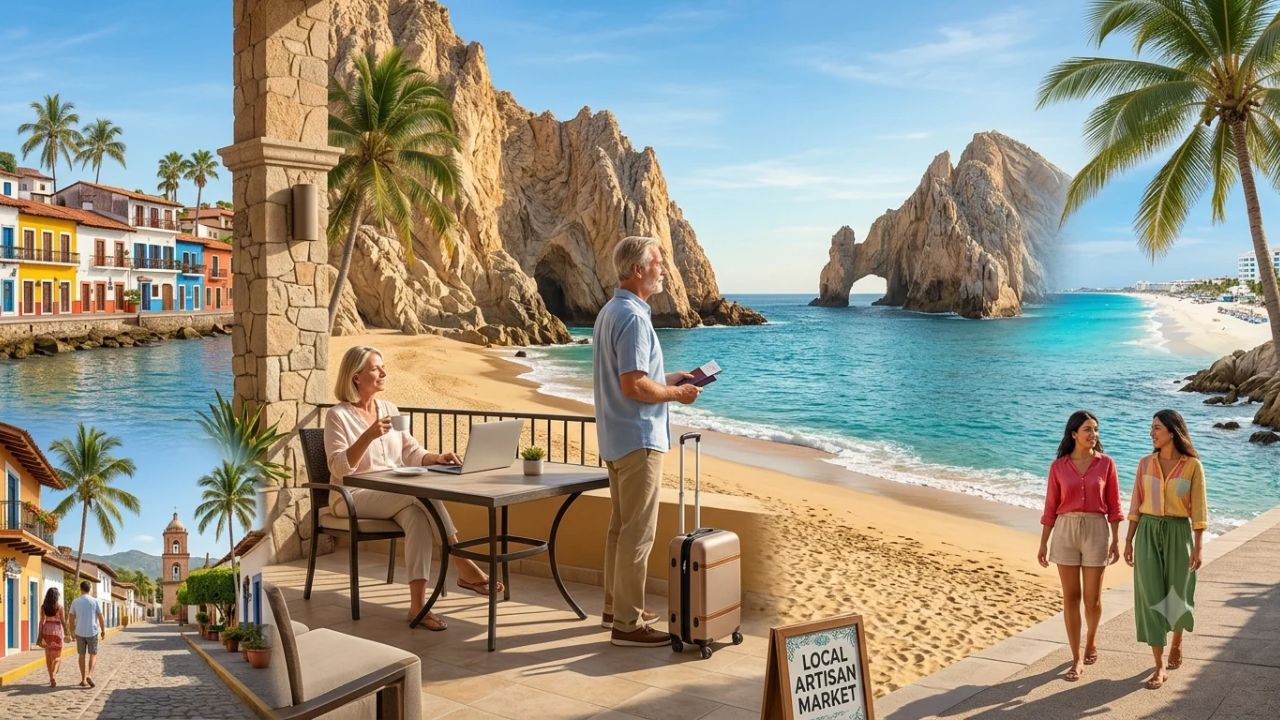
More than 450,000 Canadians migrate south to Mexico each January, and a coordinated push across premier coastal gateways—combining Mexico's 180-day digital visitor allowance, automated airport e-gates, and long-stay rental infrastructure—is transforming traditional two-week vacations into multi-week independent winter residencies.
As winter temperatures plunge across North America, Canadian travelers constitute nearly 25 percent of all international tourist arrivals entering Mexico during the peak first quarter. However, the traditional vacation model is undergoing a decisive shift. Rather than defaulting to packaged two-week resort stays, Canadian snowbirds are increasingly prioritizing extended self-catering stays of 14 to 28 nights, and in many cases several months, seeking neighborhood immersion, private kitchen-equipped accommodations, and transparent daily living expenses.
At the center of this seasonal migration is an operational alignment linking five premier Mexican coastal gateways: Los Cabos, Puerto Vallarta, Bucerías (Riviera Nayarit), Playa del Carmen, and Cancún. Anchored by the 180-day digital visitor permit (Forma Migratoria Múltiple Digital / FMMD) and rapid automated biometric border e-gates at major international terminals, these destinations are redefining extended-stay holiday value. Understanding how fixed airfare overhead decays over longer stays, how provincial Canadian healthcare presence rules interact with Mexican immigration stamps, and how localized costs vary by coast is essential for planning a successful winter escape.
CANADIAN SNOWBIRD MIGRATION TO MEXICO: 2027 STRATEGIC BASELINE
| Metric Dimension | Recorded Data / Standard | Strategic Relevance to Snowbirds |
|---|---|---|
| January Canadian Wave | 450,000+ Canadian Arrivals | ~25% of all Mexican international arr. |
| Immigration Allowance | Up to 180 Days (FMMD Digital Stamp) | Visa-free tourism entry for Canadians |
| Airport Clearance | Automated Biometric E-Gates | Deployed at SJD, PVR, CUN, and MEX |
| Provincial Health Cap | 153 to 183 Days Presence in Canada | Mandatory to maintain OHIP/MSP/AHCIP |
| Fixed Flight Control | C$1,720 per Couple (Round-Trip) | Airfare overhead flat across stays |
| Budget Range (14N) | C$5,735 (Bucerías) to C$8,010 (Cabos) | Includes flights, food, lodging, 10% |
| Budget Range (28N) | C$9,376 (Bucerías) to C$13,587(Cabos) | 28-night stay costs only ~60% more |
The Regulatory Framework: 180-Day Digital Permits, E-Gates, and Canadian Healthcare
Successfully managing an extended winter stay in Mexico requires balancing Mexican immigration law against Canadian provincial residency mandates. Three regulatory pillars govern this cross-border migration.
REGULATORY PILLARS FOR CANADIAN WINTER RESIDENCY IN MEXICO
| Entity / Route | Metrics | Operational Status |
|---|---|---|
| Regulatory Area | Governing Authority & Rule | Critical Action Required for Traveler |
| 1. Mexico Entry Stamp | National Migration Institute (INM) | Check stamped date on entry voucher; |
| (FMMD Digital) | Discretionary grant up to 180 days | Ensure authorized stay covers flights |
| 2. Airport E-Gates | Biometric Border Screening | Scan Canadian e-passport; download |
| Automation | Operational at SJD, PVR, CUN, MEX | digital FMMD receipt via QR code |
| 3. Canadian Provincial | Provincial Health Plans | Must remain in home province at least |
| Health Insurance | (OHIP 153 days; MSP/AHCIP 183 days) | 153–183 days to protect travel cover |
1. The 180-Day Digital Visitor Allowance (FMMD)
Canadian citizens entering Mexico for tourism purposes do not require a pre-arranged consular visa. Under Mexican immigration regulations administered by the National Migration Institute (Instituto Nacional de Migración / INM), eligible tourists can be granted an authorized stay of up to 180 days per entry.
In recent years, Mexico replaced paper immigration arrival cards with the Forma Migratoria Múltiple Digital (FMMD):
- Discretionary Validity: While 180 days is the statutory maximum, the exact duration granted remains at the discretion of the border official or automated system.
- Verification Protocol: Travelers must examine the digital entry receipt or physical stamp received at the airport checkpoint to verify the exact number of days granted. If an officer enters 30 or 60 days on an itinerary planned for 90 days, the traveler must seek an official extension at a local INM delegation before the permit expires to avoid administrative penalties.
2. Automated Biometric Airport E-Gates
Arrival clearance has been transformed by the installation of automated biometric e-gates across Mexico’s premier international tourism gateways:
- Participating Hubs: Los Cabos International (SJD), Puerto Vallarta Licenciado Gustavo Díaz Ordaz (PVR), Cancún International (CUN), and Mexico City Benito Juárez (MEX).
- Processing Mechanics: Canadian passport holders aged 18 and older scan their biometric e-passport data page, undergo automated facial recognition matching against the digital chip, and pass through border gates in under two minutes.
- Digital Registration: The e-gate terminal prints a small digital confirmation ticket containing a QR code. Travelers can scan this code using a smartphone to download their official electronic FMMD registration, which is required for departure verification and car rentals.
3. Canadian Provincial Healthcare Continuance Rules
The primary constraint on Canadian snowbirds is not Mexican immigration law, but domestic provincial healthcare rules. To maintain continuous coverage under Canadian public healthcare programs, residents must satisfy strict physical presence thresholds:
- Ontario (OHIP): Mandates physical presence in Ontario for at least 153 days in any 12-month period.
- British Columbia (MSP): Requires physical presence in British Columbia for at least six months (183 days) in a calendar year.
- Alberta (AHCIP): Requires physical presence in Alberta for at least 183 days in any 12-month consecutive period.
The Insurance Link: Private Canadian supplemental travel medical insurance policies—which cover emergency hospitalizations and medical evacuations up to C$5,000,000—are legally contingent upon an active, valid underlying provincial health plan. If a snowbird exceeds provincial absence limits and their OHIP or MSP coverage lapses, their private travel insurance policy becomes instantly void, leaving them exposed to catastrophic medical expenses.
CANADIAN SNOWBIRD DUAL-JURISDICTIONAL BALANCE
[Max Mexican Visitor Allowance: 180 Days]
                   vs.
[Canadian Provincial Healthcare Minimum Presence: 153–183 Days]
                   =
[SAFE SNOWBIRD OPERATING WINDOW: 120 to 150 Days Maximum Abroad]
Ensures continuous OHIP/MSP validity & preserves supplemental emergency insurance
The Snowbird Dividend: Why Doubling Your Stay Does Not Double the Cost
A common misconception among first-time winter travelers is that extending a holiday from two weeks to four weeks will double the total expenditure. An economic modeling analysis demonstrates that purchasing power improves significantly on longer stays due to the decay of fixed transit overhead.
THE SNOWBIRD DIVIDEND: FIXED OVERHEAD DECAY MODEL
| Entity / Route | Metrics | Operational Status |
|---|---|---|
| Trip Component | 14-Night Escape (2 Weeks) | 28-Night Residency (4 Weeks) |
| International Flights | C$1,720 per couple (FIXED) | C$1,720 per couple (FIXED) |
| Airport Transfers | C$120–C$180 per couple (FIXED) | C$120–C$180 per couple (FIXED) |
| Amortized Daily Air | C$122.85 per day overhead | C$61.42 per day overhead (-50%) |
| Accommodation Trend | Nightly / Weekly standard rates | Monthly discounted rental contracts |
| Food Strategy | Frequent restaurant dining | Self-catering grocery provisioning |
The Mathematics of Fixed Transit Decay
For a Canadian couple flying from Toronto, Calgary, or Vancouver to Mexico, return airfares and airport transfers are fixed sunk costs. In our financial model:
- Return flights, seat selection, and baggage allowances are held constant at C$1,720 per couple.
- On a 14-night holiday, airfare contributes C$122.85 per day to the overall daily trip cost.
- On a 28-night stay, that same airfare expense is amortized across four weeks, dropping to C$61.42 per day—an instant 50 percent reduction in daily transit overhead.
When extending from 14 nights to 28 nights:
- In Playa del Carmen, doubling the trip duration adds only C$3,400 in net ground expenditures (~C$243 per couple per day).
- In Puerto Vallarta, the extra fortnight adds C$3,540 in ground spending (~C$253 per day).
- In Bucerías, the extension requires an additional C$3,310 (~C$236 per day).
- In Cancún, ground outlays increase by C$3,980 (~C$284 per day).
- In Los Cabos, the premium resort profile adds C$5,070 (~C$362 per day).
Across all destinations, doubling the length of stay increases total trip cost by only 58 to 70 percent, delivering superior experiential and financial return on capital.
Financial Blueprint: 14-Night vs. 28-Night Comprehensive Cost Breakdown
The financial model below establishes field-tested planning inputs across Mexico's five premier winter destinations for January 2027. Calculations reflect Canadian dollars (C$) using an exchange baseline of US$1.00 = C$1.40 and MXN 1.00 = C$0.075 (approx. MXN 13.33 per C$1.00), including private kitchen-equipped accommodations and a dedicated 10 percent contingency reserve.
COMPREHENSIVE BUDGET BLUEPRINT: 14-NIGHT VS. 28-NIGHT STAYS (C$)
| Column 1 | Column 2 | Column 3 | Column 4 | Column 5 | Column 6 |
|---|---|---|---|---|---|
| Budget Component | Cancún | Puerto Vall. | Los Cabos | Playa del C. | Bucerías |
| Nightly Target Rate | C$180 | C$160 | C$230 | C$150 | C$150 |
| Accommodation (14N) | C$2,520 | C$2,240 | C$3,220 | C$2,100 | C$2,100 |
| Accommodation (28N) | C$5,040 | C$4,480 | C$6,440 | C$4,200 | C$4,200 |
| Daily Food Allowance | C$85 | C$75 | C$105 | C$75 | C$70 |
| Total Food (15 Days) | C$1,275 | C$1,125 | C$1,575 | C$1,125 | C$1,050 |
| Total Food (29 Days) | C$2,465 | C$2,175 | C$3,045 | C$2,175 | C$2,030 |
| Airport Transfers | C$140 | C$120 | C$180 | C$160 | C$150 |
| Local Transit (14/28N) | C$140 / C$260 | C$120 / C$220 | C$220 / C$400 | C$100 / C$200 | C$100 / C$180 |
| Recreation Fund (14N) | C$250 | C$400 | C$450 | C$350 | C$250 |
| Recreation Fund (28N) | C$400 | C$550 | C$650 | C$500 | C$400 |
| Visitor Tax Reserve | C$43 | C$0 | C$73 | C$43 | C$0 |
| Airfare Pair Control | C$1,720 | C$1,720 | C$1,720 | C$1,720 | C$1,720 |
| 10% Contingency (14N) | C$437 | C$401 | C$572 | C$388 | C$365 |
| 10% Contingency (28N) | C$835 | C$755 | C$1,079 | C$728 | C$696 |
| TOTAL COST (14N STAY) | C$6,525 | C$6,126 | C$8,010 | C$5,986 | C$5,735 |
| TOTAL COST (28N STAY) | C$10,903 | C$10,020 | C$13,587 | C$9,726 | C$9,376 |
1. Los Cabos: Desert Scenery, Marine Life, and Upscale Living
Occupying the southern tip of the Baja California Peninsula, Los Cabos comprises San José del Cabo, Cabo San Lucas, and the 32-kilometer Resort Corridor linking the two towns:
- Climate Advantage: Los Cabos offers an exceptionally arid winter microclimate (averaging 26°C daytime highs with crisp 12°C desert evenings and a negligible 13 mm of January rainfall), eliminating damp, humid days.
- Marine Safari Season: January represents peak humpback whale breeding season, allowing snowbirds to observe breaching pods directly from coastal bluffs or chartered catamarans.
- Dual Town Character: San José del Cabo delivers a refined, colonial atmosphere centered around its historic Art District and organic farm-to-table dining in Ánimas Bajas. Cabo San Lucas provides an active marina boardwalk, sports fishing charters, and vibrant waterfront dining.
- Operational Cautions: The dramatic underwater bathymetry of Land's End produces powerful Pacific undertows. Ocean swimming is strictly prohibited along most beaches, with safe swimming restricted to protected coves at Playa Médano, Chileno Bay, and Santa María Bay. Visitors must budget for Baja California Sur’s state tourism contribution (Embrace It fund: MXN 488 / ~C$36.50 per traveler).
2. Puerto Vallarta: The Gold Standard for Urban Walkability
Sheltered within the amphitheater of Banderas Bay and framed by the emerald peaks of the Sierra Madre, Puerto Vallarta remains the benchmark for independent Canadian snowbirds:
- Community Integration: Mature residential colonias—including 5 de Diciembre, Centro, and the Zona Romántica—allow long-stay visitors to settle into authentic neighborhood life rather than isolated resort enclaves.
- The Malecón Promenade: The flat, pedestrianized oceanfront boardwalk stretches for miles, linking open-air sculptures, traditional bakeries, and municipal markets without requiring taxi travel.
- Healthcare Ecosystem: Decades of Canadian and American retirement presence have fostered modern private hospitals (such as Hospital Joya), specialized dental clinics, and English-speaking medical specialists who coordinate directly with Canadian travel insurers.
- Operational Cautions: Beyond the flat coastal avenues, neighborhoods climb steeply into the hills. Apartments located in upper colonias frequently involve hundreds of outdoor concrete steps or steep cobblestone inclines that can challenge travelers with limited mobility.
3. Bucerías: Slower Cadence on Banderas Bay
Situated 18 kilometers north of Puerto Vallarta Airport in the state of Nayarit, Bucerías offers the warm waters of Banderas Bay within a quiet, traditional village setting:
- Flat Coastal Geography: Unlike the hilly sectors of Puerto Vallarta, Bucerías is predominantly flat, easing daily walks to local fruit markets, tortillerías, and neighborhood cafés.
- Grounded Expat Culture: The community features an active resident Canadian and international presence centered in the southern Zona Dorada (Golden Zone), known for boutique galleries, community charities, and sunset beach walks.
- Operational Cautions: Highway 200 bisects the community. Accommodations situated on the inland side of the highway require crossing a multi-lane roadway to reach the beach. Extended rental contracts frequently require tenants to pay metered residential electricity (Comisión Federal de Electricidad / CFE) surcharges for air-conditioning usage.
4. Playa del Carmen: Walkable Caribbean Living
Positioned along the Riviera Maya south of Cancún, Playa del Carmen combines turquoise Caribbean waters with an orderly, pedestrian-friendly urban street grid:
- Self-Catering Independence: The grid layout makes navigation simple. Blocks run perpendicular to the beach, placing quiet condo buildings in neighborhoods like Zazil-Ha and upper Centro within a 5-to-10-minute walk of pristine white-sand beaches, Mega and Chedraui supermarkets, and local dining.
- Year-Round Warm Ocean: Sea temperatures average 26°C in January, providing reliable swimming conditions protected by the offshore reef of Cozumel.
- Public Transit Links: Central Playa del Carmen hosts major passenger ferry docks to Cozumel and ADO express coach terminals connecting directly to Tulum, Valladolid, and Cancún Airport.
- Operational Cautions: Nightlife venues around Calle 12 and central Quinta Avenida generate significant late-night noise. Securing rentals situated between Avenida 15 and Avenida 30, or north of Calle 38, is essential for peaceful sleep. Departing travelers must pay Quintana Roo’s state tourism tax (VISITAX, ~C$21.50 per person).
5. Cancún: Air Connectivity and Package Certainty
As Mexico’s most connected air transport hub, Cancún International (CUN) welcomed over 6.1 million arriving international air passengers in the first eight months of 2026 alone:
- Unrivaled Flight Networks: Non-stop flights connect Cancún with virtually every major Canadian airport, eliminating transit connections and travel fatigue.
- Package Predictability: For snowbirds seeking a two-week escape with predictable outlays, pre-purchased all-inclusive resort packages lock in lodging, meals, and beverages in Canadian dollars, mitigating currency volatility.
- Operational Cautions: Cancún is geographically divided between Downtown (El Centro) and the 22-kilometer Hotel Zone (Zona Hotelera). Downtown apartment rentals require daily bus or taxi transit along congested Boulevard Kukulcán to reach Caribbean beaches.
DESTINATION SELECTION DECISION PATHWAY
[Primary Winter Travel Priority]
          |
          +---> [Dry Climate / Whales / Desert Luxury] ---------> LOS CABOS
          |
          +---> [Urban Walkability / Authentic Culture] --------> PUERTO VALLARTA
          |
          +---> [Flat Walking / Slow Village Rhythm] -----------> BUCERÍAS
          |
          +---> [Warm Caribbean Swimming / Self-Catering Grid] -> PLAYA DEL CARMEN
          |
          +---> [Direct Non-Stop Flights / All-Inclusive Peace] -> CANCÚN
Essential Pre-Trip Verification Checklist for Canadian Snowbirds
Before transferring rental deposits or booking non-refundable flights for the 2026–2027 winter season, Canadian travelers should work through this operational checklist:
SNOWBIRD PRE-DEPARTURE VERIFICATION PROTOCOL
| Entity / Route | Metrics | Operational Status |
|---|---|---|
| Phase | Mandatory Traveler Action | Critical Operational Check |
| 1. Healthcare Audit | Verify provincial physical-presence | Maintain 153 days (OHIP) or 183 days |
| minimums before departing Canada | (MSP/AHCIP) in home province | |
| 2. Insurance Policy | Review pre-existing condition | Ensure 90–180 day medical stability; |
| stability clauses and trip limits | verify policy covers repatriation | |
| 3. Lease Agreement | Secure written rental contract | Confirm duration (28 vs 30 nights); |
| clarifying utility & deposit terms | clarify CFE electric billing caps | |
| 4. Border Documents | Verify passport validity and check | Ensure passport valid 6 months; check |
| digital entry stamp duration (FMMD) | authorized stay date on digital FMMD | |
| 5. State Taxes | Pay state visitor contributions via | Use official government portals only |
| official portals (VISITAX / Cabo) | (Avoid unauthorized fee markups) |
Actionable Travel Guidance
-
Calculate Provincial Presence Accurately:
- Count day of departure and day of return according to your province's specific calculation rules. Keep physical boarding passes, passport stamps, and credit card receipts as proof of Canadian physical presence in case of a provincial audit.
- Schedule winter trips to ensure you do not exceed 150 total days abroad in any rolling 12-month window.
-
Scrutinize Long-Term Rental Contracts:
- Verify whether a monthly quote represents 28 nights, 30 nights, or a full calendar month.
- Request clarification on electricity charges. In tropical and desert regions, running air-conditioning units constantly can generate CFE bills exceeding C$300 to C$500 per month. Establish whether electricity is included or metered separately with a baseline kilowatt-hour allowance.
-
Avoid Third-Party Tax Scam Portals:
- Pay state tourism fees exclusively on verified government websites: Quintana Roo's official VISITAX portal (
visitax.gob.mx) or Baja California Sur’s Embrace It portal. Avoid third-party commercial intermediaries that charge processing markups.
- Pay state tourism fees exclusively on verified government websites: Quintana Roo's official VISITAX portal (
-
Verify Swimmability and Mobility Needs:
- In Los Cabos, never assume beachfront properties permit ocean swimming. If beach swimming is a priority, choose accommodations near Chileno or Médano bays, or verify that condo complexes feature heated swimming pools.
- In Puerto Vallarta, use satellite street mapping to inspect elevation changes before booking apartments in colonias Alta Vista, Amapas, or upper 5 de Diciembre.
Frequently Asked Questions
What is Mexico's 180-day rule for Canadian travelers?
Under Mexican immigration regulations, eligible Canadian citizens entering Mexico for tourism can receive an authorized visitor stay of up to 180 days per entry without a pre-arranged consular visa. The permit is issued upon arrival through the digital Forma Migratoria Múltiple Digital (FMMD) system. Travelers must check the digital receipt or passport stamp to confirm the exact duration granted by border authorities.
How do automated e-gates work at Mexican international airports?
Automated biometric e-gates are operational at major international hubs including Los Cabos (SJD), Puerto Vallarta (PVR), Cancún (CUN), and Mexico City (MEX). Canadian passport holders scan their biometric e-passport, complete facial recognition verification, and pass through border gates in under two minutes, receiving a printed digital receipt with a QR code to download their electronic FMMD.
How does staying 180 days in Mexico affect Canadian provincial healthcare?
Staying out of Canada for a full 180 days can jeopardize provincial healthcare coverage. Provinces require residents to be physically present for a minimum period each year—at least 153 days in Ontario (OHIP) and 183 days in British Columbia (MSP) and Alberta (AHCIP). If provincial coverage lapses, private supplemental travel medical insurance becomes void, making it essential to keep total annual foreign travel within provincial limits.
Why does a 28-night stay cost only 60% more than a 14-night trip?
A 28-night stay does not double the cost of a 14-night trip because fixed transit overhead—primarily international round-trip airfare and airport transfers—remains constant regardless of trip length. The additional two weeks consist almost entirely of variable local living costs (accommodation and food), which are often discounted on monthly rental contracts.
Which Mexican coastal destination is best for walkable independent living?
Puerto Vallarta is considered the premier destination for urban walkability and neighborhood living. Its established colonias (Centro, 5 de Diciembre, Zona Romántica) and flat oceanfront Malecón allow Canadian snowbirds to access markets, restaurants, medical clinics, and cultural events without needing a vehicle.
Are all beaches in Los Cabos safe for swimming?
No. The steep underwater topography and heavy Pacific swells around Land's End create powerful surf breaks and dangerous undertows along most beaches in Los Cabos. Swimming is strictly limited to protected coves such as Playa Médano in Cabo San Lucas, Chileno Bay, and Santa María Bay along the Resort Corridor.
Related Travel Guides
- Iberia Equips Entire Airbus A321XLR Fleet with Free Starlink Wi-Fi: Transatlantic Routes, LEO Satellite Technology, and Fleet Plan 2030 Analysis
- Australia and Pacific Nations Showcase Monumental Rock Formations: A Comprehensive Guide to Deep-Time Geotourism and Indigenous Custodianship
- Poland and Emerging Destinations Reshape Europe's Winter Tourism: ETC Report Analyzes Surging 2026–2027 Travel Demand
- United States and Emerging Asian Markets Propel Philippines Tourism Past 5 Million Arrivals: 2026 Target Analysis
This article is for informational purposes. Flight routes, passenger regulations, visa rules, and transit advisories are subject to change by airlines and aviation authorities. Readers are advised to verify schedules and travel documentation with relevant carriers and border agencies before departure.
Related Stories

Taiwan Entry Declaration Sparks Cross-Strait Tourism Controversy: Immigration Rules, Hotel Vouchers, and Traveler Guide
Netherlands Warns of EES Border System Errors and False Schengen Overstay Flags: Traveler Rights and Rectification Guide