
Melbourne Airport Terminals Guide 2026: Navigating T1, T2, T3, and T4 for Seamless Transfers
A comprehensive operational guide to Melbourne Airport's four-terminal layout, detailing airline assignments, critical transfer protocols between T1 and T2, and logistical navigation for domestic and international travelers in 2026.

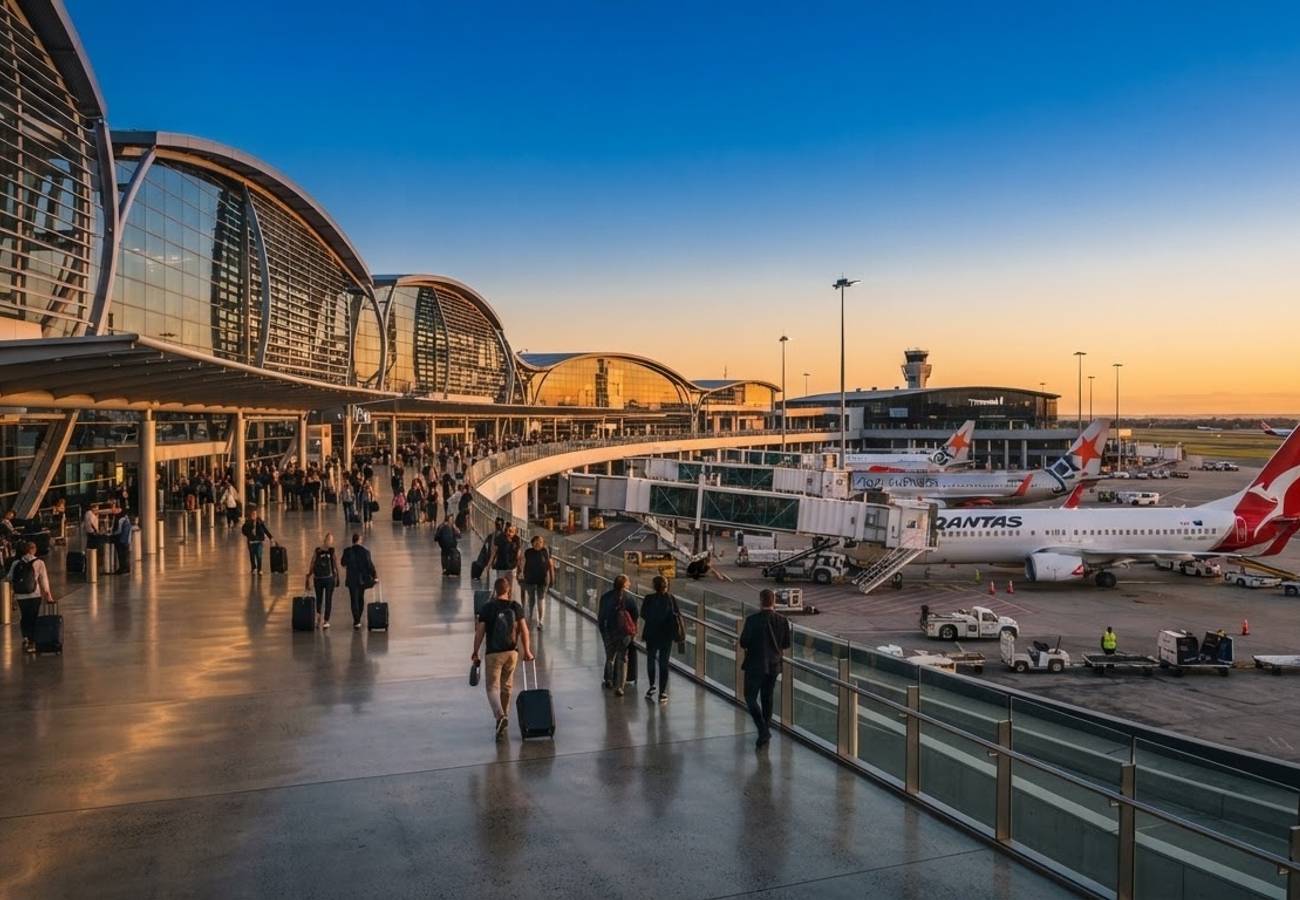
Image generated by AI
Melbourne Airport (Tullamarine) operates via a four-terminal system where airline placement is strictly divided by service type and carrier. Misidentifying your terminal can lead to significant delays, particularly for Qantas passengers splitting between domestic and international hubs.
The airport is structured around a single elevated forecourt. Terminals 1, 2, and 3 are housed within a single connected complex (T123), while Terminal 4 is a standalone building located a short walk further along the same frontage. Movement between terminals primarily occurs on the public (landside) area of security, guided by overhead signage.
Terminal Allocation and Airline Mapping
Navigation depends entirely on the carrier and the nature of the flight (domestic vs. international).
- Terminal 1 (T1): Dedicated to Qantas domestic operations. This includes major trunk routes to Sydney, Brisbane, Perth, and Adelaide, as well as regional QantasLink services.
- Terminal 2 (T2): The sole international hub. All international carriers—including Qantas, Jetstar, Virgin Australia, Singapore Airlines, Emirates, Cathay Pacific, Air New Zealand, and Malaysia Airlines—operate here.
- Terminal 3 (T3): The primary hub for Virgin Australia domestic flights.
- Terminal 4 (T4): The budget domestic terminal, utilized predominantly by Jetstar, Rex, and Link Airways.
Logistics and Transit Data
For travelers managing tight connections or coordinating pickups, the following spatial and logistical data is critical:
| Feature | Terminals 1, 2, & 3 (T123) | Terminal 4 (T4) |
|---|---|---|
| Parking | T123 Terminal Car Park (Directly opposite) | Dedicated Multi-level Car Park |
| Walking Distance | Minutes (under cover) to check-in | 7–10 minute walk from T1 |
| Transport Access | Central forecourt (SkyBus, Taxi, Rideshare) | Separate pickup point near T4 |
| Primary Use | Qantas Dom, International, Virgin Dom | Budget Domestic (Jetstar, Rex) |
The Qantas Connection Trap
Our analysis of passenger flow indicates a recurring point of failure for first-time visitors: the Qantas split. Because Qantas operates out of both T1 and T2, travelers often default to T1.
Critical Rule: If your destination is international (e.g., Singapore, Los Angeles, London), you must start at Terminal 2, regardless of the airline.
For passengers on a multi-sector journey:
- Domestic to International: Arrive at T1 $\rightarrow$ Exit to public area $\rightarrow$ Walk to T2.
- International to Domestic: Arrive at T2 $\rightarrow$ Clear immigration/customs $\rightarrow$ Collect baggage $\rightarrow$ Walk to T1 (or T3/T4) for re-check.
International Arrival Protocols (T2)
Terminal 2 handles all border control. A vital logistical detail for transit passengers is the baggage requirement: Australian regulations generally mandate that passengers collect checked luggage at T2 upon arrival, even if the bags are tagged through to a domestic destination.
After clearing biosecurity and customs in T2, passengers must manually transport their luggage to the domestic terminal (T1, T3, or T4) to re-check them for the final leg of their journey.
Why This Matters: Industry Implication
From a logistical perspective, Melbourne Airport's layout creates a "landside bottleneck." Because there is no sterile, airside transit zone for all international-to-domestic transfers, the passenger experience is heavily dependent on the efficiency of the public forecourt.
For the frequent traveler or digital nomad, this means "minimum connection times" are often underestimated. If you are traveling on separate tickets rather than a single through-ticket, a three-hour window is the baseline for safety. This accounts for the time required to clear T2 customs and the 10-minute trek to T4.
Forward Outlook
As passenger volumes increase in 2026, the reliance on the T123 complex will likely lead to increased congestion during evening long-haul departure waves. Travelers should anticipate longer queues at T2 outbound security and immigration. We expect a continued shift toward self-serve bag drops across all four terminals to mitigate forecourt congestion.
Precise terminal identification is the difference between a seamless transit and a missed connection at Tullamarine.
Related Travel Guides
Disclaimer
This article is for informational and educational purposes only. It does not constitute legal, financial, or professional advice. While we strive to provide accurate and up-to-date information, travel policies, regulations, and conditions change rapidly. Always verify information with official sources before making travel decisions. Nomad Lawyer makes no representations about the accuracy, reliability, completeness, or suitability of the information provided. Readers should consult qualified professionals for advice specific to their circumstances. The views expressed in this article are those of the author and do not necessarily reflect the views of Nomad Lawyer.
Preeti Gunjan
Contributor & Community Manager
A passionate traveller and community builder. Preeti helps grow the Nomad Lawyer community, fostering engagement and bringing the reader experience to life.
Learn more about our team →