Scandinavia's Luxury Cruise Surge: Explora III and Elite Lines Pivot to Northern Europe

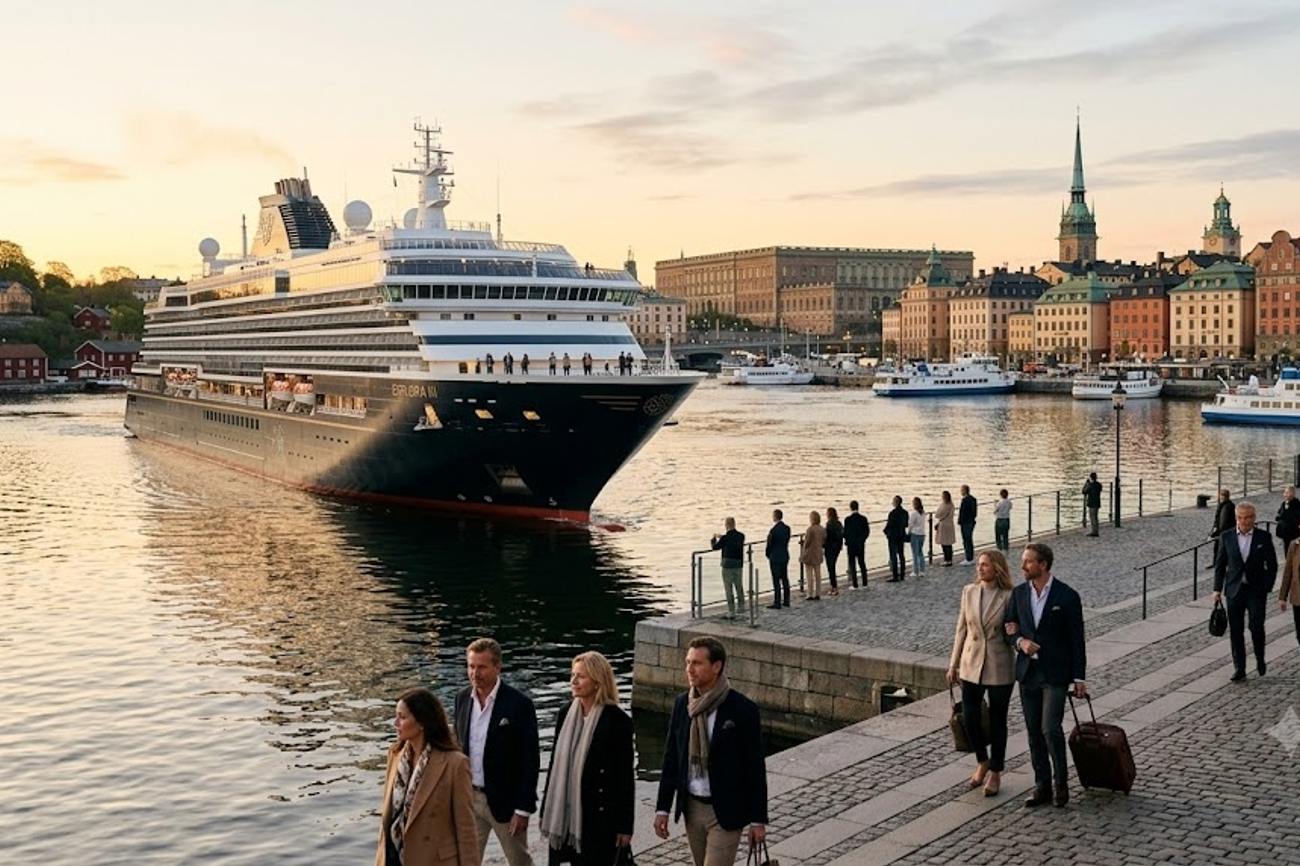
Image generated by AI
[Copenhagen, September 6, 2026] — The luxury cruise sector is undergoing a strategic pivot toward Northern Europe, with Denmark and Sweden emerging as primary hubs for high-end maritime travel. The introduction of Explora III, alongside the aggressive expansion of rival luxury lines, is transforming Scandinavia into a critical frontier for premium voyages. This shift reflects a growing appetite among affluent travelers for the region's sophisticated urban centers and dramatic coastal landscapes, moving the center of gravity away from traditional Mediterranean circuits.
The expansion into the North is not merely a trend but a response to a robust recovery in the broader European cruise market. According to the latest CLIA Europe Market Report, the number of European source passengers climbed to 8.9 million in 2025, representing a 5.3% increase from the 8.4 million recorded in 2024. This growth indicates a maturing post-pandemic market where travelers are seeking more diverse and upscale experiences.
Rapid Recovery of European Cruise Volumes
The trajectory of the European cruise market since 2021 demonstrates a steep upward curve. Industry data indicates that the region handled approximately 1.7 million passengers in 2021, a figure that surged to 5.7 million in 2022. This momentum continued with 8.2 million passengers in 2023 and 8.4 million in 2024, culminating in the 2025 peak of 8.9 million.
Demographic shifts are also evident in these figures. The average passenger age has reached 48.5 years, with the average voyage lasting 8.4 days. This profile suggests a market dominated by established professionals and retirees with higher disposable incomes, fueling the demand for the luxury amenities offered by vessels like Explora III.
European Cruise Passenger Growth
| Year | European cruise passengers | Annual change | Market situation |
|---|---|---|---|
| 2021 | 1.7 million | — | Early recovery |
| 2022 | 5.7 million | About +235% | Strong reopening |
| 2023 | 8.2 million | About +44% | Above 2019 volume |
| 2024 | 8.4 million | About +2.4% | Continued expansion |
| 2025 | 8.9 million | +5.3% | New post-pandemic high |
While the Mediterranean remains the dominant region—accounting for 45% of European cruise passengers in 2025—non-Mediterranean Europe now captures 31% of the market. This segment grew by approximately 6% year-on-year, highlighting the increasing appeal of the Baltic, Iceland, the British Isles, and the Norwegian fjords.
Economic Impact of Northern European Maritime Tourism
The financial contributions of the cruise industry to the European economy are substantial. Data from the European Commission’s Blue Economy Observatory indicates that European ports managed over 16 million cruise passengers in 2024. This activity generated approximately $16.8 billion in direct revenue and created roughly €64.1 billion in economic value added. Furthermore, the sector supports an estimated 445,000 direct and indirect jobs across the continent.
Although Italy and Spain continue to lead in volume—hosting more than 8 million passengers combined, or roughly half of the regional total—the growth in Northern Europe is providing a vital economic hedge. Overall EU maritime passenger traffic reached 417.8 million in 2024, a 6.2% increase over 2023, nearly returning to 2019 levels. Specifically, cruise passengers made up 18 million of that total, a 12.1% increase from 2023 and a significant jump from the 15 million passengers seen in 2019.
Major European Maritime Passenger Markets
| Market/indicator | Latest available figure |
|---|---|
| European cruise source passengers, 2025 | 8.9 million |
| European source passengers, 2024 | 8.4 million |
| European source passengers, 2023 | 8.2 million |
| European source passengers, 2022 | 5.7–5.8 million |
| European source passengers, 2021 | 1.7 million |
| EU cruise passengers, 2024 | About 18 million |
| EU maritime passengers, 2024 | 417.8 million |
| European cruise economic value added, 2024 | €64.1 billion |
| European cruise jobs, 2024 | 445,000 |
| European cruise revenue, 2024 | $16.8 billion |
MSC Cruises Diversifies Baltic and Fjord Itineraries
MSC Cruises is positioning itself as a versatile alternative for those weighing the choice between massive ship amenities and luxury-oriented schedules. For 2026, the operator has designed a comprehensive program spanning the Canary Islands, the Mediterranean, and Northern Europe.
Key departures are scheduled from major gateways such as Southampton and Hamburg. The Northern European itineraries specifically emphasize the Norwegian fjords, Iceland, and various Baltic capitals. By utilizing multiple departure cities, MSC provides a logistical advantage for international travelers who wish to integrate a cruise into a broader European land tour. This broad-scale approach contrasts with the more niche, intimate luxury environment of Explora III, offering a wider array of sailing dates and vessel sizes for those exploring the North.
Silversea Focuses on Boutique Access and Expeditions
For travelers prioritizing destination depth over ship size, Silversea Cruises is deploying a strategy centered on smaller vessels. Its 2026 Northern Europe and British Isles collection blends traditional ocean voyages with specialized expedition journeys.
Currently, seven Silversea ships operate within the Northern European region. The smaller footprint of these vessels allows them to dock in ports closer to city centers, reducing transit times for passengers. A notable 2026 itinerary aboard the Silver Spirit features an 11-day voyage from Southampton to Ijmuiden (near Amsterdam), stopping at nine ports across five nations. The route includes Antwerp, Bruges, Rouen, Dover, Saint-Malo, Guernsey, Amsterdam, and Southampton.
Unlike mass-market cruises, Silversea integrates shore excursions, transfers, and premium beverages into its pricing, focusing on personalized service and extended time ashore. This makes it a primary competitor for the high-net-worth demographic that Explora III is targeting in Scandinavia.
Oceania Cruises Integrates Boutique Ships with Port Variety
Oceania Cruises has similarly structured its 2026 European offerings around a boutique ship model. By focusing on smaller vessels, Oceania is able to provide a variety of European ports that are inaccessible to the industry's largest ships, further intensifying the competition for luxury travelers in the Northern European market.
Why This Matters: The Shift in Luxury Travel
For the modern traveler, the expansion of luxury lines into Denmark and Sweden means that "high-end" no longer exclusively means the French Riviera or the Greek Isles. The shift toward Northern Europe introduces a different kind of luxury—one defined by "quiet luxury," architectural exploration in Scandinavian capitals, and the raw, natural beauty of the fjords.
From a logistical standpoint, the move by MSC and Silversea to offer more flexible embarkation points (like Hamburg and Southampton) removes the friction of traditional "closed-loop" cruises. Travelers can now enter Europe in one city and exit in another, treating the cruise ship as a luxury hotel that moves between destinations rather than a fixed tour.
Furthermore, the increase in smaller, boutique vessels means that the environmental and social impact on smaller Northern European ports is being managed more carefully than with mega-ships. For the visitor, this translates to a more authentic, less crowded experience of the destination, effectively bridging the gap between a standard vacation and a true expedition.
Related Travel Guides
This article is for informational purposes. Flight routes, passenger regulations, visa rules, and transit advisories are subject to change by airlines and aviation authorities. Readers are advised to verify schedules and travel documentation with relevant carriers and border agencies before departure.
Related Stories

Japan Cruise Tourism Expands for 2027 as Princess Cruises Plans 78 Departures Across 50 Itineraries
Thailand Rivals Singapore, Malaysia and Other Regional Cruise Hubs as US$10 Billion Boom Exposes the Local Value Gap