
Los Angeles Earthquake Cluster Rattles California With More Than 60 Tremors, Raising Travel Safety Concerns
Los Angeles Earthquake Cluster Rattles California With More Than 60 Tremors, Raising Travel Safety Concerns

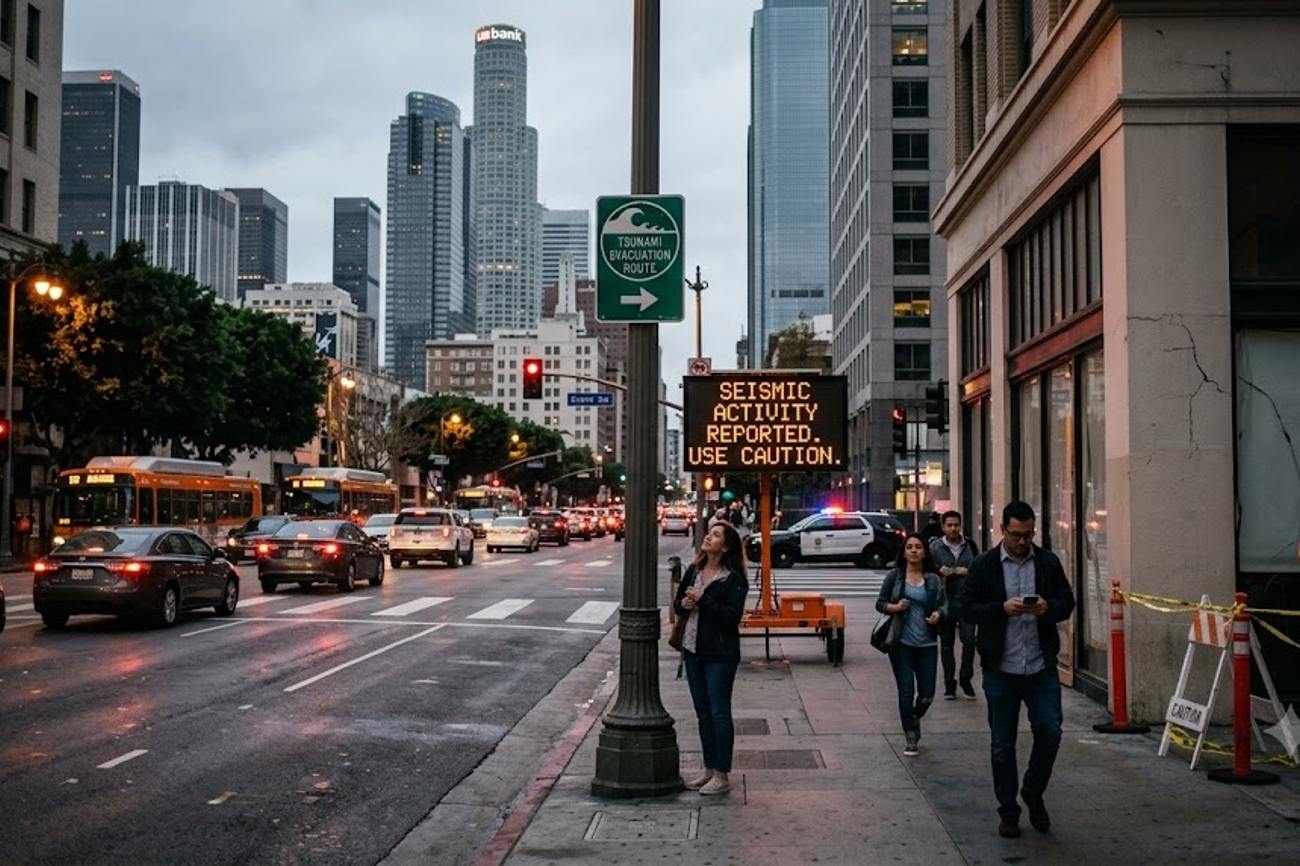
Image generated by AI
More than 60 tremors rattled Southern California on Saturday, September 13, 2026, centering primarily in South Los Angeles and signaling the region's persistent seismic volatility. While the majority of these events registered below magnitude 2.0, the concentration of activity in a high-density urban corridor highlights the precarious nature of the infrastructure supporting one of the world's most visited metropolitan areas. This seismic burst, characterized by a magnitude 2.7 event near Westmont at 2:30am and a subsequent 2.6-magnitude tremor at 4:30pm, serves as a stark reminder that the visitor economy in California operates atop a complex and active fault network.
The Mechanics of the September Seismic Sequence
The activity recorded on September 13 was not an isolated incident but part of a wider regional pattern of instability. Beyond the South Los Angeles cluster, the seismic energy extended to the coast, where two earthquakes occurred southeast of Catalina Island within minutes of each other. Simultaneously, the Northern California region experienced a magnitude 3.4 earthquake in the Bay Area.
This distributed activity underscores a critical reality for travel logistics: California's tourism infrastructure is not segmented by city but is a highly interconnected web. When seismic activity spikes, the risk is not merely the shaking itself, but the cascading failure of transport links. The reliance on a few primary arteries—specifically the freeway system and regional rail—means that even moderate disruptions in one sector can paralyze movement across the entire Southern California basin.
The following data captures the specific metrics of the September 13 cluster:
| Seismic Indicator | Recorded Data | Operational Impact for Travelers |
|---|---|---|
| Total Tremors | 60+ | Indicates high regional instability |
| Peak South LA Event | Magnitude 2.7 | Low immediate damage; high psychological impact |
| Westmont Secondary Event | Magnitude 2.6 | Confirms localized cluster activity |
| Minor Tremors | < Magnitude 2.0 | Generally imperceptible to tourists |
| Catalina Island Events | 2 events (rapid succession) | Risk to maritime and coastal transit |
| Bay Area Event | Magnitude 3.4 | Demonstrates state-wide seismic volatility |
Expert Analysis: The "Swarm" Fallacy and Infrastructure Fragility
From a risk management perspective, the primary danger following a cluster of 60+ tremors is not necessarily the "Big One," but the propagation of misinformation and the subsequent logistical chaos. In aviation and travel journalism, there is a recurring tendency to frame "earthquake swarms" as precursors to catastrophic ruptures. However, seismic data from the US Geological Survey (USGS) consistently demonstrates that small clusters do not reliably predict the timing or magnitude of a major event.
For the nomad lawyer or the high-net-worth traveler, the direct consequence of this news is not a reason to cancel bookings, but a mandate to audit the "last mile" of their itinerary. The pricing pressure created by such events is rarely seen in airfares, but it manifests in the hospitality sector through increased insurance premiums and mandatory structural retrofitting costs, which are eventually passed down to the guest.
The real vulnerability lies in the "interconnected visitor economy." Because Los Angeles serves as a primary international gateway, any disruption to the Los Angeles World Airports (LAWA) system or the surrounding freeway network creates a bottleneck that affects not just local tourists, but global transit flows. When a magnitude 3.4 or higher event occurs, the immediate result is often a wave of "precautionary" inspections of overpasses and bridges. For a traveler, this means a 20-minute Uber ride can transform into a four-hour ordeal, regardless of whether the earthquake caused actual structural damage.
Furthermore, the concentration of tremors in South Los Angeles highlights the disparity in building resilience. While luxury hotels in the Westside may be built to the latest seismic codes, the peripheral infrastructure—rental car hubs, budget motels, and local transit—may not be. This creates a fragmented safety environment where a traveler's risk profile changes drastically based on their zip code.
Key Takeaways
- Seismic Volume vs. Intensity: The reporting of 60+ tremors is a measure of frequency, not power; most events were below magnitude 2.0 and posed no structural threat.
- Regional Correlation: The simultaneous activity in the Bay Area (magnitude 3.4) and near Catalina Island indicates a broad state-wide period of instability rather than a localized LA anomaly.
- Infrastructure Bottlenecks: The primary travel risk is not the earthquake itself but the subsequent road closures, power interruptions, and mandatory building inspections.
- Preparedness Protocol: Visitors are urged to adopt the "Drop, Cover, and Hold On" method and avoid rushing toward exits during shaking to avoid falling debris.
- Verification Sources: Travelers should ignore sensationalist social media reports and rely exclusively on official catalogues provided by the USGS.
FAQ: Los Angeles Seismic Safety 2026
Should I cancel my trip to Los Angeles after the September 13 earthquake cluster? No. The tremors were low-magnitude (peaking at 2.7 in South LA) and do not indicate an imminent major disaster. Normal travel operations continue, provided you remain aware of official alerts.
What is the safest action to take if a tremor occurs while I am in a hotel? Stay inside. Do not run for the elevators or exits. Practice "Drop, Cover, and Hold On" by seeking shelter under a sturdy piece of furniture and protecting your head.
How will these earthquakes affect my flights into LAX? Small clusters like the one on September 13 typically have zero impact on flight schedules. Only significant earthquakes that damage runways or air traffic control towers cause cancellations.
What should I do if I am driving a rental car during a tremor? Pull over safely. Avoid stopping under overpasses, power lines, trees, or tall buildings. Stay inside the vehicle until the shaking stops completely.
In a region where the ground is fundamentally unstable, the only constant for the traveler is the necessity of a rigorous contingency plan.
#LosAngelesEarthquake2026 #WestmontSeismicCluster #CaliforniaTravelSafety #USGSAlerts #SouthernCaliforniaInfrastructure
Related Travel Guides
- Europe’s Golden Visa Boom Transforms Tourism As Travellers Seek Residency, Investment And Longer Stays
- Spain Emerges Alongside Many European Markets as Mallorca and Menorca Highlight Europe’s Second-Destination Shift
- Explora Journeys South America 2027-28 Introduces First Regional Sailings With Coastal Wilderness
Disclaimer
This article is for informational and educational purposes only. It does not constitute legal, financial, or professional advice. While we strive to provide accurate and up-to-date information, travel policies, regulations, and conditions change rapidly. Always verify information with official sources before making travel decisions. Nomad Lawyer makes no representations about the accuracy, reliability, completeness, or suitability of the information provided. Readers should consult qualified professionals for advice specific to their circumstances. The views expressed in this article are those of the author and do not necessarily reflect the views of Nomad Lawyer.
Raushan Kumar
Founder & Lead Developer
Full-stack developer with 11+ years of experience and a passionate traveller. Raushan built Nomad Lawyer from the ground up with a vision to create the best travel and law experience on the web.
Learn more about our team →