
LAX Built Its Newest Terminal Mile Away in a Parking Lot—Here's Why This Changes Airport Construction Forever
LAX's $421 million Midfield Satellite Concourse South used modular offsite construction to avoid operational chaos. Nine 1,000-ton building blocks were fabricated a mile away and transported by night.

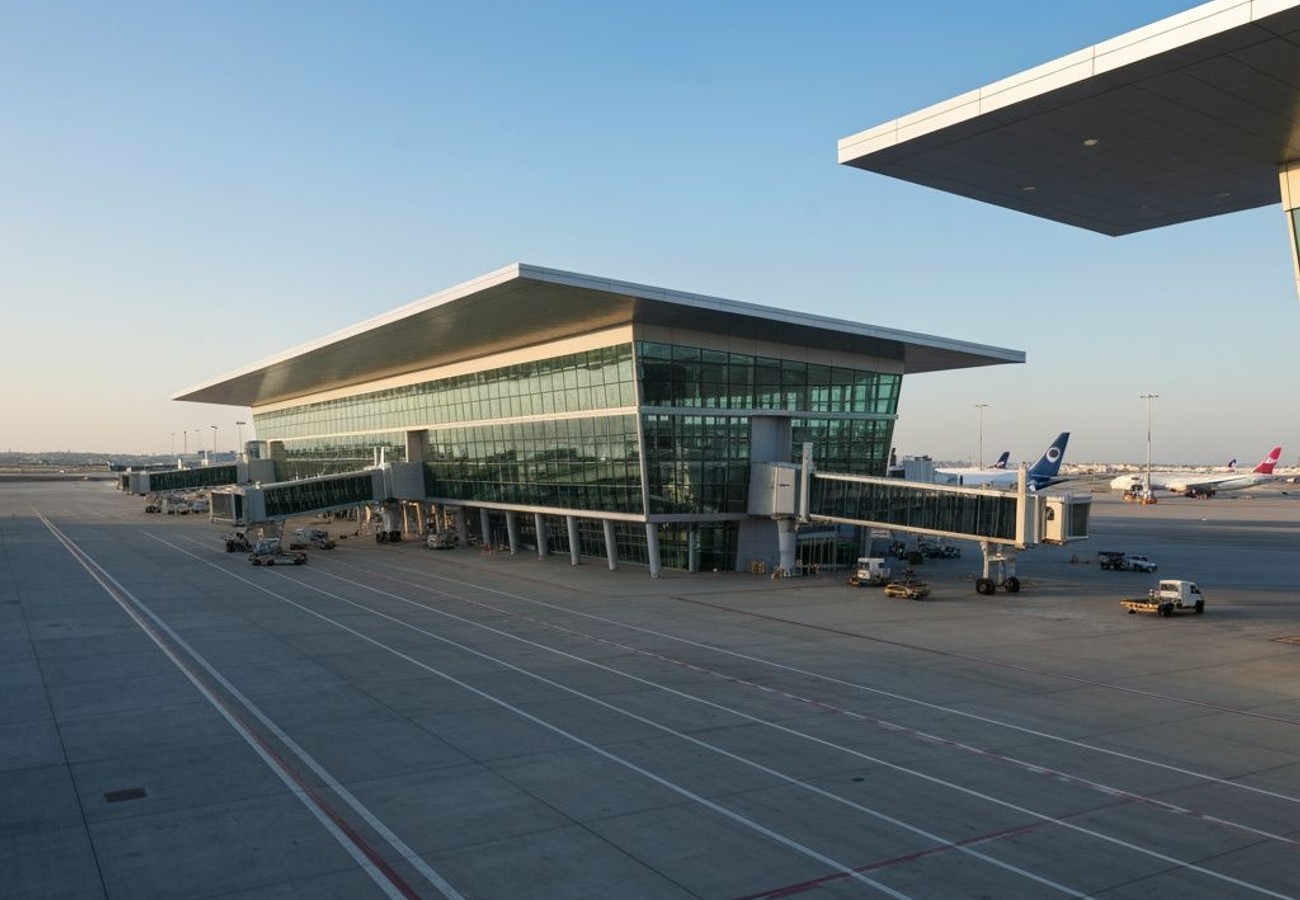
Image generated by AI
The Problem That Broke Traditional Airport Logic
Los Angeles International Airport (LAX) faced an impossible choice: either paralyze one of the world's busiest aviation hubs with construction chaos, or miss critical deadlines for the 2026 FIFA World Cup and 2028 Olympic Games. There was no middle ground—until airport planners discovered one.
The $421 million Midfield Satellite Concourse South opened its first commercial flight on September 30, 2025, with public operations beginning October 21. Eight new narrowbody gates and 150,000 square feet of terminal space materialized without strangling daily aircraft movements. But the real story isn't what was built—it's where and how.
LAX didn't build this terminal where terminals belong. It built it in a parking lot over a mile away.
Why Conventional Construction Was Dead on Arrival
Standard terminal expansion at LAX would have meant something unavoidable: shutting down taxiways. Closing gates. Parking construction cranes above active ramps. Moving concrete trucks inches away from Boeing 777s and Airbus A380s worth half a billion dollars each.
An airport managing hundreds of thousands of annual aircraft movements can't afford that luxury.
Reddit: "LAX is already gridlocked during peak hours. Adding construction equipment to active tarmac would have been a nightmare scenario." — r/aviation
Every square foot of LAX's operational space is spoken for. There's no excess concrete, no hidden staging areas, no room for traditional site logistics. The surrounding infrastructure is so densely utilized that conventional "build onsite" methodology would have created months of cumulative flight delays and gate revenue losses.
Attempting stick-built construction in the terminal core would have meant either accepting catastrophic operational disruptions or watching the project miss Olympic deadlines entirely. Project planners realized they needed to break 100 years of airport construction doctrine.
The Revolutionary Answer: Build It Somewhere Else
Engineers made a radical decision: construct the entire concourse nine miles away from its final destination.
Well, not quite nine miles. Just 1.5 to 1.75 miles—far enough to escape the active airfield's operational constraints, close enough to move the finished product when the time came.
Planners identified an underutilized parking facility and transformed it into a highly controlled manufacturing assembly line. While cranes, concrete trucks, and structural steel dominated this remote lot, the actual terminal site remained fully operational. No flight delays. No gate closures. No safety hazards from heavy machinery near million-dollar aircraft.
Inside the Modular Manufacturing Operation
The construction crew assembled the new concourse as nine independent, fully enclosed modular blocks. Each segment measured approximately 140 feet by 80 feet (43 by 24 meters)—massive, self-contained building modules that could be fabricated without depending on site-specific conditions.
Working in an unrestricted landside environment eliminated the constant bottlenecks that slow airside construction. Background checks. Security screening protocols. Restricted work windows around flight schedules. None of that applied to the parking lot operation. Workers could execute 24-hour fabrication schedules without interruption.
The real genius came next: parallel timelines.
While these nine modules took shape miles away, a separate team at the terminal site handled subterranean excavation, utility placement, and foundation pouring. By the time the first modular section was ready for transport, the landing pad was already prepared. Traditional construction would have required waiting for foundations to cure before erecting superstructure. This approach compressed months from the schedule simply by doing multiple phases simultaneously.
The Midnight Convoy: Moving 1,000-Ton Building Blocks
When modular sections reached completion, the most visually spectacular phase began: physically relocating nine partially completed terminal buildings across an active airport.
Self-Propelled Modular Transporters—massive, hydraulically synchronized vehicles—lifted individual modules weighing up to 1,000 tons (907 metric tons) each. These specialized rigs crawled across the tarmac at precisely 1.5 mph (2.4 km/h), moving the building blocks through narrow transportation corridors during the airport's lowest-traffic nocturnal windows.
Engineers constructed temporary reinforcement paths across the airfield to protect subterranean utilities. Each segment was positioned over pre-poured foundations with millimeter precision, then hydraulically lowered onto permanent structural columns. The process sounds like industrial choreography—and it essentially was.
Remarkably, this midnight assembly methodology compressed what typically takes months of sequential construction into a series of carefully orchestrated weekend deployments.
Why This Matters for Global Airport Infrastructure
The Midfield Satellite Concourse South represents more than just a clever solution to LAX's specific constraints. According to infrastructure analysis, modular construction is reshaping how major airports worldwide approach terminal expansion without operational disruption.
The parallel workflow methodology—excavation and fabrication happening simultaneously at separate sites—eliminated traditional sequential bottlenecks. Weather delays became manageable because the main manufacturing operation occurred in a controlled environment. Labor coordination improved because workers operated 24/7 on a dedicated parking lot instead of competing for space on the active airfield.
The project deployed over 30% local workforce, proving that industrial-scale modular construction creates sustainable employment while accelerating timelines. Conventional methods would have taken substantially longer while imposing exponentially greater operational chaos on one of North America's busiest aviation hubs.
Racing Against Olympic Deadlines
The urgency driving this innovation was unambiguous: 2026 FIFA World Cup and 2028 Olympic Games require immediate capacity expansion. Traditional construction methodologies would have guaranteed missed deadlines. Instead, LAX delivered eight operational narrowbody gates before the first tournament arrived.
This modular breakthrough, executed as part of LAX's broader $30 billion Capital Improvement Program, demonstrates that major airports no longer must choose between expansion and operational paralysis. They can now pursue both simultaneously—by building elsewhere and moving the finished product home.
The future of airport infrastructure isn't built onsite anymore. It's manufactured offsite and installed at midnight.
Related Travel Guides
Disclaimer
This article is for informational and educational purposes only. It does not constitute legal, financial, or professional advice. While we strive to provide accurate and up-to-date information, travel policies, regulations, and conditions change rapidly. Always verify information with official sources before making travel decisions. Nomad Lawyer makes no representations about the accuracy, reliability, completeness, or suitability of the information provided. Readers should consult qualified professionals for advice specific to their circumstances. The views expressed in this article are those of the author and do not necessarily reflect the views of Nomad Lawyer.
Preeti Gunjan
Contributor & Community Manager
A passionate traveller and community builder. Preeti helps grow the Nomad Lawyer community, fostering engagement and bringing the reader experience to life.
Learn more about our team →