
Hanle Dark Sky Reserve in Ladakh Empowers Women Astronomy Ambassadors to Drive India's Premier High-Altitude Astro-Tourism Model in 2026
Hanle Dark Sky Reserve at 4,500m in Ladakh trains local women astronomy ambassadors, creating India's premier community-led astro-tourism model.

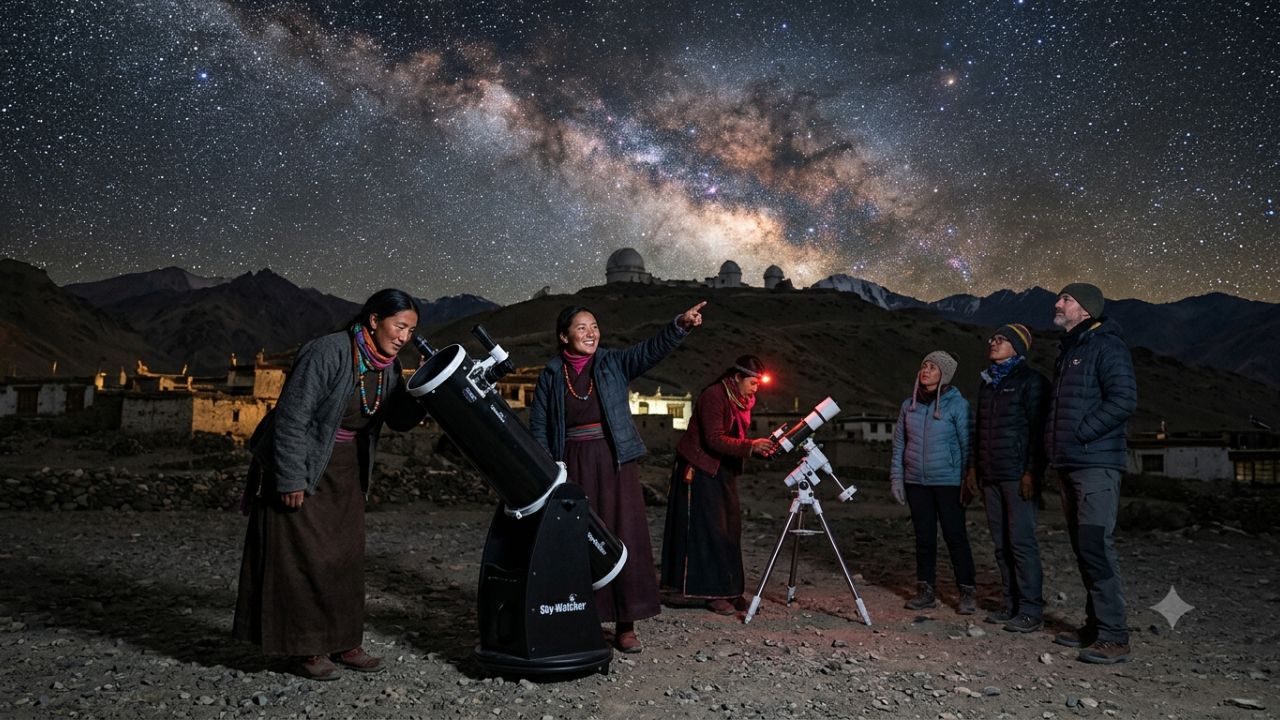
Image generated by AI
Located at an elevation of 4,500 meters (14,764 feet) within the Changthang Wildlife Sanctuary, the Hanle Dark Sky Reserve in Ladakh has established India’s first community-led astro-tourism economy, driven by trained local women astronomy ambassadors. Officially designated in December 2022, the high-altitude, low-moisture reserve leverages exceptional nocturnal atmospheric clarity to combine world-class scientific research with grassroots hospitality.
Under a joint initiative spearheaded by the Union Territory Administration of Ladakh, the Ladakh Autonomous Hill Development Council (LAHDC) Leh, the Department of Science and Technology (DST), and the Indian Institute of Astrophysics (IIA), local residents have been transformed from pastoral herders into certified astronomy ambassadors. Equipped with portable telescopes and intensive technical training, these ambassadors lead nocturnal observation sessions for international travelers while enforcing strict dark-sky conservation protocols.
Institutional Collaboration and Astronomical Infrastructure
Hanle's development as an astronomical research hub began in 2000 with the installation of the 2-metre Himalayan Chandra Telescope atop Dig-pa-ratsa Ri. Operating at 4,500 meters, the observatory is one of the highest optical astronomical sites in the world. Subsequent installations of high-altitude gamma-ray and optical arrays have solidified Hanle as a premier global research center.
Hanle Dark Sky Reserve Institutional Framework (2026)
├── Indian Institute of Astrophysics (IIA) ──► Manages 2m Himalayan Chandra Telescope & Research
├── LAHDC Leh & UT Ladakh Administration ──► Coordinates Infrastructure, Homestays & Permits
├── Department of Science & Technology   ──► Funds Portable Telescopes & Ambassador Training
└── Local Area Committee & Homestay Network ─► Enforces Light Pollution Rules & Guides Stargazing
To prevent high-altitude research installations from operating as isolated enclaves, institutional partners established the Hanle Dark Sky Reserve Local Area Committee. This community-governed body coordinates with local village leaders to enforce light pollution management plans, requiring outdoor lighting to be fully shielded and indoor illumination to be contained using heavy blackout curtains.
Hanle Dark Sky Reserve Specifications & Sector Metrics
The Hanle Dark Sky Reserve integrates scientific research, high-altitude conservation, and community homestay hospitality.
| Reserve Parameter / Sector | Technical Specification / Metric | Governing Institution | Strategic & Community Impact |
|---|---|---|---|
| Reserve Elevation | 4,500 meters (14,764 feet) above sea level | Changthang Wildlife Sanctuary / UT Ladakh | Low moisture & zero light pollution ensure pristine nocturnal sky clarity |
| Official Designation Date | December 2022 (Notification) | Department of Science & Technology (DST) | India's 1st official Dark Sky Reserve; benchmark for high-altitude eco-tourism |
| Primary Research Telescope | 2-metre Himalayan Chandra Telescope (Installed 2000) | Indian Institute of Astrophysics (IIA) | World-class optical research observatory atop Dig-pa-ratsa Ri |
| Astronomy Ambassadors | Local women & youth trained as star guides | IIA, LAHDC Leh & UT Administration | Women-led economic empowerment through guided telescope sessions |
| Community Homestays | Village-wide family homestay network | Hanle Local Area Committee | Direct revenue retention for former pastoral herding families |
| Celestial Targets Observed | Milky Way core, Jupiter, Andromeda, Neptune | Guided nocturnal observation | Immersive science education & nocturnal biodiversity protection |
Scientific Integration and Grassroots Economic Empowerment
The shift toward community-led astro-tourism marks a departure from conventional passive conservation models. By training local women to operate 8-inch and 10-inch portable telescopes, the program generates sustainable year-round income within a region traditionally reliant on seasonal pastoralism and subsistence agriculture.
Visitors to Hanle participate in structured daytime and nighttime itineraries. By day, tourists explore the 17th-century Hanle Monastery and the Changthang high-altitude desert. By night, local hosts lead observation sessions detailing deep-sky objects—including the core of the Milky Way, the rings of Saturn, the moons of Jupiter, and the Andromeda Galaxy—while sharing traditional Himalayan celestial folklore.
Hanle Community Astro-Tourism Ecosystem
├── Day Experience   ──► High-Altitude Landscape, 17th-Century Monastery & Nomadic Culture
└── Night Experience ──► Guided Stargazing (Milky Way, Andromeda) with Women Astronomy Ambassadors
Traveler Logistics Guide: Navigating Hanle, High-Altitude Acclimatization, and Stargazing
Traveling to Hanle requires meticulous logistics planning due to extreme altitude, remote Himalayan border geography, and strict conservation guidelines.
1. High-Altitude Acclimatization Schedule
- Mandatory Leh Acclimatization: Travelers arriving by air at Kushok Bakula Rimpoche Airport (IXL) in Leh (3,500m / 11,500ft) MUST complete a minimum 48-hour acclimatization period in Leh before traveling to Hanle (4,500m).
- Transit Route to Hanle: From Leh, travel via the Chumathang or Nyoma route along the Indus River (250 km / 6 to 7 hours drive). Carry portable oxygen cylinders and consult physicians regarding prophylactic altitude medication (such as Acetazolamide).
2. Inner Line Permits (ILP) and Border Documentation
- Protected Area Permit (PAP) / ILP: Because Hanle is located near international border zones within the Changthang Wildlife Sanctuary, foreign and domestic travelers must obtain an Inner Line Permit (ILP) via the official LAHDC Leh Portal or registered travel agents in Leh prior to departure.
3. Light Pollution Rules and Stargazing Protocols
- Red-Light Headlamps: Standard white flashlights and high-beam vehicle headlights disrupt nocturnal dark adaptation and scientific observations. Travelers must utilize red-light headlamps when walking outside after dusk.
- Shielded Homestay Accommodation: Book stays in certified Hanle community homestays. Guests are required to close heavy thermal blackout curtains before turning on indoor lights to maintain zero light spill into the dark sky reserve.
- Sub-Zero Thermal Clothing: Nighttime temperatures in Hanle routinely drop below -10°C to -25°C (14°F to -13°F) even during autumn and spring months. Pack heavy down jackets, windproof thermal trousers, insulated boots, and heated gloves for stargazing sessions.
Infrastructure Impact and High-Altitude Eco-Tourism Assessment
Hanle's astro-tourism model provides a sustainable template for high-altitude environmental management across the Himalayas.
- Light Pollution Mitigation: Enforcing strict municipal lighting codes protects sensitive nocturnal wildlife within the Changthang Sanctuary while safeguarding telescope optical clarity.
- Reversing Rural Migration: Economic opportunities from homestays and astronomy guiding incentivize local youth to remain in Changthang rather than migrating to urban centers.
- Scientific Science Communication: Bridging advanced astrophysics with community hosting fosters public appreciation for space science and dark-sky preservation.
Frequently Asked Questions: Hanle Dark Sky Reserve 2026
What is the elevation of the Hanle Dark Sky Reserve?
The Hanle Dark Sky Reserve is located at an elevation of 4,500 meters (14,764 feet) above sea level in the Changthang region of Ladakh, India.
Who guides the stargazing sessions in Hanle?
Stargazing sessions are guided by locally trained astronomy ambassadors—predominantly women from the Hanle community—who have been equipped with portable telescopes and technical training by the Indian Institute of Astrophysics.
What permits are required to visit Hanle in Ladakh?
Both domestic and international travelers must secure an Inner Line Permit (ILP) or Protected Area Permit (PAP) issued by the LAHDC Leh administration before traveling to Hanle.
How do travelers acclimatize for a trip to Hanle?
Travelers flying into Leh (3,500m) should spend at least 48 hours resting in Leh to acclimatize before making the 6-to-7-hour road journey up to Hanle (4,500m).
Related Travel Guides
Madhya Pradesh Astro Tourism Six Villages Cosmic Sanctuaries 2026
Dehradun Flash Flood Monsoon Travel Advisory Uttarakhand 2026
The 10 Best Stargazing Locations in India, According To Reddit
Disclaimer
This article is for informational and educational purposes only. It does not constitute legal, financial, or professional advice. While we strive to provide accurate and up-to-date information, travel policies, regulations, and conditions change rapidly. Always verify information with official sources before making travel decisions. Nomad Lawyer makes no representations about the accuracy, reliability, completeness, or suitability of the information provided. Readers should consult qualified professionals for advice specific to their circumstances. The views expressed in this article are those of the author and do not necessarily reflect the views of Nomad Lawyer.
Raushan Kumar
Founder & Lead Developer
Full-stack developer with 11+ years of experience and a passionate traveller. Raushan built Nomad Lawyer from the ground up with a vision to create the best travel and law experience on the web.
Learn more about our team →