UK Holiday Travel Under Strain as Jet2 Challenges Aviation Taxes Amid European Fuel Spike

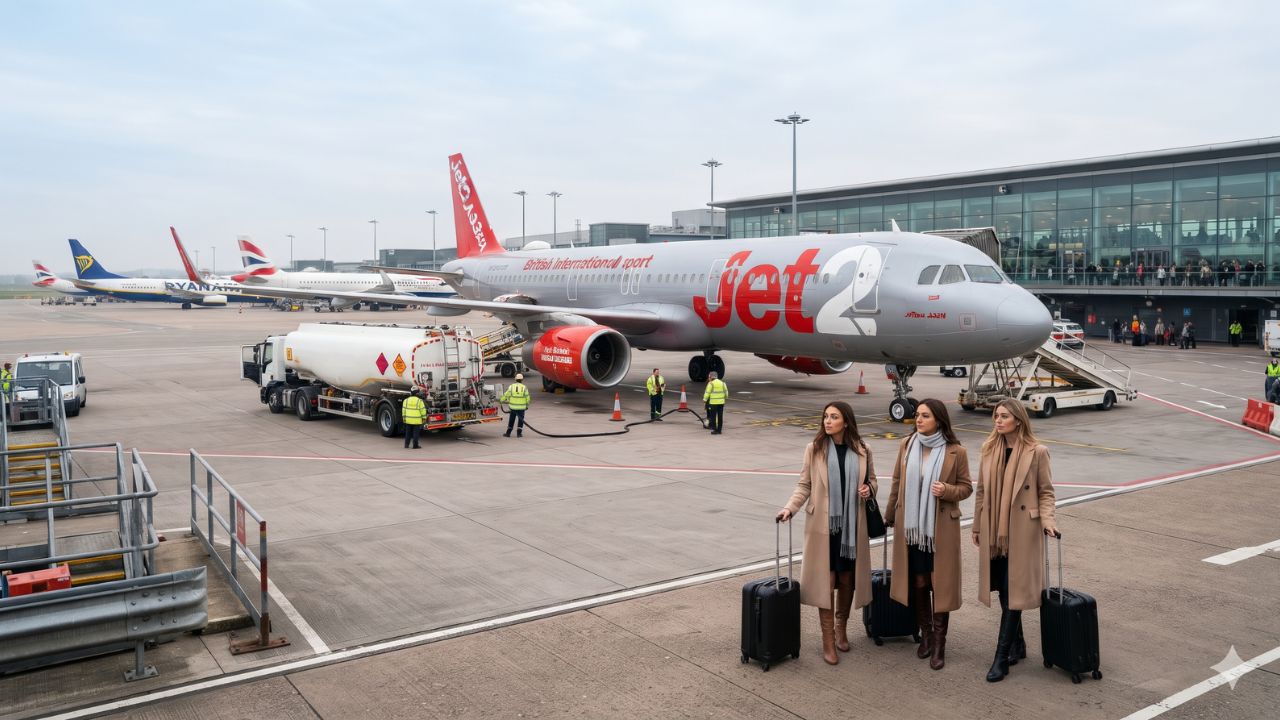
Even as Jet2 transported a record 15.4 million passengers and lifted revenues to £5.63 billion during the six months ending 30 September 2026, its pre-tax profits tumbled 19% to £652.2 million. This sharp divergence—driven by flight-only ticket yields falling 14% to £104.82 per passenger sector—reveals the financial squeeze gripping Britain’s leisure aviation sector. In its interim financial statement delivered on 18 November 2026, Jet2 Chief Executive Steve Heapy publicly challenged the mounting fiscal burden of government environmental mandates and passenger levies, while the carrier quietly removed 240,000 seats from its winter 2026–27 schedule to protect margins against volatile unhedged fuel prices.
The strain is reverberating across continental skies. As kerosene prices in European wholesale markets hovered near twice their early-year baselines, budget behemoths like Ryanair, Wizz Air, and International Airlines Group (IAG) are cautioning that the era of ultra-cheap Mediterranean getaways faces fundamental cost barriers. For British holidaymakers organizing summer 2027 escapes to Spain, Greece, and Portugal, the collision of energy volatility, green transition mandates, and climbing Air Passenger Duty (APD) threatens to reshape holiday pricing.
The Fuel Crisis and Airline Hedging Protections
The primary economic shock hitting European aviation stems from an erratic global energy market. Operational intelligence released on 12 November 2026 by EUROCONTROL showed that European jet fuel prices averaged $4.84 per US gallon in October 2026, compared to just $2.26 across January and February. Although spot rates eased to $4.42 per gallon in early November, forward kerosene markets remain severely inflated. Across the European flight network, EUROCONTROL tracked 27,649 daily flights between 2 and 8 November 2026, representing a 1% contraction compared to 2025.
To insulate operations, Jet2 secured hedge contracts covering 91% of its winter fuel requirements at an average of $880 per tonne and 50% of summer 2027 requirements at $837 per tonne, keeping first-half fuel expenditure steady at £489.5 million. Yet hedging provides only temporary shelter. Ryanair reported on 2 November 2026 that while its first-half passenger traffic grew 6% to 125.8 million, its average fare slipped 4% to €55.70, and unhedged fuel prices doubled. Europe's largest budget carrier warned that its annual fuel bill for the fiscal year ending March 2028 could swell by approximately €2 billion.
Similar warnings are sounding across the continent. Wizz Air reported a 33.7% jump in first-half fuel costs to €1.24 billion, while IAG posted a 30.4% post-hedging increase in third-quarter fuel costs. According to the International Air Transport Association (IATA), European airline net profits are projected to sink from $13 billion in 2025 to $9.6 billion in 2026, shrinking net profit margins to 3.1%.
Airline Cost Pressures, Taxes, and Fuel Comparisons
The interplay of spot energy spikes, green compliance fees, and fiscal adjustments illustrates the mounting operational pressure on European leisure flights:
| Airline / Economic Indicator | Reported Metric / Performance | Year-Over-Year Change | Key Underlying Driver | Practical Impact on Holidaymakers |
|---|---|---|---|---|
| Jet2 Passenger Traffic | 15.4 million passengers | +9.0% | Strong leisure package demand | High volume filling Mediterranean beach routes |
| Jet2 Pre-Tax Profit | £652.2 million | -19.0% | Lower flight yields & higher costs | Pressure to trim non-profitable seasonal flights |
| Jet2 Flight-Only Yield | £104.82 per sector | -14.0% | Intense seat price discounting | Flight-only deals available, but margins under pressure |
| Jet2 Package Holiday Price | £945 average booking | +1.0% | Stable hotel contracting | Packaged bundles outperforming standalone flights |
| Jet2 Carbon Expenditure | £88.4 million | +43.0% | UK/EU ETS price surges | Environmental overhead passed into ticket surcharges |
| European Jet Fuel Price | $4.84 / gallon (Oct average) | +114% vs Jan ($2.26) | Middle East supply volatility | Long-term upward pressure on 2027 base fares |
| UK Short-Haul APD (Economy) | £15.49 (from 1 April 2027) | Up from £15.00 | UK Treasury Budget revision | Added tax per departure on Mediterranean routes |
| UK Long-Haul APD (Band B) | £105.33 (from 1 April 2027) | Up from £102.00 | UK Treasury Budget revision | Modest increases on Caribbean and US holidays |
| EASA Sustainable Fuel Index | €1,925 per tonne | 3x fossil fuel (€640/t) | ReFuelEU Aviation supply deficit | Green transition mandates inflating operational inputs |
What Makes the 2027 Holiday Market Different
The landscape facing holidaymakers booking European vacations differs sharply from post-pandemic surges. While the UK Office for National Statistics (ONS) recorded that airfares rose 1.8% between September and October 2026 (roughly matching the 1.7% increase in 2025), pricing behavior varies dramatically by destination.
Eurostat figures reveal that while overall EU passenger air transport prices in August 2026 were 0.4% lower year-on-year, airfares surged 16.3% in Greece and 14.4% in Ireland, while dropping 15.8% in Spain. Package holiday prices across the EU rose 3.2%, demonstrating that all-inclusive packages insulate families against standalone airline pricing swings.
Simultaneously, European governments are splitting on aviation taxation policy. While the UK Treasury projects £5.2 billion in APD receipts for 2026–27 and plans to raise short-haul economy duty to £15.49 on 1 April 2027, Germany reduced its aviation departure tax on 1 July 2026, cutting short-haul rates from €15.53 to €13.03 to protect hub competitiveness. With the Netherlands maintaining a passenger tax of €30.25, the cost of departing European airports is becoming highly fragmented.
Visitor Insider Tips for Booking Summer 2027 Vacations
To shield holiday budgets against rising environmental levies and aviation fuel surcharges, British travelers should adjust their booking playbook:
- Prioritize ATOL-Protected Package Holidays Over Flight-Only Bookings: Jet2’s financial figures prove that while standalone flight prices fluctuate wildly, average package holiday prices increased by only 1% to £945. Bundled package holidays lock in hotel rates, transfers, and checked luggage allowances, insulating travelers against sudden airline fuel surcharges.
- Book Summer 2027 Departures Before 1 April 2027 Tax Adjustments: While the upcoming UK Air Passenger Duty adjustments are modest—short-haul economy rises by 49p to £15.49 and long-haul Band B climbs £3.33 to £105.33—booking and ticketing flights before 1 April 2027 avoids the higher tariff bands.
- Target Spanish Corridors for Airfare Value: Eurostat fare tracking demonstrates that airfares to Spain fell 15.8% year-on-year due to intense budget airline competition, compared to double-digit price hikes into Greece (+16.3%). Directing family vacations toward mainland Spain, the Balearics, or the Canaries delivers significantly more purchasing power.
- Monitor Regional Airport Flight Cancellations: Following Jet2's removal of 240,000 winter seats (reducing non-Gatwick capacity by 3.6%), travelers flying from secondary regional hubs like Leeds Bradford, Newcastle, or East Midlands should monitor flight frequencies, as airlines consolidate departures into primary bases like London Gatwick.
Cultural and Environmental Context
The deepening tension between airline executives and transport ministers centers on the accelerating timeline for aviation decarbonization. Under regulations monitored by the European Union Aviation Safety Agency (EASA), the ReFuelEU Aviation mandate requires blending increasing percentages of Sustainable Aviation Fuel (SAF). However, EASA's technical reporting confirms that SAF traded at an average of €1,925 per tonne in 2025, compared to €640 per tonne for conventional fossil kerosene.
While SAF achieves lifecycle greenhouse gas reductions of approximately 89%, commercial production remains miniscule relative to total demand. Although the European Commission allocated €430 million across 130 aircraft operators to incentivize adoption, airline executives warn that rigid mandates without local refining capacity will act as a regressive tax on leisure travel, pricing middle-income working families out of annual Mediterranean holidays.
FAQ: UK and European Holiday Flight Prices 2027
Why did Jet2 cut 240,000 seats from its winter schedule?
Jet2 removed 240,000 seats to protect profitability against high unhedged forward jet fuel prices, reducing non-Gatwick winter capacity by 3.6%.
How much is UK Air Passenger Duty increasing in 2027?
On 1 April 2027, short-haul economy duty rises from £15 to £15.49, domestic duty increases to £8.26, and long-haul Band B climbs from £102 to £105.33.
Are European flight prices rising uniformly across all destinations?
No. Eurostat records show airfares dropped 15.8% in Spain, while prices climbed 16.3% in Greece and 14.4% in Ireland due to localized demand and airport taxes.
How much more expensive is Sustainable Aviation Fuel than jet fuel?
According to EASA technical reports, Sustainable Aviation Fuel averaged €1,925 per tonne in reported transactions, roughly three times conventional jet fuel at €640 per tonne.
As green mandates and volatile oil barrels squeeze airline balance sheets, the annual pilgrimage to the Mediterranean sun is becoming a masterclass in strategic advance booking.
Related Travel Guides
This article is for informational purposes. Flight routes, passenger regulations, visa rules, and transit advisories are subject to change by airlines and aviation authorities. Readers are advised to verify schedules and travel documentation with relevant carriers and border agencies before departure.
Related Stories

Wizz Air Profit Plummets 67% Amid Intense Ryanair and Pegasus Competition in Europe 2026
Syrian Airlines Inaugurates Direct Aleppo to Moscow Flights as Airport Expansion Targets 2 Million Capacity