Cancun, Riviera Maya, and Cozumel Celebrate Living Maya Heritage Through Janal Pixán and Día de Muertos

CANCUN / PLAYA DEL CARMEN — Across the sun-drenched coastline of the Mexican Caribbean, an extraordinary cultural transformation is unfolding as Cancun, the Riviera Maya, Cozumel, and Puerto Morelos transcend their traditional reputations as conventional beach resort enclaves to celebrate the ancestral spiritual traditions of Janal Pixán alongside Mexico’s national Día de Muertos.
For generations, the state of Quintana Roo was marketed internationally through a single-minded commercial lens: white-sand Caribbean beaches, all-inclusive luxury hospitality, and high-energy nightlife corridors.
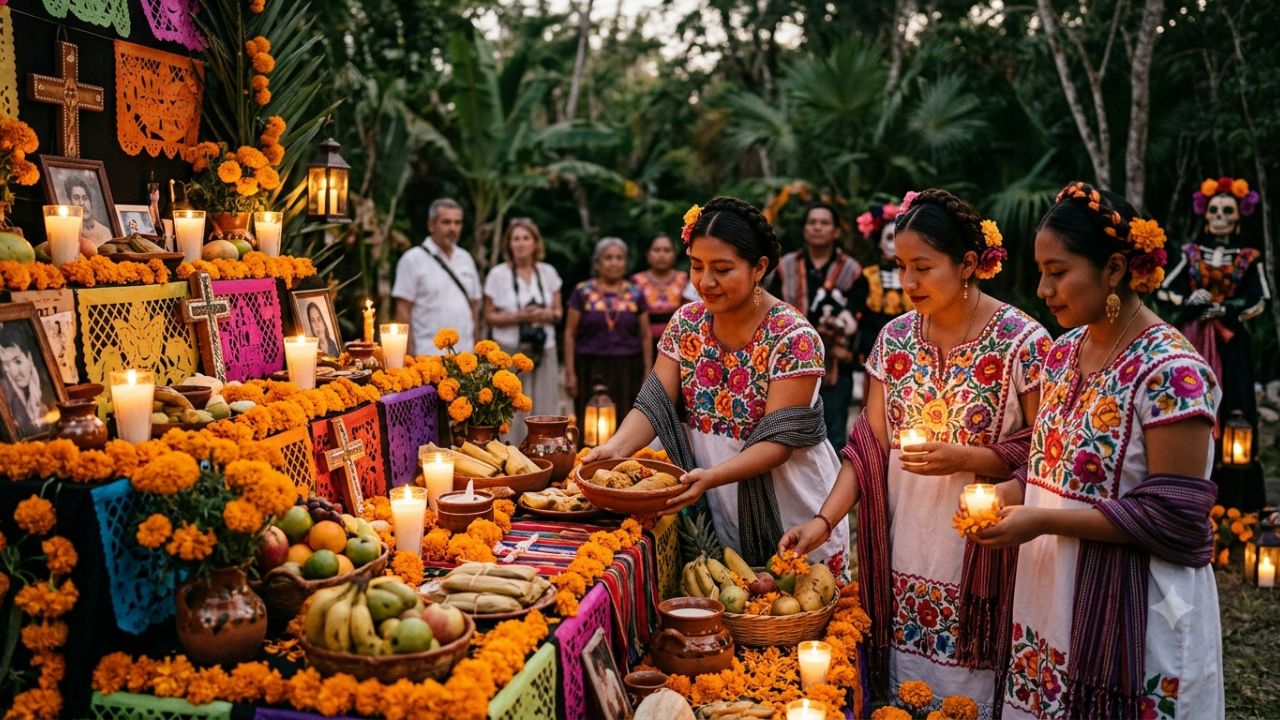
However, throughout the opening week of November 2026, the destination’s true identity has taken center stage. Communities across the Yucatán Peninsula have come together to honor the departed, constructing ceremonial three-tiered altars, conducting sacred Mayan fire blessings, presenting maritime boat processions on the Caribbean Sea, and slow-cooking ancestral subterranean culinary offerings.
Far from being a staged theatrical display manufactured for mass tourism, these observances reflect the living cultural endurance of the Yucatec Maya civilization.
By integrating authentic indigenous rituals into municipal plazas, museum galleries, and beachfront resorts, destination authorities and local cooperatives are demonstrating how modern travel can actively protect indigenous heritage.
From the illuminated reef lagoons of Puerto Morelos and the legendary Festival of Life and Death Traditions in Xcaret to monumental artistic exhibitions on the island of Cozumel, the Mexican Caribbean is proving that the spiritual connection between living communities and their ancestors remains one of the world's most compelling cultural journeys.
       THE MEXICAN CARIBBEAN JANAL PIXÁN FESTIVAL CORRIDOR

  [ CANCUN RESORT SANCTUARIES ]
  * Hilton Cancun All-Inclusive: Authentic family altars & culinary workshops
  * Resort programs introducing international guests to sacred Maya etiquette
                 |
                 v
  [ PUERTO MORELOS: MAR DE ALMAS ]
  * Traditional Maya fire ceremonies led by elder spiritual guardians
  * Illuminated boat processions sailing across the national marine reef park
  * Community altar walks and monumental artisan Catrina competitions
                 |
                 v
  [ RIVIERA MAYA & PLAYA DEL CARMEN ]
  * Xcaret Festival of Life and Death Traditions: 19th annual cultural gathering
  * Underground earthen ovens (píib) slow-roasting traditional mucbipollo
  * Theatrical productions, Pre-Hispanic sacred music, and cempasúchil arches
                 |
                 v
  [ COZUMEL: TRADICIÓN, LUZ Y REENCUENTRO ]
  * Museo de la Isla: Monumental altars honoring guest state of Michoacán
  * Monarch butterfly symbolism, video-mapping, and folkloric dance assemblies
Janal Pixán: The Sacred Maya Feast of the Souls
To appreciate the profound cultural significance of the celebrations unfolding across the Mexican Caribbean, one must distinguish between Mexico’s wider Día de Muertos traditions and the distinct, ancient Maya observance of Janal Pixán (frequently rendered in modern Maya orthography as Hanal Pixán).
In the Yucatec Maya language, Janal Pixán translates directly to "Food of the Souls" (Janal meaning feast or sustenance, and Pixán signifying the soul or spiritual essence). Rooted in the cosmological worldview of the ancient Maya, death was never conceived as a final termination of existence, but rather as a sacred transition within the cyclical cosmic order.
The human spirit journeys through the underworld (Xibalbá), returning each autumn to the terrestrial realm to be embraced, nourished, and remembered by living kin.
THE THREE SACRED CYCLES OF JANAL PIXÁN REMEMBRANCE
| Column 1 |
|---|
| OCTOBER 31: U HANAL PALAL (Feast of the Departed Children) |
| - Altars decorated with pristine white tablecloths and wild flowers |
| - Offerings: Sweet corn porridge (atole), native toys, honey, and jícama |
| NOVEMBER 1: U HANAL NUCUCH UINICOOB (Feast of the Departed Adults) |
| - Altars set with hand-embroidered cloths and traditional clay pottery |
| - Offerings: Subterranean mucbipollo, balché beverage, and strong coffee |
| NOVEMBER 2: U HANAL PICOOB (Feast of All Souls / Solitary Spirits) |
| - Community prayers, cemetery cleanings, and neighborhood banquet gatherings |
| - Offerings set for forgotten or wandering souls with no surviving family |
The observance unfolds across a strict three-day liturgical sequence:
- October 31 – U Hanal Palal: Dedicated entirely to the souls of deceased children. Altars are adorned with radiant marigold blooms, hand-carved wooden toys, sweet corn porridges, wild honey harvested from stingless Melipona bees, and delicate sweet breads, reflecting purity and youthful innocence.
- November 1 – U Hanal Nucuch Uinicoob: Dedicated to departed adult ancestors. The altar transforms to display deeper flavors and personal mementos: clay bowls of rich turkey stews, handmade cigars, cups of sacred balché, family photographs, and the ceremonial mucbipollo.
- November 2 – U Hanal Picoob: Known colloquially as the day of all souls or Misa Pixán. Communities gather in local cemeteries and municipal plazas to celebrate collective memorial masses, sharing food across family boundaries and placing special offerings outside domestic doorways to sustain lonely or forgotten spirits who have no living relatives to prepare an altar.
The Sacred Gastronomy: The Píib Underground Oven and Mucbipollo
At the physical and spiritual center of Janal Pixán lies an ancient culinary ritual that connects agricultural fertility with ancestral remembrance: the preparation of Mucbipollo (also known simply as the Pib).
Unlike conventional festive dishes prepared in modern gas ovens, the preparation of Mucbipollo is an intensive, collective ritual demanding generational collaboration.
The dish consists of a large, circular tamal crafted from freshly ground corn masa seasoned with lard, local achiote paste, and fragrant sprigs of epazote. The dough is shaped into a thick, protective crust and filled with tender shredded turkey or pork simmered in a dense, savory gravy (k'óol) thickened with seasoned corn flour.
Once assembled, the massive pie is wrapped meticulously in fresh, toasted banana leaves and tied securely with natural henequen fibers.
                  THE COSMOLOGICAL SACRAMENT OF THE PÍIB OVEN

  [ Surface Excavation ] ===> Rectangular pit dug into the limestone earth
                 |
                 v
  [ The Sacred Fire ]    ===> Pit lined with aromatic dry woods (Chukum, Jabín)
                 |
                 v
  [ Thermal Bed ]        ===> Dense river stones heated to incandescent temperatures
                 |
                 v
  [ Burial & Roasting ]  ===> Mucbipollo buried under wild leaves & earth for 3 hours
                 |
                 v
  [ Symbolic Meaning ]   ===> The tamal enters the earth as an offering to ancestors,
                              resurrecting as spiritual sustenance for the living.
The cooking method transforms cooking into a spiritual sacrament. Men of the household excavate a rectangular trench into the stony soil, constructing an underground oven known as a píib.
Dense hardwood timber (traditionally cut from local chukum and jabín trees) is layered with river stones and set ablaze until the stones glow white-hot.
Once the flames subside into embers, the banana-leaf-wrapped Mucbipollos are laid directly onto the volcanic stones, covered with wild aromatic leaves to trap steam, and sealed completely beneath a thick blanket of freshly dug earth.
The symbolic meaning of the process is profound: the food is buried beneath the earth, entering the realm of the underworld to be spiritually savored by the returning ancestors.
When the pit is ceremonially excavated three hours later, the roasted Mucbipollo emerges with a crisp, mahogany crust and a rich smoky perfume, ready to be offered first on the family altar before being shared in joyous communal feasts.
| Cultural Dimension | Ancient Maya Janal Pixán | Traditional Central Mexican Día de Muertos |
|---|---|---|
| Linguistic Root | Yucatec Maya (Food of the Souls) | Classical Nahuatl & Spanish Catholic Synthesis |
| Central Culinary Sacrament | Mucbipollo slow-baked in underground píib | Pan de Muerto and sugar skulls (calaveritas) |
| Ritual Beverages | Sacred Balché (fermented tree bark & honey) | Atole, spiced hot chocolate, and mezcal |
| Altar Architecture | Three levels representing Underworld, Earth, Sky | Multi-tiered (up to 7 levels) with Catholic icons |
| Primary Flower | Wild regional blooms alongside cempasúchil | Dominant orange cempasúchil marigold petals |
| Incense Used | Natural tree resin copal (pom) | Indigenous copal resin in ceramic censers |
| Seasonal Schedule | Three distinct cycles for children, adults, all | Broad observance focusing on Nov 1 (Saints) & Nov 2 |
Puerto Morelos: Maritime Soul Processions at "Mar de Almas"
While interior Yucatecan towns celebrate Janal Pixán amidst jungle greenery, the historic coastal fishing port of Puerto Morelos delivered a breathtaking maritime adaptation through its annual Mar de Almas (Sea of Souls) festival.
Nestled between the hotel strips of Cancun and Playa del Carmen, Puerto Morelos has fought fiercely to maintain its authentic seafaring identity.
During the festival, local fishing cooperatives, coastal artists, and municipal leaders combined Maya spiritual traditions with the town’s marine heritage.
       MAR DE ALMAS FESTIVAL: PUERTO MORELOS MARITIME HERITAGE

  [ The Ocean Procession ]            [ The Sacred Fire ]              [ Monumental Arts ]
  Flotilla of illuminated fishing     H-men (Maya spiritual elder)     Artisans craft giant
  boats carrying altars sails         ignites copal incense fires      Catrinas, alebrijes, and
  across national coral reef lagoon.  blessing town & sea spirits.     ornamental building facades.
The festival's signature spectacle was the maritime boat procession:
- The Flotilla of Souls: As dusk settled over the Caribbean Sea, a flotilla of traditional wooden fishing boats—decorated with arches of orange cempasúchil flowers, glowing wax candles, and personal family altars—navigated slowly through the protected waters of the Puerto Morelos National Coral Reef Park. The illuminated vessels reflected off tranquil turquoise waters, symbolizing the journey of departed souls across the waters to rejoin their ancestral villages.
- The Maya Fire Ceremony: On the central town square, a certified H-men (traditional Maya spiritual healer) conducted an authentic Pre-Hispanic fire ceremony. Speaking in fluid Yucatec Maya, the elder purified the communal altar with smoldering copal incense (pom), invoking the blessings of the four cardinal directions and offering prayers to the sea for the protection of local fishermen.
- Artisanal Competitions and Catrina Walks: Simultaneously, pedestrian avenues hosted community competitions for handcrafted alebrijes (fantastical folk-art sculptures), monumental Catrina figures constructed from recycled natural materials, and ornamental building façade decorations, proving that community-led cultural tourism can thrive without corporate homogenization.
Riviera Maya: Xcaret’s Festival of Life and Death Traditions
In the heart of the Riviera Maya, the renowned eco-archaeological park Xcaret celebrated the nineteenth edition of its world-famous Festival of Life and Death Traditions (Festival de Tradiciones de Vida y Muerte).
Spanning four days, Xcaret’s festival has evolved into one of the most significant cultural events in the Americas, attracting over 50,000 international visitors and local residents annually.
Rather than presenting an idealized commercial fantasy, Xcaret invites traditional indigenous communities, master craftspeople, and culinary guardians from across the Yucatán Peninsula and neighboring Mexican states to showcase their living traditions on a grand stage.
XCARET FESTIVAL OF LIFE AND DEATH TRADITIONS (EDITION XIX)
| Column 1 |
|---|
| 1. THE SANCTUARY OF ARTISANS & INDIGENOUS COMMUNITIES |
| - Over 300 Maya craftspeople presenting traditional weaving & wood carving |
| - Hands-on workshops in copal resin extraction, candle-making, and pottery |
| 2. THE CEMETERY OF THE BRIDGE TO PARADISE |
| - 365 unique handcrafted tombstones representing the days of the year |
| - Thousands of cempasúchil candles illuminating subterranean stone vaults |
| 3. THEATRICAL DRAMA & PRE-HISPANIC RITUAL PERFORMANCE |
| - Re-enactments of ancient Maya underworld ballgame myths from the Popol Vuh |
| - Contemporary Mexican theatrical productions exploring memory and grief |
The festival’s immersive programming provided visitors with unprecedented access to living Mexican heritage:
- The Bridge to Paradise Cemetery: Perched on a gentle spiral hill, Xcaret’s replica Mexican cemetery features 365 handcrafted burial niches reflecting the days of the solar year, linked by a spiral staircase containing 52 steps representing the weeks of the year. During the festival, thousands of glowing taper candles illuminate stone vaults, while local Maya families gather to maintain authentic memorial vigils, singing traditional prayers in Maya and Spanish.
- Pre-Hispanic Performance and Theater: Stages situated throughout the jungle canopy presented theatrical dramas, folkloric ballet assemblies, and musical performances utilizing ancestral Pre-Hispanic instruments—including hollowed log drums (tunkul), conch shells, and ocarinas.
- Gastronomic Pavilions: Elite regional cooks (cocineras tradicionales) operated traditional smoke kitchens, demonstrating the unearthing of authentic mucbipollo, the grinding of heirloom maize on stone metates, and the serving of traditional atole nuevo.
Cozumel: Remembrance, Light, and the Monarch Butterfly
Across the sea on the island of Cozumel, cultural authorities mounted an extraordinary celebration entitled Tradición, Luz y Reencuentro (Tradition, Light, and Reunion), hosted within the historic galleries of the Museum of the Island of Cozumel.
Cozumel holds deep ancestral ties to Maya spirituality: in Pre-Hispanic antiquity, the island (Cuzamil) was sacred to Ixchel, the Maya goddess of fertility, medicine, and the moon. Maya women from across the continent made hazardous open-ocean canoe pilgrimages across the Cozumel Channel to visit her coastal shrines.
       COZUMEL'S TRADICIÓN, LUZ Y REENCUENTRO

  [ Honoring Michoacán ]              [ The Monarch Symbolism ]        [ Modern Digital Arts ]
  Island museum invites master        Exhibitions explore Purépecha    Video-mapping projections
  craftsmen from Pátzcuaro,           belief that arriving butterflies illuminate colonial facades
  blending Purepecha & Maya rites.    carry departed family souls.     with ancestral symbology.
The 2026 festival forged a historic cultural bridge between two of Mexico's most sacred Day of the Dead regions:
- Honoring the State of Michoacán: Cozumel invited master artisans, traditional cooks, and folkloric dancers from the state of Michoacán—the geographic heart of Mexico’s purest Purépecha Día de Muertos traditions around Lake Pátzcuaro. Visitors explored monumental altars that seamlessly blended the black pottery and lake-island aesthetics of Michoacán with the palm fronds, copal incense, and subterranean tamales of the island Maya.
- The Monarch Butterfly Exhibition: A centerpiece visual exhibition explored the spiritual symbolism of the Monarch butterfly (Parakata in the Purépecha language). According to indigenous belief, the annual arrival of millions of migrating Monarch butterflies to the Mexican highlands coincides precisely with late October and early November, representing the physical souls of departed ancestors returning to visit their living descendants.
- Video-Mapping and Contemporary Expression: Cozumel paired ancient heritage with modern digital artistry, projecting illuminated video-mapping spectacles across the museum's historic façade. High-resolution animations detailed the evolution of Maya spiritual cosmology, moving from celestial star constellations to the underworld depths of the sacred cenotes.
Cancun and Tulum: Luxury Hospitality Embraces Cultural Authenticity
A critical development shaping the 2026 celebrations was the active participation of premier international luxury resorts. Rather than confining guests within generic all-inclusive vacation bubbles, properties across Cancun and Tulum integrated authentic indigenous programming directly into their resort operations.
At Hilton Cancun, an All-Inclusive Resort, guest programming moved far beyond superficial costume parties. The property collaborated with local Maya cultural historians to erect an authentic three-tiered community altar within the main lobby pavilion.
International visitors were invited to participate in guided educational workshops explaining the symbolic function of every item on the altar—from the purification bowl of salt to the symbolic path of marigold petals guiding spirits from the doorway.
Specialty dining venues presented dedicated Janal Pixán menus, allowing guests to taste authentic mucbipollo, slow-cooked beef chilorio, and spiced pumpkin desserts.
       AUTHENTIC INDIGENOUS INTEGRATION IN LUXURY RESORTS

  [ Traditional Generic Entertainment ]       [ 2026 Authentic Stewardship Model ]
  * Superficial costume dance parties         * Certified Maya elders conducting blessings
  * Plastic Halloween decorations             * Genuine three-tiered ceremonial altars
  * Generic international buffet dining       * Slow-roasted subterranean mucbipollo
  * Zero educational community engagement     * Interactive masa grinding & language workshops
Further south along the coast, Hilton Tulum Riviera Maya All-Inclusive Resort leveraged its proximity to ancestral jungle communities to present an expansive cultural program.
The resort hosted certified Maya elders who conducted authentic sunset purification blessings facing the Caribbean waves. Guests participated in ancestral cacao-brewing workshops, observed live demonstrations of traditional embroidery, and attended evening theatrical performances detailing the epic creation mythology of the Popol Vuh.
By treating indigenous traditions with reverence and compensating local cultural practitioners equitably, these resort initiatives demonstrate how luxury hospitality can serve as a respectful bridge between international visitors and living indigenous communities.
The Economic and Ethical Horizon: Cultural Tourism as a Shield for Indigenous Heritage
The widespread success of Janal Pixán and Día de Muertos celebrations across the Mexican Caribbean highlights an important economic and ethical evolution in regional tourism governance.
For decades, the rapid growth of mass tourism in Quintana Roo threatened to marginalize the state’s indigenous Maya population, confining native communities to low-wage service roles while corporate developers commodified their ancestral heritage.
Today, cultural celebrations like Janal Pixán are shifting the balance of economic power:
       CULTURAL TOURISM AS A VEHICLE FOR INDIGENOUS SELF-DETERMINATION

  Direct Economic Retention:
  * Over 1,200 indigenous artisans, farmers, and cooks earned direct income
  * Purchase of heirloom organic corn, Melipona honey, and banana leaves
  * Elimination of intermediary brokers via direct museum & resort contracts

  Intergenerational Cultural Preservation:
  * Young Maya residents learning complex underground píib preparation
  * Reinvestment of tourism revenue into bilingual Maya-Spanish school projects
  * Elevated social pride in native language, spiritual beliefs, and attire
- Direct Economic Retention in Rural Communities: The immense demand for authentic Janal Pixán experiences channels tourist expenditures directly into interior Maya municipalities (such as Felipe Carrillo Puerto, José María Morelos, and Lázaro Cárdenas). Independent agricultural cooperatives supplying heirloom native corn, organic achiote paste, Melipona honey, and hand-woven banana leaves experienced record sales, keeping tourism capital within local villages.
- Revitalizing Generational Knowledge: When young Maya men and women see their culinary arts, spiritual rituals, and native language celebrated by thousands of respectful international travelers, cultural pride is reinforced. The financial viability of heritage tourism encourages younger generations to master the demanding techniques of subterranean oven construction, traditional embroidery, and oral storytelling, preventing these sacred practices from fading into history.
- Establishing Ethical Tourism Standards: Destination leaders are establishing strict codes of conduct to ensure that ancestral rites are protected from commercial exploitation. Altar viewings emphasize quiet contemplation, photography is restricted during sacred blessings, and tourists are educated on the difference between playful carnival entertainment and sacred ancestral remembrance.
Practical Travel Playbook: Experiencing Janal Pixán Respectfully in 2026/2027
For travelers planning future autumn journeys to Cancun, the Riviera Maya, or Cozumel, travel specialists and indigenous cultural custodians offer the following actionable guidance:
       ACTIONABLE TRAVEL PLAYBOOK: EXPERIENCING JANAL PIXÁN

  [ Itinerary Planning & Timing ]
  * Travel window: October 30 to November 3 for peak celebrations
  * Secure Xcaret Festival of Life and Death tickets at least 60 days in advance
  * Split stays between a coastal resort and an interior cultural town (Valladolid)

  [ Cultural Etiquette & Respect ]
  * Treat family and municipal altars with quiet, contemplative reverence
  * Always ask explicit permission before photographing local Maya residents
  * Do NOT touch or consume food offerings placed on active ceremonial altars

  [ Authentic Culinary Exploration ]
  * Seek out traditional underground-baked mucbipollo in local village markets
  * Taste sacred balché beverage and traditional hot corn atole
  * Patronize indigenous-owned cooperatives and certified independent guides
1. Mastering the Festival Calendar
To experience the full breadth of Janal Pixán, travelers should book accommodations between October 30 and November 3.
While major celebrations like Xcaret's Festival of Life and Death Traditions continue through the first week of November, intimate family ceremonies and cemetery vigils occur strictly between October 31 and November 2.
Travelers wishing to attend Xcaret's cultural festival should purchase admission tickets and theater seat reservations months in advance, as evening admission quotas sell out rapidly.
2. Respecting Altar and Ceremony Etiquette
Travelers visiting municipal altars in Puerto Morelos, Cozumel, or local villages must remember that these installations are sacred family memorials, not artistic photo props.
- Approach altars with quiet respect, similar to the decorum observed inside a cathedral.
- Never touch, reposition, or consume offerings placed on an altar; according to local belief, the spiritual essence of the food belongs to the returning souls until the holiday concludes.
- Always ask polite verbal permission before photographing residents dressed in traditional embroidered huipiles or participating in prayer vigils.
3. Seeking Out Authentic Gastronomic Encounters
Travelers should venture beyond hotel dining rooms to sample genuine Janal Pixán cuisine.
Visiting municipal central markets in Valladolid, Felipe Carrillo Puerto, or local neighborhoods in Cancun allows travelers to purchase freshly baked mucbipollo directly from the families who constructed the underground ovens.
Pairing this smoky delicacy with a warm cup of spiced atole de maíz nuevo provides an unforgettable sensory connection to the culinary soul of the Yucatán.
The celebration of Janal Pixán and Día de Muertos across Cancun, the Riviera Maya, and Cozumel demonstrates the enduring majesty of Mexico’s living heritage.
By opening their sacred ancestral rites to the world with dignity, generosity, and pride, the Maya communities of the Mexican Caribbean are redefining modern travel.
In a world increasingly dominated by fleeting digital distractions, the ancient feast of the souls reminds every traveler of a timeless truth: those we love never truly depart—they live on in our memories, in the food we share, and in the sacred light of the candles we illuminate in their honor.
Related Travel Guides
- Greece and Eight Global Partners Supercharge EU Sustainable Tourism Strategy Through Data Alignment
- Spain and 42 European Nations Break Global Tourism Records with 5% Surge in Overnight Visitors
- Latin America Deploys Coordinated Tech and Police Crackdown on Street Crime and Phone Snatching Across Major Tourist Hubs
- Thailand Pushed by Vietnam in Tourism Race as Visa Shake-Ups and Escalating In-Country Costs Erode Bangkok Dominance
This article is for informational purposes. Flight routes, passenger regulations, visa rules, and transit advisories are subject to change by airlines and aviation authorities. Readers are advised to verify schedules and travel documentation with relevant carriers and border agencies before departure.