Japan Autumn Travel Guide: How to Navigate Tokyo and Kyoto Foliage, Temple Illuminations, and November Bookings

TOKYO / KYOTO — Navigating Japan’s peak autumn travel season in November 2026 demands a level of calendar precision far beyond ordinary holiday planning, as staggered foliage transformations, strictly ticketed evening temple illuminations, and sold-out cultural fixtures define the travel landscape. Across major urban hubs and historic regional capitals, official tourism authorities and cultural venue administrators have released their confirmed schedules for November and early December. From the illuminated Edo-period stroll gardens of Rikugien in northern Tokyo to the cliffside platforms of Kiyomizu-dera in eastern Kyoto, autumn sightseeing is governed by separate daytime and evening admission windows, mandatory lottery and advance reservation systems, and dynamic seasonal pricing structures that require travelers to synchronize daily itineraries with exacting operational timelines.
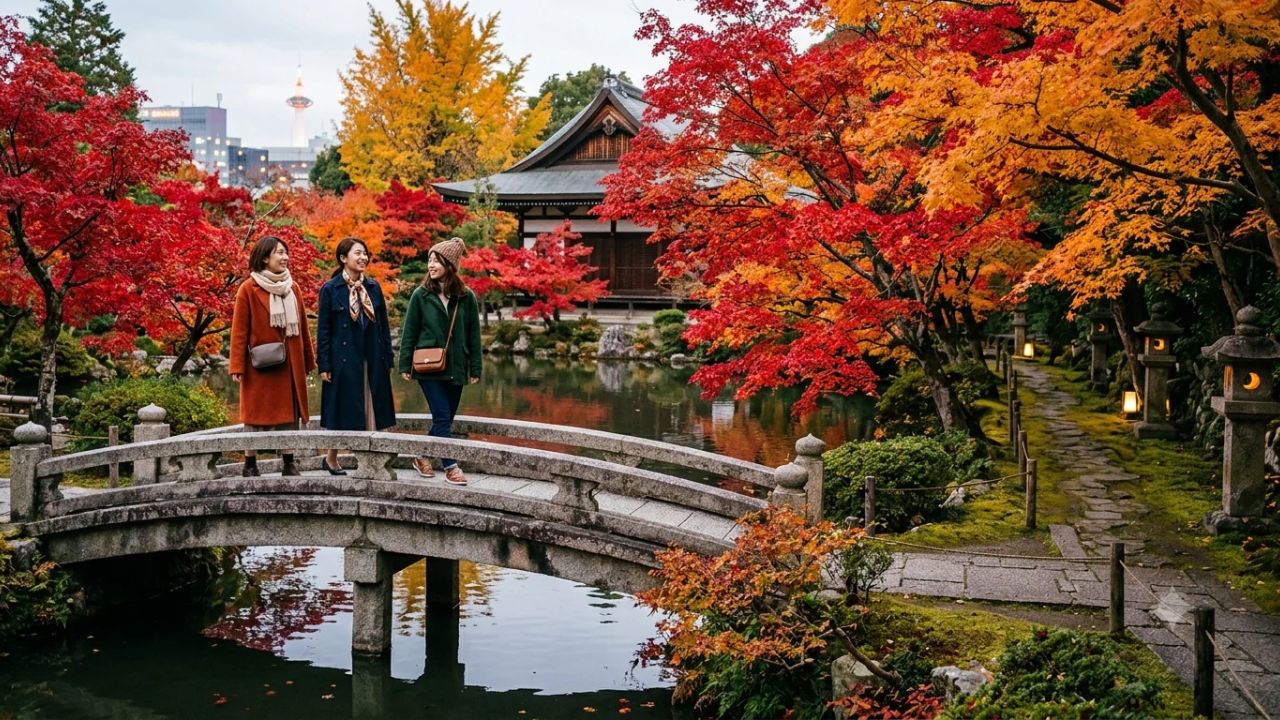
While promotional tourism campaigns celebrate the picturesque appeal of Japanese maple canopies (kōyō) and golden ginkgo avenues (ichō), practical on-the-ground execution requires travelers to distinguish between recurring seasonal patterns and confirmed venue restrictions. Major cultural events—such as the Fukuoka Grand Sumo Tournament—have completely sold out of general admission seating, while celebrated sanctuaries like Enko-ji and Ruriko-in in Kyoto legally bar walk-up visitors without advance digital registrations. By understanding the microclimatic drivers of autumn foliage, respecting venue clearing policies between afternoon and twilight sessions, and adopting municipal crowd-mitigation initiatives such as hands-free luggage transfers, visitors can experience Japan’s autumn splendour while bypassing severe congestion.
       JAPAN AUTUMN 2026 SIGHTSEEING TIMELINE & BOOKING ARCHITECTURE
       ============================================================

       [ PHASE 1: EARLY AUTUMN / MOUNTAIN ELEVATIONS (OCT LATE – NOV EARLY) ]
       * Alpine Zones: Koyasan, Nikko, Oku-Nikko, Japan Alps reach peak color
       * Seasonal Openings: Nabana no Sato illuminations launch (Oct 17, Mie)
       * Passed Festivals: Karatsu Kunchi (Nov 2–4, Saga Prefecture concluded)
                                       |
                                       v
       [ PHASE 2: MID-NOVEMBER EXPANSION (NOV 10 – NOV 20) ]
       * Kyoto Reservation Temples Open: Enko-ji (Nov 10), Ruriko-in (Nov 13)
       * Mega-Illumination Begins: Sagamiko Pleasure Forest (Nov 14, Kanagawa)
       * Tokyo Ginkgo Corridors: Meiji Jingu Gaien turns brilliant gold
       * Cultural Events: Fukuoka Sumo Tournament (Nov 8–22; 100% SOLD OUT)
                                       |
                                       v
       [ PHASE 3: PEAK ILLUMINATION & DYNAMIC PRICING (NOV 21 – DEC EARLY) ]
       * Kyoto Night Viewing: Kiyomizu-dera (Nov 21–30; Last entry 21:00)
       * Kamakura Night Viewing: Hasedera Temple (Nov 21 – Dec 6)
       * Tokyo Night Stroll: Rikugien Garden (Nov 25 – Dec 6; Closes 17:00, Reopens 18:00)
       * Pricing Shift: Nabana no Sato advance tickets jump from ¥2,500 to ¥3,000
The Biometeorology of Kōyō: Tracking Regional Foliage Waves Across Honshu
The timing of autumn leaf transformation across Japan is governed by strict physiological and meteorological mechanisms. Unlike spring cherry blossoms (sakura), which bloom from south to north as warming temperatures sweep upward from Kyushu to Hokkaido, autumn foliage moves in reverse—progressing from north to south and cascading from high mountain summits down into coastal valleys and lowland plains.
The biochemical trigger for foliage coloration is driven by diurnal temperature swings. During the daytime, lingering late-autumn sunlight encourages photosynthesis; however, when nighttime and early morning temperatures plummet below 8°C, trees begin to shut down nutrient transport to their leaves. A layer of cork cells forms at the base of the leaf stem, trapping carbohydrates within the leaf structure. This temperature shock accelerates the degradation of green chlorophyll, exposing underlying yellow and orange carotenoid pigments in ginkgo and birch trees, while synthesizing rich red anthocyanin pigments within wild Japanese maples (Acer palmatum). When nocturnal temperatures consistently dip beneath 5°C, foliage achieves its most vivid, deep-crimson coloration.
AUTUMN FOLIAGE PROGRESSION & VENUE ACCESS MATRIX (2026)
| Entity / Facility | Delays | Cancellations | Details |
|---|---|---|---|
| Region & Key Venue | Historical Peak | Operational Access | Special Access Rules |
| Color Window | Hours Profile | & Admission Costs | |
| Tokyo: Rikugien | Late November to | Day: 09:00–17:00 | Daytime: ¥300 entry |
| Garden (Bunkyo Ward) | Early December | Night: 18:00–20:30 | Night: ¥1,000 entry; |
| (Last entry 19:30) | Park cleared at 17:00 | ||
| Tokyo: Meiji Jingu | Mid-November to | Open 24/7 (Public | Free public access; |
| Gaien Ginkgo Avenue | Early December | pedestrian avenue) | heavy weekend crowds; |
| parking restricted | |||
| Kyoto: Kiyomizu-dera | Mid-November to | Day: 06:00–17:30 | Daytime: ¥400 entry |
| (Higashiyama Ward) | Late November | Night: 17:30–21:30 | Night: ¥400 entry; |
| (Last entry 21:00) | Kannon blue laser beam | ||
| Kyoto: Enko-ji | Mid-November to | 09:00–17:00 | ¥1,000 admission; |
| Temple (Ichijoji) | Early December | (Timed entry slots) | MANDATORY advance online |
| reservation required | |||
| Kamakura: Hasedera | Late November to | Day: 08:00–17:00 | Daytime: ¥400 entry |
| Temple (Kanagawa) | Early December | Night: Sunset–19:00 | Night: ¥400 entry; |
| (Last entry 18:30) | Coastal view over bay |
Because microclimatic variations dictate this biochemical process, autumn colors unfold at vastly different rates across Honshu:
In alpine and highland elevations—such as Nikko, Lake Chuzenji, Mount Takao, and the sacred mountain plateau of Koyasan in Wakayama—the foliage transformation initiates in late October and reaches its definitive peak during the first ten days of November. Travelers journeying to these mountain districts in mid-to-late November will frequently encounter bare branches and cold early-winter winds.
Conversely, in metropolitan lowland basins such as Tokyo, Kyoto, Osaka, and Kamakura, the thermal mass of urban concrete, asphalt, and sheltered coastal topography insulates the foliage against premature cold snaps. Consequently, Tokyo's premier autumn viewing corridors—including the historic Koishikawa Korakuen Garden, the Shinjuku Gyoen National Garden, and the four-row ginkgo promenade at Meiji Jingu Gaien—typically reach peak visual splendour between November 20 and December 5.
In Kyoto, the geographical amphitheater formed by the surrounding Higashiyama, Kitayama, and Arashiyama mountain ridges creates distinct pocket microclimates. Northern and mountainous sanctuaries—including Kurama, Kibune, and Takao—turn deep red early in the month, whereas valley floor treasures such as Tofuku-ji, Nanzen-ji, and the riverbanks of the Kamogawa peak toward late November. Travel planning must therefore follow localized elevation profiles rather than generalized national forecasts.
The Night Illumination Circuit: Timetables, Clearing Policies, and Ticketing Rules
One of the defining pleasures of autumn travel in Japan is experiencing heritage landscape gardens and Buddhist temples under nighttime floodlighting (Yakan Tokubetsu Haikan). However, international visitors frequently make costly planning errors by failing to understand the administrative distinction between general daytime admission and separately ticketed evening programs.
A premier case study is Tokyo’s historic Rikugien Garden, an exquisite stroll-style landscape garden constructed in 1702 by grand chamberlain Yanagisawa Yoshiyasu. For autumn 2026, Rikugien’s evening illumination runs from November 25 through December 6, operating nightly from 18:00 to 20:30, with final admission strictly capped at 19:30.
Importantly, daytime admission tickets do not grant access to the evening illumination. At exactly 17:00, garden security staff systematically clear the entire park, ushering all daytime visitors out through the main gates. The grounds remain closed for one hour to allow groundskeepers to inspect lighting fixtures, secure unlit perimeter paths, and prepare admission gates.
       DAYTIME VS. EVENING VENUE CLEARING & RE-ENTRY PROTOCOL
       ======================================================

       [ DAYTIME GARDEN OPERATIONS (09:00–17:00) ]
       * Standard Daytime Entry: ¥300 per adult
       * Stroll around central pond, teahouses & wooden bridges
                                       |
                                       v
       [ MANDATORY SITE CLEARING WINDOW (17:00–18:00) ]
       * ALL VISITORS MUST VACATE THE GROUNDS AT 17:00
       * No remaining inside teahouses or sheltering in pavilions
       * Groundskeepers inspect safety ropes, LED cables & lanterns
                                       |
                                       v
       [ EVENING SPECIAL ILLUMINATION (18:00–20:30) ]
       * Separate Evening Ticket Required: ¥1,000 per adult
       * Dedicated directional one-way walking circuits enforced
       * Final entry gate closes promptly at 19:30
To re-enter for the evening illumination, travelers must purchase a dedicated evening ticket priced at ¥1,000 (tax inclusive)—substantially higher than the standard ¥300 daytime admission fee. Visitors attempting to linger inside the park or sheltering in traditional teahouses to avoid the separate fee are strictly removed by park marshals. Travelers must plan their afternoon schedules accordingly, allowing sufficient time to relax in nearby cafes or explore adjacent shopping streets in Sugamo or Komagome during the one-hour clearing closure.
In Kyoto, the revered hillside temple of Kiyomizu-dera stages its world-famous autumn night illumination from November 21 to November 30, 2026. Gates open for evening viewing from 17:30 through 21:30, with the final admission window closing promptly at 21:00. During this ten-day window, a powerful, focused blue laser beam (Kannon-no-hikari) is projected from the temple grounds across the eastern skies of Kyoto, symbolizing the compassionate light of the Bodhisattva Kannon cutting through earthly darkness. Below the main wooden stage—constructed entirely without nails using traditional Japanese interlocking timber joinery (kigumi)—hundreds of concealed uplights illuminate a dense sea of crimson maple branches, casting dramatic shadows against the sheer hillside cliffs.
Along the Pacific coast in Kanagawa Prefecture, the coastal city of Kamakura presents a magical evening program at Hasedera Temple, famous for its eleven-headed statue of Kannon and hillside coastal vantage points. Hasedera’s autumn light-up operates from November 21 through December 6, illuminating mountain paths, moss-covered stone Jizo statues, and maple reflections across lower temple ponds from sunset until 19:00, with last entry at 18:30.
Beyond historic temple grounds, regional commercial illuminations introduce seasonal dynamic pricing structures that require careful financial budgeting:
REGIONAL MEGA-ILLUMINATION OPERATING PROFILES (2026–2027)
| Entity / Facility | Delays | Cancellations | Details |
|---|---|---|---|
| Attraction & Region | Operating Season | Admission Pricing | Operational Caveats |
| Calendar Range | Schedule Changes | & Transit Connections | |
| Nabana no Sato | October 17, 2026 | Advance: ¥2,500 | Advance price jumps to |
| (Kuwana, Mie Pref.) | to May 31, 2027 | (Through Nov 20) | ¥3,000 on Nov 21; Gate |
| Advance: ¥3,000 | price rises to ¥3,200; | ||
| (From Nov 21 Onward | Closed Jan 6–7, 2027 | ||
| Sagamiko Pleasure | November 14, 2026 | Standard Night | Daily through Jan 3; |
| Forest Illumillion | to May 9, 2027 | Pass: ~¥2,000 | switches to designated |
| (Sagamihara, Kanag.) | (Varies by ride pk) | closure days in spring |
In Mie Prefecture, the renowned botanical garden of Nabana no Sato hosts one of Japan’s largest winter illumination spectacles, featuring millions of precision-engineered LED bulbs arranged into immersive light tunnels and sprawling animated landscape displays. The illumination season opened on October 17, 2026, and extends through May 31, 2027. However, travelers booking visits in late November must account for a significant seasonal price increase: on November 21, 2026, the advance ticket price rises from ¥2,500 to ¥3,000 (a 20 percent increase), while on-site gate admission climbs from ¥2,700 to ¥3,200. This planned price hike coincides with the illumination's peak attendance window, and budget-conscious travelers must align their ticket purchases with these established pricing thresholds.
Similarly, the Sagamiko Resort Pleasure Forest in Kanagawa Prefecture launches its celebrated "Sagamiko Illumillion" on November 14, 2026, running through May 9, 2027. While the six-million-bulb display operates daily through January 3, 2027, park administrators introduce regular midweek closure days starting in late January and switch to weekend-only operations from April 5 onward. Travelers relying on autumn marketing materials must verify exact operational dates before planning regional excursions, as published season endpoints do not imply unrestricted daily access.
Advance Reservation Protocols: Securing Kyoto’s Contested Sanctuaries
As international inbound tourism continues its robust recovery—with Japan recording over 30 million cumulative arrivals through September 2026—Kyoto’s most fragile religious sanctuaries have abandoned walk-up ticketing in favor of mandatory online advance reservation systems. Travelers who arrive at temple gates expecting to buy a ticket on the spot will be turned away by security marshals.
Two prominent examples illustrate the necessity of pre-trip reservation planning:
       ADVANCE RESERVATION SANCTUARIES: KYOTO PEAK AUTUMN (2026)
       =========================================================

       [ ENKO-JI TEMPLE (圓光寺, ICHIJOJI DISTRICT) ]
       * Reservation Window: November 10 to December 10, 2026
       * Signature View: Ju-gyu-no-niwa (Ten Oxen Zen garden moss & maples)
       * Access Model: Strictly pre-booked online timed entry slots (¥1,000)
       * Walk-up Policy: ZERO walk-up admissions; entry refused without barcode
                                       |
                                       v
       [ RURIKO-IN TEMPLE (瑠璃光院, YASE DISTRICT) ]
       * Reservation Window: November 13 to December 6, 2026
       * Signature View: Mirrored black lacquer table reflecting maple canopy
       * Access Model: Mandatory designated time-reservation portal (¥2,000)
       * Walk-up Policy: High congestion; same-day slots strictly prohibited
First, Enko-ji Temple, nestled in the peaceful northern neighborhood of Ichijoji, is celebrated for its historic Zen heritage and the breathtaking "Ju-gyu-no-niwa" (Garden of the Ten Oxen). Framed by sliding shoji screens, the garden presents a sublime composition of raked gravel, moss-covered groundscapes, and weeping Japanese maples. To protect the contemplative atmosphere and prevent overcrowding in the fragile wooden tatami halls, Enko-ji enforces a strict mandatory online reservation system from November 10 through December 10, 2026. Visitors must register their specific arrival date and time slot via the temple's official booking portal and pay the ¥1,000 admission fee in advance. No tickets are sold at the gate under any circumstances.
Second, Ruriko-in Temple, situated in the forested river valley of Yase at the base of Mount Hiei, has become an international photography sensation due to its second-floor sukiya-style tea room. Here, a pristine, polished black lacquer table reflects the surrounding autumn maple canopy like a flawless mirror, creating an optical illusion of floating among scarlet and amber leaves. Ruriko-in requires mandatory online reservations for all autumn visits between November 13 and December 6, 2026. The ¥2,000 admission ticket must be secured weeks in advance through dedicated digital reservation platforms. During peak morning and midday slots, reservation availability is exhausted within minutes of release.
Concurrently, travelers must pay heed to sold-out cultural milestones. The November Grand Sumo Tournament (Kyushu Basho), held at the Fukuoka Kokusai Center from November 8 through November 22, 2026, has officially announced a complete sell-out across all fifteen competition days. According to the Japan Sumo Association and official ticketing agent Ticket Pia, high demand from international and domestic enthusiasts has exhausted all chair seating and traditional four-person box seats (masu-seki). The ticketing agency has confirmed that no same-day general admission tickets will be released at venue box offices. Sightseers visiting Fukuoka during mid-November must eliminate sumo attendance from their daily schedules unless they possess verified, pre-purchased tickets secured during the initial lottery phase.
Decentralized Exploration: Beating Kyoto’s Overtourism via Secondary Corridors
To mitigate intense crowd density across congested tourist corridors—specifically the crowded streets of Gion, the approach to Kiyomizu-dera along Ninenzaka and Sannenzaka, and the bamboo paths of central Arashiyama—the Kyoto City Tourism Association (DMO KYOTO) and municipal authorities are actively promoting decentralized autumn exploration.
Official municipal guidance encourages travelers to explore Kyoto's less congested eastern and southern districts, where historic temple architecture and pristine autumn foliage can be enjoyed in tranquility:
       DECENTRALIZED KYOTO: ALTERNATIVE AUTUMN TRANQUILITY CORRIDORS
       ============================================================

       [ THE CONGESTED CORE (AVOID PEAK MIDDAY 11:00–15:00) ]
       * Gion, Kiyomizu-dera approaches, Arashiyama Bamboo Grove
       * Narrow streets overwhelmed by crowds, tour buses & taxi gridlock
                                       |
                 +---------------------+---------------------+
                 |                                           |
                 v                                           v
       [ CORRIDOR 1: YAMASHINA & DAIGO ]           [ CORRIDOR 2: LAKE BIWA CANAL ]
       * Accessible via Tozai Subway Line          * Peaceful walking path: Kyoto to Otsu
       * Daigo-ji: Five-story pagoda & pond        * Biwako Sosui: Historical Meiji aqueduct
       * Zuishin-in: Ono no Komachi gardens        * Keage Incline: Brick tunnels & maples
       * Kajū-ji: Serene lotus pond maples         * Nanzen-ji Suirokaku: Romanesque aqueduct
The Yamashina and Daigo district, conveniently accessible via the Kyoto Municipal Subway Tozai Line, represents one of the ancient capital's finest hidden treasures. Daigo-ji, a sprawling UNESCO World Heritage complex founded in 874, features the oldest verified wooden building in Kyoto—a majestic five-story pagoda (Gojūnotō) completed in 951 that has survived centuries of earthquakes and civil wars. In the temple's lower and upper precincts, weeping maples arch over the tranquil Bentendo Hall pond, casting vivid red reflections across the water with a fraction of the visitor density seen in central Higashiyama. Nearby, Zuishin-in and Kajū-ji offer secluded dry landscape Zen gardens, historic sliding screen paintings (fusuma-e), and peaceful moss pathways that capture the serene essence of traditional Kyoto.
In parallel, the Lake Biwa Canal (Biwako Sosui) walking route provides an exceptional combination of historical civil engineering and autumn tranquility. Constructed during the Meiji Era to transport water, goods, and hydroelectric power from Lake Biwa to Kyoto, the canal is lined with thousands of mature maple and cherry trees. Walking from the Keage Incline past the brick Romanesque arches of the Suirokaku Aqueduct inside Nanzen-ji toward the Philosopher's Path (Tetsugaku-no-Michi) allows travelers to admire breathtaking seasonal foliage along quiet waterside footpaths away from roadway exhaust.
HANDS-FREE SIGHTSEEING: MUNICIPAL LUGGAGE DISPERSAL
| Entity / Facility | Delays | Cancellations | Details |
|---|---|---|---|
| Service Provider | Strategic Benefit | Typical Cost | Operational Procedure |
| Sagawa Express | Same-day baggage | ~¥1,500 to ¥2,000 | Drop luggage at Kyoto |
| / Yamato Transport | delivery to hotels | per large suitcase | Station concourse desk |
| (Hands-Free Kyoto) | across Kyoto City | before 12:00 noon | |
| Central Station | Electronic locker | ¥500 to ¥1,000 | Reserve via mobile app |
| Smart Lockers | storage; cashless | per calendar day | or utilize IC transit |
| (JR Kyoto / Subways) | payment via Suica | cards (Suica / Pasmo) |
To prevent pedestrian congestion on public transport, Kyoto authorities have expanded the "Hands-Free Sightseeing" (Tebura Kankō) initiative. Overcrowded municipal buses—such as the notorious Route 206 circulating Higashiyama—are frequently paralyzed when tourists board carrying large rolling suitcases.
Under the municipal program, travelers arriving at JR Kyoto Station can deposit their heavy luggage at dedicated courier desks (operated by Sagawa Express and Yamato Transport on the B1 floor and near the Hachijo Exit) before 12:00 noon, and have their bags delivered directly to their hotel or ryokan by 17:00 for a modest fee of approximately ¥1,500 to ¥2,000 per bag. Traveling unencumbered by baggage allows visitors to navigate subway networks, walk through narrow temple lanes, and respect local residents sharing municipal transit corridors.
Thermal Packing, Onsen Day Trips, and Transit Precision
Successful autumn travel across Japan requires careful adaptation to rapid weather transitions. While November daylight hours frequently offer mild, sunny temperatures between 16°C and 19°C, the lack of cloud cover and cool continental air masses from Siberia cause temperatures to plummet sharply at dusk. By 18:00, when evening illuminations commence, ambient temperatures in Kyoto and Tokyo regularly plunge to between 6°C and 9°C, with mountain valleys dipping near freezing.
Travelers must embrace intelligent layering strategies:
       AUTUMN PACKING & CLOTHING STRATEGY: DIURNAL COLD PROTECTION
       ===========================================================

       [ 1. BASE LAYER: THERMAL REGULATION ]
       * Breathable thermal tops & leggings (e.g. Uniqlo Heattech)
       * Moisture-wicking fabrics preventing sweat chills during walking
                                       |
                                       v
       [ 2. MID LAYER: ADJUSTABLE WARMTH ]
       * Lightweight fleece or merino wool sweater
       * Easily unbuttoned or removed during warm midday sunshine
                                       |
                                       v
       [ 3. OUTER LAYER: WIND & DUSK DEFENSE ]
       * Compact ultra-light packable down jacket or windproof coat
       * Warm woollen scarf, lightweight gloves & beanie for garden night walks
                                       |
                                       v
       [ 4. TEMPLE-SPECIFIC FOOTWEAR ESSENTIALS ]
       * High-cushion walking shoes (15,000+ daily steps across stone paths)
       * SLIP-ON DESIGN: Shoes must be removed 5–10 times daily for temple halls
       * THICK WOOL SOCKS: Wooden temple floors and tatami mats are unheated!
In addition, traditional Buddhist temple architecture demands specialized footwear consideration. When entering historic temple halls—such as the Hondo at Kiyomizu-dera, the Abbot’s quarters at Nanzen-ji, or the tea rooms of Ruriko-in—visitors are legally required to remove their outdoor footwear. Walking across unheated, polished cypress wood floors in thin socks can be physically punishing in late November. Travelers should pack thick, warm wool socks and wear slip-on walking shoes that can be removed and replaced quickly without struggling with complex laces in crowded temple vestibules.
To complement autumn sightseeing, travelers can integrate therapeutic hot spring (onsen) excursions into their itineraries:
HOT SPRING (ONSEN) EXCURSIONS LINKED TO AUTUMN ITINERARIES
| Entity / Facility | Delays | Cancellations | Details |
|---|---|---|---|
| Onsen Destination | Transit Logistics | Historic Heritage | Recommended Autumn |
| & Geographic Base | & Travel Duration | & Water Chemistry | Sightseeing Extension |
| Atami Onsen | 50 Minutes from | Ancient coastal spa | Combine coastal onsen |
| (Izu Peninsula, | Tokyo Station via | hot springs; high | with Atami Plum Garden |
| Shizuoka Pref.) | Tokaido Shinkansen | chloride mineral content | autumn maple displays |
| Arima Onsen | 30 Min from Kobe / | One of Japan's 3 | Stroll historic wooden |
| (Mount Rokko, | 60 Min from Osaka | oldest springs; | town; pair with Mount |
| Hyogo Prefecture) | via express bus/train | Kinsen & Ginsen waters | Rokko cable car foliage |
| Hakone Yumoto | 75 Minutes from | Gateway to Mount | Open-air rotenburo |
| (Kanagawa Pref.) | Shinjuku via Odakyu | Fuji; 17 historic | baths with view of |
| "Romancecar" train | mineral spring sources | golden mountain slopes |
From Tokyo, the coastal resort town of Atami on the Izu Peninsula is located just 50 minutes away via the Tokaido Shinkansen. Travelers can spend the morning exploring the autumn maple walks at the Atami Plum Garden (Atami Baien)—which boasts some of the latest-turning autumn maples in Honshu—before soaking in oceanfront geothermal baths rich in salt and calcium minerals.
In western Japan, Arima Onsen, nestled on the northern slopes of Mount Rokko behind Kobe, offers an extraordinary immersion into one of Japan’s three oldest hot spring settlements. Famed for its dark reddish-brown, iron-rich "Golden Spring" (Kinsen) and clear, radium-infused "Silver Spring" (Ginsen), Arima provides the ultimate rejuvenation following intensive walking days across Kyoto and Osaka.
Finally, travelers exploring rural temple precincts must maintain rigorous transit timing. In suburban and mountainous districts—such as Takao, Ohara, and Kurama in northern Kyoto—local municipal buses operate on limited evening schedules. Frequencies drop precipitously after 18:00, with final buses back to central urban railway terminals often departing between 19:30 and 20:30. Travelers attending evening illuminations in peripheral valleys must verify return bus timetables upon arrival, ensuring they do not find themselves stranded in remote mountain villages where taxi services are non-existent.
Strategic Traveler Blueprint: Step-by-Step Autumn Execution
To ensure a seamless, deeply rewarding autumn journey across Japan in November 2026, international travelers should execute the following operational sequence:
       STRATEGIC AUTUMN TRAVEL PLAYLIST: FIVE ESSENTIAL PROTOCOLS
       =========================================================

       [ 1. CALENDAR SYNCHRONIZATION ]
       * Separate daytime sightseeing (09:00–16:00) from night illuminations
       * Account for mandatory 1-hour clearing closures (e.g. Rikugien at 17:00)
       * Book advance temple reservations (Enko-ji, Ruriko-in) weeks ahead
                                       |
                                       v
       [ 2. SENSORY & THERMAL DEFENSE ]
       * Dress in adaptable layers; anticipate 10°C temperature drops at dusk
       * Carry thick woollen socks for cold wooden temple floors
       * Select slip-on footwear for rapid entry at shoe check stations
                                       |
                                       v
       [ 3. DECENTRALIZED EXPLORATION ]
       * Avoid central Arashiyama & Gion during peak midday congestion
       * Explore Yamashina, Daigo-ji, and the Lake Biwa Canal corridor
       * Utilize luggage delivery (Hands-Free Kyoto) to bypass crowded buses
                                       |
                                       v
       [ 4. REGIONAL EXTENSIONS ]
       * Escape urban crowds via Shinkansen to Atami Onsen (50 min from Tokyo)
       * Soak in Arima Onsen's mineral waters (30 min from Kobe / Osaka)
       * Double-check last-bus departures from peripheral mountain temples
- Audit Venue Calendars Independently: Never rely on generic seasonal guides that imply open-ended access. Cross-reference specific operating dates for evening programs—such as Rikugien (Nov 25 – Dec 6) and Kiyomizu-dera (Nov 21 – Nov 30)—and verify that your travel days align with these exact operational windows.
- Secure Advance Bookings for Regulated Sanctuaries: Monitor official temple websites for reservation announcements. If visiting Kyoto between mid-November and early December, secure time-stamped digital passes for Enko-ji and Ruriko-in well in advance, and confirm whether secondary cultural attractions require lottery entries.
- Budget for Dynamic Evening and Seasonal Pricing: Anticipate higher admission costs for nighttime viewing programs (typically ¥1,000 for garden night walks versus ¥300 during the day), and factor in dynamic pricing shifts, such as the ¥500 admission increase taking effect at Nabana no Sato on November 21.
- Implement Hands-Free Sightseeing Protocols: Forward large rolling suitcases between major cities using reliable luggage courier networks (Takkyubin), or utilize same-day station-to-hotel baggage delivery services at JR Kyoto Station to keep public transit corridors open and accessible.
- Respect Sacred Etiquette and Resident Privacy: When photographing illuminated temples and bamboo paths, adhere to local signage. Tripods, monopods, and selfie sticks are strictly prohibited inside almost all historic Japanese temples and landscaped gardens to prevent pedestrian accidents and protect wooden structures. Maintain quiet reverence in temple halls, and refrain from trespassing on private residential side streets in geisha districts like Gion.
Japan’s autumn season offers an unforgettable sensory encounter with centuries-old landscape aesthetics, architectural mastery, and natural transience. By planning around verified admission dates, respecting evening clearing policies, and venturing beyond overcrowded tourist gateways, travelers will unlock the very best of Tokyo, Kyoto, and regional Japan during this magnificent seasonal window.
Related Travel Guides
- Paris and Brussels Launch Joint European Gastronomy Pass Promoting Organic Dining
- Japan Overhauls Tax-Free Shopping as Tourists Must Pay Upfront Consumption Tax
- European Business Travel Spending to Surge to €404 Billion in 2026 as Germany and UK Lead
- Haiti Issues Marine Weather Warning as Six-Foot Waves and Thunderstorms Threaten Northern Waters
- Kyoto Sagano Romantic Train Enters Final Season as Historic Rolling Stock Retires
This article is for informational purposes. Flight routes, passenger regulations, visa rules, and transit advisories are subject to change by airlines and aviation authorities. Readers are advised to verify schedules and travel documentation with relevant carriers and border agencies before departure.
Related Stories

US Travelers Adding Dubai Stopovers Urged to Update STEP Safety Plans & Itinerary Details

Fiji Will Be a Big Name Followed by Tonga and Others as Highly Potential Budget-Friendly Retirement Retreats in 2027