European Rail Disruption Alert: Italy Engineering Works, Swiss Border Closures, and Rome Night Train Retimings Reshape November 2026 Travel

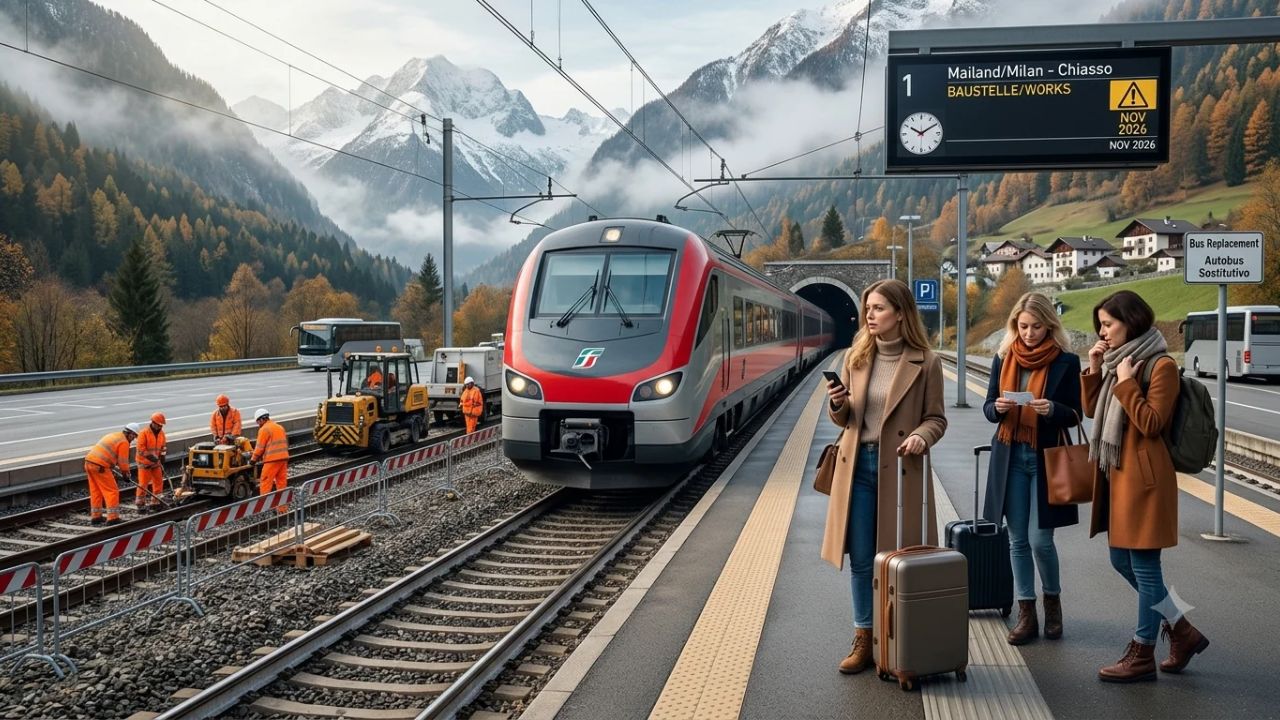
MILAN, Italy — A concentration of concurrent railway engineering projects and cross-border track closures across northern Italy, Switzerland, Germany, Austria, and France is set to disrupt transalpine passenger travel in mid-November 2026.
Official infrastructure bulletins published by Rete Ferroviaria Italiana (RFI) on November 6 detail significant operating restrictions along the primary alpine transit routes connecting Milan with Switzerland, specifically the Milan–Chiasso and Milan–Domodossola corridors.
Simultaneously, national rail carrier Trenitalia has issued revised timetables for its premier international overnight services linking Rome with Munich and Vienna, while separate engineering closures administered by Swiss Federal Railways (SBB), Deutsche Bahn (DB), and France's SNCF overlap during the weekend of November 14 and 15.
The resulting operational bottlenecks do not constitute a blanket, five-country rail network shutdown, but rather an intricate cluster of route-specific line closures, omitted station calls, bus replacement bridges, and retimed departures.
However, because these localized works converge within an eight-day window on lines serving international passenger traffic, travelers crossing borders on multi-operator itineraries face severe missed-connection risks.
Coming at a time when newly published Eurostat data reveals European rail passenger-kilometers reaching an all-time record of 457 billion, this operational convergence highlights the friction between essential infrastructure modernization and cross-border mobility.
+----------------------------------------------------------------------------------------------------+ | NOVEMBER 2026 CENTRAL EUROPEAN RAIL DISRUPTION SCORECARD | +----------------------------------------------------------------------------------------------------+ | Core Disruption Window | November 10 to November 23, 2026 (Peak Overlap: November 14–15) | | Countries Directly Affected | Italy, Switzerland, Germany, Austria, France | | Primary Infrastructure Bodies| RFI (Italy), SBB (Switzerland), DB InfraGO (Germany), SNCF (France) | | Gotthard Corridor (Chiasso) | Monte Olimpino 1 Tunnel works; EuroCity trains bypass Como S. Giov. | | Gotthard Closure Windows | November 13–16 and November 20–23, 2026 | | Simplon Corridor (Domodossola)| Rho–Busto Arsizio night closures (Nov 14–15 & 28–29); 4m upgrades | | Transalpine Night Trains | Rome–Munich/Vienna EN 294 departs earlier (17:10); EN 295 delayed | | Ferrara Junction Modernization| Modifies Frecciarossa, InterCity, and EuroNight paths (Nov 6–16) | | German EuroCity Axis | Lindau-Reutin to Munich cancelled (Nov 13–16); bus replacements | | Franco-Italian Border | Ventimiglia–Taggia Arma rail maintenance (Nov 10–11); bus shuttles | | Franco-Swiss Gateway | Saint-Louis–Basel line closure (Nov 14–16); Basel Tram 3 diversion | | EU Rail Volume Benchmark | 457 Billion Passenger-Kilometers in 2025 (+2.6% YoY Historical High)| +----------------------------------------------------------------------------------------------------+
The November 14–15 Convergence: How Independent Works Create a Transalpine Knot
The defining operational feature of the November 2026 railway situation is not a single systemic failure, but the synchronized execution of independent national maintenance programs within the same narrow calendar window.
Throughout Western and Central Europe, national railway infrastructure managers traditionally concentrate heavy capital renewal projects into mid-November. This window falls strategically between the conclusion of the heavy summer tourism peak and the commencement of the winter ski season and Christmas holiday market rushes in early December.
                    THE NOVEMBER 14–15 TRANSALPINE CONVERGENCE

   [GERMAN FLANK]                              [FRENCH FLANK]
   Lindau-Reutin to Munich                     Saint-Louis to Basel SBB
   EuroCity Cancelled -> Bus Bridge            Line Closed -> Tram 3 Transfer
            \                                            /
             \                                          /
              ===> [ SWISS CENTRAL TRANSIT HUB ] <======
                   - Zurich & Basel Terminals
                   - SBB Simplon Corridor Weekday Cuts
                   - SBB Gotthard EuroCity Route Diverts
                            /            \
                           /              \
    [ITALIAN SIMPLON AXIS]                 [ITALIAN GOTTHARD AXIS]
    Rho to Busto Arsizio                   Como San Giovanni to Chiasso
    Overnight Line Closures                Tunnel Works: COMO STOP OMITTED!
              \                                   /
               \                                 /
                ===> [ MILAN CENTRALE HUB ] <====
                            |
                            v [Ferrara Junction Upgrades]
                     [ROME NIGHT TRAINS]
                     EN 294 / EN 295 Retimed
When national operators execute maintenance simultaneously, cross-border travelers absorb compounding delays:
- A traveler departing Strasbourg for Milan via Basel on November 14 encounters an SNCF line closure at Saint-Louis, requiring an urban tram detour into Basel SBB.
- Upon boarding a connecting EuroCity south through Switzerland, the passenger finds that the train cannot call at Como San Giovanni due to RFI tunnel waterproofing at Chiasso.
- If that traveler intended to connect in Milan onto the night train to Munich or Vienna, they encounter modified departure times triggered by separate junction renewals in Ferrara.
While each railway undertaking has published independent notices detailing localized mitigation measures, no unified international agency coordinates cross-border passenger communication. Travelers holding unbundled tickets across multiple operators are left to reconcile conflicting timetables independently.
The Italian-Swiss Alpine Crossings: Gotthard and Simplon Vulnerabilities
The alpine frontier separating northern Italy from southern Switzerland is defined by two primary railway corridors: the Gotthard route (via Chiasso and Lugano) and the Simplon route (via Domodossola and Brig). In November 2026, both conduits face significant structural restrictions.
+----------------------------------------------------------------------------------------------------+ | ITALIAN–SWISS ALPINE CORRIDOR ENGINEERING RESTRICTIONS | +----------------------------------------------------------------------------------------------------+ | Corridor / Line Segment | Infrastructure Work Scope | Operating Impact on Services | +------------------------------+---------------------------------+-----------------------------------+ | Como San Giovanni – Chiasso | Monte Olimpino 1 Tunnel | Line closed during weekend windows| | (Gotthard Southern Approach) | Consolidation & Waterproofing | EuroCity trains bypass Como stop; | | | Active: Nov 13–16 & Nov 20–23 | TILO regional RE80/S10/S40 altered| | Rho – Busto Arsizio | Four-Track Line Expansion & | Complete overnight line closures | | (Simplon Southern Approach) | Civil Flyover Construction | (22:40 Nov 14 to 07:20 Nov 15); | | | Active: Nov 14–15 & Nov 28–29 | Long-distance & regional reroutes | | Domodossola – Iselle | Multi-Year 4-Meter Transalpine | Permanent weekday reduction: | | (Simplon Alpine Tunnel Axis) | Freight Gauge Height Expansion | 1 fewer train/dir on Basel-Milan | | | Continuous through End of 2028 | and Geneva-Milan Simplon routes | +----------------------------------------------------------------------------------------------------+
The Gotthard Axis: Omitted Stops at Como San Giovanni
The most disruptive measure on the Gotthard corridor centers on the Monte Olimpino 1 Tunnel, an essential subterranean link piercing the mountains between Como San Giovanni and the Swiss border station at Chiasso. RFI engineering crews are conducting intensive structural consolidation, tunnel lining repairs, and waterproofing installations.
To accommodate work machinery and safety isolations, RFI has scheduled two extended weekend closure windows:
- Window 1: From Friday, November 13 through Monday, November 16, 2026.
- Window 2: From Friday, November 20 through Monday, November 23, 2026.
During these operational windows, international EuroCity services operating between Milan Centrale and Swiss destinations (Zurich, Basel, and Frankfurt) will continue running across the border via auxiliary freight bypass tracks, but will completely omit their scheduled commercial station stops at Como San Giovanni.
                  COMO SAN GIOVANNI STATION CALL OMISSION

  STANDARD ROUTING:
  [MILAN CENTRALE] =====> [COMO SAN GIOVANNI] =====> [CHIASSO] =====> [ZURICH / BASEL]

  NOVEMBER 13–16 & 20–23 RE-ROUTING:
  [MILAN CENTRALE] ================================> [CHIASSO] =====> [ZURICH / BASEL]
                                |
                   (COMO SAN GIOVANNI BYPASSED!)
                   - Passengers at Como cannot board
                   - Inbound travelers cannot disembark
                   - TILO RE80 / S10 / S40 replaced by buses
This omission creates a major trap for international travelers. Flagship international trains—including EC 150 and EC 151 (connecting Milan with Frankfurt am Main) and EC 173 (from Basel to Milan)—will glide past Lake Como without opening doors.
Travelers holding confirmed tickets to or from Como San Giovanni cannot board these trains, requiring them to utilize localized regional commuter rail (Trenord) or replacement bus shuttles to connect with their long-distance services at Chiasso or Milan Centrale.
The Simplon Axis: Four-Track Expansion at Rho
Simultaneously, the second transalpine approach via Domodossola confronts nighttime track shutdowns between Rho and Busto Arsizio. RFI is advancing a multi-million-euro civil project to expand the corridor from two to four tracks, enhancing capacity between Milan and the industrial northwest.
Full line suspensions are scheduled for:
- Overnight November 14–15: From 22:40 Saturday evening to 07:20 Sunday morning.
- Overnight November 28–29: From 22:40 Saturday evening to 07:20 Sunday morning.
These closures directly impact late-evening and early-morning Trenitalia regional trains, Malpensa Express airport connections, and long-distance freight flows.
In addition, Swiss Federal Railways (SBB) reminds travelers that the Simplon corridor is undergoing a multi-year 4-meter clearance corridor expansion lasting through late 2028. This long-term project modifies standard weekday timetables, eliminating one round-trip train daily on both the Basel–Bern–Milan and Geneva–Brig–Milan routes to allow engineering access in the Simplon mountain tunnels.
Transalpine Night Trains: Schedule Modifications on Rome–Munich and Rome–Vienna
For long-distance travelers who rely on overnight rail travel to traverse Central Europe, the engineering focus shifts to east-central Italy. Infrastructure renewals at the major rail junction of Ferrara—a strategic transit throat in Emilia-Romagna connecting Bologna with Venice and the northeastern border—are altering Trenitalia and ÖBB night train operations.
The works, scheduled across two discrete phases (November 6–10 and November 14–16), force substantial timetable adjustments on the flagship EuroNight EN 294 and EN 295 services, operated jointly by Trenitalia and Austrian Federal Railways (ÖBB Nightjet).
                 EURONIGHT 294 / 295 ROUTE & SCHEDULE DISRUPTIONS

   EN 294 [ROME TIBURTINA TO MUNICH / VIENNA]
   +-----------------------------------------------------------------+
   | Affected Departure Dates: November 7, 14, and 15, 2026          |
   | Standard Departure: ~19:00 | REVISED EARLY DEPARTURE: 17:10     |
   | Advanced Stops: Earlier boarding at Firenze Campo di Marte      |
   | and Bologna Centrale; travelers missing 17:10 forfeit cabins    |
   +-----------------------------------------------------------------+

   EN 295 [MUNICH / VIENNA TO ROME TIBURTINA]
   +-----------------------------------------------------------------+
   | Affected Arrival Dates: November 7–9 and November 15–16, 2026   |
   | Standard Arrival: ~09:15 | REVISED DELAYED ARRIVAL: 12:25       |
   | Travel Impact: Arrival delayed by over 3 hours into Rome;       |
   | onward morning flight & rail connections completely severed     |
   +-----------------------------------------------------------------+
The Southbound Delay and Northbound Early Departure
The operational adjustments for EN 294 and EN 295 demand strict attention from passengers:
- EN 294 (Northbound to Munich and Vienna): On November 7, 14, and 15, the train departs Roma Tiburtina at the sharply advanced time of 17:10—nearly two hours earlier than its standard evening slot. Boarding times at Firenze Campo di Marte and Bologna Centrale are advanced correspondingly. Passengers arriving at Roma Tiburtina expecting a relaxed 19:00 departure will discover that their sleeping-car train has already departed.
- EN 295 (Southbound to Rome): Operating in the reverse direction from Munich and Vienna, EN 295 is rerouted over secondary tracks around Ferrara on November 7–9 and November 15–16. The detour pushes the scheduled arrival time at Roma Tiburtina back to 12:25 in the afternoon.
This three-hour arrival delay effectively eliminates morning business appointments in Rome and severs connections for passengers holding morning high-speed Frecciarossa tickets to Naples, Florence, or Fiumicino Airport.
Beyond night trains, the Ferrara works disrupt daytime high-speed Frecciarossa and regional services between Bologna, Ferrara, and Venice, requiring passengers on selected regional links to transfer onto highway bus replacements.
The Northern Flank: German EuroCity Shutdowns on the Lindau–Munich Axis
Travelers assembling multi-country rail itineraries through Switzerland and southern Germany face separate, unrelated infrastructure constraints in Bavaria. Between November 12 and 17, 2026, German rail infrastructure manager DB InfraGO is executing track renewals between Memmingen and Munich.
During the peak four-day construction window from November 13 to November 16, all international EuroCity (EC) services operating between Lindau-Reutin (on the Swiss-German border) and Munich Hauptbahnhof are cancelled.
                 LINDAU-REUTIN TO MUNICH EUROCITY CLOSURE

  STANDARD HIGH-SPEED EUROCITY ROUTE:
  [ZURICH HB] === SBB EuroCity ===> [LINDAU-REUTIN] === DB EuroCity ===> [MUNICH HBF]

  NOVEMBER 13 TO 16 REPLACEMENT REGIME:
  [ZURICH HB] === SBB EuroCity ===> [LINDAU-REUTIN]
                                           |
                                           v [MANDATORY BUS TRANSFER]
                                    [HIGHWAY MOTORCOACH]
                                    (Slow Transit via Memmingen)
                                           |
                                           v
                                    [MUNICH HAUPTBAHNHOF]
To bridge the gap, Deutsche Bahn is operating replacement motorcoaches (Schienenersatzverkehr or SEV) between Lindau-Reutin and Munich.
However, transferring hundreds of passengers and luggage from six-car high-speed electric trains onto highway buses introduces severe friction:
- Journey times between Zurich and Munich expand by 60 to 90 minutes.
- Replacement buses cannot accommodate full bicycle allotments or oversized sports equipment.
- Travelers combining an SBB journey from Milan or Zurich with an onward German ICE connection in Munich face high probabilities of missing their designated train connections.
The Western Flank: Riviera Disruptions and the Basel Tramway Detour
Along the western approaches to northern Italy and Switzerland, independent engineering programs in Liguria and Alsace compound cross-border travel logistics.
The Riviera Gateway: Ventimiglia Maintenance
On November 10 and 11, 2026, Trenitalia is executing maintenance across the coastal rail corridor linking Ventimiglia (the Italian border station adjacent to Menton, France) with Taggia Arma and Imperia.
Key operational impacts include:
- InterCity Modifications: Flagship domestic long-distance services—including IC 505 (Ventimiglia to Roma Termini) and IC 633 (Milano Centrale to Ventimiglia)—face modified timetables, with selected services starting or terminating short of Ventimiglia at Taggia Arma.
- Regional Bus Bridges: Local regional trains (Regionale) connecting French SNCF TER services from Nice with Italian trains are partially cancelled between Ventimiglia and Taggia Arma, replaced by road shuttles.
- Trenitalia explicitly cautions that local traffic congestion along the coastal Via Aurelia can delay replacement buses, and road coaches cannot transport bicycles or electric scooters.
The Franco-Swiss Gateway: The Saint-Louis to Basel Rail Interruption
Simultaneously, in the Upper Rhine tri-border region, SNCF Réseau is conducting infrastructure upgrades between Saint-Louis (France) and Basel SBB (Switzerland) from November 14 to November 16.
This project severs direct rail transit between Alsace and Switzerland:
- TER Fluo Grand Est Services: Regional commuter trains from Strasbourg and Mulhouse terminate short at Saint-Louis, unable to enter Basel SBB.
- The Tramway Bypass: Rather than operating traditional buses, transit authorities have established an urban tram bridge. Eligible ticket holders must exit the train at Saint-Louis, board Basel Tram Line 3, and transfer to Tram Line 1 to reach Basel SBB railway station.
- TGV Lyria Disruptions: On November 14 and 15, high-speed TGV Lyria services connecting Paris Gare de Lyon with Basel are partly cancelled or terminated at Mulhouse.
                  SAINT-LOUIS TO BASEL CROSS-BORDER DETOUR

  STANDARD SNCF TER RAIL ROUTE:
  [STRASBOURG / MULHOUSE] ========= Rail Sector =========> [BASEL SBB STATION]

  NOVEMBER 14 TO 16 URBAN TRANSIT DETOUR:
  [STRASBOURG / MULHOUSE] === Rail ===> [SAINT-LOUIS STATION]
                                              |
                                              v [Walk to Tram Stop]
                                        [BASEL TRAM LINE 3]
                                              |
                                              v [Cross International Border]
                                        [TRANSFER TO TRAM LINE 1]
                                              |
                                              v
                                        [BASEL SBB RAILWAY TERMINAL]
European Rail Demand at Historic Peaks: The 457-Billion-Km Reality
The operational stress caused by these overlapping closures unfolds against an unprecedented surge in European railway patronage. On October 30, 2026, Eurostat released its comprehensive annual rail transport assessment, confirming that European passenger rail travel has expanded past all historical records.
In 2025, railway undertakings across the European Union registered 457 billion passenger-kilometers—a 2.6 percent increase compared to 445 billion in 2024. This performance marks the highest volume of rail travel recorded since Eurostat initiated centralized data collection in 2004.
+----------------------------------------------------------------------------------------------------+ | EUROSTAT 2025 EUROPEAN RAILWAY PATRONAGE SCORECARD | +----------------------------------------------------------------------------------------------------+ | EU Total Passenger-Kilometers| 457 Billion Passenger-Km (+2.6% Increase | All-Time Record) | | Total Rail Passengers: Germany| 2,954 Million Passengers (Europe's Highest Domestic Volume) | | Total Rail Passengers: France | 1,312 Million Passengers (Sustained High-Speed TGV Growth) | | Total Rail Passengers: Italy | 844 Million Passengers (Robust Frecciarossa & Regional Demand) | | Austria Rail Intensity Index | 1,588 Passenger-Kilometers per Inhabitant (Highest EU Rail Usage) | | Capital Re-Investment Target | €345 Billion Needed by 2040 to Complete Trans-European High-Speed | +----------------------------------------------------------------------------------------------------+
This record demand illustrates the structural dilemma confronting European transport policy. Driven by corporate sustainability mandates, flight-shame movements, and national investments in high-speed rail, millions of travelers are substituting short-haul flights with transalpine train journeys.
However, Europe's railway infrastructure is operating at near-total capacity. Decades of deferred maintenance on alpine tunnels, electrical substations, and border bridges require urgent capital interventions.
According to an official assessment published by the European Commission in June 2026, completing the core Trans-European Transport Network (TEN-T) high-speed rail corridors by 2040 will require over €345 billion in capital investment.
The overlapping closures of November 2026 are the direct physical manifestation of this renewal program: essential for the long-term viability of green transport, but intensely disruptive to travelers in the immediate term.
Passenger Rights and the Through-Ticket Trap: EU Regulation 2021/782
When international rail travel encounters severe operational disruptions, travelers' financial and logistical protections depend entirely on legal ticketing structures. Under EU Regulation 2021/782 on Rail Passengers' Rights and Obligations (which took full legal effect across the European Union in June 2023), passengers holding valid transport contracts enjoy defined statutory protections.
                    EU REGULATION 2021/782 COMPENSATION TIERS

  FINAL ARRIVAL DELAY AT DESTINATION               STATUTORY CASH COMPENSATION
+------------------------------------+          +------------------------------------+
| Delay of 60 to 119 Minutes         | =======> | 25% Refund of Ticket Purchase Price|
+------------------------------------+          +------------------------------------+
| Delay of 120 Minutes or Greater    | =======> | 50% Refund of Ticket Purchase Price|
+------------------------------------+          +------------------------------------+
| Delay Exceeds 60 Minutes (Choice)  | =======> | Free Re-routing or Full Refund     |
| Prior to Departure                 |          | with Return to Origin Station      |
+------------------------------------+          +------------------------------------+
However, applying these protections during the November disruptions involves complex legal caveats:
The "Prior Knowledge" Exclusion
Under Article 19 of Regulation 2021/782, railway undertakings are exempt from paying delay compensation if the passenger was officially informed of the delay, timetable change, or route diversion prior to purchasing the ticket.
Because RFI, Trenitalia, SBB, and DB published these engineering notices on or before November 6, passengers who purchase tickets after these notices were issued cannot claim statutory compensation for the planned timetable retimings (such as EN 294's early departure or EN 295's late arrival).
The Through-Ticket vs. Separate Contract Trap
The most critical legal vulnerability for cross-border travelers is the distinction between a Through-Ticket (Contrat de Transport Unique) and separate point-to-point tickets:
- Protected Through-Ticket: If a passenger purchases a single, contiguous reservation covering their entire journey (for example, booking Strasbourg to Milan via Basel on a single booking reference through SBB or SNCF Connect), the ticketing carrier is legally liable for missed connections. If the Saint-Louis tram delay causes the traveler to miss their Swiss EuroCity train in Basel, SBB must rebook them onto the next available service at zero expense and provide hotel lodging if an overnight stay is required.
- Unprotected Separate Tickets: If a traveler books separate tickets—for example, purchasing a cheap TER ticket from SNCF, a separate Swiss domestic ticket from SBB, and an independent EuroCity ticket from Trenitalia—each ticket represents an isolated legal contract. If the French train delay causes a missed connection in Basel, neither SBB nor Trenitalia bears legal responsibility. The passenger is deemed a "no-show," forfeits their forward ticket, and must purchase a new full-fare ticket at the station counter.
Cross-Border Switzerland Rules
While Switzerland is not an EU member state, Swiss Federal Railways (SBB) applies reciprocal passenger protection standards through the Agreement on Journey Continuation (AJC) administered by the International Rail Transport Committee (CIT).
Participating operators (including SBB, DB, SNCF, Trenitalia, and ÖBB) agree that passengers who miss an international connection due to a prior delay can have their tickets endorsed by station staff to travel on the next available train, provided the booking was made as a recognized international connection.
Actionable Travel Advisory: Step-by-Step Rerouting and Itinerary Protection
For travelers, corporate travel managers, and tour operators managing journeys through Italy, Switzerland, Germany, Austria, and France between November 10 and 23, 2026, executing a rigorous verification protocol will prevent travel stranding.
                      TRAVELER VERIFICATION WORKFLOW

  STEP 1: RECHECK TRAIN NUMBERS
  - Audit exact booked train numbers against Trenitalia, SBB, and DB portals
  - Verify whether your departure date matches Nov 10–11, 13–16, 20–23, or 28–29
                    |
                    v
  STEP 2: AUDIT CRITICAL INTERMEDIATE STOPS
  - Are you boarding or disembarking at Como San Giovanni? (Bypassed by EuroCity)
  - Are you traveling via Ferrara on EN 294/295? (Retimed by 2 to 3 hours)
  - Are you crossing at Ventimiglia or Basel? (Transfers to bus or tram required)
                    |
                    v
  STEP 3: EXTEND CONNECTION MARGINS
  - Expand minimum connection times from standard 15 mins to 60+ minutes
  - Never book separate unlinked tickets across international borders
                    |
                    v
  STEP 4: ESTABLISH CONTINGENCY CONTACTS
  - Save 24-hour customer service contacts for Trenitalia (+39 06 68475475)
  - Save SBB Contact Center (+41 848 44 66 88) and DB Helpline (+49 30 2970)
Navigating the Como San Giovanni Bypass
If you hold tickets for a Swiss-Italian EuroCity train to or from Como San Giovanni during the weekends of November 13–16 or 20–23:
- Inbound to Como from Switzerland: Disembark at Chiasso (the final Swiss station before the border). Board a local TILO replacement bus or local regional train into central Como.
- Outbound from Como to Switzerland: Take a local Trenord commuter train or regional bus from Como to Chiasso, and board your scheduled EuroCity train at Chiasso station.
- Outbound from Como to Milan: Utilize domestic Trenord regional trains operating via the Saronno corridor directly into Milano Cadorna, bypassing the RFI main line completely.
Mitigating Night Train Schedule Shifts
- Passengers on EN 294 (Rome to Munich/Vienna): On November 7, 14, and 15, arrive at Roma Tiburtina before 16:30. The train will depart promptly at 17:10. If joining at Firenze Campo di Marte or Bologna Centrale, re-check departure monitors two hours prior to travel.
- Passengers on EN 295 (Munich/Vienna to Rome): On November 7–9 and 15–16, anticipate a delayed arrival in Rome around 12:25. Do not schedule connecting flights from Fiumicino Airport (FCO) earlier than 16:00, and ensure all forward rail connections from Rome are booked on flexible, re-bookable fare classes.
Managing Bus and Tram Bridges (Basel, Ventimiglia, Lindau)
- Luggage Compliance: Replacement highway motorcoaches between Lindau-Reutin and Munich, and between Ventimiglia and Taggia Arma, have restricted luggage bays. Travel with standard wheeled suitcases and avoid oversized sporting gear.
- The Basel Tram Shuttles: When transferring from Saint-Louis to Basel SBB via Tram Line 3 and Line 1, allow a minimum transfer buffer of 45 minutes. Keep your physical or digital SNCF/TER rail ticket readily accessible, as Swiss and French municipal transit inspectors conduct fare spot-checks aboard cross-border trams.
Related Travel Guides
- European Rail Passenger Rights: Claiming Compensation Under Regulation 2021/782
- Gotthard and Simplon Alpine Rail Navigation: Scenic Routes and Base Tunnel Guides
- EuroNight and Nightjet Travel Masterclass: Booking Sleeper Cabins Across Central Europe
- Milan Centrale to Switzerland EuroCity Transit and Lake Como Connection Advice
This article is for informational purposes. Flight routes, passenger regulations, visa rules, and transit advisories are subject to change by airlines and aviation authorities. Readers are advised to verify schedules and travel documentation with relevant carriers and border agencies before departure.
Related Stories
Gulf Air Air-Rail Single-Ticket Frontier: Saudi Arabia–Bahrain Rail Link, Dammam Feeder Corridor, and the 2030 GCC Railway Vision
Germany and France Lead Ten-Nation European Coalition Expanding Sustainable High-Speed and Sleeper Rail to Replace Short-Haul Flights