Etihad Airways' Business Class A350 Fares Reach Premium Heights as Airline Expands Ultra-Modern Fleet

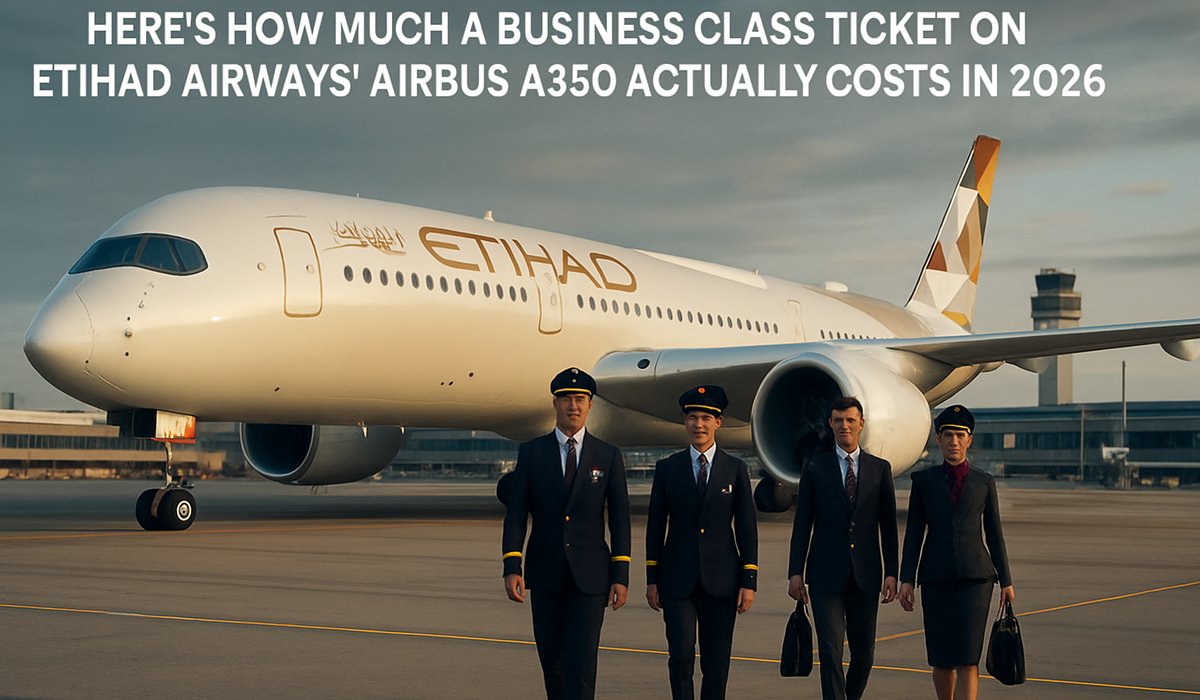
Image generated by AI
The UAE carrier's investment in Airbus' flagship widebody jets signals aggressive expansion strategy, with ticket prices reflecting operational efficiency gains
Premium Positioning on Next-Generation Aircraft
Etihad Airways is commanding top-tier business class fares on its expanding fleet of Airbus A350-1000 aircraft, positioning the aircraft as a cornerstone of the airline's premium long-haul strategy heading into 2026. The Abu Dhabi-based carrier currently operates 12 of the advanced widebody jets, with an additional 15 aircraft on firm order—a significant commitment that underscores the airline's confidence in the aircraft's commercial viability across its network.
The A350-1000 represents a deliberate operational choice for Etihad, distinguishing it from most competing carriers that have gravitated toward the more compact A350-900 variant. This strategic decision reflects the airline's focus on maximizing cabin density and payload capacity on both regional corridors and ultra-long-haul routes, where the larger variant's range and passenger configurations deliver enhanced revenue potential.
Fleet Modernization Driving Operational Advantage
The A350's integration into Etihad's operations addresses a critical industry imperative: fuel efficiency coupled with premium passenger experience. With volatile jet fuel prices continuing to impact airline profitability across the sector, the A350's advanced aerodynamics and fuel-efficient engines provide meaningful cost savings that carriers are strategically deploying to enhance margins rather than reduce fares.
Business class pricing on the A350 reflects this operational reality. The aircraft's configuration allows Etihad to offer an elevated onboard experience—wider cabins, superior entertainment systems, and enhanced amenities—justifying premium ticket valuations in an increasingly competitive long-haul market.
Strategic Fleet Expansion Amid Industry Headwinds
Etihad's continued investment in 15 additional A350-1000 airframes signals confidence in sustained demand for premium international travel, despite macroeconomic uncertainties. The airline's exclusive focus on the larger A350-1000—a positioning few carriers have adopted—indicates a deliberate strategy to differentiate itself in markets where competitors operate smaller variants.
This fleet modernization initiative also positions Etihad advantageously as rising fuel costs and evolving environmental regulations reshape aviation economics. The A350's 25% fuel efficiency advantage over predecessor aircraft translates directly to operational flexibility in pricing strategies and route planning.
The expanded fleet deployment across Etihad's global network will likely influence competitive dynamics in premium long-haul segments, particularly on routes connecting the Middle East with Europe, Asia, and North America.
FAQ: Etihad Airways A350 Business Class Fares & Fleet Strategy
What is the difference between the A350-900 and A350-1000? The A350-1000 is the larger variant with extended fuselage, offering greater passenger capacity and range. Etihad exclusively operates this version, unlike most A350 customers who favor the smaller, more fuel-efficient A350-900.
How do A350 jet fuel efficiency gains impact airline ticket prices? Improved fuel efficiency typically enhances airline margins rather than reducing fares. Carriers like Etihad leverage efficiency gains to maintain competitive pricing while protecting profitability amid fluctuating jet fuel markets.
Why is Etihad ordering 15 additional A350 aircraft? The orders reflect strong demand projections for premium long-haul travel and the aircraft's operational flexibility across Etihad's diverse route network, from high-demand regional flights to ultra-long-haul international corridors.
How does the A350 compare to competing widebody aircraft for business class operations? The A350 delivers superior fuel economy, spacious cabin dimensions, and advanced avionics compared to older widebody platforms, enabling carriers to offer premium experiences while maintaining competitive operational costs.
Will Etihad's A350 expansion affect baggage fees and ancillary charges? Fleet modernization typically enables airlines to optimize revenue management systems, potentially impacting baggage policies and ancillary service pricing as carriers balance capacity expansion with yield optimization strategies.
Related Travel Guides
-
Flight Delays Inflict $34 Billion Annual Burden on Global Aviation
-
AirBaltic Launches 12 Routes: Winter Bases in Tenerife, Kuusamo Expansion 2026
External Resources
This article is for informational purposes. Flight routes, passenger regulations, visa rules, and transit advisories are subject to change by airlines and aviation authorities. Readers are advised to verify schedules and travel documentation with relevant carriers and border agencies before departure.
Related Stories
easyJet Launches Direct Liverpool to Reykjavik Flights: Inside the North West's New Winter Gateway to Iceland
British Airways Revives Long-Haul Meal Pre-Orders on Las Vegas Flights: Inside the World Traveller Plus Dining Trial