
Germany Railway Disruptions: Altenburg and Zwickau Lose Direct Rail Links Until October 2026
Major infrastructure works on the Sachsen-Franken rail corridor are forcing passengers between Zwickau and Altenburg onto replacement buses, severely impacting direct access to Leipzig/Halle Airport.

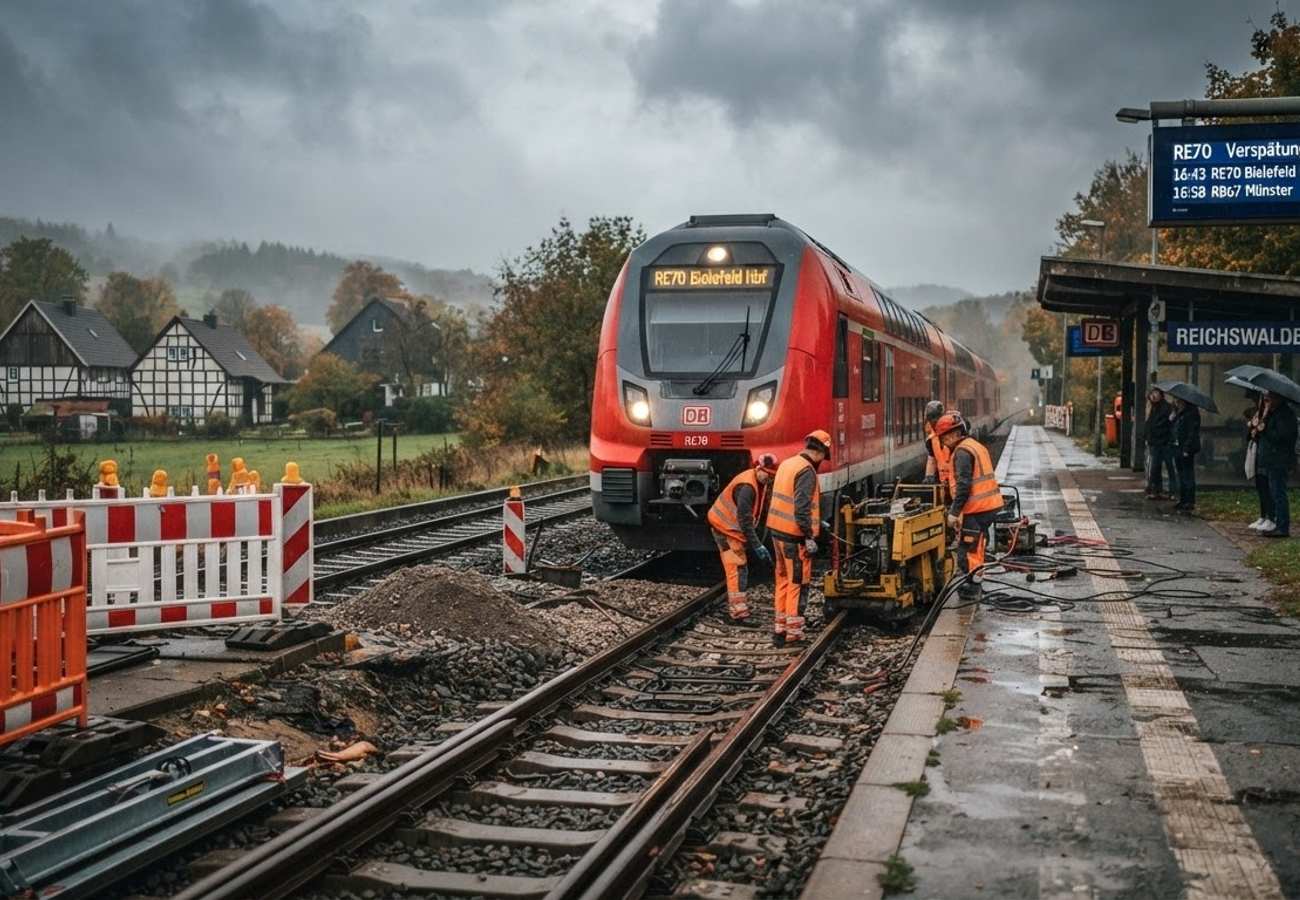
Image generated by AI
Travelers traversing the Sachsen-Franken rail corridor face a significant shift in transit logistics starting August 23, 2026, as direct train connections between Altenburg and Zwickau are suspended for major infrastructure upgrades. This disruption forces passengers onto replacement bus services, fundamentally altering the commute to Leipzig, Halle, and the Leipzig/Halle Airport.
The transition marks a critical phase in a broader modernization effort by Deutsche Bahn. While a shorter replacement window existed between Gößnitz and Zwickau through August 22, the scope of the disruption expands significantly on Sunday, August 23. For the next two months, the replacement bus corridor will stretch north to cover the entire Altenburg–Zwickau section, remaining in effect until October 18. Following this period, the bus replacement boundary is slated to shift back to the Gößnitz–Zwickau segment until the comprehensive timetable overhaul in December.
Shifting Transit Boundaries and Passenger Impact
For those planning journeys in late August, the specific date of the transition is paramount. The current replacement phase, which operates between Gößnitz and Zwickau, concludes on Saturday, August 22. However, this does not signal the end of the disruption but rather the beginning of a more extensive service gap.
From August 23 through October 18, the bus substitution expands to encompass the Altenburg–Zwickau stretch. This means that any itinerary planned for August 22 will be invalid by August 23. Furthermore, these plans will require another revision after October 18 when the interchange point moves south once more.
| Operational Phase | Dates | Replacement Section | Principal Traveller Implication |
|---|---|---|---|
| Phase One | 17–22 August 2026 | Gößnitz–Zwickau | Passengers interchange between rail and bus further south |
| Phase Two | 23 August–18 October 2026 | Altenburg–Zwickau | Longer bus sector disrupts through-journeys to Leipzig/Halle axis |
| Phase Three | 19 October–Dec Timetable Change | Gößnitz–Zwickau | Interchange point shifts south, requiring itinerary revision |
| Network Transition | December 2026 | S5 and S5X Reset | Länderbahn assumes operation of affected S-Bahn services |
Source: Deutsche Bahn and Mitteldeutscher Verkehrsverbund
Critical Disruptions to Leipzig/Halle Airport Access
The most pressing concern for international travelers is the severance of the direct rail chain to the airport. Typically, the S5 and S5X S-Bahn Mitteldeutschland services provide a seamless link from Zwickau and Altenburg directly to the Leipzig/Halle Airport station, which is located immediately beneath the terminal.
Starting August 23, this convenience vanishes. Travelers departing from Zwickau must now navigate a replacement bus sector to Altenburg before they can resume their journey north by rail. This adds a critical point of failure to the itinerary. Unlike a standard regional trip, airport transfers are bound by strict flight departure deadlines. The introduction of bus transfers increases the risk of delays due to road traffic, luggage handling complications, and the potential for missed flights.
Industry observers warn that historical travel times between Zwickau and the airport are no longer reliable. It is imperative that travel coordinators and passengers verify real-time schedules for the specific date of travel before finalizing bookings.
Technical Scope of the Sachsen-Franken-Magistrale Upgrades
The scale of the current disruption is a result of a massive engineering undertaking. Deutsche Bahn is not performing simple maintenance but is instead executing a comprehensive overhaul of the Sachsen-Franken-Magistrale. This corridor, spanning approximately 288 kilometers, is a vital artery connecting the Dresden–Hof and Leipzig–Werdau axes.
The project involves the reconstruction of 288 kilometers of track, the installation of 32 electronic interlockings, and the rehabilitation of 223 railway bridges. A primary goal of these works is to increase the design speed from 120 km/h to 160 km/h on upgraded sections, which will eventually reduce travel times.
| Infrastructure Element | Confirmed Programme Detail | Long-term Passenger Relevance |
|---|---|---|
| Corridor Length | About 288 km | Links Saxony, Thuringia, and Saxony-Anhalt to Bavaria/Baden-Württemberg |
| Electronic Interlockings | 32 planned | Modernized signaling and operating control |
| Railway Bridges | 223 renewed/rehabilitated | Increased infrastructure resilience |
| Passenger Design Speed | Up to 160 km/h | Potential for shorter journey times |
| Gößnitz Project Section | 2.85 km | Major reconstruction at a key junction |
| New Track at Gößnitz | 13.04 km | Reconfigured operating infrastructure |
| New Overhead Line | 25.82 km | Supports modern electric operation |
| Gößnitz Platforms | 2 island platforms (4 edges) | Expanded station functionality |
| Platform Length | 210 metres each | Capacity for regional operations |
| Flood-resilience | Raised by about 20 cm | Greater resilience around the Pleiße catchment |
Source: Deutsche Bahn Sachsen-Franken-Magistrale project documentation
Current onsite activities include the renewal of points and tracks at Gößnitz, overhead-line construction, and the installation of bridges near Crimmitschau and Ponitz.
Werdau Station and the December Operational Shift
The works at Werdau station are particularly significant for the future of the region's transit. Deutsche Bahn is currently installing two 750-metre overtaking tracks along with new signaling and points. A new signal at platform 2 will allow for the efficient coupling and separation of trains.
These upgrades are designed to facilitate an expanded S-Bahn offering toward Plauen, scheduled for the December timetable change. This indicates that the current autumn disruptions are a bridge to a new operating model. Under the MDSB2025plus contract, the S5 and S5X services—covering the axis from Halle-Trotha and Leipzig/Halle Airport through Altenburg and Gößnitz to Zwickau and Plauen—will transition to Länderbahn operation.
The contract encompasses approximately six million train-kilometres, with Länderbahn officially taking over the S3, S5, and S5X operations in December 2026.
Tourism Economic Impact in Saxony and Thuringia
The disruption affects more than just daily commuters; it hits a growing tourism sector. Both Zwickau and Altenburg are key destinations with measurable economic reliance on visitor arrivals.
In 2025, the Chemnitz.Zwickau.Region saw 584,000 guests and 1.2 million overnight stays, representing a growth of nearly 10%. This surge was driven largely by the European Capital of Culture program in Chemnitz. Specifically, the Zwickau district recorded approximately 215,000 overnight stays in the first half of 2025 alone.
Similarly, the Altenburger Land in Thuringia reported 71,983 arrivals and 155,876 overnight stays in 2025, with an average stay length of 2.2 days. Arrivals in this region grew by 5.6% compared to the previous year.
| Tourism Indicator | Period | Result |
|---|---|---|
| Chemnitz.Zwickau.Region Guests | 2025 | 584,000 |
| Chemnitz.Zwickau.Region Overnight Stays | 2025 | 1.2 million |
| Growth in both measures | 2025 | Nearly 10% |
| Zwickau District Overnight Stays | H1 2025 | ~215,000 |
| Altenburger Land Arrivals | 2025 | 71,983 |
| Altenburger Land Overnight Stays | 2025 | 155,876 |
Why This Matters
For the traveler, these changes transform a simple rail journey into a multi-modal logistical challenge. The shift of the interchange point from Gößnitz to Altenburg and back again means that "standard" routes are non-existent for the next few months.
From a logistical standpoint, the most critical risk is the "last mile" to the airport. When a rail link is replaced by a bus, the predictability of the journey evaporates. Travelers should budget an additional 60 to 90 minutes for their airport transfers to account for potential road congestion and the inherent delays of boarding replacement buses. For those visiting the Chemnitz.Zwickau.Region for cultural events, the lack of direct rail access may necessitate a shift toward rental cars or private transfers to avoid the uncertainty of the replacement bus schedule.
The current inconvenience is the price of a faster, more resilient rail network for 2027.
Related Travel Guides
Disclaimer
This article is for informational and educational purposes only. It does not constitute legal, financial, or professional advice. While we strive to provide accurate and up-to-date information, travel policies, regulations, and conditions change rapidly. Always verify information with official sources before making travel decisions. Nomad Lawyer makes no representations about the accuracy, reliability, completeness, or suitability of the information provided. Readers should consult qualified professionals for advice specific to their circumstances. The views expressed in this article are those of the author and do not necessarily reflect the views of Nomad Lawyer.
Kunal K Choudhary
Co-Founder & Contributor
A passionate traveller and tech enthusiast. Kunal contributes to the vision and growth of Nomad Lawyer, bringing fresh perspectives and driving the community forward.
Learn more about our team →