Frontier Airlines Unveils First-Class Cabins and Starlink Wi-Fi as Q3 Revenue Surges 53% to $1.35B

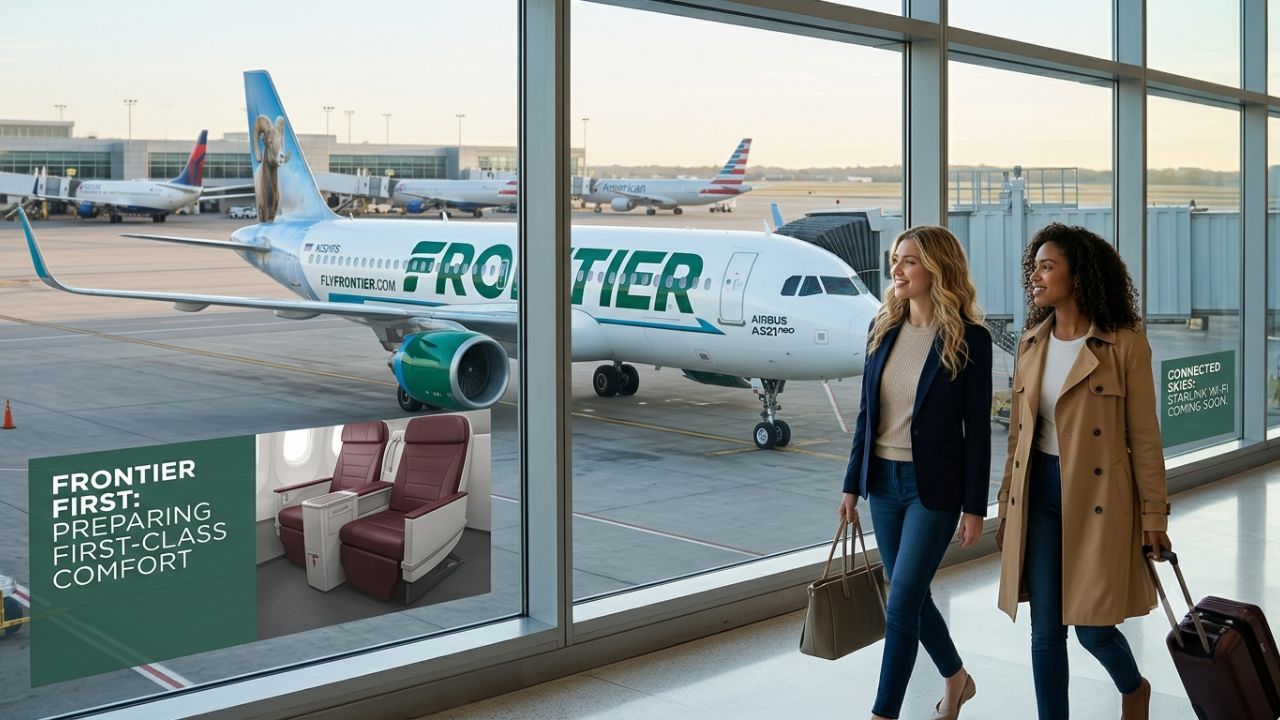
Frontier Airlines is installing 2x2 first-class seats and high-speed Starlink satellite Wi-Fi across its fleet, entering direct competition with major legacy carriers
[DENVER, Oct 30, 2026] — In a landmark strategic pivot signaling the evolution of the American budget airline model, Frontier Airlines is rolling out dedicated 2x2 first-class seating and high-speed Starlink satellite Wi-Fi across its fleet, propelled by record quarterly operating revenue of $1.355 billion and an aggressive push to compete head-to-head with legacy giants United Airlines, Delta Air Lines, and American Airlines.
[!NOTE] Key Operational and Financial Metrics: Frontier Group Holdings reported $1.355 billion in operating revenue for the third quarter of 2026, marking a 53% surge year-on-year. Passenger revenue jumped 55% to $1.327 billion, driven by a 71% increase in average fare revenue per passenger ($67.82) and a 30% rise in total revenue per passenger ($138.22). Revenue per available seat mile (RASM) expanded 30% to 11.87 cents across 9.8 million passengers (+18% YoY). While GAAP accounting registered a net loss of $104 million—impacted by $425 million in fuel costs and aircraft lease restructuring charges—adjusted net income reached $40 million. Installations of the new two-by-two first-class cabins begin in Q4 2026 with commercial ticketing launching in late Q1 2027, complemented by fleet-wide Starlink Wi-Fi rollouts starting in Q1 2027.
FRONTIER AIRLINES FLEET TRANSFORMATION (2026–2027)
| Column 1 |
|---|
| [ RECORD FINANCIAL ENGINE: Q3 2026 PERFORMANCE ] |
| +----------------------------+-----------------------------+ |
| v v |
| [ CABIN MODERNIZATION: FIRST CLASS ] [ INFLIGHT CONNECTIVITY: STARLINK WI-FI ] |
| - 2x2 Seating Geometry (Replaces 3x3) - Low Earth Orbit (LEO) Satellite Constellation |
| - Wider pitch, plush leather, armrests - Low latency (<30ms), high bandwidth streaming |
| - Retrofit Start: Q4 2026 - Fleet Retrofit Start: Q1 2027 |
| - Commercial Fare Debut: Late Q1 2027 - Direct competitor to legacy mainline offerings |
| +----------------------------+-----------------------------+ |
| v |
| [ MARKET RESTRUCTURING: POST-SPIRIT ERA ] |
| - Cessation of Spirit Airlines (May 2026) rationalized excess domestic seat capacity |
| - Loyalty revenue expanded 37% YoY via Frontier Miles and co-branded credit card programs |
| - Direct competitive convergence with United, Delta, and American on key leisure corridors |
The Evolution of the Low-Cost Carrier Model in North America
For more than two decades, the United States domestic aviation sector operated along clearly bifurcated lines. On one side stood full-service network carriers—United Airlines, Delta Air Lines, and American Airlines—commanding vast hub-and-spoke systems, multi-cabin aircraft, premium lounges, and global alliance partnerships. On the other stood ultra-low-cost carriers (ULCCs), led by Frontier Airlines and Spirit Airlines, whose unbundled business model stripped tickets down to the bare metal, charging separately for carry-on bags, seat selection, printed boarding passes, and onboard refreshments.
However, the post-pandemic commercial environment fundamentally altered passenger psychology and airline cost structures. Rising labor expenses, elevated jet fuel volatility, and airport operational constraints significantly narrowed the unit-cost advantage that budget airlines historically maintained over legacy carriers. Simultaneously, American travelers across every income bracket developed an appetite for premium leisure. Passengers who once tolerated cramped 28-inch seat pitch to save fifty dollars increasingly demonstrated a willingness to pay extra for wider seats, priority boarding, and dependable high-speed Wi-Fi.
Recognizing that single-cabin ultra-dense aircraft faced a structural revenue ceiling, Frontier Group Holdings initiated a comprehensive strategic transformation. Rather than remaining confined to the hyper-discount leisure basement, Frontier is repositioning itself as a hybrid carrier. By introducing a dedicated premium first-class cabin and outfitting its Airbus fleet with SpaceX's Starlink satellite connectivity, the Denver-based airline is creating a multi-tiered travel experience designed to capture high-yield leisure travelers, remote professionals, and small business travelers who demand comfort without paying traditional legacy first-class prices.
Record Q3 2026 Financials: Deconstructing the Revenue Surge
The decision to invest heavily in cabin retrofits and satellite hardware is supported by Frontier's third-quarter 2026 financial performance, which established historic revenue records across its operating network.
FRONTIER GROUP HOLDINGS: Q3 2026 FINANCIAL SUMMARY
| Column 1 |
|---|
| Operating Revenue $1.355 Billion +53% YoY |
| Passenger Revenue $1.327 Billion +55% YoY |
| Average Fare Revenue per Passenger $67.82 +71% YoY |
| Total Revenue per Passenger $138.22 +30% YoY |
| Revenue per Available Seat Mile (RASM) 11.87 Cents +30% YoY |
| Passenger Volume 9.8 Million +18% YoY |
| Scheduled Load Factor 78.8% -1.9 pts (vs. 80.7% in Q3 2025) |
| GAAP Net Loss $(104) Million Impacted by lease restructuring |
| Adjusted Net Profit (Non-GAAP) $40 Million Excludes special charges |
| Total Jet Fuel Expenses $425 Million Reflects elevated commodity cost |
| Loyalty-Related Revenue Growth +37% YoY Co-brand cards & subscriptions |
Frontier Group Holdings delivered $1.355 billion in total operating revenue for the third quarter of 2026, representing a dramatic 53% surge compared to the third quarter of 2025. Passenger-generated revenue accounted for $1.327 billion of that total, climbing 55% year-on-year.
This financial expansion was driven not merely by flying more planes, but by extracting significantly higher yields from each ticket sold. The average fare revenue per passenger jumped 71% to $67.82, reflecting a shift in Frontier's revenue-management algorithms, which prioritized profitable pricing over low-fare volume dumping. When combined with ancillary options—such as bundled baggage options and seat assignments—total revenue collected per passenger reached $138.22, a 30% increase year-on-year.
A key efficiency metric, Revenue per Available Seat Mile (RASM), rose 30% to reach 11.87 cents. Frontier transported approximately 9.8 million passengers during the quarter, an 18% increase compared to the prior-year period. Interestingly, this revenue expansion coincided with a modest reduction in load factor, which slipped from 80.7% in Q3 2025 to 78.8% in Q3 2026. This deliberate trade-off demonstrated that flying slightly fewer empty-fare passengers at substantially higher average ticket prices yielded superior top-line revenue.
Balancing GAAP Net Loss Against Adjusted Operating Profits
While top-line revenue expanded significantly, Frontier's bottom-line results highlighted the ongoing cost pressures across the airline industry. Under Generally Accepted Accounting Principles (GAAP), Frontier recorded a net loss of approximately $104 million for the quarter.
This statutory loss was heavily influenced by two major financial headwinds:
- Elevated Fuel Costs: Frontier's aircraft fuel expense totaled $425 million for the quarter, reflecting volatile global refinery crack spreads and sustained aviation turbine fuel costs.
- Aircraft Lease Restructuring Charges: The airline incurred non-cash restructuring expenses and fleet transition charges as it accelerated the phase-out of older leased airframes in favor of higher-efficiency, company-owned Airbus A320neo and A321neo deliveries.
On an adjusted basis—excluding these specified restructuring charges and one-time balance sheet items—Frontier achieved an operating profit of approximately $40 million. Looking ahead, executive guidance for the fourth quarter of 2026 projects continued operational momentum, with RASM expected to increase by more than 20% year-on-year and overall system capacity expanding between 5% and 6%.
Inside Frontier’s New First-Class Cabin: Architecture, Geometry, and Timing
The centerpiece of Frontier’s brand evolution is the introduction of a genuine domestic first-class product, breaking entirely with the single-class, high-density seating configuration that defined the airline since its founding.
FRONTIER FIRST-CLASS CABIN ARCHITECTURE (2x2)
| Column 1 |
|---|
| [ CABIN GEOMETRY & PHYSICAL SPECIFICATIONS ] |
| - Configuration: Two-by-Two (2x2) seating layout at the front of the aircraft cabin |
| - Seat Dimensions: Wider contoured seating with distinct sculpted headrests and lumbar support |
| - Pitch & Legroom: Expanded pitch providing generous legroom and easy aisle egress |
| - Personal Amenities: Dedicated bi-fold tray tables, cocktail side consoles, personal power |
| - Overhead Storage: Reserved overhead bin space dedicated exclusively to first-class guests |
| v |
| [ INSTALLATION TIMELINE & FLEET ROLLOUT ] |
| - Q4 2026: Physical aircraft modifications and retrofit installations commence at maintenance |
| - Late Q1 2027: Commercial sales debut and initial revenue flights across key domestic trunks |
| - Retrofit Targets: Standardized integration across Airbus A320neo and A321neo fleets |
Historically, Frontier offered "UpFront Plus"—a modified seating product that blocked the middle seat in the first two rows of its standard 3x3 layout to give passengers extra elbow room. While popular as an incremental add-on, it remained an economy seat with a vacant center cushion.
The newly announced first-class cabin replaces that interim solution with purpose-built first-class furniture. Configured in a two-by-two (2x2) arrangement across the forward rows of the aircraft, the cabin eliminates middle seats entirely. The new seats feature wider, contoured leather upholstery, enhanced padding, adjustable winged headrests, dedicated center consoles with cocktail tables, integrated AC and USB power outlets, and generous legroom.
According to executive disclosures on the company’s earnings call, engineering modifications and physical seat installations begin in the fourth quarter of 2026. The airline plans to open commercial ticketing and commence revenue flights featuring the first-class cabin toward the end of the first quarter of 2027.
This cabin modification creates an intermediate pricing segment in American skies. Rather than competing directly for corporate travelers with $1,200 transcontinental legacy tickets, Frontier aims to price its first-class seats attractively for affluent leisure travelers, couples, and small business owners seeking extra comfort on two- to four-hour flights at price points below legacy network carriers.
Frontier’s approach also requires recalibrating airport terminal workflows. The carrier is outfitting designated airport departure gates in Denver, Orlando, and Las Vegas with dedicated premium boarding lanes, ensuring first-class passengers receive early cabin access to stow their bags in designated overhead lockers before main-cabin boarding commences. In-cabin service protocols will feature complimentary premium snack baskets and beverage services, distinguishing the forward cabin from the buy-on-board economy menu without introducing heavy, galley-space-consuming ovens or hot-meal carts that would add aircraft weight and drag down fuel performance.
The Inflight Connectivity Race: Deploying SpaceX’s Starlink Satellite Wi-Fi
Alongside physical seat upgrades, Frontier is addressing a long-standing deficiency of the budget airline model: the absence of onboard internet. Beginning in the first quarter of 2027, Frontier will initiate fleet-wide installations of SpaceX's Starlink satellite Wi-Fi system.
STARLINK SATELLITE CONNECTIVITY ADVANTAGES
| Column 1 |
|---|
| [ LOW EARTH ORBIT (LEO) NETWORK ARCHITECTURE ] |
| - Altitude: ~550 km above Earth (vs. ~35,786 km for traditional geostationary satellites) |
| - Latency: Sub-30 milliseconds, eliminating frustrating delays during real-time web tasks |
| - Bandwidth: High-throughput capacity supporting simultaneous streaming across all passengers |
| v |
| [ PASSENGER CAPABILITIES ONBOARD FRONTIER ] |
| - High-Definition Video Streaming (YouTube, Netflix, Disney+, Apple TV+) |
| - Live Interactive Work (Zoom video calls, cloud computing, real-time corporate VPN access) |
| - Seamless Messaging & Browsing (iMessage, WhatsApp, live social media, web navigation) |
| - Gate-to-Gate Activation: Continuous internet access from pushback through final arrival taxi |
In-flight connectivity has transformed from a luxury amenity into a baseline requirement for modern airline travelers. Passengers expect to answer work emails, stream digital entertainment, and stay connected with family throughout their flight.
Traditional commercial aircraft Wi-Fi relied on geostationary (GEO) satellites orbiting approximately 35,786 kilometers above the equator. Because signals had to travel thousands of miles into space and back, passengers experienced latency of 600 milliseconds or more, resulting in sluggish browsing speeds and dropped connections.
Starlink operates a constellation of thousands of Low Earth Orbit (LEO) satellites circling approximately 550 kilometers above Earth. This proximity reduces signal latency to under 30 milliseconds, delivering ground-like broadband speeds directly to moving aircraft. Passengers onboard Starlink-equipped Frontier flights will be able to stream high-definition video, play online games, access corporate cloud servers via VPN, and participate in live video calls.
The competitive landscape for onboard Wi-Fi across the US airline industry is evolving rapidly:
- United Airlines: Signed an agreement to outfit its entire mainline and regional fleet with Starlink Wi-Fi, with initial aircraft entering service in 2025 and 2026.
- Delta Air Lines: Partnered with Viasat to provide fast, free Wi-Fi for all passengers enrolled in its Delta SkyMiles loyalty program across the vast majority of its domestic mainline fleet.
- American Airlines: Equipped its domestic fleet with high-speed satellite Wi-Fi powered by Viasat and Intelsat, offering ad-supported free connection windows and paid passes.
By selecting Starlink, Frontier matches United’s next-generation satellite technology, giving the budget carrier a modern technological platform that leapfrogs older satellite systems. From an operational viewpoint, Starlink's electronically steered phased-array antennas feature an ultra-low-profile aerodynamic radome. This design minimizes parasitic aerodynamic drag on the aircraft's fuselage, conserving fuel over long cross-country stages compared to heavier mechanical gimbaled dish antennas used by legacy providers.
Loyalty Programs as Competitive Drivers: Frontier Miles Expansion
An integral component of Frontier's financial evolution is the rapid expansion of its loyalty ecosystem. During the third quarter of 2026, Frontier's loyalty-related revenue grew by 37% year-on-year, providing a high-margin cash flow stream that cushions against passenger fare volatility.
FRONTIER MILES LOYALTY REVENUE ARCHITECTURE
| Column 1 |
|---|
| [ REVENUE EXPANSION ENGINE (+37% YOY GROWTH) ] |
| - Co-Branded Barclays Credit Cards: Accelerated cardholder acquisition and retail spend swipes |
| - Elite Status Restructuring: Silver (10k), Gold (20k), Platinum (50k), Diamond (100k) |
| - Family Pooling & Ancillary Perks: Free seat selection, waived change fees, free baggage |
| v |
| [ TRANSITION FROM TRANSACTIONAL TO RELATIONSHIP TRAVEL ] |
| - Shifts customer booking habits away from anonymous third-party online travel agencies (OTAs) |
| - Encourages repeat direct bookings via FlyFrontier.com and the Frontier Mobile App |
| - Provides recurring non-ticket cash flow through financial partner point sales |
Historically, ultra-low-cost carriers struggled to generate meaningful loyalty revenue. Passengers routinely viewed budget carriers as interchangeable commodities, booking flights through third-party metasearch engines based solely on the lowest price.
To break this pattern, Frontier overhauled its Frontier Miles program, introducing spend-based accrual structures, family point pooling, and clear elite tier thresholds (Silver, Gold, Platinum, and Diamond). Elite status holders enjoy complimentary seat selection, waived change and cancellation fees, and free carry-on baggage.
The 37% increase in loyalty revenue during Q3 2026 reflects expanded co-branded credit card partnerships with Barclays, higher cardholder spending, and increased membership in the airline's Discount Den subscription program. For major carriers like Delta (SkyMiles), United (MileagePlus), and American (AAdvantage), loyalty programs and credit card agreements generate billions in annual revenue, often valued higher than the airlines' flight operations. Frontier is adopting this proven financial playbook, building long-term customer relationships that generate recurring income regardless of ticket prices.
In addition, the airline's co-branded credit card strategy incentivizes daily retail card swipes among secondary-market consumers in metro areas like Cleveland, Cincinnati, and Tampa. Because cardholders earn qualifying points for every retail purchase, Frontier successfully anchors itself into the everyday financial habits of regional travelers, establishing brand affinity that directly counteracts legacy carrier credit card dominance.
Reshaping the US Skies: The Post-Spirit Market Landscape
Frontier’s strategic transformation is taking place within an altered domestic aviation environment, influenced by the cessation of operations by Spirit Airlines in May 2026.
POST-SPIRIT US DOMESTIC MARKET REALIGNMENT
| [ THE MAY 2026 VACUUM: SPIRIT AIRLINES DEPARTURE ] |
|---|
| - Significant capacity removed from high-volume vacation routes (Florida, Vegas, Caribbean) |
| - Relieved chronic seat overcapacity and fare discounting across key leisure markets |
| +----------------------------+-----------------------------+ |
| v v |
| [ FRONTIER IMMEDIATE RESPONSE ] [ STRUCTURAL MARKET IMPACT ] |
| - Launched Spirit customer relief fares - Rationalized seat capacity lifted baseline yields |
| - Expanded frequencies on core routes - Enabled Frontier to lift average fares by 71% |
| - Absorbed leisure demand in Orlando & Vegas- Legacy carriers captured premium displaced travelers |
For over a decade, Spirit Airlines operated as Frontier’s primary ultra-low-cost rival, frequently competing on identical routes out of hubs like Orlando, Las Vegas, Fort Lauderdale, and Atlanta. The intense fare discounting between the two carriers often pushed prices below operating costs, depressing profitability across the budget sector.
Following Spirit's shutdown in May 2026, significant seat capacity was removed from key US domestic leisure markets. While Frontier stepped in with special discount fares to assist stranded travelers and absorbed aircraft and route opportunities, the broader effect was a rationalization of industry supply.
The departure of Spirit removed surplus discount seats from the market, allowing surviving carriers to stabilize yields. This market shift helped Frontier increase average passenger fares by 71% without suffering severe declines in passenger volume. However, the elimination of Spirit also reduced budget travel options on certain routes, making Frontier's dual focus on affordable economy fares and premium comfort an important balance for cost-conscious travelers.
Market analysts note that the exit of Spirit created a permanent bifurcation in consumer booking flows. Budget purists who exclusively booked sub-$30 bare fares have migrated toward unbundled basic economy offerings, while travelers seeking predictable service reliability are gravitating toward Frontier’s upgraded network. By pairing improved operational reliability with premium cabin choices, Frontier is positioning itself to capture both segments simultaneously.
Comparative Matrix: Frontier vs. Legacy Carriers
The table below contrasts Frontier Airlines' emerging premium model against the established cabin and service structures of United Airlines, Delta Air Lines, and American Airlines.
| Airline | Primary Domestic Premium Product | Seat Configuration | Inflight Wi-Fi Technology | Loyalty Program | Primary Network Hubs & Bases |
|---|---|---|---|---|---|
| Frontier Airlines | First Class (Launching Q1 2027) | 2x2 Dedicated Premium Seating | SpaceX Starlink (LEO, High Speed, Low Latency) | Frontier Miles | Denver, Orlando, Las Vegas, Atlanta, Philadelphia, Cleveland |
| United Airlines | United First | 2x2 Recliner Seating (Mainline) | SpaceX Starlink (Rolling out fleet-wide) | MileagePlus | Chicago O'Hare, Denver, Houston Intercontinental, Newark, San Francisco |
| Delta Air Lines | Delta First | 2x2 Ergonomic Recliner (Mainline) | Viasat Satellite (Free for SkyMiles members) | Delta SkyMiles | Atlanta, Minneapolis/St. Paul, Detroit, Salt Lake City, New York JFK |
| American Airlines | Domestic First | 2x2 Leather Recliner (Mainline) | Viasat & Intelsat Satellite (Paid & Ad-supported) | AAdvantage | Dallas/Fort Worth, Charlotte, Miami, Chicago O'Hare, Phoenix |
Strategic Challenges: Fuel Costs, Fleet Utilization, and Execution
While Frontier's strategic pivot presents clear revenue opportunities, transitioning from a pure ultra-low-cost carrier to a hybrid airline involves notable operational and financial risks.
STRATEGIC TRANSITION RISKS & OPERATIONAL TRADEOFFS
| Column 1 |
|---|
| [ CABIN DENSITY & UNIT REVENUE BALANCE ] |
| - Replacing 3x3 economy rows with 2x2 first-class seats reduces total aircraft seat count |
| - First-class premium fares must generate enough extra revenue to offset fewer total seats sold |
| v |
| [ FUEL PRICE VOLATILITY & EXPENSE HEADWINDS ] |
| - Quarterly fuel expense of $425 million underscores vulnerability to global oil price spikes |
| - Modern Airbus A320neo and A321neo fuel efficiency remains central to managing unit costs |
| v |
| [ GROUND OPERATIONS & SERVICE CONSISTENCY ] |
| - First-class travelers expect reliable baggage handling, priority boarding, and support |
| - Tight aircraft turn times (35-45 minutes) must be preserved to maintain fleet productivity |
The Seat Density Equation
The ultra-low-cost business model depends heavily on maximizing the number of seats per aircraft. Packing 186 seats onto an Airbus A320neo or 240 seats onto an A321neo allows an airline to spread fixed operating costs over more passengers, keeping cost per available seat mile (CASM) low.
Installing a 2x2 first-class cabin reduces total seat count. For the investment to succeed, Frontier’s first-class tickets must command a sufficient revenue premium to make up for the lost economy seats. If macroeconomic headwinds soften consumer discretionary spending, filling premium seats at profitable rates could become challenging.
Preserving Fast Turnaround Times
Frontier’s profitability relies on high aircraft utilization, often keeping planes airborne ten to twelve hours a day with quick 35- to 45-minute gate turns. Introducing first-class services—such as priority boarding and dedicated carry-on management—must be executed smoothly to avoid ground delays that can disrupt downstream flight schedules.
Managing Fuel Expense and Fleet Modernization
A fuel bill of $425 million in a single quarter underscores the impact of commodity price fluctuations on airline earnings. While Frontier operates one of the youngest, most fuel-efficient fleets in America—consisting primarily of Pratt & Whitney-powered Airbus A320neo and CFM LEAP-powered A321neo aircraft—fuel remains its largest variable expense. Maintaining disciplined cost control across non-fuel operations will be essential to achieving sustained GAAP profitability alongside its cabin investments.
Fleet commonality provides an operational cushion. Because Frontier operates an all-Airbus A320 family fleet, pilot type ratings, flight attendant qualifications, and spare parts inventories remain standardized across its nationwide maintenance stations. As newly delivered A321neo aircraft arrive from Airbus manufacturing facilities in Mobile, Alabama, and Hamburg, Germany, their higher baseline seat capacity allows Frontier to install two rows of 2x2 first-class seats while still maintaining over 220 main-cabin seats. This favorable scale helps absorb cabin reconfiguration costs without compromising the airline's overall seat production capacity.
What Frontier’s Transformation Means for US Travelers
For American air travelers, Frontier’s evolution introduces new travel choices across competitive domestic routes:
- A New Mid-Tier Travel Option: Passengers who desire extra personal space and priority amenities without paying legacy first-class fares will have an accessible alternative on major leisure routes between cities like Denver, Orlando, Las Vegas, Philadelphia, and Phoenix.
- True In-Flight Connectivity: The installation of Starlink satellite Wi-Fi eliminates dead zones on Frontier flights, enabling business travelers and families to stream entertainment, browse the web, and stay productive in the air.
- Important Booking Considerations: Travelers should examine fare inclusions carefully. Frontier’s first-class ticket bundles will differ from legacy network carriers, which typically include complimentary checked bags, premium lounge access, and hot plated meals. Comparing the complete price, included perks, and baggage rules before booking remains sound travel practice.
- Enhanced Loyalty Upgrades: High-tier members of the Frontier Miles program can leverage status to obtain complimentary upgrades to the new 2x2 first-class cabin on available domestic legs. This structural benefit introduces a tangible incentive for frequent leisure flyers to consolidate their domestic bookings onto Frontier.
Frontier Airlines' transition from a bare-bones discount carrier into a hybrid airline featuring two-by-two first-class seating, Starlink broadband, and an expanding loyalty ecosystem marks an important milestone in domestic aviation. By combining cost-conscious operational efficiency with modern passenger amenities, Frontier is redefining the value proposition for American air travelers.
Frequently Asked Questions (PAA)
When will Frontier Airlines introduce first-class seating?
Frontier Airlines plans to begin installing two-by-two (2x2) first-class seating on its aircraft during the fourth quarter of 2026. Commercial ticket sales and regular scheduled flights featuring first-class cabins are scheduled to debut toward the end of the first quarter of 2027.
How does Frontier's new first-class cabin differ from UpFront Plus?
UpFront Plus was an economy seating product that simply kept the middle seat vacant in the first two rows of a standard 3x3 layout. The new first-class cabin features dedicated, wider seats built in a permanent 2x2 configuration with upgraded leather upholstery, enhanced legroom, adjustable headrests, center cocktail tables, and dedicated overhead bin space.
When will Starlink Wi-Fi be available on Frontier flights?
Fleet retrofits for SpaceX’s Starlink satellite Wi-Fi system are scheduled to begin in the first quarter of 2027. Starlink provides low-latency, high-bandwidth broadband that supports video streaming, online work, and messaging throughout the flight.
How did the closure of Spirit Airlines affect Frontier's business?
The shutdown of Spirit Airlines in May 2026 removed substantial discount seat capacity from major US leisure markets, including Florida and Las Vegas. This capacity reduction eased fare competition, allowing Frontier to increase average passenger fares by 71% and grow total third-quarter 2026 revenue to a record $1.355 billion.
What amenities are included with a Frontier first-class ticket?
While final bundle details will be announced closer to the late Q1 2027 launch, Frontier’s first-class product is designed to include wider 2x2 seating, guaranteed window or aisle access, priority boarding, dedicated overhead storage space, and integrated in-seat power outlets, positioned at price points below legacy airline first-class fares.
Related Travel Guides
This article is for informational purposes. Flight routes, passenger regulations, visa rules, and transit advisories are subject to change by airlines and aviation authorities. Readers are advised to verify schedules and travel documentation with relevant carriers and border agencies before departure.
Related Stories
Brazil Nears 100 Million Air Passengers in 2026 Amid Divergent Global Aviation Growth
Ultra-Comfortable Budget Flights: How Singapore, Japan, Malaysia, and Spain Are Redefining Long-Haul Low-Cost Air Travel