
Flights Cancelled Across United States As Chicago, Washington, And Other Major Airports Cancel 275 And Delay 4,218
Flights Cancelled Across United States As Chicago, Washington, And Other Major Airports Cancel 275 And Delay 4,218

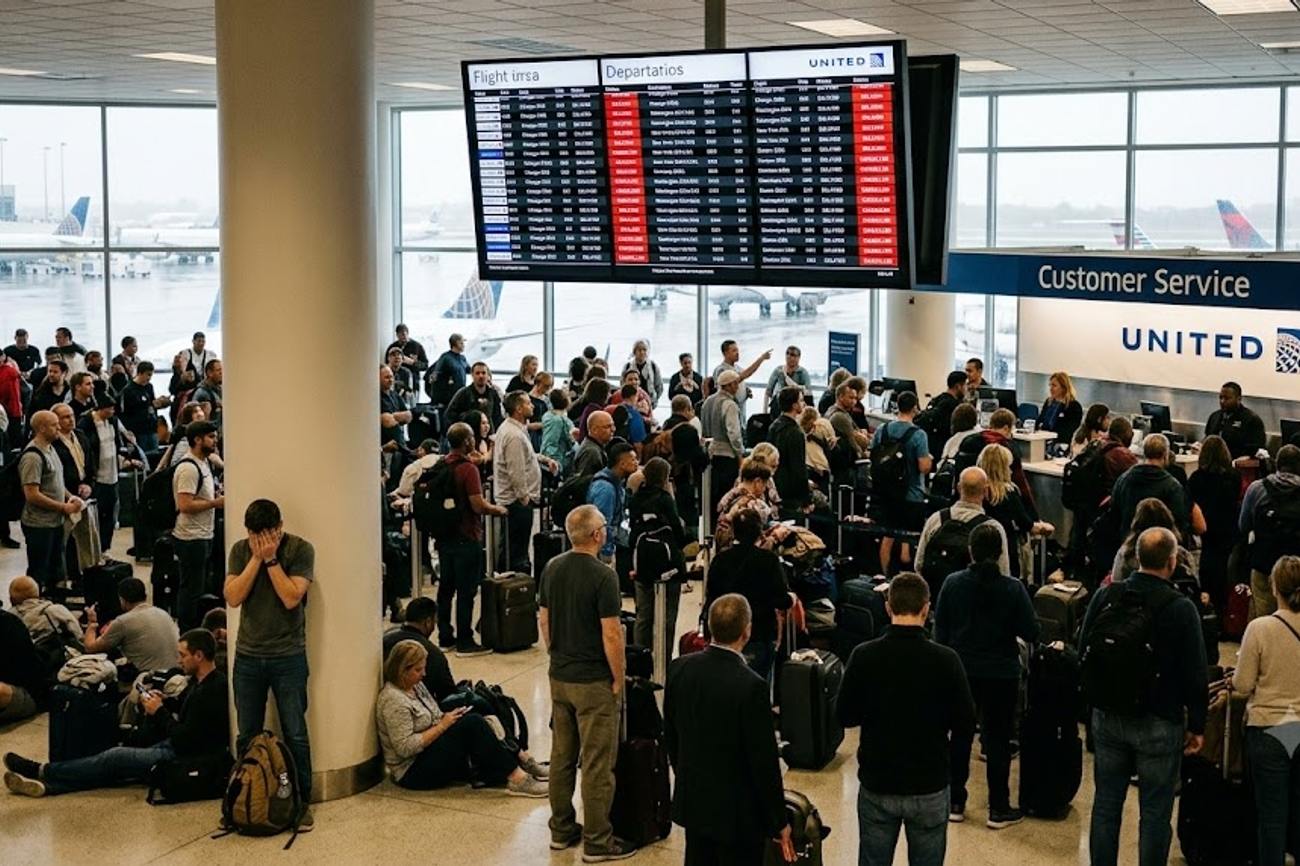
Image generated by AI
4,218 delays and 275 cancellations across the United States signal a systemic failure in hub-and-spoke resilience, with Chicago O’Hare emerging as the primary epicenter of the chaos. The scale of these disruptions suggests that current aviation infrastructure is unable to absorb simultaneous shocks from weather events and planned maintenance, creating a ripple effect that transcends individual airlines.
The Chicago Convergence: A Hub Under Pressure
The disruption is not evenly distributed across the national airspace; rather, it is heavily concentrated in the Midwest. Chicago O’Hare has become the focal point of the current crisis, recording 1,055 delays and 175 cancellations. The severity of the situation is highlighted by the Federal Aviation Administration (FAA), which reports ground delays at O'Hare averaging 126 minutes.
The operational breakdown at O'Hare is comprehensive. For passengers originating from the airport, the cancellation rate stands at 6% with delays affecting 33% of flights. The situation for arriving passengers is even more volatile, with delays climbing to 38% and cancellations remaining at 6%. When combined with the data from Chicago Midway—which reported 176 delays and 29 cancellations—it becomes clear that the entire Chicago metropolitan aviation corridor is experiencing a near-total degradation of schedule reliability. At Midway, departing flights saw a 5% cancellation rate and 28% delay rate, while arriving flights faced 2% cancellations and 19% delays.
National Disruption Metrics and Airport Performance
While Chicago is the epicenter, the disruptions extend to nearly every major coastal gateway. The cause of these delays varies by region, ranging from atmospheric conditions to physical infrastructure failures. In Boston, runway construction has combined with weather to create ground delays averaging 136 minutes, resulting in 327 delays and nine cancellations. In Philadelphia, thunderstorms have pushed departure delays to an average of 165 minutes, the highest average delay among the reported hubs.
The following table delineates the specific operational impacts across the most affected US airports:
| Airport | Delays | Cancellations | Primary Cause | Avg. Delay (Mins) |
|---|---|---|---|---|
| Chicago O'Hare | 1,055 | 175 | Thunderstorms | 126 |
| Boston Logan | 327 | 9 | Runway Construction | 136 |
| San Francisco | 287 | 2 | Low Ceilings | 77 |
| Dallas-Fort Worth | 219 | 5 | High Traffic Volume | N/A |
| Philadelphia | 176 | 4 | Thunderstorms | 165 |
| Chicago Midway | 176 | 29 | Regional Weather | N/A |
| Reagan National | 167 | 3 | Traffic Management | 30 |
| Fort Lauderdale | 143 | 1 | Thunderstorms | 30 |
| Harry Reid (LV) | 138 | 4 | Wind | 30 |
| Seattle-Tacoma | 138 | 3 | General Disruptions | N/A |
| Baltimore/Wash | 129 | 5 | Thunderstorms | 15 |
| LaGuardia | 126 | 4 | Traffic Management | 15 |
| Newark Liberty | 89 | 1 | Traffic Management | 15 |
Expert Analysis: The Fragility of the Regional Feed
The data reveals a critical vulnerability in the US aviation model: the disproportionate impact on regional carriers. While legacy carriers like American Airlines are feeling the pressure—reporting 524 delays and 21 cancellations—the regional operators are suffering more acute losses relative to their size. SkyWest, for instance, is facing 332 delays and 66 cancellations. Republic and Envoy Air follow closely with 138 and 157 delays, and 34 and 31 cancellations respectively.
For travelers, the direct consequence of this is a "broken link" in the journey. Because regional airlines feed passengers from smaller markets into major hubs like Dallas-Fort Worth or Philadelphia, a SkyWest or Envoy cancellation often results in a missed connection on a long-haul flight. The pricing pressure this creates is significant; when regional capacity collapses, airlines are forced to rebook passengers on alternative carriers or provide hotel vouchers, eroding the profit margins of the flight.
Furthermore, the disparity between "Traffic Management Initiatives" (TMI) and weather-related delays is telling. At airports like LaGuardia and Newark, where delays are attributed to TMIs and "swaps," the disruption is administrative. However, at O'Hare and Philadelphia, the disruptions are environmental. When administrative delays (TMI) overlap with environmental delays (thunderstorms), the system loses its ability to recover in real-time. This explains why the International Air Transport Association (IATA) frequently emphasizes the need for better predictive weather modeling to prevent the "cascading failure" seen in today's figures.
Key Takeaways
- Regional Collapse: SkyWest and Envoy Air are experiencing higher cancellation-to-delay ratios than major carriers, making regional connections the highest-risk segment of current travel.
- Chicago Deadlock: The combined impact of O'Hare and Midway disruptions creates a regional blockade, with O'Hare specifically seeing nearly 40% of arriving flights delayed.
- Infrastructure Friction: Boston Logan demonstrates that planned runway construction, when paired with poor weather, creates a bottleneck (136-minute average delay) that rivals severe storm impacts.
- Southwest Volume: Southwest is absorbing the highest volume of delays (893), suggesting their point-to-point model is currently struggling more than hub-based systems in the face of widespread weather events.
- Recovery Lag: With departure delays in Philadelphia reaching 165 minutes, passengers should expect "knock-on" effects that will likely persist into the next 24-hour operational cycle.
FAQ: US Flight Disruptions 2024
What should I do if my regional flight (SkyWest/Envoy) is cancelled? Immediately use the airline's mobile app to rebook. Because regional flights have limited daily frequencies, waiting in line at the airport gate often results in the remaining seats being taken by other displaced passengers.
Why are delays higher at O'Hare than at other major hubs? O'Hare is currently facing a combination of severe thunderstorms and high traffic volume, leading to a 33-38% delay rate for both arriving and departing aircraft.
Does runway construction at Boston Logan affect all flights? Yes, ground operations are slowed for all carriers. The FAA reports average ground delays of 136 minutes, meaning passengers should arrive at the airport significantly earlier than usual.
Is Southwest the only airline experiencing delays? No, but they are the most affected in terms of volume with 893 delays. American Airlines and various regional partners are also seeing significant disruptions.
The thin line between a scheduled journey and a logistical nightmare is often just a few thunderstorm cells over a Midwest hub.
Tags: Chicago O'Hare, Southwest Airlines, SkyWest, FAA Traffic Management, US Aviation Disruptions 2024, American Airlines
Related Travel Guides
- Emirates and Medical Tourism Association Forge Alliance to Shape Global Healthcare Travel
- Heathrow Airport Deploys Digital Navigation Strategy to Combat Terminal Complexity in 2026
- Avianca Achieves 100% Business Class Network Coverage Across Americas with Over 400 Weekly Flights Connecting US, Colombia, and Guatemala
Disclaimer
This article is for informational and educational purposes only. It does not constitute legal, financial, or professional advice. While we strive to provide accurate and up-to-date information, travel policies, regulations, and conditions change rapidly. Always verify information with official sources before making travel decisions. Nomad Lawyer makes no representations about the accuracy, reliability, completeness, or suitability of the information provided. Readers should consult qualified professionals for advice specific to their circumstances. The views expressed in this article are those of the author and do not necessarily reflect the views of Nomad Lawyer.
Naina Thakur
Contributor & Travel Specialist
Travel enthusiast and legal writer covering visa regulations, responsible tourism, and cultural journeys across global destinations.
Learn more about our team →