
F-35 Delivery Surge Masks Software Crisis: Why Lockheed Martin's Record 191 Jets in 2025 Tells a Darker Story
Lockheed Martin delivered 191 F-35s in 2025—a record—but it wasn't a success story. A software integration crisis created a backlog of completed jets sitting idle for months, revealing the fragility of modern military aviation.

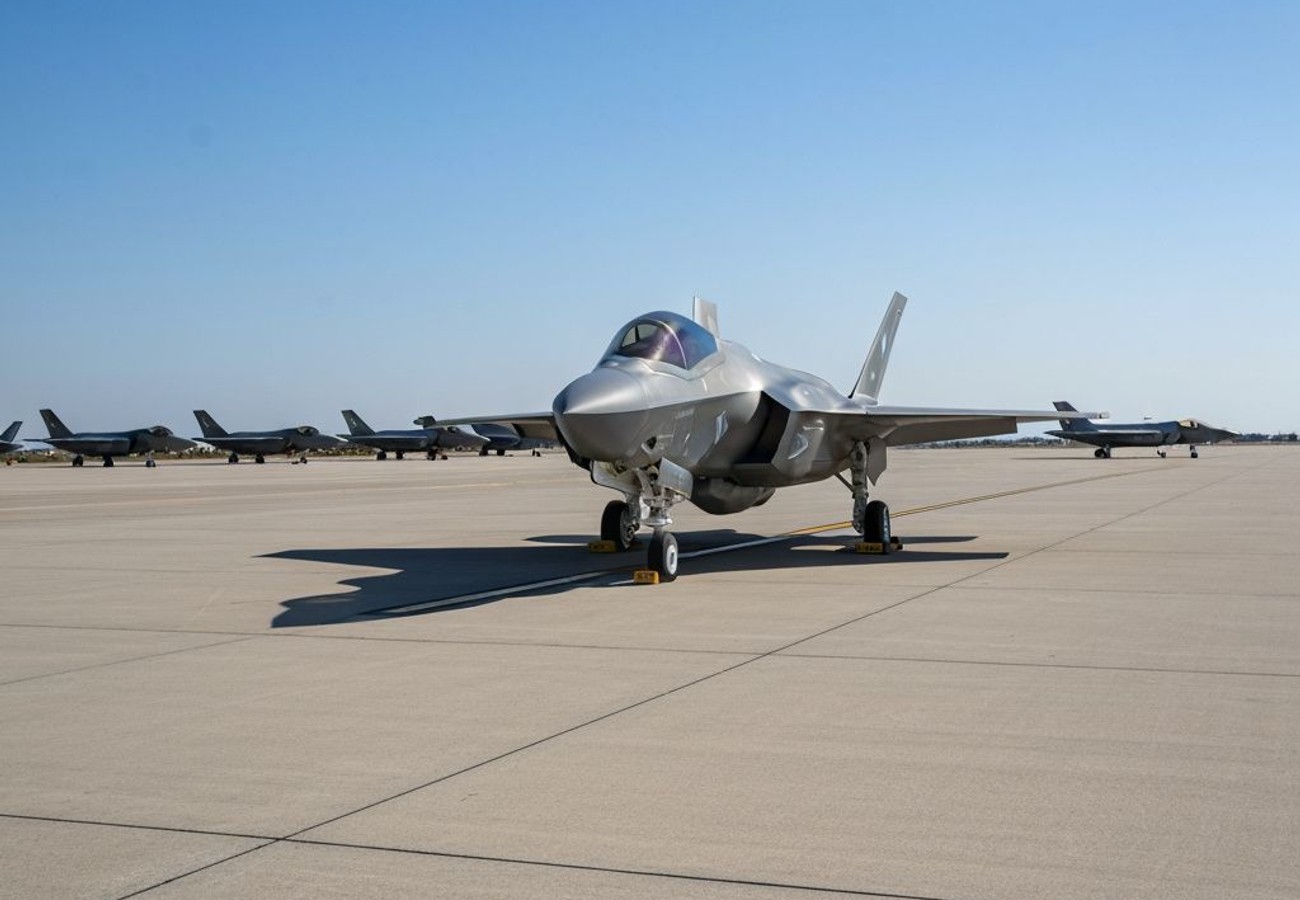
Image generated by AI
The Delivery Mirage That Fooled Washington
In 2025, Lockheed Martin announced a headline that appeared to vindicate the world's most expensive weapons program. The company delivered 191 F-35 Joint Strike Fighters in a single year—the highest annual total since the program's inception. Defense analysts celebrated. Government officials pointed to momentum. On paper, it looked like the most ambitious fighter jet program of the 21st century had finally conquered its demons.
But the real story was far darker.
The Software Bottleneck Nobody Talks About
What actually happened wasn't a manufacturing triumph. It was the sudden release of a backlog.
Throughout 2023 and 2024, Lockheed Martin continued building F-35s at planned production rates at its Fort Worth, Texas facility. Engines were integrated. Avionics were installed. Airframes were completed. But here's the catch: the Pentagon refused to accept them.
By mid-2024, over 100 finished F-35s were sitting idle on the factory floor, awaiting certification rather than construction. These weren't incomplete aircraft. They were done. Ready. But they couldn't be delivered because the software wasn't approved.
This is what happens when you build a fighter jet as a software-defined weapon system. The airframe is just the shell.
Technology Refresh 3: The Invisible Killer
The culprit was an upgrade called Technology Refresh 3 (TR-3).
The TR-3 modernization introduced faster processors, expanded memory, and improved cockpit displays. It sounds routine. It wasn't. TR-3 was mandated by the Pentagon for all aircraft delivered after mid-2023 because it was essential infrastructure for Block 4, the next major capability upgrade.
Without TR-3, newly built F-35s would arrive operationally obsolete—unable to integrate future weapons, sensors, or electronic warfare systems. The Pentagon faced an impossible choice: accept jets that were already behind the technology curve, or wait.
They waited. For 13 months.
"The F-35 cannot simply be upgraded incrementally after delivery like older fighters," according to defense manufacturing analysis. "Its combat effectiveness is fundamentally tied to its software integration."
Reddit: "The military built a fighter jet that's basically a computer with wings. When the software breaks, the entire program breaks." — r/military
Why They Couldn't Just Deliver Them Early
The natural question surfaced inside the Pentagon: why not hand over the jets and upgrade them later?
Earlier generation fighters—the F-16, F/A-18, Harrier, Tornado—entered service in basic configurations and were modernized incrementally. The F-35 was architected differently from day one. Retrofitting TR-3 after delivery would have been exponentially more expensive than installing it on the production line.
More critically: operationally, it would have flooded squadrons with reduced-capability aircraft, complicating training, mission planning, and interoperability with allied air forces. For a platform designed to be the backbone of US Air Force, US Navy, US Marine Corps, and allied airpower for the next 30 years, that trade-off was unacceptable.
The US Department of Defense required perfection—or at least stability. They got neither quickly.
The Factory Kept Humming. The Deliveries Froze.
This is the detail that exposes the fragility of modern defense contracting.
Lockheed Martin didn't pause production. It couldn't afford to. Labor contracts, supplier commitments, and political pressure to maintain employment in Fort Worth all pushed the company to keep building. So it did.
The factory floor looked normal. Jets rolled off the line on schedule. But they went straight into storage, not to customer squadrons. The disconnect between production and delivery is nearly unprecedented in military aviation.
Software certification—not physical production—became the program's constraint. A $1.7 trillion program was held hostage not by rivets or riveting, but by lines of code that couldn't be debugged fast enough.
July 2024: The Relief Valve Opens
In July 2024, the Pentagon granted limited approval for an interim TR-3 configuration. Full Block 4 capability would take additional time. But at least the jets could move.
The floodgates opened. All those aircraft that had been sitting in Texas suddenly had a pathway to delivery. By 2025, those previously warehoused F-35s finally transferred to operational squadrons across the US and allied nations. The "record year" was really a one-time release of inventory that had been artificially constrained.
Why This Matters Beyond Fort Worth
The F-35 is flown by US Air Force, US Navy, US Marine Corps, and allied air forces across Europe, the Middle East, and Asia-Pacific. When delivery surges like this occur, air forces are forced to induct aircraft faster than training pipelines and maintenance infrastructure can support.
The 2025 surge created cascading effects across military aviation globally. Pilot training backlogs widened. Maintenance technicians scrambled. Older aircraft like F-16s and F/A-18s that were scheduled for retirement had to stay in service longer while squadrons absorbed the sudden influx of new platforms.
Reddit: "One country gets a sudden delivery of F-35s and suddenly every allied air force is scrambling to train pilots faster. This program affects everyone." — r/aviation
The Uncomfortable Truth
The F-35's "record year" wasn't a vindication of Lockheed Martin or the Pentagon's management of the program. It was evidence of how completely the program had lost control of its own supply chain and certification processes.
A functioning program delivers aircraft steadily. A broken program builds them in warehouses and releases them in waves when software eventually stabilizes. The 2025 numbers looked impressive. The reality behind them was anything but.
For governments relying on this platform to replace aging fighter fleets, the lesson is sobering: military aviation has become so software-dependent that a coding delay can cascade into years of operational disruption. There's no physical workaround. There's no "just ship it anyway." Modern fighters are defined by their digital architecture, not their airframes.
The F-35 learned this the hard way. The 191 aircraft delivered in 2025 were proof of that hard lesson, not evidence that the problem had been solved.
The future of military aviation belongs to whichever nation masters software-defined warfighting first.
Related Travel Guides
Disclaimer
This article is for informational and educational purposes only. It does not constitute legal, financial, or professional advice. While we strive to provide accurate and up-to-date information, travel policies, regulations, and conditions change rapidly. Always verify information with official sources before making travel decisions. Nomad Lawyer makes no representations about the accuracy, reliability, completeness, or suitability of the information provided. Readers should consult qualified professionals for advice specific to their circumstances. The views expressed in this article are those of the author and do not necessarily reflect the views of Nomad Lawyer.
Kunal K Choudhary
Co-Founder & Contributor
A passionate traveller and tech enthusiast. Kunal contributes to the vision and growth of Nomad Lawyer, bringing fresh perspectives and driving the community forward.
Learn more about our team →