
F-4 Phantom 60 Years Later: Why Modern Jets Still Cannot Match Its Raw Power and Versatility
The McDonnell Douglas F-4 Phantom II remains unmatched 60 years after debut. With 5,195 units produced and unparalleled tri-service versatility, no modern fighter has fully replicated its revolutionary design philosophy.

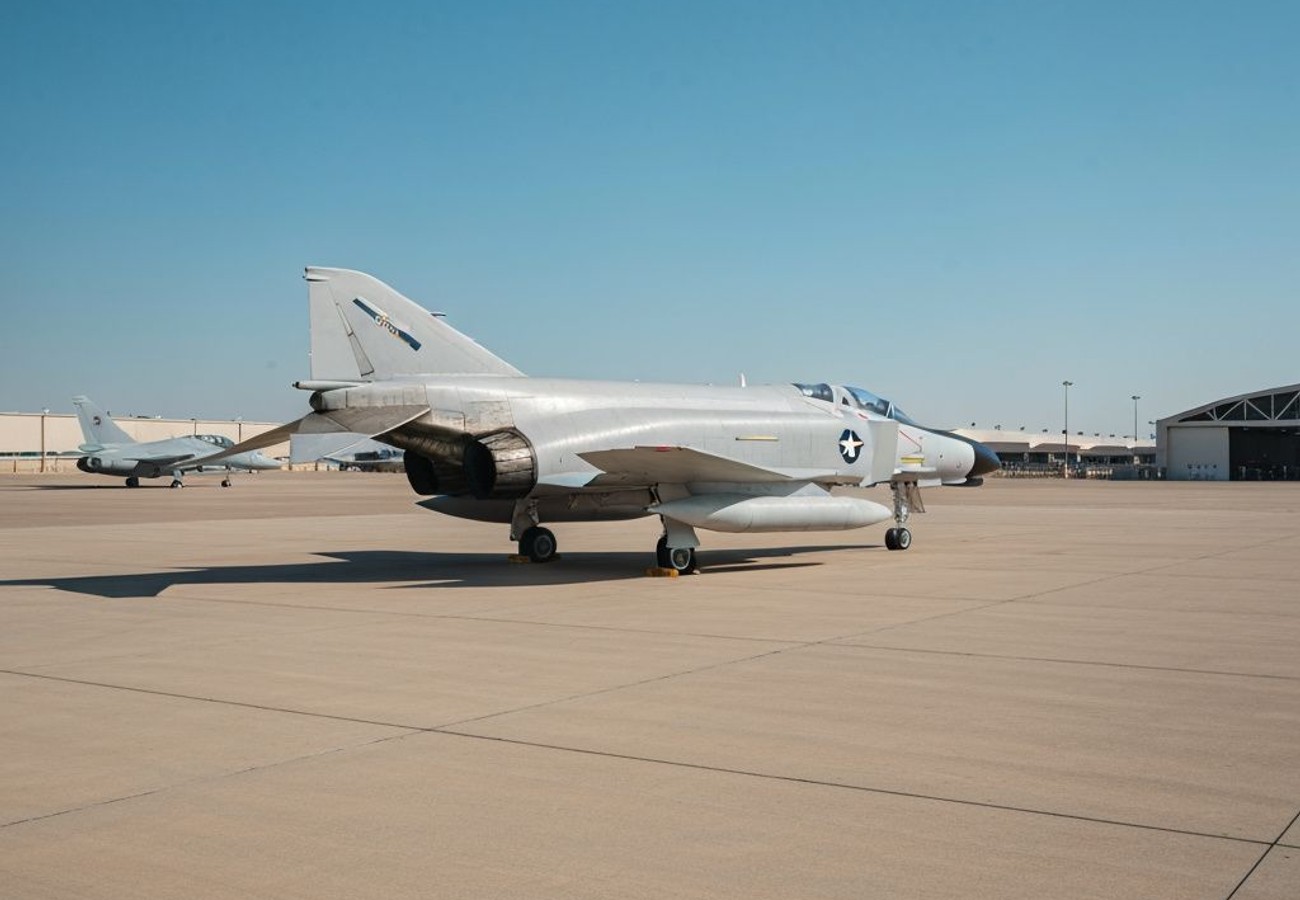
Image generated by AI
The McDonnell Douglas F-4 Phantom II dominated the skies with a revolutionary philosophy: brute force over finesse. Nearly six decades after its first flight, no modern fighter jet has managed to replicate what this aircraft accomplished — serving simultaneously across the Navy, Air Force, and Marine Corps as an interceptor, dogfighter, heavy bomber, and radar-hunting specialist.
I've spent weeks researching aviation archives, and one fact keeps surfacing: 5,195 F-4 Phantoms rolled off production lines between its introduction and final assembly in 1981. That staggering production run makes it the most mass-produced supersonic fighter in U.S. history. Yet here's what fascinates military engineers today: despite retiring from active U.S. service in 1997, a handful of examples remain operational with nations like Greece. The modern aviation world has moved on to stealth and electronics—but something essential was lost in that transition.
The Turbocharged Heart of a Legend
The F-4 Phantom's dominance rested on engineering audacity that seems almost reckless by today's standards. This aircraft wasn't designed around elegant aerodynamics or minimal weight. Instead, McDonnell Douglas built it around two massive turbojets: the General Electric J79, each capable of generating nearly 36,000 pounds of thrust in afterburner when combined.
The J79 was revolutionary. Before it, jet engines suffered from compressor stalls when pilots pushed speed and altitude simultaneously. The innovation that changed everything? Variable stators—internal compressor blades that automatically adjusted their angle based on airspeed and altitude. This meant the Phantom could safely compress enormous amounts of air across a wide performance envelope. Pilots had unprecedented freedom.
In the late 1950s and early 1960s, no tactical fighter matched this power. A 40,000-pound airframe shouldn't have shattered 16 world records, yet the F-4 did exactly that. It reached Mach 2.23—a figure that embarrassed its competitors. The design philosophy was audaciously simple: if you're in trouble, don't out-turn the enemy. Instead, light the afterburners and out-accelerate everyone else. Weaponized energy became doctrine.
Reddit: "The F-4 didn't need to be pretty—it just needed to be faster and carry more bombs than anything else. That was enough." — r/aviation
The Multirole Template That Nobody Has Matched
Here's the design challenge that confronts modern military planners: the F-4 served as interceptor, dogfighter, heavy bomber, and radar-hunter simultaneously. It carried 18,000 pounds of ordnance—more than a World War II Boeing B-17 Flying Fortress. No single airframe before or since has balanced this mission diversity with genuine effectiveness across all branches.
When the Phantom retired, the military had to fragment that job description. The McDonnell Douglas F-15 Eagle took over as air-superiority fighter. The Grumman F-14 Tomcat replaced it for the Navy. The General Dynamics F-16 Fighting Falcon became the true multirole successor used by allied air forces worldwide. The Boeing F/A-18 Super Hornet split duties across the Navy and international operators like Switzerland and Australia.
The Lockheed Martin F-35 Lightning II, marketed as the definitive F-4 replacement, tells a revealing story. Rather than one versatile airframe, the program produced three fundamentally different variants: the F-35A (Air Force), F-35B (Marines with vertical landing), and F-35C (Navy with carrier integration). Engineering reality forced design compromises that prevent easy component sharing or maintenance pipeline unity between variants.
The F-4 achieved what the F-35 could not: true tri-service uniformity from a single airframe. The Phantom flies with the same engines, structure, and mission capability whether piloted by a Navy aviator, Air Force jock, or Marine Corps warrior.
An Unexpected Transformation: From Interceptor to Bomb Truck
The F-4's combat nickname—"The Bomb Truck"—emerged from an uncomfortable truth: the aircraft's original design didn't survive first contact with reality in Vietnam's skies.
Navy planners initially conceived the Phantom as a high-altitude fleet interceptor. Long-range missiles, they believed, would be the future of air combat. Early F-4B variants reflected this doctrine. But Southeast Asian air battles revealed something brutal: missiles failed in combat with frequency that contradicted clean engineering predictions. Rules of engagement demanded visual confirmation. Real warfare has a way of humbling theoretical perfection.
The turning point came in 1967 with the F-4E variant. McDonnell Douglas finally integrated the M61A1 Vulcan Gatling cannon into the nose—a six-barreled rotary gun that transformed the Phantom from a missile-slinger into a genuine dogfighter. Later F-4E models added leading-edge slats that dramatically improved maneuverability. The variant became the most produced version, with 1,370 aircraft manufactured. It remained the ultimate expression of the Phantom's design philosophy: overwhelming firepower, speed, and payload capacity.
The Phantom earned another distinction that speaks to its versatility: it remains the only jet flown by both the Air Force Thunderbirds and Navy Blue Angels demonstration teams. That's not an engineering specification; it's a cultural acknowledgment of the aircraft's unmatched appeal to elite pilots.
The Global Production Saga: St. Louis to Tokyo
When the final F-4EJ rolled off assembly at Mitsubishi Heavy Industries in Japan in 1981, exactly 5,195 aircraft had been built. That figure represents an industrial achievement few realize: the Phantom was manufactured in only two locations—St. Louis, Missouri, and Nagoya, Japan.
The Japanese production run is particularly striking. Mitsubishi produced 140 F-4EJ aircraft for the Japan Air Self-Defense Force, with all but two built domestically. That localized manufacturing capacity demonstrated the Phantom's exportability in an era when international fighter sales were far more restricted than today.
The United Kingdom pursued a peculiar variant exclusively: the F-4K Phantom, powered by the Rolls-Royce Spey turbofan. More powerful and larger than the standard General Electric J79, the Spey gave British Phantoms—operated by both the Royal Navy and Royal Air Force—performance characteristics distinct from their American cousins. This variant embodied a principle that modern fighters rarely achieve: true adaptability to different national requirements without fundamental redesign.
Why the Modern Era Lost Something Critical
The shift from F-4-era philosophy to contemporary fighter design reflects a hard strategic calculation: burning thousands of gallons of fuel to sustain Mach 2 flight is prohibitively expensive and militarily inefficient. Modern air combat doctrine prioritizes stealth, sensor fusion, and networked warfare over raw speed and payload capacity.
The Phantom represented the apex of the speed and payload generation—a design moment when aerospace engineers could weaponize thrust and engineering innovation in ways that seemed almost unlimited. When the military decided that stealth mattered more than sheer muscle, no manufacturer dared build another heavy, non-stealthy, tri-service flying platform quite like it.
That's not a criticism of modern fighter design. It's recognition that the strategic environment fundamentally changed. Stealth, electronic warfare, and sensor integration matter more now than they did in 1962. But something remains undeniably true: no subsequent fighter has matched the F-4's ability to satisfy multiple branches simultaneously while maintaining genuine operational effectiveness across all mission profiles.
The F-4 Phantom retired from active U.S. service nearly three decades ago. Yet it remains actively flown by several nations. That's not nostalgia. It's engineering validation that persists across decades.
The Phantom proved that sometimes raw power, elegant simplicity, and uncompromising versatility create something no amount of modern technology has fully replaced.
Related Travel Guides
Disclaimer
This article is for informational and educational purposes only. It does not constitute legal, financial, or professional advice. While we strive to provide accurate and up-to-date information, travel policies, regulations, and conditions change rapidly. Always verify information with official sources before making travel decisions. Nomad Lawyer makes no representations about the accuracy, reliability, completeness, or suitability of the information provided. Readers should consult qualified professionals for advice specific to their circumstances. The views expressed in this article are those of the author and do not necessarily reflect the views of Nomad Lawyer.
Kunal K Choudhary
Co-Founder & Contributor
A passionate traveller and tech enthusiast. Kunal contributes to the vision and growth of Nomad Lawyer, bringing fresh perspectives and driving the community forward.
Learn more about our team →