
European Air Traffic Delays 2026: Hub Congestion Hits UK, France, and Germany
Record flight volumes in 2026 are pushing European airspace to its limits, forcing airlines to implement aggressive rerouting and ground-slot strategies to maintain schedule integrity across major hubs.

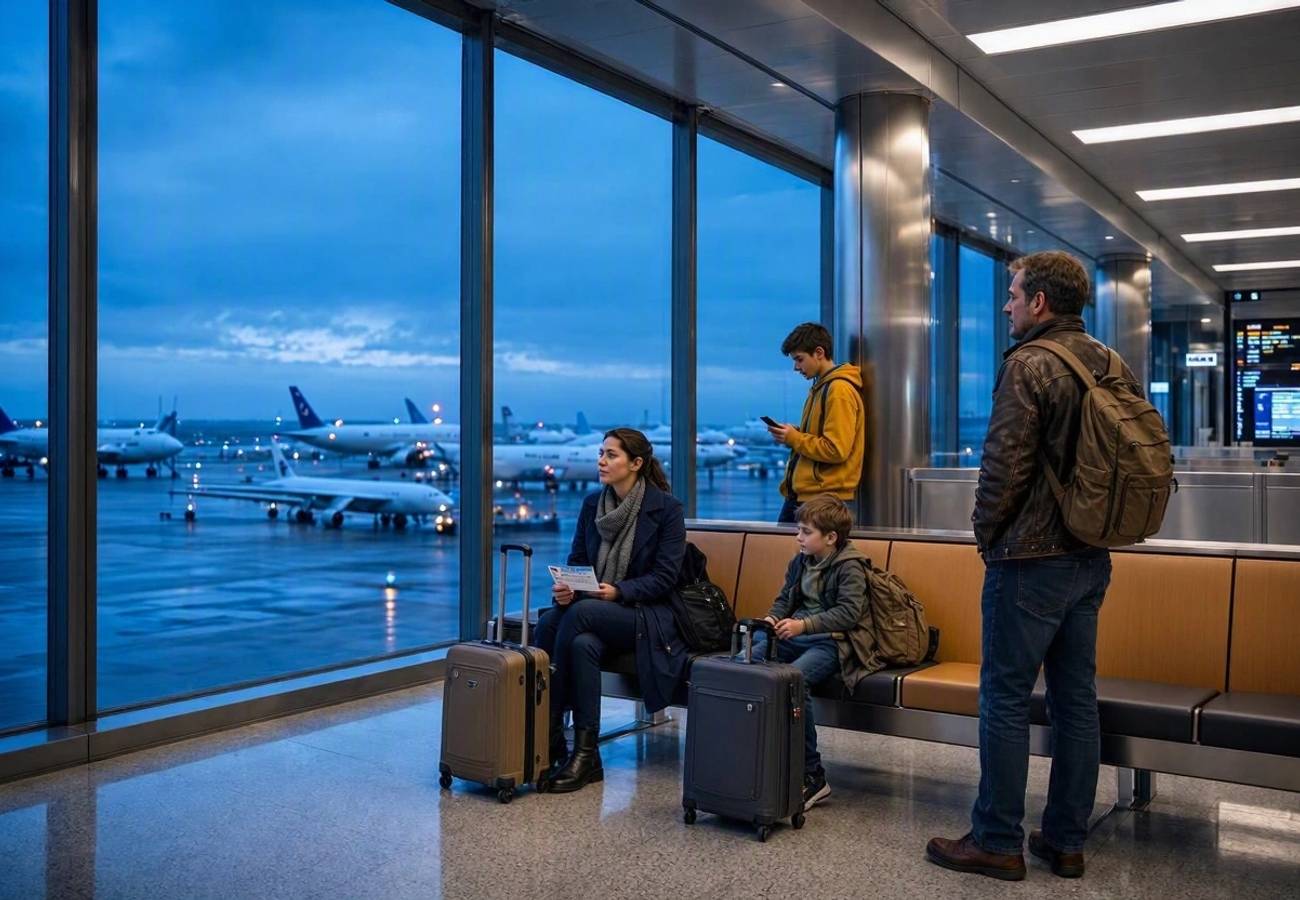
Image generated by AI
[Brussels, October 17, 2026] — European airspace is operating at its absolute limit in 2026, as record-breaking flight volumes trigger systemic delays across the United Kingdom, France, Germany, Turkey, and the Netherlands. Despite an increase in overall traffic, aviation authorities are struggling to balance unprecedented demand with rigid infrastructure capacity.
The crisis centers on the inability of air traffic control (ATC) sectors to absorb the surge in summer travel. While EUROCONTROL reports a slight improvement in average en-route delays, the sheer volume of aircraft is forcing airlines to abandon traditional flight paths in favor of costly rerouting and strict ground-holding patterns to avoid mid-air congestion.
The Catalyst for Systemic Congestion
The current instability is driven by a mismatch between flight scheduling and available ATC staffing. Airspace is managed in three-dimensional sectors, each with a mathematically defined limit on how many aircraft a single controller can safely manage. When staffing levels drop or demand spikes, these sectors must be merged into larger blocks, which immediately slashes the total number of flights that can pass through a region.
To prevent dangerous airborne holding patterns, authorities utilize Air Traffic Flow Management (ATFM). This system forces aircraft to remain on the tarmac via a "Calculated Take-Off Time" (CTOT). While this prevents mid-air chaos, it manifests as unexplained gate delays for passengers.
High-Traffic Hub Analysis 2026
Five primary airports are currently bearing the brunt of this operational pressure. Istanbul Airport has emerged as the dominant hub in the network, surpassing traditional European capitals in daily movement.
Peak Summer Daily Flight Volume
| Airport Name | Country | Average Daily Flights | Network Rank |
|---|---|---|---|
| Istanbul Airport (IST) | Turkey | 1,671 | 1 |
| Paris Charles de Gaulle (CDG) | France | 1,424 | 2 |
| Amsterdam Schiphol (AMS) | Netherlands | 1,418 | 3 |
| London Heathrow (LHR) | United Kingdom | 1,330 | 4 |
| Frankfurt Airport (FRA) | Germany | 1,321 | 5 |
Market Dominance and Operational Response
The response to these delays varies by carrier type. Low-cost carriers, led by the Ryanair Group, are driving the volume growth, with Ryanair averaging over 3,100 daily flights this year and peaking at 3,700 during the late summer. Legacy carriers, including the Lufthansa Group and Air France-KLM, are focusing on maintaining capacity and revenue despite the bottlenecks.
To bypass these delays, flight dispatchers are increasingly using the Route Availability Document to find "Conditional Routes"—paths that only open under specific traffic conditions. In some cases, airlines are opting for "altitude capping," flying at lower levels to avoid congested upper-airspace sectors. While this increases fuel burn and operational costs, it allows airlines to avoid ground slots and keep schedules intact.
What This Means for Travelers
For the average passenger, these technical airspace constraints translate into three specific disruptions:
- The "Invisible" Delay: You may sit at the gate for 30 to 90 minutes after the aircraft is boarded. This is rarely a mechanical issue; it is a mandatory ATC ground slot designed to prevent airborne congestion.
- Increased Ticket Volatility: As airlines absorb higher fuel costs from flying at lower altitudes to avoid delays, these expenses are likely to be passed down to consumers via fuel surcharges.
- Unpredictable Flight Paths: Rerouting may result in longer flight times than listed on your original itinerary, even if the departure was on time.
Passengers are encouraged to monitor real-time updates via the European Union Aviation Safety Agency (EASA) or their specific airline's app to track slot-related delays.
Future Mitigation and Infrastructure
The industry is now relying on the EUROCONTROL Network Operations Portal (NOP), a centralized dashboard that allows dispatchers to see rerouting opportunities in real-time. By automating route modifications across entire fleets, airlines hope to mitigate regional disruptions before they cascade into total network failure. However, until staffing levels at national ATC centers increase, the reliance on ground-holding and fuel-heavy rerouting will remain the primary survival strategy for European aviation.
FAQ: European Air Traffic 2026
Why is my flight delayed at the gate even though the plane is ready? This is likely an ATFM ground slot. To prevent overcrowding in the air, EUROCONTROL assigns a specific take-off time. Your plane must wait on the ground until that exact window opens for safety.
Are these delays caused by weather or staffing? Both. While severe weather can instantly destroy sector capacity, the underlying issue is often staffing. Short-staffed ATC centers must merge sectors, which reduces the number of planes that can safely fly through that airspace.
Will rerouting affect my arrival time? Yes. When airlines bypass congested zones or fly at lower altitudes to avoid ground slots, the flight path is often longer and slower, which can add time to your total journey.
Which airports are most likely to experience delays? The highest risk is at the top five hubs: Istanbul (IST), Paris (CDG), Amsterdam (AMS), London (LHR), and Frankfurt (FRA), as they handle the highest daily flight volumes.
Airspace is a finite resource, and Europe is currently hitting the ceiling.
Related Travel Guides
Disclaimer
This article is for informational and educational purposes only. It does not constitute legal, financial, or professional advice. While we strive to provide accurate and up-to-date information, travel policies, regulations, and conditions change rapidly. Always verify information with official sources before making travel decisions. Nomad Lawyer makes no representations about the accuracy, reliability, completeness, or suitability of the information provided. Readers should consult qualified professionals for advice specific to their circumstances. The views expressed in this article are those of the author and do not necessarily reflect the views of Nomad Lawyer.
Kunal K Choudhary
Co-Founder & Contributor
A passionate traveller and tech enthusiast. Kunal contributes to the vision and growth of Nomad Lawyer, bringing fresh perspectives and driving the community forward.
Learn more about our team →