
Dublin MetroLink Moves Ahead as AECOM and Jacobs Lead Ireland’s Major Airport Rail Transformation in 2026
Dublin MetroLink Moves Ahead as AECOM and Jacobs Lead Ireland’s Major Airport Rail Transformation in 2026

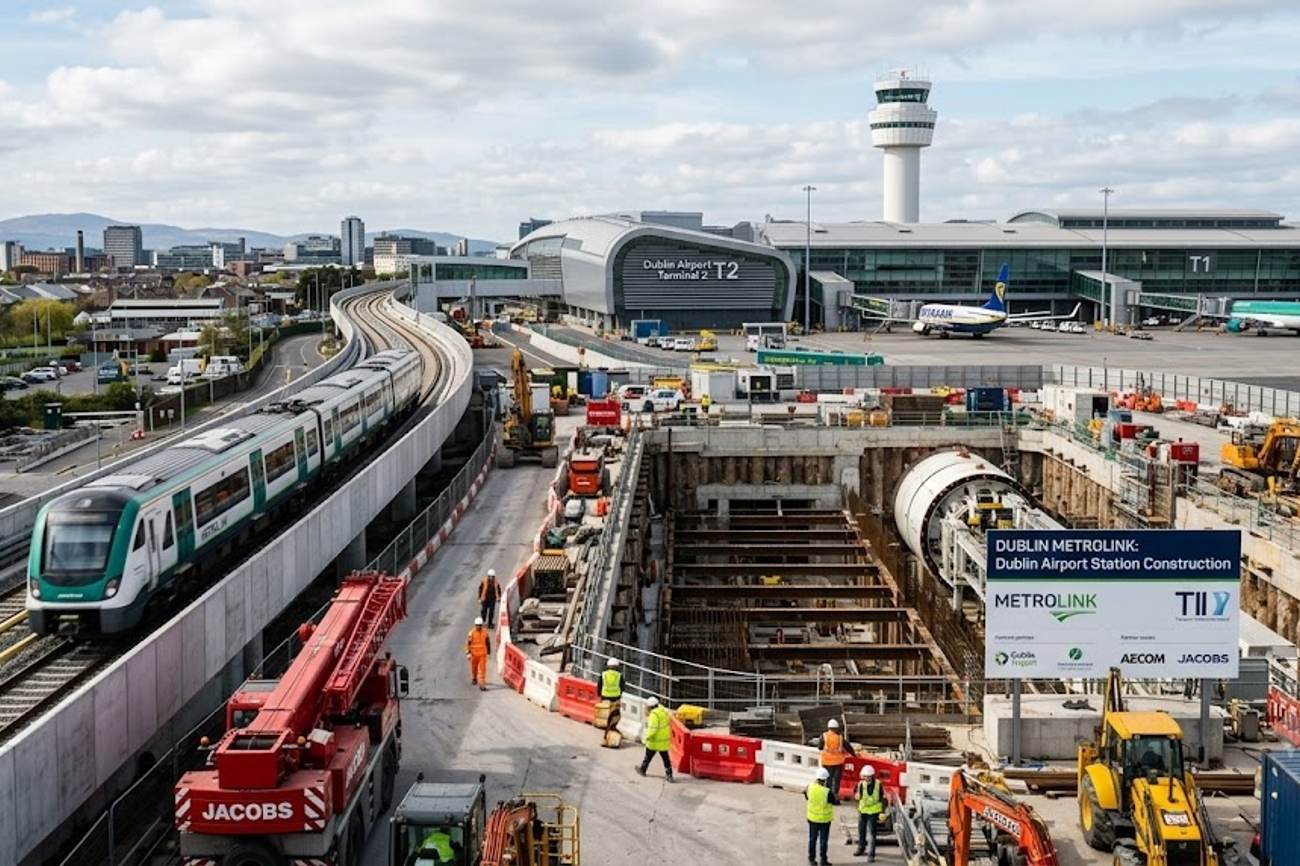
Image generated by AI
[Dublin, September 14, 2026] — Transport Infrastructure Ireland (TII) has appointed a joint venture between global infrastructure giants AECOM and Jacobs to serve as the Programme Delivery Partner for MetroLink, a massive €9.5 billion high-capacity rail project designed to overhaul connectivity between Dublin Airport and the city center.
The strategic partnership signals the start of a new delivery phase for the project, which aims to alleviate severe road congestion and accommodate surging passenger volumes at Ireland's primary international gateway. The AECOM and Jacobs venture will provide critical governance, risk coordination, and programme management to ensure the successful execution of the segregated metro system, which will link Swords in North County Dublin, the airport, and downtown Dublin.
The Catalyst for MetroLink
The acceleration of MetroLink is a direct response to the systemic failure of Dublin's current transport networks to keep pace with rapid population growth and increased air traffic. Currently, passengers arriving at Dublin Airport (DUB) rely almost exclusively on road-based transport, including taxis, private vehicles, and buses. This dependence has created a bottleneck that increases travel times, lowers productivity, and increases the carbon footprint of the Greater Dublin region.
Unlike existing rail services that share tracks with other trains—leading to delays and limited frequency—MetroLink will utilize a fully segregated infrastructure. This means the metro will operate on its own dedicated tracks, removing the possibility of interference from other rail traffic and allowing for significantly higher service frequencies and pinpoint reliability.
Who Is Affected
The rollout of MetroLink will fundamentally alter the movement of people across the eastern coast of Ireland. The following groups and regions will see the most immediate impact:
- International Travelers: Passengers arriving at Dublin Airport will transition from road-dependent transit to a direct, high-speed rail link into the city's central districts.
- North County Dublin Residents: Specifically those in the Swords area, who will gain rapid access to the city center and the airport.
- Daily Commuters: Thousands of workers in the Greater Dublin region will have an alternative to congested arterial roads.
- Tourism Operators: Hotels and businesses in the city center will see a shift in visitor behavior as the "first mile" journey from the airport becomes seamless.
- Existing Transit Users: Passengers of the Luas, DART, and BusConnects will benefit from a more integrated multimodal network.
What This Means for Travelers
For the average traveler, the corporate appointment of AECOM and Jacobs is a signal that the project is moving from the planning and conceptual stage into a rigorous delivery phase. In plain language, this means the timeline for a rail-based airport connection is becoming more concrete.
Currently, a trip from the airport to the city center is subject to the unpredictability of Dublin's traffic. Once MetroLink is operational, the "airport experience" will shift from a stressful navigation of road congestion to a predictable, timed transit. For those booking trips to Ireland, this removes a significant layer of uncertainty regarding arrival and departure times.
Furthermore, the integration of MetroLink with the DART, Luas, and BusConnects means that a traveler landing at Dublin Airport will eventually be able to navigate the entire city and its outskirts using a single, integrated transport logic. This reduces the need for multiple taxi fares or navigating complex bus routes with heavy luggage.
The Strategic Roadmap and Global Benchmarking
Ireland is positioning MetroLink not merely as a commuter tool, but as a tourism infrastructure strategy. By investing €9.5 billion, the state is attempting to mirror the success of global hubs like Singapore, Hong Kong, and Copenhagen, where seamless airport-to-city connectivity is viewed as a competitive advantage for attracting foreign direct investment and high-spending international tourists.
The AECOM and Jacobs joint venture is tasked with managing the immense technical complexity of this goal. Their mandate includes:
- Contractor Interface Management: Coordinating the various firms building the tunnels, stations, and tracks.
- Procurement Support: Ensuring the acquisition of rolling stock and technical systems meets international standards.
- Risk Mitigation: Identifying potential engineering or budgetary bottlenecks before they cause delays.
- Governance: Providing a structured framework for TII to oversee the project's progress.
The project will introduce 16 new stations, creating a web of accessibility that extends far beyond the airport corridor. This expansion is designed to distribute tourism and business traffic more evenly across the Greater Dublin region, rather than concentrating it solely in the historic city center.
FAQ: Dublin MetroLink 2026
How will MetroLink differ from the current Luas or DART services? MetroLink is a fully segregated system. Unlike the Luas (which often interacts with road traffic) or the DART (which shares some infrastructure), MetroLink trains run on dedicated tracks. This ensures higher speeds, more frequent departures, and eliminates delays caused by other rail traffic.
Will I still need to use buses or taxis to get from Dublin Airport to the city? Once completed, MetroLink will provide a direct rail alternative. While buses and taxis will remain available, the metro will offer a faster, more reliable, and lower-carbon option for passengers moving between the airport and central Dublin.
What is the primary role of the AECOM and Jacobs partnership? They are not the primary builders, but the "Programme Delivery Partners." They provide the expert management, risk coordination, and governance needed to oversee the multiple contractors and government agencies involved in the €9.5 billion project.
How does this project impact the broader tourism industry in Ireland? By removing the "transport uncertainty" of the first and last leg of a journey, MetroLink is expected to increase visitor confidence, encourage more short-term city breaks, and make Dublin more competitive for international conferences and business events.
Dublin is finally trading the steering wheel for the rail.
#MetroLink2026 #DublinAirport #TII #AECOM #Jacobs #DublinTransport #IrelandInfrastructure
Related Travel Guides
- Ministry of Transport of Türkiye Advances $70 Billion Master Plan to Double National Railway Network to 28,590 Kilometers
- Tren Felipe Ángeles Passenger Service Opens Direct 50-Minute Rail Corridor Between Central Mexico City and AIFA Terminal
- Transport for Greater Manchester and Aviva Launch Free Bee Network Metrolink Tram Travel for 90,000 School Students Starting September 2026
Disclaimer
This article is for informational and educational purposes only. It does not constitute legal, financial, or professional advice. While we strive to provide accurate and up-to-date information, travel policies, regulations, and conditions change rapidly. Always verify information with official sources before making travel decisions. Nomad Lawyer makes no representations about the accuracy, reliability, completeness, or suitability of the information provided. Readers should consult qualified professionals for advice specific to their circumstances. The views expressed in this article are those of the author and do not necessarily reflect the views of Nomad Lawyer.
Preeti Gunjan
Contributor & Community Manager
A passionate traveller and community builder. Preeti helps grow the Nomad Lawyer community, fostering engagement and bringing the reader experience to life.
Learn more about our team →