
Delta Flight DL2311 Depressurization: Boeing 737 Diverts to Las Vegas

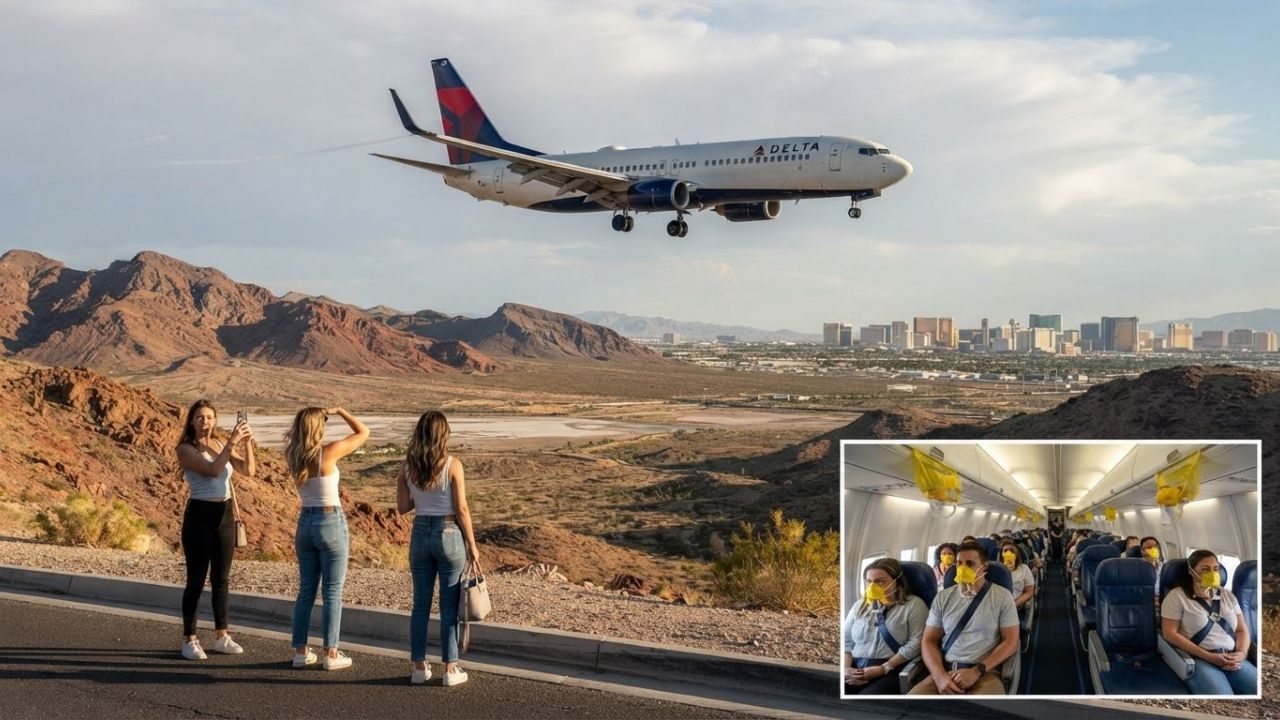
Carrying 174 passengers and six crew members, Delta Air Lines flight DL2311 executed a rapid emergency descent of roughly 27,000 feet from 36,200 feet down to 9,000 feet in around 10 minutes following a sudden cabin pressurization failure. The Boeing 737-900 diverted safely to Las Vegas Harry Reid International Airport with passenger oxygen masks deployed, avoiding injuries while activating established commercial aviation life-support protocols.
On 6 September 2026, the scheduled domestic flight linking Los Angeles International Airport with Salt Lake City faced an acute airborne decompression emergency. What is typically a routine 593-mile hop lasting less than two hours across the American West turned into an emergency descent when cabin pressurization anomalies forced the flight deck crew to initiate a steep dive to reach breathable atmospheric air.
Flight tracking records identify the specific airframe as a Boeing 737-900-series twin-jet registered N902DN. After leveling off at a safe altitude of about 9,000 feet, the aircraft diverted immediately to southern Nevada, touching down safely on the runways of Harry Reid International Airport in Las Vegas without reported injuries to any of the 174 travelers or six crew members on board.
The Rapid Descent Sequence: 27,000 Feet in 10 Minutes
The emergency occurred while flight DL2311 cruised at an assigned flight level of approximately 36,200 feet over the desert Southwest. Without warning, an unexpected pressurization problem compromised the aircraft's ability to maintain safe interior barometric pressure.
Commercial passenger jets cruise at altitudes where the surrounding ambient atmosphere lacks sufficient partial pressure of oxygen to sustain human consciousness. When a cabin begins losing pressure, cockpit crews are trained to immediately don their personal oxygen masks and direct the aircraft downward at maximum safe rates of descent. Flight tracking data shows that N902DN dropped roughly 27,000 feet in around 10 minutes, stabilizing at about 9,000 feet.
During this swift descent, overhead passenger oxygen compartments opened automatically, deploying yellow masks throughout the cabin. Passengers reported experiencing sharp ear discomfort and hearing muffled public address announcements while flight attendants moved through the aisle wearing portable oxygen equipment to verify safety compliance.
| Flight Event Parameter | Official Incident Record |
|---|---|
| Operating Carrier | Delta Air Lines |
| Flight Number | DL2311 |
| Origin & Scheduled Destination | Los Angeles (LAX) to Salt Lake City (SLC) |
| Flight Distance & Standard Time | About 593 miles (less than 2 hours) |
| Aircraft Model & Registration | Boeing 737-900 (N902DN) |
| Occupants on Board | 174 passengers, 6 crew members (180 total) |
| Initial Cruise Altitude | Approximately 36,200 feet |
| Emergency Descent Level | About 9,000 feet (loss of ~27,000 feet) |
| Descent Duration | Around 10 minutes |
| Diversion Facility | Harry Reid International Airport (LAS), Las Vegas |
| Cabin Systems Triggered | Automated passenger oxygen mask deployment |
| Reported Injuries | None |
| Passenger Disposition | Coordinated rebooking to Salt Lake City |
Aviation Physiology and FAA Decompression Directives
The Federal Aviation Administration enforces rigid airworthiness standards under transport-category certification to guard against atmospheric hypoxia. At 36,200 feet, the time of useful consciousness for an unpressurized human is counted in seconds.
FAA regulations require transport aircraft to maintain a cabin pressure altitude no higher than 8,000 feet under maximum operating altitudes. If cabin pressure altitude climbs beyond 10,000 feet, visual and aural cockpit warnings alert the pilots. If cabin altitude reaches approximately 14,000 feet, barometric pressure switches trigger the automatic drop of passenger oxygen masks. Chemical oxygen generators overhead deliver roughly 12 to 15 minutes of breathable air—a window engineered specifically to provide supplemental oxygen while flight crews execute an emergency descent down to an altitude below 10,000 feet, where the outside air supports natural breathing.
By descending steadily to 9,000 feet, the pilots satisfied federal safety directives, eliminating the dependency on cabin oxygen tanks and providing ambient air for everyone on board while coordinating diversion clearance with regional air traffic control.
Fleet Context: Boeing 737-900 vs Previous Airbus A319 Incident
Delta Air Lines operates the Boeing 737-900ER extensively on domestic medium-haul routes. The carrier's standard configuration features 173 seats—comprising 12 First Class recliner seats, 24 Delta Comfort seats, and 137 Main Cabin seats. On flight DL2311, 174 passengers were accommodated, reflecting near-capacity passenger loads.
The September 6 incident represents the second high-profile cabin-pressure event for Delta Air Lines in 2026. In January 2026, an Airbus A319 flying from Boston to Dallas-Fort Worth experienced a loss of cabin pressurization at approximately 36,000 feet, prompting a rapid descent toward 10,000 feet and an emergency diversion to New York John F. Kennedy International Airport (JFK).
| Metric Comparison | January 2026 Delta Incident | September 2026 Delta DL2311 Incident |
|---|---|---|
| Aircraft Type | Airbus A319 | Boeing 737-900 |
| Flight Route | Boston to Dallas-Fort Worth | Los Angeles to Salt Lake City |
| Reported Cruise Altitude | About 36,000 feet | About 36,200 feet |
| Descent Target Altitude | Toward 10,000 feet | Down to about 9,000 feet |
| Diversion Terminal | New York JFK | Las Vegas Harry Reid (LAS) |
| Mask Deployment Status | No cabin deployment reported | Full passenger cabin deployment |
| Casualties / Injuries | None | None reported |
Aviation safety experts emphasize that these two events involve entirely separate aircraft manufacturers, airframe designs, and mechanical pneumatic systems. A single pressurization valve or duct anomaly does not suggest a fleet-wide airframe defect on the Boeing 737-900. Instead, both occurrences illustrate how rigorously flight crews and computerized avionics apply fail-safe diversion pathways when barometric integrity fluctuates.
Why Harry Reid International Airport Was the Strategic Diversion Hub
When an in-flight emergency occurs over the Mojave Desert and southern Great Basin, Las Vegas offers unparalleled airfield capabilities. Harry Reid International Airport features four expansive commercial runways (including Runway 1L/19R measuring over 14,000 feet), full Category III instrument landing systems, and dedicated Clark County Department of Aviation emergency rescue teams.
Choosing Las Vegas over smaller desert strips gave the flight crew extensive runway lengths, calm valley air patterns, and an immediate gate network capable of handling 174 displaced passengers. Delta maintains robust station operations at Harry Reid International, allowing customer service agents to process baggage transfers, arrange meal vouchers, and rebook passengers onto alternative connections to Salt Lake City.
Environmental Sustainability and Fleet Reliability
Emergency diversions necessitate precise resource management to avoid unnecessary environmental impacts. In modern narrow-body twin-jets like the Boeing 737-900, pilots carefully manage descent profiles to conserve fuel and avoid fuel-jettisoning maneuvers over sensitive desert wildlife corridors and protected basin habitats.
Following the diversion, FAA safety inspectors and Delta technical operations teams removed N902DN from active service for mandatory inspections. Technicians inspect the digital outflow valves, positive pressure relief valves, air conditioning packs, and fuselage door seals. Rigorous maintenance diagnostics prevent chronic pneumatic leaks, preserving airframe efficiency and minimizing lifecycle emissions.
Visitor Insider Tips: Navigating Sudden In-Flight Diversions at Las Vegas
For travelers who find their journeys interrupted by an unscheduled landing at Harry Reid International Airport (LAS), knowing local airport logistics transforms an overwhelming ordeal into a smooth transit:
- Eustachian Tube Equalization & Desert Hydration: Rapid pressure changes from 36,200 feet to 9,000 feet induce barometric trauma on the inner ear. Drink plenty of water immediately upon entering the terminal to combat both arid Nevada humidity (often under 15%) and eardrum inflammation. Practice gentle swallowing or the Valsalva maneuver rather than aggressive ear-clearing.
- Terminal Logistics for Delta Travelers: Delta operations at Harry Reid International are centered primarily in Terminal 1, utilizing the D Gates concourse connected via the automated transit system. The Delta Baggage Service Office is situated on Level 1 near Carousels 21–26. If your luggage remains locked in transit for an onward rebooking, request a overnight amenity kit directly at the gate desk before exiting the secure perimeter.
- Mobile Rebooking Efficiency: Rather than queuing in long customer service lines with 173 fellow passengers, use the Fly Delta mobile app or airport Wi-Fi to confirm automated rebooking assignments. Delta's automated system prioritizes displaced passengers on the next scheduled Salt Lake City departures.
- Quiet Waiting Retreats: The D Gates concourse can become noisy. If you face an extended multi-hour layover, head toward the higher-numbered gates (D40–D58) for quieter charging workstations. Alternatively, grab fresh local dining options like Rachel's Kitchen near the central rotunda for clean, nourishing wraps and smoothies instead of heavy fast food.
Commercial Aviation Safety Outlook
The safe conclusion of Delta flight DL2311 underscores the resilience of commercial aviation safety architecture. While emergency oxygen deployments and steep descents can unsettle passengers, they represent the textbook execution of established protective procedures. The combination of immediate flight deck intervention, fail-safe passenger oxygen delivery, and rapid diversion to Las Vegas ensured that all 174 passengers and six crew members reached the ground without injury, reaffirming North American aviation as one of the safest travel environments in the world.
Related Travel Guides
Disclaimer
This article is for informational and educational purposes only. It does not constitute legal, financial, or professional advice. While we strive to provide accurate and up-to-date information, travel policies, regulations, and conditions change rapidly. Always verify information with official sources before making travel decisions. Nomad Lawyer makes no representations about the accuracy, reliability, completeness, or suitability of the information provided. Readers should consult qualified professionals for advice specific to their circumstances. The views expressed in this article are those of the author and do not necessarily reflect the views of Nomad Lawyer.
Raushan Kumar
Founder & Lead Developer
Full-stack developer with 11+ years of experience and a passionate traveller. Raushan built Nomad Lawyer from the ground up with a vision to create the best travel and law experience on the web.
Learn more about our team →