
Aviation Updates: Massive Boston Logan Airspace Failure Triggers Terrifying Travel Chaos as Delta Flight 2351 Executes Emergency Go-Around
As a massive air traffic control breakdown completely suffocates Boston Logan Airport, desperate passengers face terrifying near-misses and agonizing domestic airport disruptions.

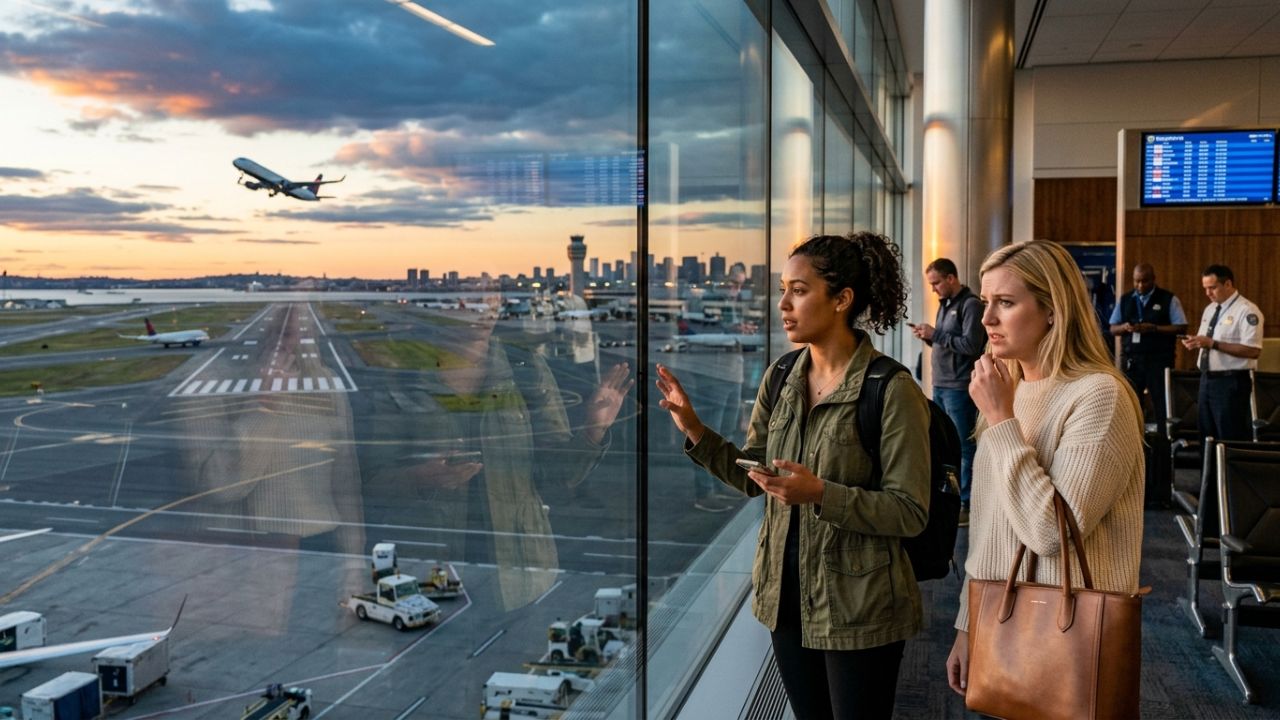
Image generated by AI
Aviation Updates: Massive Boston Logan Airspace Failure Triggers Terrifying Travel Chaos as Delta Flight 2351 Executes Emergency Go-Around
As incredibly severe terminal gridlock and massive air traffic management failures completely suffocate the primary aviation gateway of Massachusetts, tens of thousands of global passengers are trapped in terrifying travel chaos following a catastrophic near-miss involving Delta Flight 2351, rippling violently into Charlotte and Dallas.
While incredibly exhausted global passengers desperately navigate an incredibly brutal peak travel season defined by rolling flight cancellations and severe, localized airport disruptions, a massive, highly destructive operational failure is actively shattering the absolute highest levels of American aviation safety. According to the absolute latest breaking airline news, Boston Logan International Airport has officially suffered a terrifying breakdown of its intersecting runway protocols. Desperate to ensure that severe, localized regional hub gridlock does not completely destroy the flow of East Coast traffic, air traffic controllers aggressively packed the arrival sequence. However, at the time of reporting, the Federal Aviation Administration (FAA) has officially launched a massive, formal investigation after Delta Flight 2351 was violently forced to abort its final approach and execute a massive emergency go-around following a simultaneous departure from an intersecting runway.
This highly critical operational collapse explicitly exposes Boston Logan not just as an efficient regional gateway, but as a heavily congested, deeply fragile airspace zone prone to sudden, catastrophic failure. By violently overwhelming air traffic control coordination and aircraft rotation schedules, this systemic breakdown directly risks human life while generating the kind of massive travel chaos that routinely paralyzes under-resourced mega-hubs. Because traditional legacy transit nodes frequently suffer from severe tarmac congestion leading to massive, unannounced airport disruptions, this current near-miss serves as an absolute, terrifying warning. It completely bypasses the logistical nightmares of simple weather delays, representing a structural failure of separation standards that forces massive legacy carriers into brutal, high-stakes emergency maneuvers just feet above the tarmac.
Aviation Updates: The Collapse of the East Coast Safety Corridor
This massive, highly structural shift in regional safety stability perfectly illustrates the intense, incredibly fragile nature of modern domestic mobility.
According to highly detailed, official aviation updates, this strategic safety failure was explicitly triggered by a toxic combination of dense traffic volume and a highly complex, intersecting runway layout. Boston Logan’s intersecting runway configuration requires absolute, perfectly timed precision to avoid overlap. Because primary connecting hubs are increasingly crippled by rolling travel chaos stemming from systemic infrastructure bottlenecks, air traffic controllers are under massive pressure to clear arriving flights rapidly. This massive breakdown occurred when Delta Flight 2351—completing a routine approach from Dallas—was forced into a critical timing conflict with another domestic service beginning its takeoff roll bound for Charlotte, North Carolina. This near-collision generated severe, cascading safety holds that ripple violently across the entire airport, directly impacting inbound and outbound flows.
Section-Wise Breakdown: Navigating the Paralyzed Airspace
The sudden, massive evolution of these critical safety failures actively impacts several incredibly distinct, highly sensitive operational dynamics at Boston Logan's central airport.
The Boston Logan (BOS) Epicenter and Intersecting Gridlock
At the absolute core of this massive operational pivot is the total logistical failure affecting Boston's runway geometry. As the absolute epicenter of the crisis, Boston Logan operates with a terrifyingly complex runway layout. Unlike modern airports utilizing parallel runways, Boston utilizes intersecting paths designed to brutally maximize capacity during high-traffic conditions. When operations are tightly sequenced, even a micro-second of misaligned communication between runway controllers triggers absolute catastrophe. The near-miss forced an immediate halt to local operations while safety inspectors cleared the airspace, actively subjecting subsequent passengers to severe airport disruptions and holding patterns.
The Delta Flight 2351 Emergency Go-Around
The ultimate execution of this highly destructive failure heavily targeted the passengers onboard Delta Flight 2351. Arriving from Dallas, the aircraft was on short final approach when onboard traffic alert and collision avoidance systems (TCAS) screamed a warning. A go-around is a standard aviation safety procedure, but executing a sudden, massive climb-out feet above the runway to dodge a departing Charlotte-bound aircraft is an incredibly terrifying experience for passengers. The landing sequence was violently discontinued to eliminate any possibility of collision risk, immediately injecting massive fuel costs and schedule delays into Delta's daily operations.
The Massive FAA Investigation Protocol
While delays spread across the tarmac, the structural failure triggered a massive federal response. The Federal Aviation Administration routinely investigates all runway incursions, but events involving intersecting runway operations are treated as absolute top-tier emergencies. Authorities are now aggressively reviewing radar data, cockpit communications, and air traffic control recordings to determine exactly how separation standards collapsed.
Flight Details and Verified Disruption Impact Matrix
To fully understand the exact structural parameters of this massive performance collapse and how pilots are desperately attempting to navigate complex congestion, the following matrix explicitly details the operational failures at the hub.
Confirmed Boston Logan Safety Disruption Matrix
| Operational Metric / Incident Detail | Documented Safety Failure & Impact |
|---|---|
| Primary Arriving Aircraft | Delta Flight 2351 (Arriving from Dallas). |
| Conflicting Departing Aircraft | Scheduled domestic service bound for Charlotte, NC. |
| Incident Location | Boston Logan International Airport (Intersecting Runways). |
| Safety Evasion Maneuver | Immediate pilot-initiated emergency go-around. |
| Onboard Safety Trigger | TCAS (Traffic alert and collision avoidance system). |
| Investigating Authority | Federal Aviation Administration (FAA) Formal Investigation. |
Data explicitly reflects the massive, highly structural operational collapse currently paralyzing the Massachusetts gateway, directly forcing legacy carriers to violently execute emergency procedures to prevent runway collisions.
Passenger Impact: The Psychological and Emotional Toll
For the highly demanding passengers actively engaged in this massive domestic safety crisis, traditional, highly anticipated peak travel is currently viewed as completely terrifying and incredibly unpredictable.
The immediate enforcement of this emergency go-around significantly degrades travel confidence for tens of thousands of incredibly exhausted families and corporate transit passengers. Instead of relying absolutely solely on a highly secure global network, travelers are now trapped in a capacity-managed system operating on a knife's edge. Passengers facing these massive airport disruptions following the incident were forced to endure prolonged tarmac holds, suffering intense anxiety as operations were paused. The massive volume of subsequent delayed departures guarantees persistent high stress, as airlines desperately attempt to recover from the airspace halt. When an airport is forced to close an intersection to investigate a near-miss, it triggers rolling flight cancellations that instantly strand passengers attempting to connect through Boston.
Industry Analysis: The Economics of Systemic Runway Congestion
Aviation structural analysts strictly point out that this massive, multi-national operational collapse perfectly illustrates the extreme, highly vital importance of heavily optimized, continuous runway management.
Aviation data explicitly indicates that massive global carriers are absolutely desperate to secure rapid tarmac turnarounds to actively combat the terrifying reality of capacity saturation. Industry observers strongly view this Boston Logan near-miss as the absolute ultimate catalyst for broader US East Coast aviation instability. When intersecting runway operations are tightly constrained by mixed arrival and departure flows on closely spaced tarmac, relying on a deeply fragile infrastructure completely destroys the safety margin of scheduled rotations. Recent aviation safety analyses highlight that serious runway events are primarily driven by communication delays in high-workload environments, rather than mechanical failure. By aggressively packing the sequence to avoid delays, Boston absolutely ensures that it maintains a highly unpredictable, dangerous grip on regional transit.
Conclusion: A Highly Congested Domestic Future
The massively evolving infrastructure dynamics directly defining the integration of massive passenger volume into the Boston network violently reflect a much broader, highly critical structural transformation currently dominating how American commercial aviation is physically managed in 2026.
Rather than violently forcing massive domestic traffic through deeply congested, highly restricted, delay-prone legacy networks featuring intersecting runways, the FAA must actively reconsider capacity limits. As airlines aggressively struggle to clear the backlog and safety investigators alter immediate flight protocols, travelers actively navigating the incredibly busy sector must absolutely remain highly vigilant. To actively survive potential travel chaos this evening, passengers must aggressively monitor all breaking aviation updates, actively utilize airline mobile applications to check real-time status before leaving for the airport, and perfectly understand that escaping modern airport disruptions fundamentally requires accepting that schedules out of Massachusetts are currently heavily scrutinized and heavily delayed.
Key Takeaways
- Massive Safety Failure: Boston Logan International Airport suffers a terrifying near-miss on intersecting runways, triggering massive local airport disruptions.
- The Delta Go-Around: Delta Flight 2351 arriving from Dallas was violently forced to abort its landing just feet above the tarmac.
- The Conflict: A scheduled domestic service bound for Charlotte began its takeoff roll simultaneously, breaching separation standards.
- FAA Intervention: The Federal Aviation Administration has launched a massive, formal investigation into air traffic control sequencing and communication breakdowns.
- Root Causes: The incident exposes the extreme danger of forcing dense, rapid flight sequencing onto Boston Logan’s complex, intersecting runway layout to prevent delays.
- Passenger Survival Strategy: Stranded travelers impacted by the subsequent holding patterns and flight cancellations are urged to bypass physical queues and use airline mobile apps for rebooking during the active travel chaos.
Related Travel Guides
Massive UAE Visa Bombshell: Strict New 30-Day Escape Window Announced
Travel Chaos Cripples Spain as Iberia and Ryanair Suffer 1,079 Delays
Disclaimer
This article is for informational and educational purposes only. It does not constitute legal, financial, or professional advice. While we strive to provide accurate and up-to-date information, travel policies, regulations, and conditions change rapidly. Always verify information with official sources before making travel decisions. Nomad Lawyer makes no representations about the accuracy, reliability, completeness, or suitability of the information provided. Readers should consult qualified professionals for advice specific to their circumstances. The views expressed in this article are those of the author and do not necessarily reflect the views of Nomad Lawyer.
Preeti Gunjan
Contributor & Community Manager
A passionate traveller and community builder. Preeti helps grow the Nomad Lawyer community, fostering engagement and bringing the reader experience to life.
Learn more about our team →