
Manihiki Airport Progress Signals New Tourism Potential in Cook Islands' Northern Group
The Cook Islands is upgrading Manihiki Airport, paving the way for larger aircraft and potential fare discounts under the Pa Enua scheme.

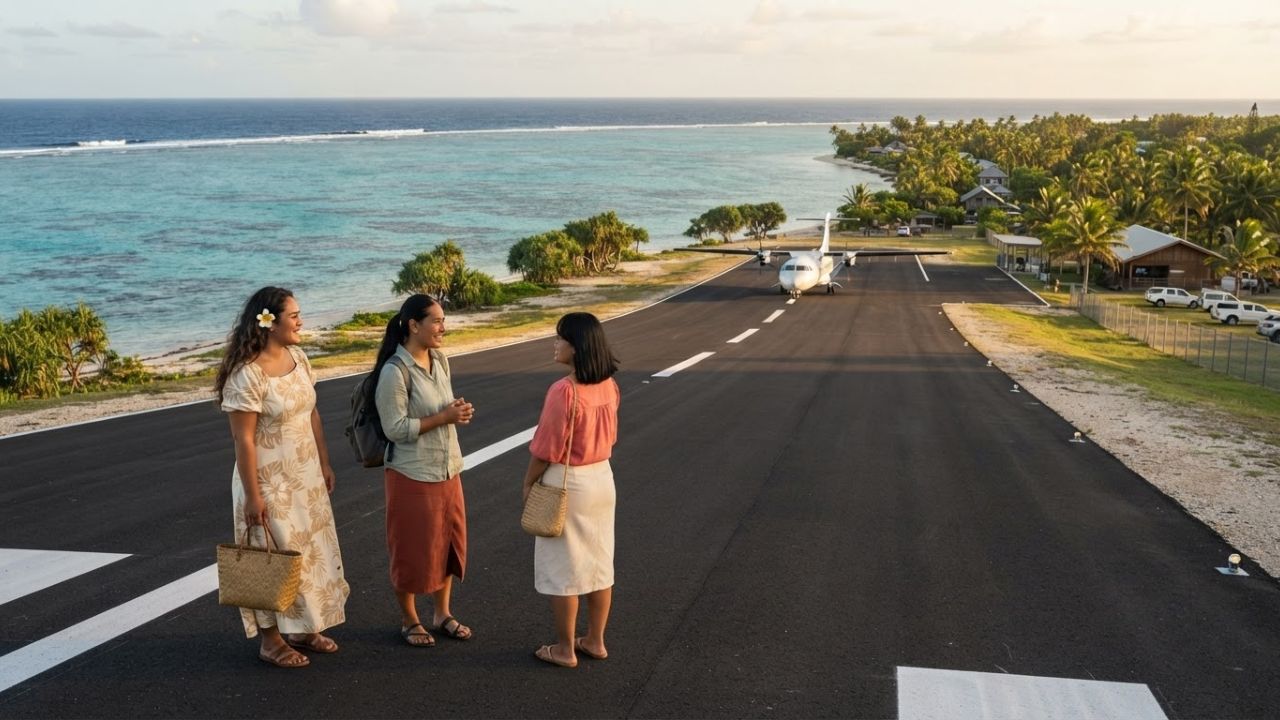
Image generated by AI
The Cook Islands is advancing the physical mobilization of the Manihiki Airport improvement project in 2026, a critical development that could trigger the deferred Pa Enua Air Discount Scheme. By expanding runway capacity to accommodate larger commercial aircraft, the infrastructure upgrade aims to lower travel costs and open up the remote Northern Group to sustainable tourism.
The Strategic Infrastructure of the Manihiki Airport Project
Manihiki, situated approximately 1,299 kilometres north of Rarotonga, is one of the most remote inhabited atolls in the Cook Islands and the center of the country's black pearl industry. For decades, the difficulty of accessing the island has limited the growth of local enterprises and restricted visitor travel to a small number of charter flights. According to Infrastructure Cook Islands, the need for a runway upgrade was first identified in the 2007 Preventative Infrastructure Master Plan, followed by a detailed feasibility study in 2013.
In 2026, the long-planned project transitioned into physical implementation. On 6 February 2026, a transport barge departed Rarotonga carrying heavy machinery, construction plant, and enabling supplies to establish a temporary landing site on Manihiki. A review of the Infrastructure Cook Islands airport project page on 16 August 2026 confirmed that engineers and construction crews continue to work toward sealing and strengthening the airstrip, indicating that the project is actively progressing toward physical delivery.
Detailed Government Funding and Budget Structure
The financial framework supporting the Manihiki Airport project is documented in the 2025/26 Cook Islands Government Budget Estimates. The project funding is divided into distinct operational phases:
Phase 1, approved in March 2024 with a total budget of $6.0 million, focused on acquiring specialized plant machinery and establishing the temporary ship-landing infrastructure. The 2025/26 capital provision allocated $1.0 million to continue these enabling activities. Phase 2, approved in August 2024 with an envelope of $13.8 million, covers the physical upgrading, widening, and sealing of the airstrip. The 2025/26 capital provision allocated $10.0 million to fund the main construction window, with an additional forward estimate of $3,807,608 projected for the 2026/27 financial year to complete Phase 2 works.
In addition, the 2025/26 infrastructure investment program separately summarized the airport upgrade at $14.8 million. The national budget process continued normally in 2026, with the 2026/27 Budget tabled in parliament in May and passed in June 2026, while the Appropriation Act 2026 commenced on 1 July. The total approved project funding across both phases remains recorded at $19.8 million.
Aviation Economics and the Pa Enua Air Discount Scheme
The most significant aspect of the runway upgrade is its connection to regional travel affordability. According to the Cook Islands Ministry of Finance and Economic Management (MFEM), the implementation of the Pa Enua Air Discount Scheme—a proposed policy designed to subsidize airfares for residents in remote outer islands—was formally deferred pending further progress on airport runway sealing.
Sealing and strengthening the Manihiki runway is a technical prerequisite for this fare support mechanism. Currently, flight operations are limited by runway strength and length. Feasibility work from Infrastructure Cook Islands suggests that the completed airstrip could accommodate larger commercial aircraft, such as the Saab SF340 and the ATR 72. Utilizing larger turboprops improves operating economics, allowing airlines to distribute fixed flight costs across more passenger seats, which is essential to make outer-island routes commercially viable for carriers like Air Rarotonga.
Network Resilience: Alternate Landing Fields at Penrhyn
The development of a sustainable aviation market in the Northern Group requires network resilience beyond a single runway upgrade. Infrastructure Cook Islands planning documents record that operating larger aircraft like the Saab SF340 in the remote north requires at least two suitable airports to provide alternate landing options. Manihiki is designated as the primary northern hub, with the airport on Penrhyn island serving as the required alternate.
This alternate landing capability is critical for weather safety planning, aircraft dispatch confidence, and fuel reserves. If a flight encounters poor weather or mechanical issues near Manihiki, having a certified alternate airport at Penrhyn allows the aircraft to divert safely rather than returning to Rarotonga. For tour operators, this network development is vital, as reliable schedules are a prerequisite for marketing multi-island itineraries to international visitors.
Rarotonga and Avarua: Inbound Tourism and Gateway Dynamics
For international travelers, the journey to the outer islands begins at Rarotonga International Airport. Under the guidelines of the Cook Islands Ministry of Transport, all aircraft entering or departing national territory must make their first landing or final departure at Rarotonga, making the capital of Avarua the commercial gateway from which remote-island packages are coordinated.
The need to disperse visitors to the outer islands is highlighted by the latest tourism statistics. The Cook Islands Statistics Office monthly release for May 2026, published on 30 June, recorded 18,755 total arrivals, including 17,285 international visitors. This represents an increase of approximately 9.7 per cent compared with May 2025, which saw 15,757 visitors and 17,140 total arrivals. Visitor volumes in May were also 7.5 per cent higher than in April. New Zealand remained the dominant market with a 62.0 per cent share (compared to 63.8% in May 2025), while Australia generated 27.0 per cent of arrivals (compared to 25.6% in May 2025), giving the two neighboring markets a combined 89.0 per cent share of the peak May-to-October travel season.
Engineering Challenges and Marine Logistics in the North
Upgrading a runway on a remote coral atoll involves significant logistical and environmental challenges. The Manihiki runway works are designed to protect the low-lying airstrip from ocean overwash, requiring realignment and reconstruction of a 195-metre section of the adjacent coastal road.
Because the island lacks deep-water port facilities, all heavy machinery and construction materials must be brought ashore via a temporary maritime landing platform. The design includes a sheet-piled platform, a 40-metre causeway, and a 120-metre section built using composite mats and sandbags. These mats are rated to handle loads of up to 20 tonnes, allowing heavy trucks and rollers to move from barges to the shore. Unloading operations are coordinated with low-tide windows to minimize risk to the machinery, highlighting how completion schedules depend on marine weather and shipping logistics.
Visitor Guide: Black Pearls, Lagoon Dining, and Island Etiquette
Traveling to the remote Northern Group requires preparation regarding flight logistics, packing essentials, and respecting local customs. By planning ahead, visitors can support the local community.
Air Rarotonga operates scheduled flights to Manihiki, but due to aircraft size, luggage weight limits are strictly enforced. Check current baggage policies, which can limit checked bags to 10kg and carry-on items to 3.5kg. Carry sufficient cash, as digital banking and card readers are not available, and bring basic medicines, as remote atolls do not have commercial pharmacies.
Experience traditional Cook Islands dishes during your stay. Try Ika Mata, the national dish of raw tuna marinated in fresh lime juice and served with fresh coconut cream and finely chopped vegetables. Sample Rukau, young taro leaves cooked in coconut cream. Learn about the black pearl industry by visiting local pearl farms in Tauhunu and Tukao villages, and purchase certified black pearls directly from farming families to support the local economy.
Respect local customs by dressing modestly, especially when visiting churches. Follow the island's waste management guidelines by packing out all plastic packaging and non-biodegradable waste when you depart, as waste processing facilities on small atolls are limited.
Future Outlook: Sustainable Dispersal of Tourism Revenue
The completion of the Manihiki Airport upgrade and the eventual integration of the alternate airport network will establish a new era for Pa Enua tourism. By resolving the physical constraints that have limited outer-island aviation, the Cook Islands is building a resilient foundation for its visitor economy.
Ultimately, the goal is to distribute travel expenditure from the Rarotonga-Avarua gateway to remote northern communities, supporting local pearl farmers, homestay hosts, and boat captains. Combining infrastructure upgrades with sustainable resource management ensures that the pristine environment of Manihiki is preserved, proving that infrastructure development and ecological conservation can progress together.
Related Travel Guides
Disclaimer
This article is for informational and educational purposes only. It does not constitute legal, financial, or professional advice. While we strive to provide accurate and up-to-date information, travel policies, regulations, and conditions change rapidly. Always verify information with official sources before making travel decisions. Nomad Lawyer makes no representations about the accuracy, reliability, completeness, or suitability of the information provided. Readers should consult qualified professionals for advice specific to their circumstances. The views expressed in this article are those of the author and do not necessarily reflect the views of Nomad Lawyer.
Preeti Gunjan
Contributor & Community Manager
A passionate traveller and community builder. Preeti helps grow the Nomad Lawyer community, fostering engagement and bringing the reader experience to life.
Learn more about our team →