
Severe Travel Chaos Hits Colorado Springs as Southwest and SkyWest Trigger Flight Cancellations, While Chicago Airport Disruptions Paralyze the US Network: Latest Airline News
Colorado Springs Municipal Airport suffers localized travel chaos as Southwest and SkyWest Airlines cancel flights amidst a massive national airspace collapse radiating from Chicago.

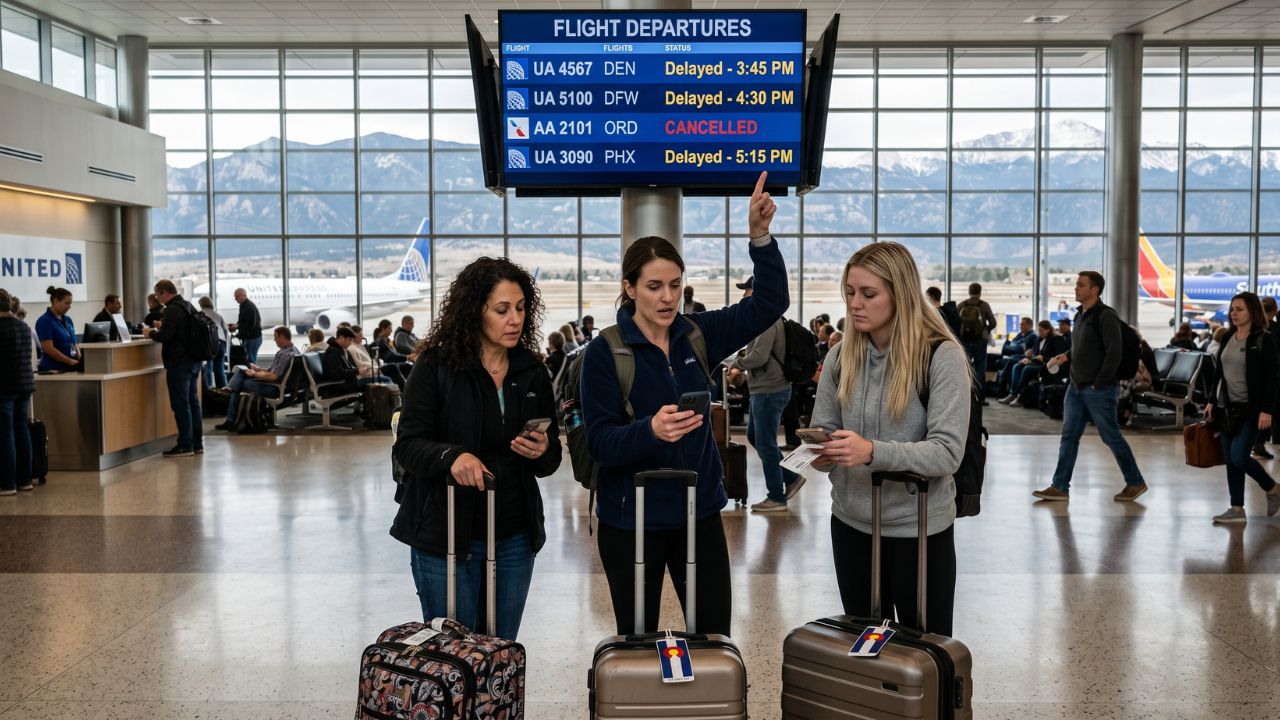
Image generated by AI
In a clear demonstration of how massive national airspace gridlock instantly infects regional transit corridors, severe travel chaos has officially struck Colorado Springs Municipal Airport. On June 18, 2026, major carriers including Southwest Airlines and SkyWest Airlines buckled under cascading network pressure, triggering outright flight cancellations and multiple severe delays. This rolling operational failure has trapped passengers inside the Colorado terminal, rapidly creating localized airport disruptions that are severing vital connecting routes to major hubs in Denver, Dallas, Chicago, and Phoenix. However, this regional breakdown is merely a symptom of a catastrophic national collapse; with Chicago O'Hare currently experiencing over 100 cancelled flights, the entire US aviation system is failing. As airlines desperately struggle to recover their shattered schedules coast-to-coast, this massive infrastructure failure stands as the premier headline in today's breaking airline news and absolutely vital global aviation updates.
By introducing direct passenger coordination and dynamic scheduling backups, the regional aviation hubs target growing passenger demand across vital commerce sectors. The choice to coordinate flight departures in phases helps to manage gate capacity, supporting the country's broader regional transportation network.
Context: The Collapse of the Colorado Gateway
For the thousands of domestic commuters and leisure travelers navigating the Rocky Mountain airspace this week, the sheer scale of this operational ripple effect has transformed routine regional travel into an absolute nightmare.
Historically, Colorado Springs Municipal Airport relies on highly fluid aircraft rotations, acting as a crucial feeder network for massive western hubs. However, today’s data reveals a breakdown of that localized system. With both Southwest and SkyWest actively destroying connecting schedules, airlines failed to reposition crews efficiently. Consequently, 4 flights were completely canceled locally, alongside a cluster of delays, stranding passengers without warning. Because Colorado Springs acts as a vital bridge to larger domestic interiors, operational failure here instantly forces terrified passengers to battle customer service lines just to secure emergency rebooking options before their subsequent connecting flights depart from Dallas or Denver without them.
To view live flight schedules, verify your exact delay times, or to track active regional airspace restrictions, travelers must consult official aviation directories. For direct rebooking access into less-congested regional bypass corridors, travelers should aggressively check the official portals for Southwest Airlines. To explore live flight tracking and monitor the exact severity of the national bottlenecks causing the flight cancellations you are trapped in, passengers can consult the official FlightAware tracking service.
Section-Wise Breakdown of the National Gridlock
The Colorado Core & Western Ripple
Flight disruptions linked to these regional airports affected travelers across several major US corridors. Colorado Springs experienced the highest concentration of localized cancellations and delays. This immediately radiated outward, impacting Denver, Las Vegas, and Phoenix with a smaller number of delays, indicating operational challenges on select western routes. Dallas was impacted through both cancellations and delays, affecting massive connections across the southern region. Meanwhile, Minneapolis–Saint Paul also recorded disruptions, contributing to broader travel interruptions.
The Epicenter: Chicago O'Hare Collapse
The disruptions in Colorado are directly tied to a massive national collapse. As of June 18, Chicago O’Hare International Airport (ORD) remained the absolute epicenter of the disruption. The airport accounted for the overwhelming majority of the nationwide chaos, recording more than 100 canceled flights, highlighting significant operational challenges at one of North America’s busiest aviation hubs. Chicago saw disruptions spread across both its major aviation hubs (O'Hare and Midway).
The Nationwide Spillage: Cross-Border Chaos
Beyond Chicago and Colorado, massive cancellations were reported in Louisville, Indianapolis, Traverse City, Detroit, Cincinnati, Toronto (Canada), St. Louis, Boston, Atlanta, Pittsburgh, Dayton, Fort Wayne, Rochester, Columbus, Jacksonville, Nashville, Cleveland, Milwaukee, Buffalo, Appleton, Green Bay, Raleigh, and Montreal (Canada). Several smaller regional airports also experienced elevated cancellation rates, with some locations reporting the complete cancellation of scheduled services.
Technical Roster: The Exact Cancellation Data
To ensure absolute factual accuracy regarding the specific airlines responsible for the current travel chaos in Colorado and the exact scale of this localized gridlock, the following table details the exact, verified integration data sourced directly from FlightAware for June 18, 2026:
Colorado Springs Carrier Flight Cancellations Matrix
| Airline | Cancelled Flights | Delayed Flights |
|---|---|---|
| Southwest | 3 | 3 |
| SkyWest | 1 | 5 |
Passenger Impact: Stranded in the Rockies
For the thousands of tourists and business travelers trapped inside Colorado Springs today, the operational failure is absolute psychological torture.
The immediate passenger impact is severe terminal gridlock and the destruction of highly complex itineraries. When a regional hub like Colorado Springs collapses, the reliability of connections to vital destinations like Chicago or Phoenix is instantly shattered. For a business traveler, a canceled flight means missing the crucial connection out of Denver, subsequently losing an entire day of productivity. Furthermore, the widespread disruptions affecting both domestic and cross-border travel (Toronto, Montreal) create massive ripple effects throughout airline networks, exponentially increasing the likelihood of missed connections and extended travel times. Passengers are experiencing extreme travel uncertainty, forced to seek expensive last-minute hotel accommodations as customer service agents struggle to rebook thousands of stranded clients simultaneously.
Industry Analysis: The Fragility of the Feeder Network
Aviation industry analysts view today's flight disruptions at Colorado Springs as a critical indicator of the extreme fragility inherent in the domestic regional feeder network when massive national hubs fail.
Analysts note that legacy carriers rely heavily on regional operators (SkyWest) and point-to-point networks (Southwest) to funnel passengers. When an absolute epicenter like Chicago O'Hare fails—whether due to localized weather or ATC staffing—the massive volume of aircraft attempting to funnel through the Midwest ensures that delays cascade exponentially outward, eventually hitting regional outposts like Colorado Springs. The widespread nature of the disruptions, hitting major hubs from Atlanta to Montreal, demonstrates how operational issues at a single key airport instantly ripple through the entire North American travel network. Industry experts warn that unless carriers build more robust regional bypass routes, these catastrophic delay days will completely undermine consumer confidence.
Actionable Advice for Surviving the Gridlock
If you are trapped in Colorado Springs today, or flying through the domestic network in the coming days, execute this strategic survival checklist immediately to navigate the severe travel chaos:
- Abandon Customer Service Desks: Do not wait in the physical line at the airport; the agents are completely overwhelmed by the cascading national delays. Use the Southwest or SkyWest mobile app to instantly rebook your missed connections digitally.
- Avoid Chicago for Transit: With Chicago O'Hare suffering over 100 cancellations today, actively re-route your future cross-country connections through southern hubs like Dallas/Fort Worth or Atlanta to entirely avoid the Midwestern bottleneck.
- Know Your Passenger Rights: Familiarize yourself with your carrier's specific cancellation policies. If the disruption is within their control (e.g., crew shortages), heavily demand rebooking options, meal vouchers, and hotel compensation before leaving the terminal.
- Maintain Extreme Flexibility: Do not panic. If you cannot find a suitable flight out of a paralyzed hub like Colorado Springs, immediately consider alternative transport, such as driving to Denver International Airport to catch a flight on a competing carrier to extract yourself from the immediate travel chaos.
FAQ: Colorado Springs Flight Cancellations & Travel Chaos
Which airlines caused the travel chaos at Colorado Springs Airport today?
The localized flight disruptions were driven by operational failures at Southwest Airlines (3 cancellations, 3 delays) and SkyWest Airlines (1 cancellation, 5 delays).
Which major cities were affected by the Colorado Springs disruptions?
The regional disruptions severed vital connecting routes, heavily impacting travelers heading to Denver, Dallas, Chicago, Phoenix, Las Vegas, and Minneapolis–Saint Paul.
How did the national gridlock impact this regional airport?
The Colorado delays are part of a massive national airspace collapse centered at Chicago O'Hare, which recorded over 100 cancelled flights, sending a catastrophic ripple effect across the US and into Canada (Toronto, Montreal).
The Reality of Localized Airspace Collapse
The operational collapse at Colorado Springs today proves definitively that America's regional air traffic hubs are hyper-vulnerable to cascading national failure. By documenting localized cancellations and severe delays in a single day, Southwest and SkyWest have inadvertently triggered absolute, agonizing travel chaos, trapping thousands of exhausted passengers in terminal purgatory. As carriers desperately struggle to recover their shattered aircraft rotations across a paralyzed North American network—triggering severe airport disruptions and missed connections from Phoenix to Montreal—travelers must accept a critical new reality: avoiding brutal travel anxiety during peak summer congestion requires actively demanding immediate digital rebooking, securing massive layover buffers, and bracing for the psychological endurance test of a nationwide systemic delay.
Key Takeaways
- The Colorado Epicenter: Colorado Springs Municipal Airport suffered localized scheduling failures, led by Southwest and SkyWest Airlines.
- The Chicago Collapse: The regional delays are a direct symptom of a massive national airspace failure, with Chicago O'Hare logging over 100 flight cancellations.
- Cross-Border Failure: The domestic gridlock instantly infected international routes, delaying flights to Toronto and Montreal in Canada.
- Coast-to-Coast Delays: Rolling delays paralyzed dozens of vital domestic hubs including Denver, Dallas, Phoenix, Boston, and Atlanta.
- Passenger Survival: Stranded travelers must utilize mobile apps for immediate rebooking, avoid physical customer service lines, and actively route future itineraries away from the paralyzed Chicago corridor.
Related Travel Guides
Massive Travel Chaos Paralyzes Chicago O'Hare with 1,425 Disruptions
Severe Travel Chaos Paralyzes Chicago Midway with Southwest Disruptions
Disclaimer
This article is for informational and educational purposes only. It does not constitute legal, financial, or professional advice. While we strive to provide accurate and up-to-date information, travel policies, regulations, and conditions change rapidly. Always verify information with official sources before making travel decisions. Nomad Lawyer makes no representations about the accuracy, reliability, completeness, or suitability of the information provided. Readers should consult qualified professionals for advice specific to their circumstances. The views expressed in this article are those of the author and do not necessarily reflect the views of Nomad Lawyer.
Kunal K Choudhary
Co-Founder & Contributor
A passionate traveller and tech enthusiast. Kunal contributes to the vision and growth of Nomad Lawyer, bringing fresh perspectives and driving the community forward.
Learn more about our team →